This site is primarily about aerodynamics, but I stray into tire tests, performance driving, and other topics. Over the years the website has become less organized with its broader focus, but it’s still essentially an educational outlet.
I spent my professional career in technical writing and curriculum development, and I consider myself an educator. Good educators are forever-students. We have open minds, and find teachers, and teaching moments, in the least likely places.
Like in a tiny dog.
Growing up I always wanted a dog, but I didn’t have one of my own until a dozen years ago. I had always imagined a short-haired medium-sized dog with a good nose, and a love of the chase. We’d be hunting partners. He’d flush and retrieve birds, or find deer I’d shot with my bow. We’d bond over blood, like the original dogs and men.
What I got was a miniature Schnauzer. He turned out to be she. Small, gentle, fragile, and scared of loud noises, she wasn’t going to be much of a hunter.
But she loved seeing deer. She would bark four times and get herself so excited that her voice would break on the second syllable. Her bark would go Roh-Ri-Roh-Roh. But she’d only do that bark for deer. Later, anytime I’d see a deer I’d go “Roh-Ri-Roh-Roh” and she’d stop whatever she was doing and frantically look for deer.
She had some hunting instincts, but used her eyes more than her nose. This got her a couple squirrels, and amazingly one rabbit, in the middle of the night. I fed her seared kidneys at 2am and she picked up another nickname: Tiny Wolf.
I don’t do yoga, but sometimes we did doga.
Pepper was a nervous traveler, didn’t like cars, motorcycles, or hunting implements, and I can’t say she took to any of my hobbies. But it’s the routines that bind us. That find us.
In the morning, she’d wait at the top of the stairs for me, so we could start our day together. Then she’d sit in the window, and suddenly sprint out the doggie door to bark at passersby. She took this job very seriously, and she was an excellent watchdog.
At night, she’d sleep at the foot of the bed. And when she was sure I was sleeping deeply, move up and cuddle next to me, pushing her bodyweight into mine.
She was a different dog than I ever imagined owning. I ended up finding what I needed in a place I never would have thought to look.
This tiny dog with a huge heart melted mine. But that heart was medically too large. I forget the name of it, but it’s a chronic medical condition; her heart would eventually grow too large and take up her chest cavity, making it impossible to breathe. This bundle of joy had a time bomb for a ticker, and I knew it was going to absolutely level me when it went off.
Up to this point she subsisted entirely on kibble, never had people food, nor begged at the table. But since she was on borrowed time, I endeavored to spoil her. And transformed an obedient pet into an entitled princess. Anytime I was in the kitchen she’d trot in with expectant eyes. Or make sounds that could not be misinterpreted as “where’s mine?”
Methinks the daily charcuterie boards were a little over the top.
Bark-u-terie.
The meds held her heart in check for years, but recently Pepper began having trouble breathing. Last weekend we took her to the ER at Cornell, where she spent the night in an oxygen tent. The vet got the fluid out of her lungs and said she had made a good recovery, and we could still expect more time with her.
But it didn’t work out that way. Pepper went downhill fast and never recovered. She passed peacefully with a final meal, a bedtime story, cuddles, and an injection. I petted her one last time, blubbering in sadness and madness.
I’m no stranger to loss. I’m also no good at it. My son Zack died of an overdose in 2020.
I can’t think about him without crying. I had to move all photos of him on my phone into a private album so that I don’t see them. I’ve never opened a condolence letter. I haven’t had a service or even looked at his ashes. I haven’t moved on. I’m holding onto the pain because that’s all I have left of him. I won’t lose that, too.
So I had always imagined that losing Pepper would incapacitate me. I’d be a wreck for a week or a month or for however long. I’d feel around for her in the middle of the night. I’d wait for her waiting for me at the top of the stairs. But that hasn’t happened.
Pepper had one final lesson for me. It’s about keeping the love with the loss. It’s about cherishing the time we had, rather than the time that was cheated away from us. One fifth of my life I shared with her. And her entire life with mine. It was a blessing, and I’m fortunate.
I don’t understand this entirely, so I can’t explain it very well. But I haven’t cried. I’m not incapacitated. I feel Pepper with me as a strength.
With that support, I know I can finally say goodbye to Zack. To put both of their ashes up on the mantle. To look at photographs, to remember, to love, and to move on.
I feel so strongly about that, that I can get into this fixed mindset: “Everyone will benefit from doing the no-brakes drill!” But after reading Ken’s article, I 100% agree with his assessment of why and how it didn’t work out for him. This seems contradictory, so let me explain.
22 years ago I was a globe trotting motorcycle journalist for a boutique quarterly magazine called Moto-Euro. It was a heavy and expensive coffee-table magazine, and our snobbery meant we only covered British and European bikes. But Keith Code’s California Superbike School wanted us to write an article about them, and I wanted to take the school. So the publisher went colorblind for an issue and said OK to a lime green Kawasaki ZX-636, rather than our usual blood red Ducatis.
I was a rider of average skills, with a motorcycle racing license from the Penguin Racing School at Loudon, NH. My racetrack experience was limited to NHMS on my Hawk GT and tracking a brace of Ducatis in Almeria (Spain). So this would be only my 5th track day, and my first time at Sears Point (which is Sonoma Raceway now, but is forever Sears Point to me).
Sears Point is a rollercoaster of blind corners and walls, and not what I’d call an easy track to learn. Nor would I call it one of the safer tracks in the USA. And if that setting wasn’t challenging enough, it was raining.
But it gets worse; in the classroom, Keith informed us that the first two sessions of the day, we would not be shifting or using the brakes. Wait, what?
I’m supposed to ride a high-performance bike I’ve never ridden, on a highly technical track I’ve never seen, in the goddamn rain, without using the brakes?!?!
But we all did it. And survived it. And then we did it again. And I can tell you, it was astonishing. Self preservation is a strong instinct. But as any racer can tell you, catching the rider in front of you is a stronger instinct!
So I gradually increased my speed, changed my lines, took a few risks, let off the gas later, found even more time on corner entry, and kept going faster and faster. All the while staying in 4th gear and never touching the brakes. In the rain.
Of course we eventually got around to shifting and braking, but those first two sessions were the foundation of the entire program.
Over the next two days, most of the coaches, including Keith Code himself, shared track time with us. As often as not, they’d elect to do the 4th-gear no brakes drill for the entire session – the whole train of them going nose to tail, scything through backmarkers.
Since that school, I’ve done the no-brakes drill on over 30 tracks, both on bikes and in cars. These days I use 3rd gear instead of 4th gear, because I’m in cars more than on bikes, but the drill is the same.
Trailbraking on a motorcycle
Back in 2004, the Keith Code order of operations was brake in a straight line while downshifting, release the brakes completely, then tip the bike into the corner, next crack open the throttle to stabilize the bike mid corner, and finally roll on throttle to corner exit. You read that correctly, no trailbraking.
Later (much later) I would learn motorcycle trailbraking from Bill Sink at EvolveGT, and that brought a whole new level to my riding. Same bike, same track, I dropped 1.5 seconds on corner entry alone! As effective as trailbraking is in a car, on a motorcycle, it’s a world of difference.
What happens when you trailbrake a motorcycle is slightly different than on a car. In both vehicles weight transfers to the front end, which results in a wider contact patch from the increased load, plus more heat, more mushing into the tarmac, and thus more grip.
But on a motorcycle, it’s proportionately more weight transfer. You never see a car go into the braking zone with the rear tires hovering just off the ground, but this is business as usual on a motorcycle. And so corner entry depends almost entirely on the front tire, and you control that, and feel that, with the brake lever.
Another thing that happens when you trailbrake a motorcycle is that the steering sharpens due to changes in geometry. The forks compress, which shortens the wheelbase slightly, but this also changes the steering angle, because the ass-end of the bike is in the air, and the forks are shorter.
When you take all of these factors together, it means a motorcycle on the brakes at corner entry has a very different feel than one that is coasting. Feel is super important, especially on a bike. Less so at the novice level, but certainly at Ken’s level, so let me delve into that for a sec.
Driving the front vs the rear
There are two types of riders and drivers: those who require front-end feel, and those who drive the rear end. Riders and drivers who drive the rear tire(s) are looser and more fun to watch. Their general attitude is “I’ll throw it into the corner and figure it out.” These are riders like Marc Marquez and drivers like Michael Schumacher or Max Verstappen. Their skill is legendary, and they seem like aliens because no other humans can do what they do, lap after lap.
Then you have the riders and drivers who depend on front-end feel. They can be incredibly fast and consistent when they are 100% comfortable with the front end. But it takes them time to get there, and if the planets aren’t aligned, the aliens are light years in front. In this category I’m thinking of riders like Colin Edwards and drivers like Jenson Button or Alain Prost.
I’m a front-end rider and driver myself. I suspect Ken Hill is as well. But even if he favors the rear, he’s obviously comfortable standing the bike on the front tire with the brakes, trailing off the brakes gradually while turning in, and then settling into the corner, and doing that all as one smooth uninterrupted action. He’s been able to take that complicated series of steps and push it into the subconscious, executing the dance with thoughtless precision. And so not doing that with the extra grip and feel generated by trailbraking seems weird and unsafe.
Coasting into the corner isn’t just a strange feeling, it’s new. Ken has to engage his conscious mind to do it. The subconscious mind can process information 500,000 times faster than the conscious mind. Think about the scale of that for a second. Actually, don’t think about that; if you have to think, you’re processing power goes down by magnitudes.
And this is why an intermediate rider doing this drill is faster. Intermediate riders have too much on their minds, and nothing has been pushed to the subconscious yet. They are thinking their way into the corner: Brake, blip-shift, trail brakes, tip in, body position, weight balance, roll throttle, etc. The fewer things they can think about, the better they get at executing everything else.
As they say, smooth is fast, and that’s the other reason the no brakes drill is faster than it should be. There is no braking that’s smoother than air braking. There is no downshifting technique that’s smoother than the not-shifting technique. There’s no acceleration that’s smoother than being in too tall of a gear. The end result is that 4th gear no brakes on a motorcycle results in a smoother and faster corner for the intermediate rider.
But not for riders that are very advanced, because not-braking takes more mindshare than braking. You can see this in Ken’s vMins. His mid-corner speeds are lower everywhere compared to when he’s braking, and that shouldn’t be the case; mid corner has no braking or accelerating in it. He’s thinking his way into the corner, and losing speed because of it.
Now this was the first time Ken did this drill. If he’d done this 1000 times, as I’m sure Keith Code has, then Ken’s vMins would be the same or higher than when using the brakes. He may not believe it, but the law of physics says so.
I’ve already described the reasons that trailbraking is more effective on a bike than on a car, and how feel is perhaps the most important variable when you have a contact patch that’s smaller than a credit card. But there’s yet another difference between cars and bikes, which is how a motorcycle steers.
Motorcycle tires aren’t flat across the tread surface like a car tire. Turning on a bike is accomplished by leaning the tire onto the curved profile of the tire carcass. Ergo, a tire with a more triangular profile falls into a turn quickly, while a tire with a more rounded profile, takes more effort to turn. But there isn’t a lot of scrubbing of the tire surface, and therefore, turning doesn’t slow a bike much.
Conversely, on a car, the front tires turn by scrubbing and this reduces speed a lot. It also gives the driver a lot of feedback through the steering wheel, making it heavier to turn. Motorcycle riders can also feel trailbraking as a a waggle through the bars, but they don’t get the dramatic slowing down that you get when steering in a car, and this is a significant difference between cars and bikes.
Let me show you what I mean.
Pineview Run, no-brakes drill
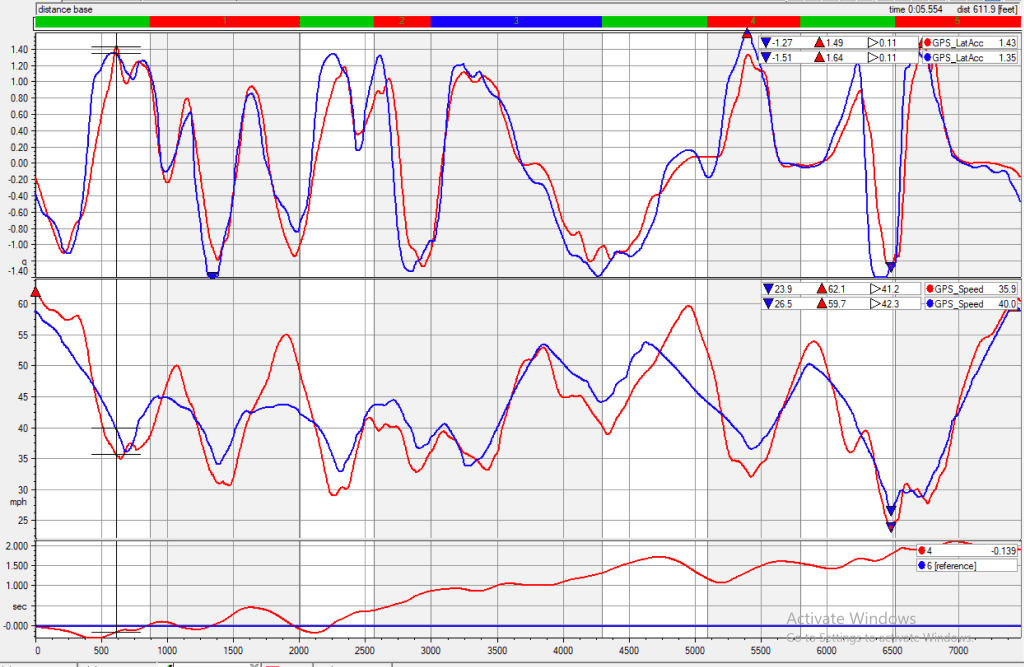
In the following speed trace, both drivers are in the same car (Miata) on the same tires (Hankook RS4). The red line is an intermediate driver, braking and shifting, and trying his hardest to impress his instructor. The blue line is the instructor (me), doing the 3rd gear no brakes drill (3GNB). I also put up the latG trace so you can see we have the same amount of peak grip, but we use it differently.
Red student, Blue instructor.
You can see from the steepness of the upward slopes that the red driver is using 2nd gear a few times, while I’m in 3rd gear the whole time. Likewise, his deceleration slopes are very steep, and mine are gradual, because I’m air-braking. But if you look at the very end of the deceleration zone, it looks like I’m braking or in some cases, even trailbraking. I swear I’m not.
What you’re seeing is nothing more than me increasing steering angle towards the apex, but it results in a lot of deceleration, and grip, and feel, right where it matters most. If you look at the data, you can see the intermediate driver at this point of corner entry often has less deceleration than I do, even though he’s on the brakes. Crazy, right?
In the end, my ability to be smooth and carry entry speed into the mid-corner is more important than any amount of braking and shifting, and so I go two seconds faster than my student. Let that sink in.
But don’t take this to mean the no-brakes drill is the fast way around the track. Beating up on intermediate drivers is easy, so let’s see how I compare, as Bad Brains would say it, I against I.
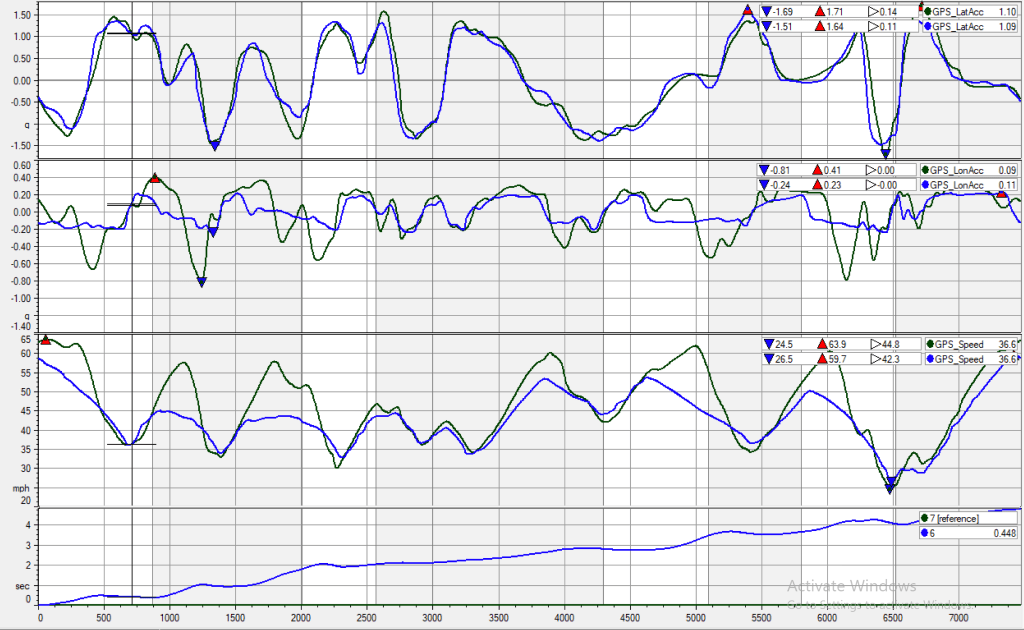
In the following speed trace, the blue lines are the same 3GNB lap I did against the student. Contrast that with the green line, which is me braking and shifting. I’ve added longG to the middle of the graph so we can see just how much more braking and accelerating I’m doing, it’s a ton.
Blue 3rd gear no brakes, Green brakes and shifting.
In the speed trace, you’ll notice that I’m getting down to the same vMins in most corners, but sometimes it’s difficult to improve on a no-brakes vMin. The reasons for that are A) smooth is fast, and B) sometimes it’s important to sacrifice maximum cornering grip to rotate the car early in the corner, so that you can get to full throttle earlier.
The result is that I’m 5 seconds faster. In reality, the no brakes drill is quite slow. This is a short track only 1 mile long, but it has a lot of corners, and on most tracks the difference is usually around 6 seconds or so. I obviously don’t teach the no-brakes drill because it’s the fastest way around the track, I teach it because it’s the foundation of performance driving.
A skid pad No-brakes is the foundation of performance driving
Is the no-brakes drill the foundation of performance driving? Or is a skid pad?
It’s hard to argue the incredible value of a skid pad. This is the best way to learn how to drive the limit of lateral grip. Skip Barber taught this for many years at Lime Rock Park, and if you watch this old video (skip ahead to 15 minutes), you’ll see that the skid pad was how they taught both limit driving and car control.
The skid pad makes it easy; hold the wheel so that you’re turning at a constant angle, go faster and faster, and you’ll find the limit of lateral grip. And then you’ll push harder and go over it. And then recover. And then go over. And recover. Again and again and again. A skid pad is the best way to find the limit, input that sensory information into your brain and butt for later retrieval, and train muscle memory for recovery.
Once you can regularly find and stay at the limit, you can experiment with limit steering. Most people start with the gateway drug, lift-throttle oversteer (LTO).
LTO is exactly what it sounds like; when you’re cornering at the limit, lift your foot off the throttle for a second, and the weight transfers forward, giving the front tires more grip. This in turn makes the rear end have less grip, so the car oversteers. You’d want to practice this many times on a skid pad, rotating the car just by interrupting the throttle.
After LTO you might practice holding oversteer into a drift because A) that’s super fun, and B) it’s a tool in your toolbox. After drifting, maybe you practice fully pivoting the car so that it spins. Because spin recovery is another important skill.
But you’d also want to practice inducing understeer by adding too much throttle too soon. That’s another important skill, for dealing with a loose car, driving in mixed conditions, or pushing understeer to the exit in an increasing radius turn.
After doing all of these experiments, you come to the realization that when the car is at the limit, you can steer with your feet and control speed with your hands! And now you’ve gone from a person who drives a fast car to someone who drives a car fast. Thank you skid pad.
But a skid pad isn’t always the answer.
Most of us don’t have access to a skid pad. I daresay it’s cheaper and easier to find track time than it is a skid pad.
Only one person can use it at a time. If you’re teaching a class of students, you have to rotate everyone through. Each student might need 15 minutes, half an hour, or half a day to get comfortable finding the limit and experimenting with what they can do there.
So if you don’t have a skid pad, what can you do? Simply drive a track without braking or shifting! This is essentially the same thing you’d do on a skid pad, but do this on a track. The no brakes drill is how you can find and experiment with the cornering limit, with the added benefit that many people can share the track at the same time (provided they are all doing the same drill).
In the end, the reason the no-brakes drill is the foundation of performance driving is because we don’t all have skid pads.
I’ve worked with one HPDE group that does the no-brakes drill, but it’s only for two laps at the start session. Their heart is in the right place, but they got it wrong, wrong, wrong.
Wrong: the whole pint of the drill is to be at the limit, and you can’t do that on cold tires. Braking and accelerating is what heats up tires, and so you need a couple laps going full blat before you can do the drill.
Wrong: two laps isn’t enough time to find your visual references of where to get off the gas. And you need those just to survive this! At Ross Bentley’s Speed Secrets Academy, we set up two cones for EoA (brave and braver) so students can instantly get up to speed. Otherwise they would spend the whole session identifying and remembering references, rather than driving and experimenting at the limit.
Wrong: they do no brakes at Watkins Glen, which is not an appropriate track for this drill. The straights are too long and the walls are too close. The best tracks for this drill are low speed, long corners, and lots of runoff. You know, like a skid pad.
I’d also say this drill isn’t for absolute novices. Right seat instruction is still important for making sure the driver has the right seating position, ergos, and can get around the track comfortably.
And as we saw with Ken, expert level riders (and perhaps drivers) may not get anything out of this drill. But that leaves the majority of people in the middle, who will truly benefit from setting a solid foundation for their performance driving.
So why is the limit higher?
I want to delve into one more thing that I’ve kind of touched on here, but haven’t explained yet. It’s the answer to the question, “why is the cornering limit higher in the no-brakes drill?”
The reason is, because this drill allows you to easily set the ideal entry speed for the highest possible mid-corner speed (vMin). Smooth is fast, and not upsetting the vehicle with any changes in speed means the tires can do all of their work in the lateral direction.
Does that make sense? Perhaps a better way to explain this is what happens when your entry speed is too low.
When you come into a corner too slow, your subconscious mind will make you add throttle. It’s a natural and almost unavoidable consequence of arriving at the corner too slowly. When you change speed in the corner, you create an artificially lower limit. This is because tires can accelerate, brake, or corner, and now you’ve asked the tire to sacrifice some cornering for acceleration, and so the limit is now lower.
The result of adding gas with an artificially lower limit is usually understeer. The weight has shifted off the front tires, and so the car pushes to the outside of the turn. I’d hazard a guess that 90% of people that complain about their car understeering are arriving at the corner too slowly.
The other thing that happens when you enter under the limit is oversteer. The tires were already being used for cornering, so they don’t have as much grip for acceleration, and it’s not that difficult to add too much throttle and lose rear traction.
In the end, both understeer and oversteer are the result of an artificially induced lower cornering limit, which is because the driver didn’t set the ideal entry speed. Which is why not braking, using a taller gear, longer and lighter braking, and other similar strategies that focus on maintaining momentum result in faster lap times. Lap times comes from lateral grip. But that’s a story for another time.
Getting back to Ken Hill
If there’s one thing I’m taking away from Ken’s experience with the no-brakes drill, is that it made him uncomfortable. I love that.
If you can execute something with 100% ability and confidence, then you’re not learning anything. You have to stretch your abilities and get uncomfortable in order to learn; that’s where the growth is.
I also think Ken is beating himself up too much. Given the differences between trailbraking on a bike versus a car, plus the fact that you can’t slow a bike much by steering, and the fact that Ken had to use his conscious brain for corner entry, I’m pretty impressed with his 10 second delta when not using the brakes.
Ken instructs mostly on bikes, but also in cars. In a car, I bet this drill would have gone better, and that 10 seconds would be more like 6 seconds. Perhaps his lack of comfort might even be reframed as a good thing. So here’s an open invitation to Ken:
Ken, come to Pineview Run as my guest, drive my Veloster N (it’s not that different from your son’s Elantra N), and do the no-brakes drill for a few sessions. Compare your data with and without brakes (we can be Race Studio 2 buddies), and see what happens to your vMins. We can both write about the conclusions on our respective blogs, and give the readers more information on the no brakes drill.
I’ll try not to have a fixed mindset about the result, but it won’t surprise me if you find that the no-brakes drill is the foundation of performance driving!
The Veloster N has electronically controlled shocks that dictate how the car rides in normal driving situations, and then changes the damping automagically whenever the system detects the need to do so. It’s a sophisticated system that allows the car to have both Jekyll and Hyde personalities, without the driver ever being aware that this transformation is happening instantaneously, behind the scenes.
This split personality has three pre-programmed modes, which are selected by using the different drive modes on the steering wheel. Or if you go into N Custom mode, you can choose the suspension setting you want in that mode, and save it. The three modes are:
Normal – This setting is mostly Jekyll, and works great for everyday driving. But when the car detects a handling event, there’s enough Hyde personality to compensate. This is my preferred mode on a wet or bumpy track.
Sport – This is quite a bit firmer, and so I don’t use this on the street. But it’s a good setting for both Jekyll and Hyde, as long as you have a smooth and dry track.
Sport+ – At this setting, Dr Jekyll is an ornery pain in the ass, and My Hyde is an unpredictable and dangerous monster. I never use this, it’s awful.
In essence, the system gives you a three way switch. But since the shocks are controlled electronically, it makes sense that you could have the equivalent of a dimmer switch instead. This way you could set the firmness anywhere you want. For example, I’d like one mode that’s softer than the Normal. My daily driving includes many potholes, recessed manhole covers, potholes, bad pavement, and more potholes.
I’d also like a track-only mode that allows me to tune the suspension somewhere in between Normal and Sport. I also want to adjust the front and rear shocks independently, because on a FWD car, setting the rear shocks a bit firmer can help a lot with rotation.
The Mando ECS10 suspension controller allows you to do exactly that. It’s essentially a Bluetooth potentiometer that allows you to set the suspension softer, firmer, or anywhere in between. More importantly, you can set the front and rear independently. And in Advanced mode, you can even set the damping at different speeds!
Installation
It took me about an hour to install it, but it’s really a 30 minute job. You need to remove the steering wheel cowl, unplug a harness and plug in a piggy back harness that goes into the Mando brain unit.
The Mando has one wire that needs power, and so you’ll need to provide a fuse doubler for that. I jumped the interior light fuse, but there are plenty of candidates in the fuse box. Once it’s hooked up, you’ll see a green light indicating the unit is on. I mounted the Mando inside the fusebox area with some zip ties; it’s completely out of sight.
You access the ECS10 using a Bluetooth phone app. The app is a little quirky the first time you use it, it keeps saying that it’s not connected or some such. But be patient and you’ll figure it out, it’s just like most motorsports apps in this way.
How it works
Once in the app, the controller allows you change the settings for Ride and Handling. This is exactly what the shocks were doing all along, but now you have precise control over how much Jekyll and how much Hyde.
Ride is the normal driving mode. It’s active whenever there are no Handling events.
Handling mode is triggered by an event. This could be hard acceleration or braking, changes in steering angle or speed, changes in yaw, swilling a potion, etc. Out comes My Hyde.
The shocks go into Handling mode in milliseconds whenever one of those events is detected. It’s not clear on what triggers going back to Ride mode, perhaps just an interval of time with no more Handling events.
In both Ride and Handling modes, only the low-speed compression damping is adjusted. This doesn’t mean low vehicle speed; it means the shock has a single curve for damping. A dual-adjustable shock would have more sophisticated digressive damping, with low and high speed curves that absorb sharp impacts like curbing differently.
But the shocks aren’t that sophisticated, and so while we don’t get two damping curves, we do get to control the compression damping over two driving situations, normal (ride) and sporty (handling).
The controller allows you to set the compression from 0 to 100 for both Ride and Handling. Hereafter I’m going to refer to these numerical settings as percentages, because these go from 0 to 100. But 0% is not a blown shock absorber and 100% is not locked out suspension. These are just a range of numbers based on who knows what, and I’m calling it a percentage.
Pre-programmed settings
The Mando ECS10 comes with three pre-programmed modes. Although the names are similar to the Veloster’s suspension menu, I don’t know for sure if the settings within these modes are exactly the same.
Comfort – I haven’t tested this vs Normal mode, as I made my own custom mode that’s as soft as it goes.
Sport – I tried this once, it seemed similar to Sport mode in the Veloster, but I didn’t evaluate this much considering there are custom settings available, and that’s the whole point of the ECS10 controller.
Sport+ – The Veloster’s Sport+ mode is useless and dare I say, dangerous. So I avoided this mode altogether in the Mando; once bitten, twice shy.
You can’t adjust the pre-programmed modes.
Custom settings
In addition to the pre-programmed modes, there are three user configurable custom settings. This is where the fun (and confusion) begins.
Luckily a user on the Veloster N forum who goes by ProjectVeloN went through an exhaustive process to determine what the Ride settings control (see parts 1, 2, 3.) He did this street driving, not on a race track, but the data and insights were still very valuable. Generally he found the following.
Changes at the lower end of the scale were more significant. So going from 10% to 20% was a larger difference than going from 60% to 70%.
He found that the rear shocks should be set slightly stiffer than the front: If the front Ride setting is 10% or less, multiply rear by 1.5; For front in the 10-20% range, multiply rear by 1.3-1.4; For front 20-30%, multiply rear by 1.2-1.3.
With that information, I started to experiment both on the street and on the track. I set the Ride to the following:
F0%, R5% – This was too floaty for anything but street driving, but what a difference! More on this later.
F10%, R15% – Feels too soft on track, and I preferred it softer still on the street.
F20%, R25%: Still not stiff enough for track work.
For Handling events, I started with 60F, 80R, and then gradually softened both ends.
F60%, R80% – Pretty terrible.
F40%, R55% – Better, but needing fine tuning.
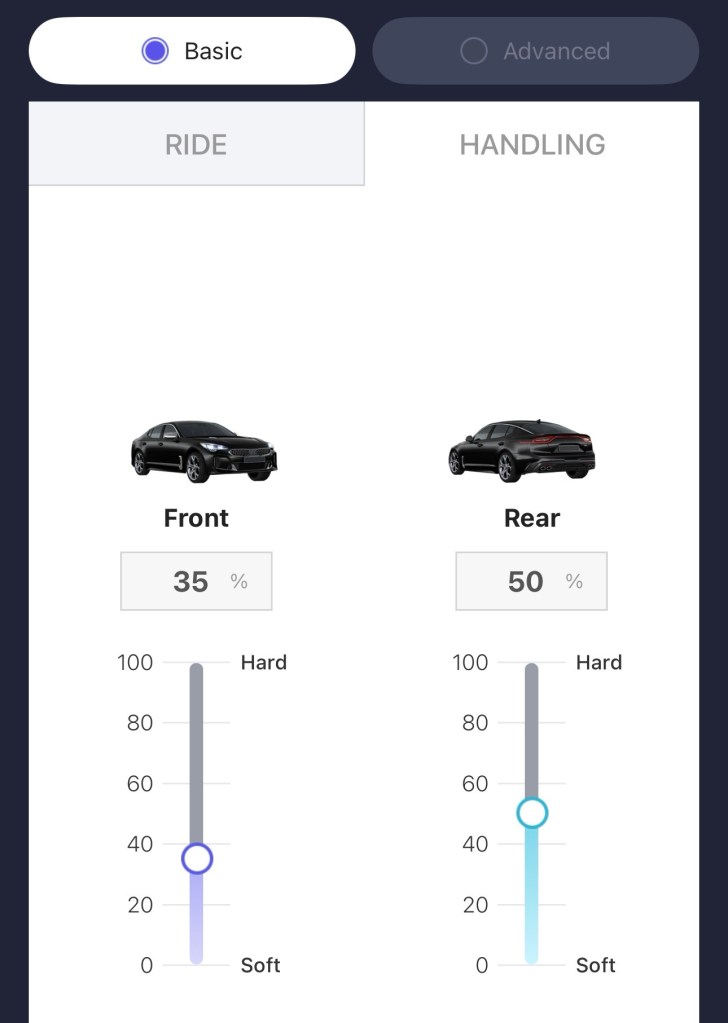
F35%, R50% – Good for a bumpy tracks or rain.
My custom settings
You can save your custom settings and give them a descriptive name; I went with Buick, Track, and Rain.
My three custom modes.
Buick – This is my daily mode (I don’t daily this car, but when I drive it around town, this is the setting I use).
Track – My track mode for dry conditions.
Rain – This is for driving on a wet race track, not on the street, where I always use Buick.
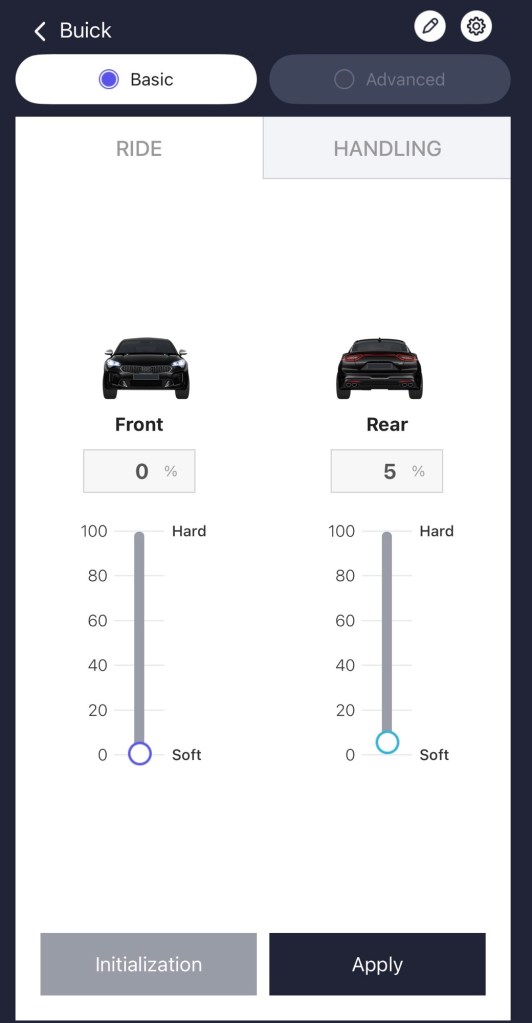
Buick
My philosophy for this setting was to make the car as plush as possible. I don’t foresee needing any handling events in this mode, but just in case I need to run from the cops, I changed the handling to base track settings.
Soft is wonderful.
Mode: Basic
Ride: Front 0%, Rear 5%. I’ve tried the rear at full soft as well, but I can’t tell much difference.
Handling: Front 30%, Rear 50%. This is an all-purpose track setting, which probably (hopefully) won’t be triggered during street driving.
Rain
My philosophy for this setting was to make the car as predictable as possible. Since I would only be using this on a race track, I could set the Ride and Handling settings to be identical. This should (in theory) keep the car from behaving differently when it kicks into a handling event.
Mode: Basic
Ride and Handling: Front 35%, Rear 50%.
For wet or bumpy tracks, both Ride and Handling are set the same.
Track (basic)
Before I got the Mando I used Normal mode for wet weather and Sport for dry and smooth tracks (Watkins Glen). For dry tracks with some undulations (Pineview, NYST), I flip-flopped between Normal and Sport without a clear indicator of which was better.
With the Mando I began to experiment a lot more, but I still haven’t figured out exactly what I like, other than a firmer rear. My Rain setting is honestly quite good all around. Bumping up both ends by 5% in the dry work great, but I haven’t found a full stiff setting that I like.
Track (advanced)
Advanced mode allows you to change the damping at different speeds. I don’t have enough data to say that the Advanced mode is better than Basic, but it surely has potential. Here’s how Advanced differs.
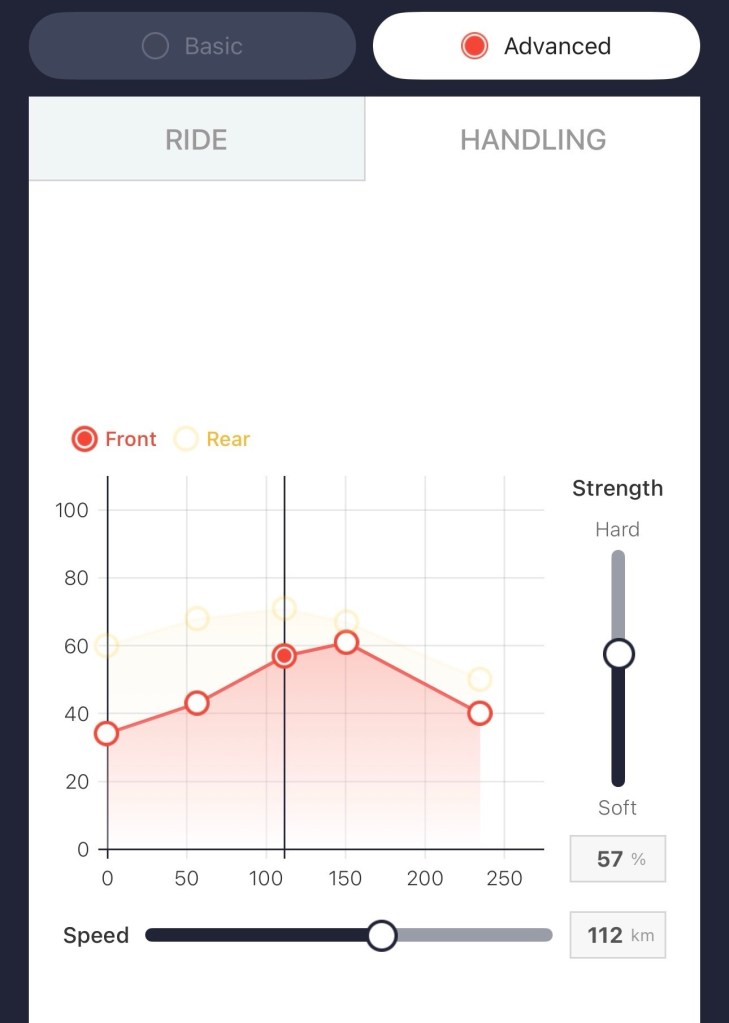
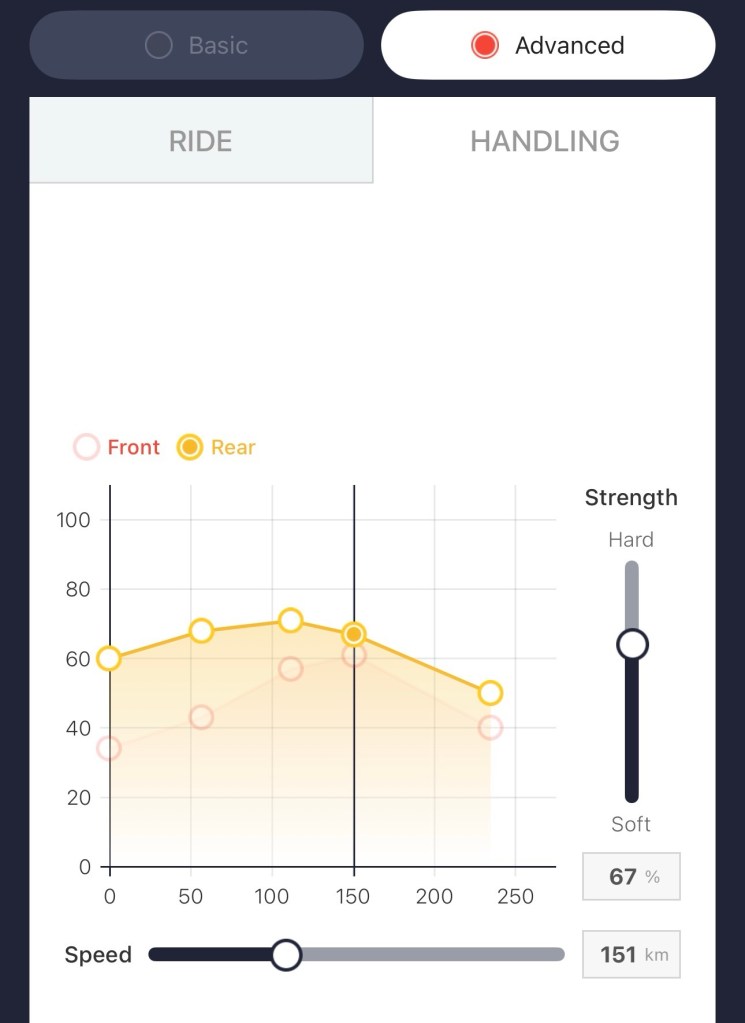
You define different speed zones on a chart (see image).
You can then set the compression damping at each speed, both front and rear, for both ride and handling.
This means you could do something like set front compression to 40% at 50 kph, and then at and 55 kph it bumps up to 50% front, and then at 60 kph it goes back down to 40% again. I don’t know why someone would do that, but it’s possible.
A better approach might be to set a low-speed zone where the front is medium-soft, say 35%, and the rear is much harder at like 60%. At lower speeds, you want the car to pivot more, and the imbalance in front/rear compression should help that.
Similarly, you might define a medium-speed zone where most of the corners are, say around 100 kph. At this speed you ramp up the compression of the front and rear, but more front, to gain some predictability in turn-in. Because you want balanced handling for the average corner, you set the rear to be just more than the front.
Finally you set a high-speed zone where the front and rear compression are both a little softer. This is so you don’t upset the chassis at high speed, or some such logic. This is depicted below.
Front
The previous logic might make sense for defining three speed zones, but the ECS10 allows you to set five different speeds. These are completely custom, you can set them anywhere you want on the graph.
Rear
A neat usecase for this would be setting the suspension up for basic track work, but there’s one corner, like a bumpy fast kink or bit of bit curbing you hit at a particular speed, and you soften the suspension for that one event (speed). You could go pretty far into the weeds with this shit, fine-tuning the suspension for different tracks and specific corners, with a log book for every track.
Conclusion
If you daily your Veloster N (or Kona N) on shitty roads, the Mando ECS10 might be the best modification you can make. It has transformed my car from a being uncomfortably stiff to acceptably compliant. The change is more significant than going from 235/35R19 tires on OE wheels to 235/40R18 tires on lightweight wheels. Combine the Mando with the increased sidewall height and it’s like a totally different car.
On the race track, the Mando has allowed me to unlock much better handling balance, even just using the Basic settings. My suspension is otherwise completely stock, and the car handles just incredibly, with laugh-out-loud four-wheel drifts.
As for the Advanced settings, I’m still on the fence. Having the ability to control damping at different speeds sounds incredible, but is the complexity really worth it? I’m not sure yet.
I don’t know how the ECS10 would handle things like lowering springs, stiffer spring rates, sway bars, and other seasonings, but I can imagine the ability to tune all of those things together with the Advanced damping options could get very rewarding. And very complex.
Although this also reminds me of my youth as a twenty something living in Seattle. I was the guitarist in a punk/grunge band playing a Gibson Les Paul through a vintage Fender Bassman head. The Fender had a nice warm sound, to which I added a Rat rack-mount distortion pedal with three options (A, B, and stacking A+B). This gave me four different voicing options: clean, bluesy, sludge, and heavier than fucking dinosaurs.
Later I got a Mesa Boogie Studio amp with switchable channels, preamp inputs (for the Rat), and a built-in graphic EQ. There were so many good sounds coming out of that thing that I could never really settle on what I liked. I was like the proverbial donkey that starves to death deciding between two piles of hay. Except there were 10 piles of hay. A couple years later I sold the Boogie and kept the Bassman.
Maybe the Mando’s Advanced mode is like the Mesa Boogie? I don’t know yet, but being able to set five different speeds of my choosing, and then front and rear and ride and handling at each speed… well it’s going to take a lot of experimenting to get everything out of this. I’ll certainly document this journey, but I won’t be surprised if I wind up with a track mode that’s 35% front, 50% rear, at all speeds.
I’ve tested several tires on my Veloster N over the past two years and have pulled that data together for this comparison article. The tires were tested on different dates and in different conditions, but I use the same Pirelli P Zero PZ4 control tire to normalize the lap times, and I feel that that all the data can be compared pretty equally.
Note that my Veloster N is a dual-duty car with camber bolts netting -1.8 degrees of camber, but is still on OE suspension. A more track focused setup with coilovers would be able to exploit better suspension and alignment settings, and get more performance out of softer tires. But I haven’t gone down that road yet, and so this tire test should be thought of as applicable to a trackable street car, rather than a streetable track car.
I’ve put the tires in this article into four categories, and noted the best rolling lap time for each. At the end you’ll find a summary table listing predicted lap and something I’m calling compiled lap, as well.
Pirelli PZero PZ4 vs Michelin Pilot Super Sport
My control tire is the Pirelli PZero PZ4, which came as original equipment on my Veloster N. It’s an excellent rain tire, but has mush sidewalls and wears out a little too quickly on a dry track. As a result, I don’t use them much other than for benchmarking other tires.
I killed the first set of PZ4s in the OE 235/35R19 size, and probably wouldn’t have bought them again, but saw the 18” tires on ridiculous sale. I couldn’t help myself, but this time I got them in 235/40R18 and mounted them on 18×8.5 +45 wheels.
Another tire that came as original equipment on the Veloster N was the Michelin Pilot Super Sport. But this tire was on the non-Performance Pack version, which had 25 hp less, no eLSD, smaller brakes, and smaller tires. I got a set of PSS for free on Marketplace with about half their life remaining and figured I should compare stock vs stock. These came in a narrower 225/40R18 size, but I mounted these on 18×8.5 +45 wheels. Thus, I can do a fairly direct comparison between PZ4 and PSS, but only if I ignore the fact that the PSS is 10mm narrower.
In terms of lap times, it was a wash, as the PZ4 and PSS performed identically in lap times. The .03 seconds between them equatable to noise from any number of variables, such as air and track temperature, rubber on the track, driver consistency, etc. For a 300 TW tire, I’d take the PSS in the dry and the PZ4 in the wet, but neither is really a track tire.
Pilot Super Sport (45.207) – I like the way these feel at the limit, but the audible feedback is a little strange, being more of a protesting whine than a loud shriek.
Pirelli P Zero PZ4 (45.170 and 45.176) – The PZ4 gives an earlier warning and they are louder, so they give a better indication of the approaching limit. The sidewalls are too soft and so limit handling is a little compromised, but I’d still drive these all day. I tested these tires twice, a year apart, and they were .006 seconds apart. Given that the lap times, rolling lap, and predicted lap are all within .01%, I feel confident that my PZ4 benchmark laps can be used to equate the various tires to each other. So let’s take a look at those tests.
Armstrong Blu Trac Race vs Atlas Force UHP vs Linglong Crosswind
The next three tires I’ll examine are budget tires, and they are the slowest by a fair margin. But they are also the most fun! They slide early and make a lot of noise, and I can do four-wheel drifts in my FWD hatchback.
Blu Trac Race (46.247) – Armstrong left the e off of Blue, the k off of Track, and the grip off a 200TW tire. In lap times, it performed in between the two all-season tires I tested, and it’s a joke to classify it as a 200. Certainly the tread pattern looks the part, but these are all-season grip levels.
Atlas Force UHP (46.450) – I wanted to try these budget all-season tires because Jonathan Benson (Tyre Reviews) raved about their track handling in his video review. He says that the Atlas Force punches well above its weight and was fun to drive. I agree. But it was also the slowest tire here. At 520 treadwear, it ought to be! I got them for $55 as dealer takeoffs that were mounted once but never used (still with stickers).
Linglong Crosswind UHP (46.095) – This is another budget all-season, with a 400 TW rating. I put down one flyer lap that was the quickest in this segment, but in reality, I think it’s no better than the others. I got them for $65 on sale (regularly $76). These have a symmetrical tread pattern, but at this price, I’m not flipping them once.
It’s worth noting that the Blu Trac Race were 235/40R18, and mounted on Konig 18×8.5 +45 wheels. The all-season tires were 235/35R19 and mounted on OE 19×8 +55 wheels, which weigh 10 lbs more. Each! If you put all the tires on equal wheels, the Blu Trac might be the slowest!
Which is not to say the Blu Trac are worthless. They are still the most fun, and should hold up to track abuse better than all-season tires, which have more and deeper sipes. Nevertheless, I’m still on a quest to find a bargain UHP all-season tire, and see no reason to go back to Armstrong when I can get something comparable in performance for half the price.
For those who are reluctant to try all-season tires on track, I say get a set of Atlas Force and just try them out. I often hear resistance to using all-season tires on track, with fears that the tires will blister or chunk. I’ve not had the problem (yet) and at $75 per tire, it’s a gamble I’m willing to take.
Also, let me give a quick shout out to the mobile tire service I use, On the Go Tire Pro. They do my tire changes at the track in between sessions, which is pretty much the only way I can get this many tests done in a day. Thanks Paul, you make this possible.
Hankook R-S4 vs Kumho V730
The ideal track tire for a car with OE suspension and limited camber is an endurance 200 TW. There are a lot of great tires in this segment, such as Continental ExtremeContact Force, Falken RT615K+, Hankook R-S4, Maxxis VR1, Yokohama AD09R, etc. For a camber challenged car, I also like a symmetrical tread pattern, because if you get too much wear on the outer shoulder, you can flip the tire once.
Hankook RS4 (44.568) – The RS4 was once considered average in the 200TW segment, but time has moved on, and this is now considered a pretty slow tire. Just the same, it beat out a couple other 200TW tires in this test, and proves to be a great match for a FWD car. This is my favorite tire, and my familiarity with it means I may have driven it slightly faster than other tires.
Kumho V730 (44.616) – In every other test I’ve seen, the V730 is considered a faster tire than the RS4, so why is it slower here? Well it’s actually not, I’m just not driving it as well. On predicted lap, it’s .271 seconds faster than the RS4, and I think it’s mostly a case of not enough time getting used to the tires. I ended up destroying the outside shoulder with 2/3 of the life still remaining.
Goodyear Supercar 3R vs Vitour P1 Tempesta
Neither of these tires performed great on my Veloster, and this is to be expected because the car doesn’t have enough negative camber. But I tried them anyway, and these are my results.
Goodyear Supercar 3R (43.965) – The SC3R posted the fastest time by a fair margin, but I honestly didn’t like the the way they felt. The rears didn’t come up to temperature at the same time as the fronts, and so the first laps were sketchy. They didn’t give much audible feedback, and so the limit was harder to drive. But oh man do they grip. The steering is immediate, and it felt like I was driving someone else’s car. With coilovers and camber, I’m sure they are amazing.
Vitour P1 Tempesta (44.877) – I liked the way these tires felt. They have very stiff sidewalls and despite a soft rubber compound, they don’t require a lot of camber. From the seat of the pants I expected a PB lap, but it never materialized. The reason was because of Turn 2, which requires braking, turning, and accelerating all in short order. This overwhelmed the tires, creating a micro heat spike (I think). In the data, this was clearly visible as a V-shaped vMin in the speed trace, and a corresponding M-shaped LatG trace.
The reasons the P1 Tempesta underperformed could be down to a variety of factors.
Tire pressure – They like very low pressure, but I was afraid of cording the shoulders and ran them at 34 hot. This is still very low for a FWD hatchback, but lower might have been better.
Heat cycle – I did heat cycle these, but many people have reported they get faster and faster with more cycles. Perhaps the next day would have been faster.
Heavy FWD – The Veloster has about 2/3 of the weight on the nose, on a skinny 235 tire. Most of the people having great success with the P1 are using lighter cars, and most of them are RWD, where combined loading isn’t as much of an issue.
Track – Pineview Run is a strange track to begin with, being very short and slow. At a track like Watkins Glen, I might never have experienced the Turn 2 phenomenon.
I’ve given the tires to a buddy to test on his Subaru, and so perhaps next year I can unravel the mystery of why these tires underperformed on my car.
Summary data
The following data is sorted by Compiled lap time, which is an average of the rolling lap and the predicted best lap.
A rolling lap is the fastest lap time where the start/finish line is most beneficial to the lap, rather than a start/finish in a static location. The rolling lap is a legit fastest lap, and a more consistent data point across multiple laps.
I’ve also added the predicted lap time, which assembles my best sectors together. I use a five-sector map, which makes for a realistic the lap time if I hit my marks and drive without errors. But there are always errors, and this way I can see what the potential is.
Tire
Rolling
Predicted
Compiled
% Time
SC3R
43.965
43.694
43.830
98.34%
V730
44.616
44.351
44.484
99.81%
RS4
44.568
44.568
44.568
100.00%
P1
44.877
44.514
44.696
100.29%
PSS
45.207
44.927
45.067
101.12%
PZ4 6/4/25
45.170
45.096
45.133
101.27%
PZ4 6/25/24
45.176
45.125
45.151
101.31%
Crosswind
46.095
46.095
46.095
103.43%
Blu Trac
46.247
46.026
46.137
103.52%
Atlas Force
46.450
46.401
46.426
104.17%
Note the final column in the table, % Time. You can use this value to find your approximate lap time using different tires. For example, on RS4s I typically do Watkins Glen in about 2:16 (136 seconds) and so on SC3Rs that would be a 2:13.7 (136 * .9843 = 133.74). Likewise, if I use my shitty Atlas Force tires, I can expect a lap time of around 2:21.7 (136 * 1.0417 = 141.67).
As I noted previously, I didn’t like the feel of the SC3R, and I actually drove the V730 to a better lap time at NYST. If my Veloster had coilovers, I would surely be singing a different tune. The P1 Tempesta felt fantastic, but V730s are a performance bargain, and that’s probably what I’d use most of the time.
But as my car sits now, all-season tires are a better driving experience than Super 200s. Sliding around sideways with the tires howling is where the fun is at. And even if my off-brand all-season tires are a few seconds slower per lap, my budget Korean FWD hatchback is still getting a lot of point bys in the Advanced/Instructor group… from people driving expensive German sports cars, on expensive French rubber. Just sayin.
But at the end of the day, the Hankook R-S4 is the best dual-duty tire for a FWD car with OE suspension and not a lot of camber. The tires grip well enough, have great feedback, and when I wear out the shoulders I can flip them once and get more life out of them. The more I test, the more I come back to old faithful. Long Live the RS4.
2026 Tire Tests?
I enjoy tire testing as much as racing, and I’ll certainly do more of it in the future. Pineview Run’s short track is the ideal venue for this, as it’s mostly vacant during weekdays, and I can get in runs whenever I want. The 45-second lap time is also a bonus, as I can get in many more laps to normalize the data. So what’s up for 2026?
Super 200 – The fact that my Veloster doesn’t like tires that are any better than a 200 TW Enduro tire begs the question: is there any reason to test anything else in the Super 200 category? Probably not. My Veloster will destroy the outside shoulder on a A052, CRS, RE71RS, RT660+, Hoosier TAP, etc., without getting much more performance out of them. But I got a set of used RE71RS tires and I’ll have to at least bench mark those vs the PZ4s. And if I get anything else for free in this category, I’ll test them out.
Enduro 200 – The Continental ExtemeContact Force is supposed to be a smidge faster than RS4s, but the price is typically a lot higher. There really isn’t anything else with a symmetrical tread pattern that’s worth experimenting on. But I’m thinking about going back to an old friend, the RT615K+, just to see how they compare.
Max Performance 300s – At the top of the list is an old favorite, the Continental ExtremeContact Sport. I loved these on my Miata, but I haven’t tried the Sport 02 yet.
Drift tires – Nobody believes me when I tell them the Veloster is a drift car, but it goes sideways like no FWD car should! There are a couple drift tires with symmetrical tread patterns that look like they’d suit my purposes. The Kenda Vezda KR20A is about $135 each, while the Accelera 351 GD is about $5 cheaper. Both go on sale regularly, and I might pull the trigger on either. Another one that looks interesting is the Vitour Enzo, which comes in a 300TW and 340TW.
UHP All-Season – I’m also curious about high-end UHP tires like the Continental DWS06+ and Pirelli PZero A/S Plus 3. Tyre Reviews and Tire Rack have tested these and put them within 1% of a Pilot Sport 4S in lap time, which is kind of shocking. So I got a set of used DWS 06+ tires on Marketplace for a song. I got them in a 225/45-18 size. The taller sidewall and narrower tread won’t help on track, but they will be my daily tires, and the Veloster can use some more cushion. Of course I’ll test them on track, and maybe they can beat the budget tires.
Every year people wait for Black Friday sales so they can get cheap parts that make their cars faster. Buy and large (sic), they set a faster lap time, but the driver remains the same. The best strategy for lower lap times is driver education and seat time. With an eye on that, here are some of the best BF deals going.
Pineview Run Track Pass
The best deal in motorsports is Pineview Run’s track pass, and right now it’s 10% off. In years past, there have been a limited number of track passes available, and when they are sold out, they are sold out. I’m not sure if that’s the policy again this year, but you might want to jump on this early in case that happens.
Pineview is a great technical track, with a luxurious club house, and a supportive community. You’ll never have to sit through another 7:30am driver meeting! No more dumb jokes, explanations of how to do a point by, or reviewing what the flags mean. Ever. Again.
And that’s one of the best parts about being in a private track club; I show up whenever I want, and run however many sessions I want. But more than that, I really love the layout. The track has every type of corner, on and off camber, elevation, and compromises. Simply put, there is no other track that is more a measure of driver skill than Pineview Run.
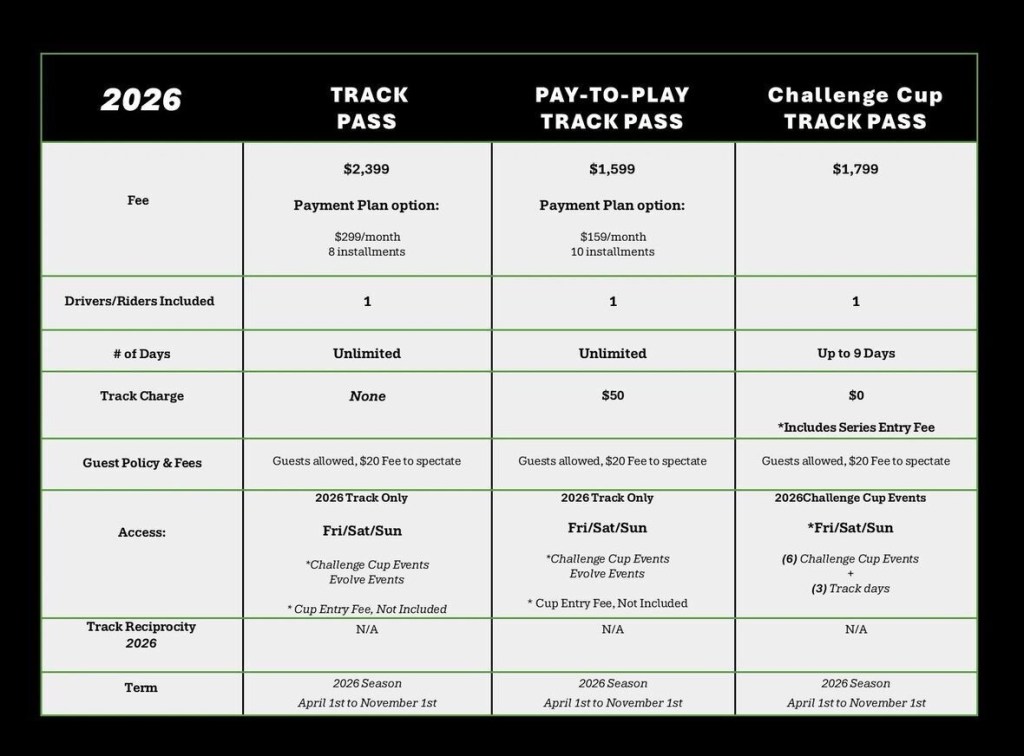
There are three track pass options:
Track pass – The best deal is the most expensive, but for just $2160 (10% discount applied), you get unlimited track days in 2026 (Friday to Sunday). Come to the track 20 times and that’s $108 per track day!
Pay-to-play track pass – At $1460 (discount applied), this is a cheaper option, but you pay $50 per visit. If you come 10 times, this works out to $196 per track day, and that’s still a great deal. If you come 15 or more times, the unlimited track pass is cheaper.
Challenge Cup track pass – This pass includes six Challenge Cup races and three a-la carte events of your choosing. Challenge Cup races are all-day competitions, and so you’re getting a full track day with timing, scoring, and awards. $1620 (with discount) works out to $180 per event, which has to be the cheapest time trial racing series around.
Mass Tuning
Every year Mass Tuning releases their calendar around Thanksgiving time, with a huge discount for advanced purchases. For every track day you buy in advance, you get $100 off. Some tracks, like Canaan, Pineview, and NYST are less expensive to begin with, and so you can track them for as low as $150 for a day! And in the past there were Ladies Day and Miata Day events that were only $200, and ended up being half price.
There are a limited number of discounted track days available, so get on this before they are sold out (I’ll update this article as soon as the sale goes live). Note that I often coach with Mass Tuning when they are in my area (Watkins Glen, Pineview, and NYST), so if you sign up as a Novice, give me a holler and I’ll try and get in your passenger seat.
SCDA
There are several trackday organizations in the northeast to choose from, but I feel that SCDA sets the high water mark for the E in HPDE (education). SCDA is a little more expensive, but you get what you pay for.
Their Black Friday deals include decent discounts on their track packs. For example, their 7-day track pass is usually $3143 ($450 per event) and is discounted to $2595 ($370 per event). You can pick and choose which events to run, from Lime Rock to Watkins Glen to VIR and more.
Sim Racing
If you aren’t sim racing yet, see my brother’s article on a minimal sim rig. For less money than you think, you can get started with a very usable sim rig and Assetto Corsa. You can buy Assetto Corsa on Steam for $5, which is a one-time purchase, unlike iRacing which is double that price every month.
Doctor Korf has cataloged a lot of his sim racing articles at You Suck At Racing, so check those out. And stay up to date with this blog, as there’s always a lot of sim content.
Ross Bentley’s Speed Secrets
Seat time on its own is useful, but if you want to be a better driver, you need education and direction. Head to Ross Bentley’s Speed Secrets site and peruse his book, playbooks, and other content.
The off season is the ideal time to join his Sim Racing Academy. If you want something more intensive, then join the Sim Racing Boot Camp, which includes a month of the academy and 1:1 coaching.
Use the discount code BFCM25 to get 25% off.
JKF Aero
If you’re interested in learning about aerodynamics, Kyle Forster’s online classes on aerodynamics are a huge 30% off on Black Friday. You can read my review of his first course, and then head over to his site and save major bucks.
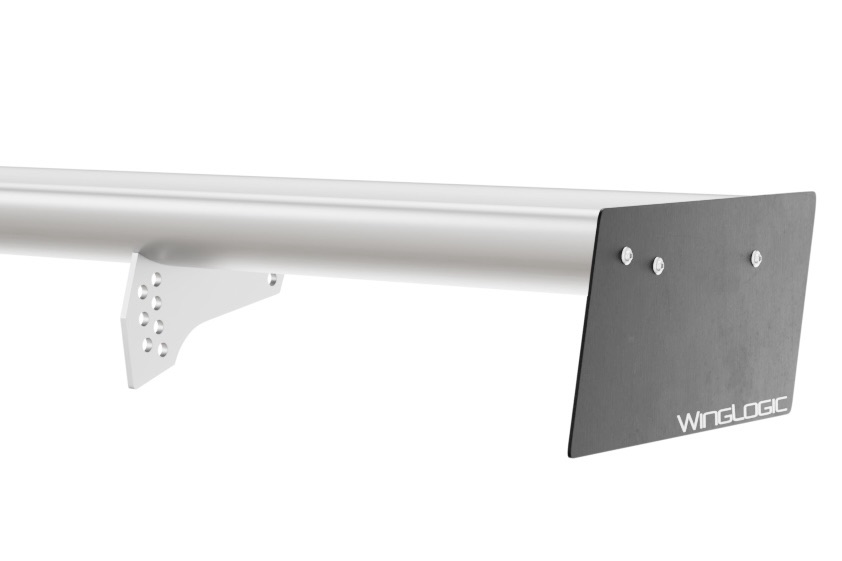
WingLogic MSHD
I wrote about the WingLogic MSHD in a previous article, and it’s still on sale for a ridiculous $350 for a 65” wing! I don’t know if there will be a Black Friday sale on top of this, but it’s a crazy good deal already. You’re not going to find an aluminum wing that makes more downforce, weighs less, or is less expensive.
This is how stoked I am on this wing: All of my DIY wing projects are now in the trash. I’m using the WingLogic MSHD from here on out.
I’m less serious about performance or aero on my second Veloster N, and doing some mods just for fun, appearance, or convenience. One of the things I’ve done is to install rally lights.
I deliberated on 3.7” and 5” lights, bought both, and eventually returned the 5” lights. The larger lights were higher quality and gave the car a more legit rally look, but they were also a lot heavier. I was concerned about the extra weight bouncing around on the front of the car, more than a weight from a performance aspect.
I also went back and forth on white versus yellow lights, and in the end I decided to buy a pair of each.
These are cheap ($42), lightweight, and plenty bright. They come with a quick-release wiring harness and lighted power switch.
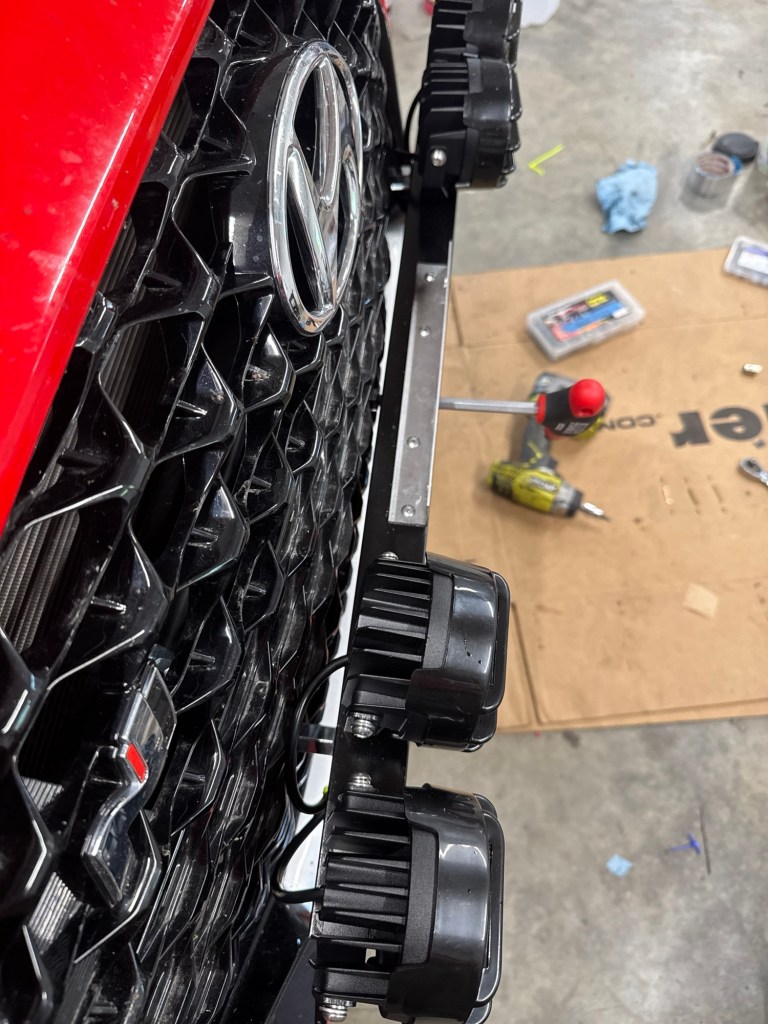
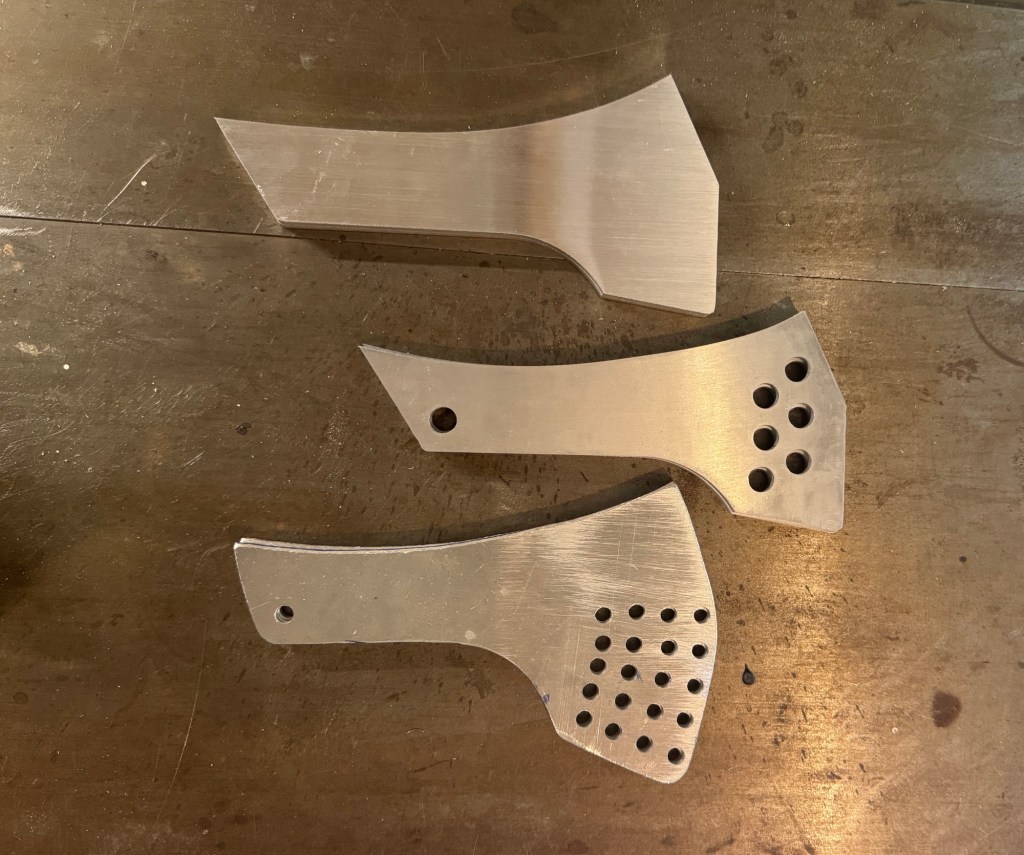
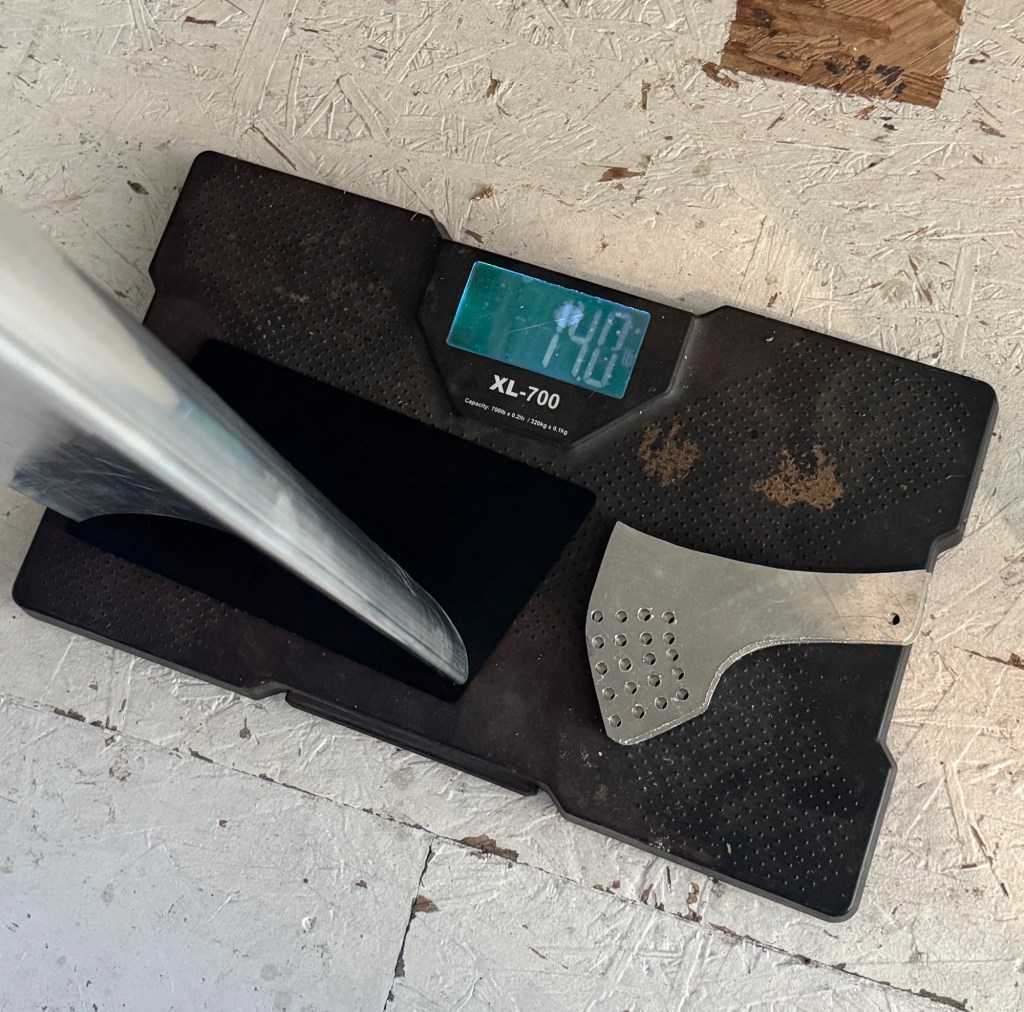
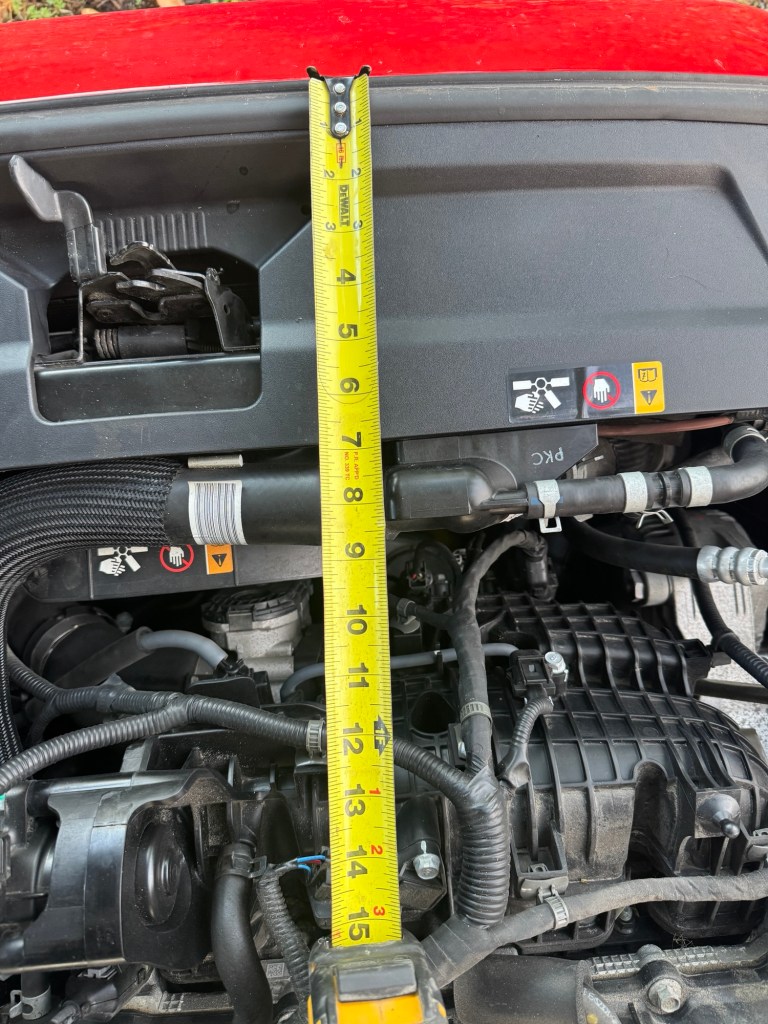
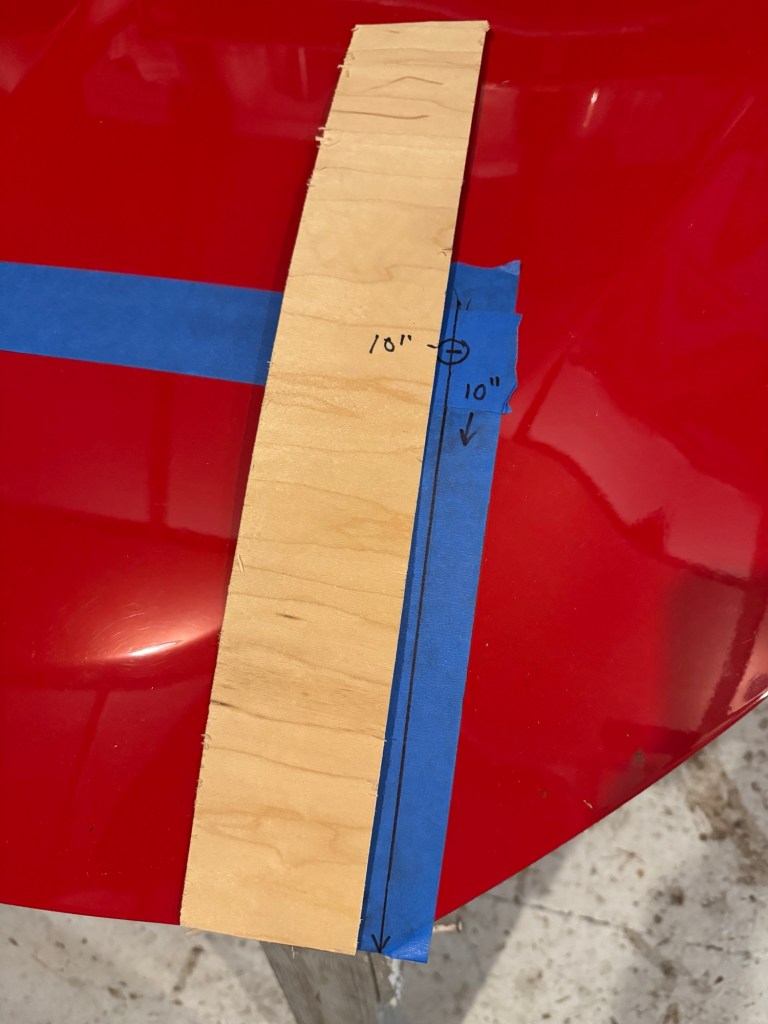
To mount the lights I removed the front fascia and installed U-bolts around the front bumper beam. I then used coupling bolts on the bottom of the U-bolts to hold up an aluminum U-channel, which would serve as the mounting point for the lights.
U-bolts fasten to the bumper beam. Aluminum U-channel (painted black) holds the lights and hides the wires underneath.
I mounted everything up, checked clearances, ran the wires, tested the lights, and let out a sigh of satisfaction. And then I disassembled everything. Now that I was sure everything worked and fit, I could put the front fascia back on again.
In the following picture you can see a T-handled hex key inserted into the mounting bar (black U-channel), which is how the lights are installed and removed. If I need to remove the fascia, I undo three Allen bolts, unclip the wiring harness, and pull the whole light bar away. It all comes off in a minute or two. The mounting system is otherwise invisible, and I’m pretty happy with how it came out.
The light bar fastens with Allen bolts, but you don’t see any of the hardware.
The final step was to run the wires into the cockpit. This required removing a few pieces of interior trim, zip tying wires, and drilling holes in the dash plastic to mount the switches.
Top view shows management of wires and the tight clearance between the front grille and light bar. The angle aluminum in the center is the license plate bracket.
All told, the project cost me a little over $100 and took about a day to install. I removed and installed the front fascia at least three times figuring out how to mount the light bar in front of the fascia, and moving the U-bolts around. Other time sinks included managing all of the wires so that the bar would disconnect easily, and running the wires into the cockpit.
A better look at the U-channel, and how the lights are mounted. The wires are tucked up and zip tied inside the channel.
I’ve tested the lights a few times now, and they are awesome. I have the white lights pointed out into the corners as apex lights, and they do a great job illuminating the sides of the road. This is important this time of year with all of the deer collisions. The yellow lights are pointed straight ahead and down, to be used as fog lights.
PittRace ranks as one of my favorite race tracks. It’s not just a great technical layout, but has multiple configurations, usable curbs, and great facilities. I was lucky enough to attend the final ever wheel to wheel race there, and the final ever event. Neither went to plan.
Out with a whimper
The final race was with Lucky Dog Racing, an endurance racing series that I really enjoy. Like AER or Lemons, they divide cars into brackets based on speed. But the cars must be 2006 or older, and there’s a speed cap (minimum lap time) to discourage and eliminate really fast cars.
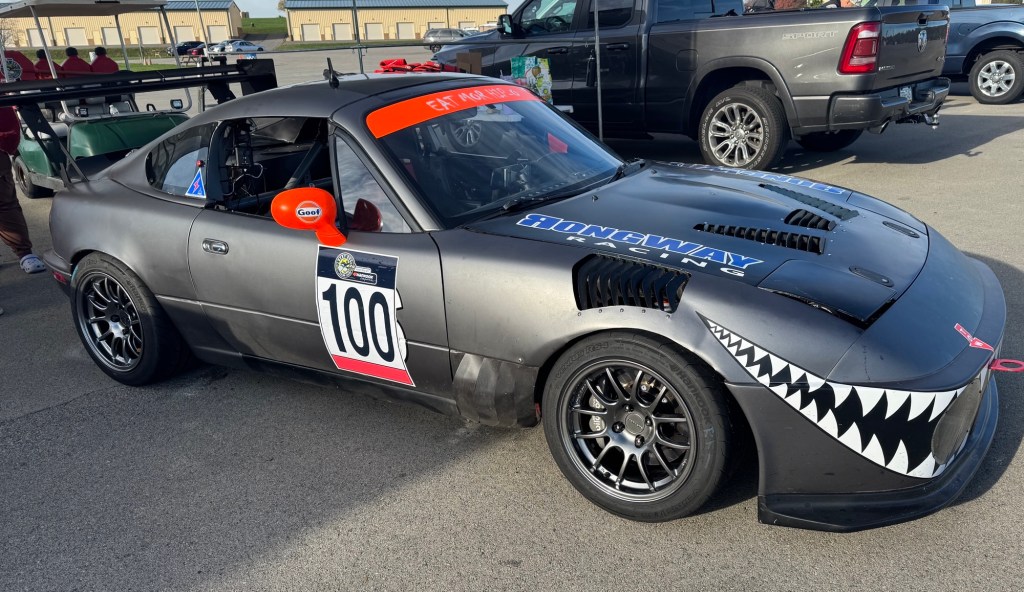
The car I was set to drive is the same Miata I took to the wind tunnel. It’s one of the best built Miatas you’ll ever see, with a stoker crank, 85.5mm pistons, big cams, Skunk2 intake, Haltech ECU, and a Quaife sequential gearbox. Look around the car you’ll see an attention to detail that is second to none. Aim dash, Chill Out driver cooling system, you name it, it’s got it.
Sweet looking car with shark theme. Loving the gill-shaped fender vents behind the front wheels, even if they do zilch for performance (see Wind Tunnel Report 02).
It lasted about 10 laps.
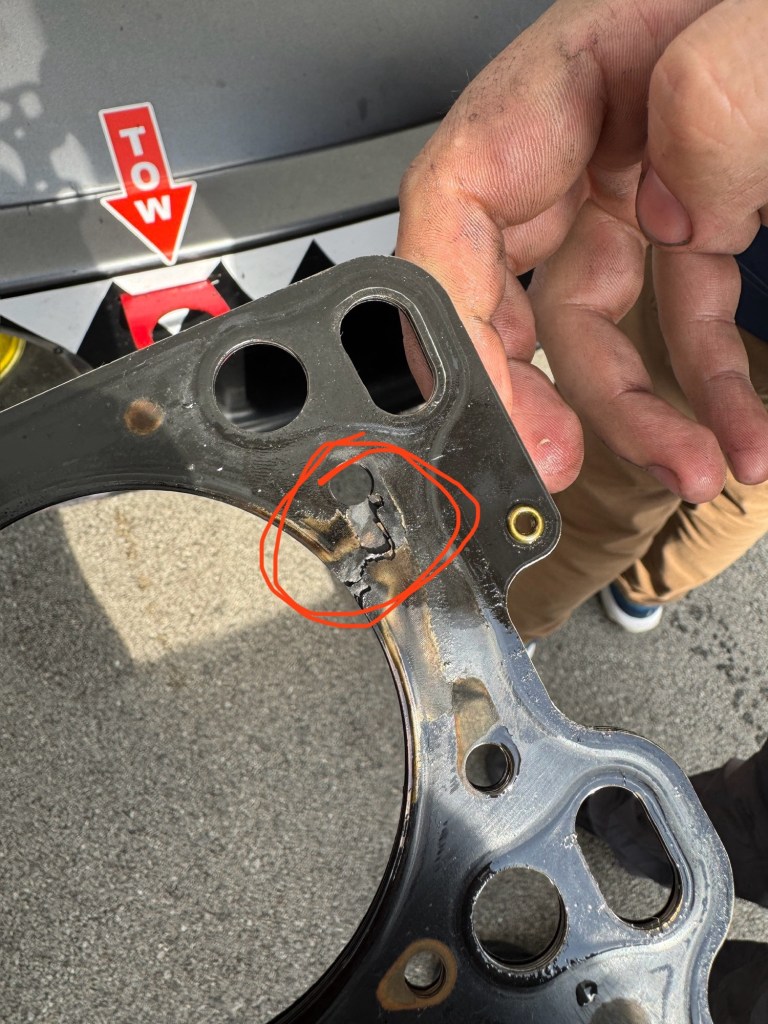
The problem was a rookie mistake, which is normal for a rookie team. The owner and builder was chasing more power, and installed new cams before the race. This required claying up the pistons for valve-to-piston clearance, and then removing the head to measure that. In the process, Phil reused the head gasket, and that was probably not a good idea.
Head gaskets are typically single-use items, but since this Miata runs 2.5mm over the standard bore size, it’s much harder to find a 85.5mm head gasket. I guess there wasn’t an extra for testing valve clearance, and there certainly wasn’t an extra in the spares box. You win or you learn; we learned.
Burned through here.
That’s the way to goes sometimes, and it was at least fun to be at the track, talk to people, and watch the racing. It was a good opportunity to see how other teams use (or don’t use) aero, and that lead me to doing a podcast episode on Garage Heroes in Training on aero for endurance racing. Thems sour grapes, but grapes just the same.
Strike three for MSHD!
This race was also strike three for testing the MSHD wing. I had previously loaned a wing to Alyssa Merrill for testing at Watkins Glen, as she has a 9 Lives Racing wing. I also loaned her an original WingLogic to test. But she had assorted car troubles and wasn’t able to do any extensive testing on the wing. She was able to try the new MSHD vs the 9LR, and concluded that the new wing made the car more stable (more downforce), but there’s no data to go with that.
Then I gave the MSHD to Steve Leo to test at WGI versus the old WingLogic on his Subaru. The wing supports are the same distance apart, so it was easy to use the same wing. Unfortunately Steve had car trouble, and wasn’t able to test the wings back to back.
So this Lucky Dog race was also supposed to be yet another wing test, and this time I brought my MSHD set up as a dual wing, to test versus the 9LR dual wing (which is what is on the Miata now). But obviously none of that happened.
All said, I didn’t get to run any of the back to back tests I had envisioned at the end of 2025, and so it looks like maybe I’ll hit the wind tunnel first and then do the track tests in early 2026. One thing is for sure, me planning to track test aero ends up breaking cars.
Out with a bang
So if the Lucky Dog finale was less than eventful, the Hooked on Driving finale was eventful in the wrong way.
I signed up to instruct, but HoD didn’t have a novice group. Instead, I would have a low-intermediate solo driver, who I’d be instructing and evaluating. My student knew the track, in fact it was his home track, and during the pre-drive interview, we commiserated on the loss of this wonderful track, and discussed where he’d go next; Mid Ohio, or Nelson Ledges perhaps.
His car was a Shelby GT350 with 522 hp at the wheels. “At the wheels,” I echoed back, and he nodded. This is about what a stock GT350 has at the crank, and so it had been breathed on a bit. The car was on Michelin Cup 2 tires, which have a reputation for heat resistance, but they do take a few laps to come in.
So I asked about traction control and stability control in the drive mode he selected, and he said no to the former and yes to the latter. I should have stopped him right there and made him put on the traction control.
We started the session with two laps under full course yellow on a cold (40F) and wet track. This is not enough time Cup 2s to get up to temperature. I think you see where this is going.
We got stuck behind someone who clearly didn’t belong in the Solo group for being slow giving point bys on the wrong side, and then we went into T13 and my student got on the gas just a little too much. Like a tiny, tiny too much.
The rear wheels lost grip, we went into a slide, and then hit the grass at about 25 mph. If it was dry, we’d have come to a stop and laughed about it. But the wet grass was like ice and we picked up speed going sideways, straight into the Armco.
What’s absolutely wild about the incident was I was completely calm the whole time. I saw the wall coming and knew for sure we were going to hit the wall on my side. The driver was freaking out at this point, “oh no, we’re going to crash!” But I was loose and totally calm.
If you follow the blog, you know I was hit from behind by a fire and rescue vehicle earlier this year. So when you’ve seen a 7000-lb vehicle run into you from behind at 60 mph, and watched it coming the whole time, a 25 mph crash is fucking nothing.
Except that it was a pretty sudden stop, very loud, with plastic shrapnel and airbag chemicals in the air. My back and neck are a little sore (again), and my arms have scrapes and bruises. Enh, I’ll certainly walk it off, but FFS! This was definitely not how I saw 2025 ending, or my final two events at PittRace going.
Still, I feel oddly fortunate for getting to experience something (anything) at PittRace, and walking away from another accident with a smile, and a story to tell.
In my first article on the MSHD, I mentioned the author of the MSHD thesis, Sriram Saranathy Pakkam, also tested the wing as a dual element. The results looked fantastic, with a CL of over 4.0, That’s over 170% more downforce than when used as a single element. But what’s more remarkable, was that as wing angle increased, it never seemed to stall. Stalling is the point where downforce decreases with more angle, and drag goes way up.
You might wonder why stall is important for a wing that’s not used on an airplane; it’s not like the car is going to fall out of the sky! But because cars have cambered rooflines, the middle of the wing experiences a steeper angle than the outsides of the wing. Air coming down the center of the roofline might be anywhere from 5-10 degrees, while the air at the sides of the car is at zero degrees.
This means if you set up a typical 2D wing at zero degrees AoA, the middle of the wing might be at 5 degrees (for a hatchback) or 10 degrees (for a sedan). The maximum angle of attack is often around 10 degrees for most wings, and so the middle wing could be at maximum downforce, while the ends of the wing are underperforming at zero degrees.
This is a suboptimal condition, but some people do worse and set the angle so that the outsides of the wing are at 10 degrees. But now the middle of the wing is at 15-20 degrees and certainly stalling.
In the end, what most people do is hedge their bets and set the wing to 2 or 3 degrees AoA. At this setting, none of the wing is at peak downforce, but neither is it stalling badly.
This is why the best performing single wings have a 3D shape that follows the camber in the roofline. The ends of the wing twist downward (or the middle is pushed upwards if you prefer), and so the entire wing experiences the same angle of attack across the surface.
But if you looked at the MSHD data, it appears that it can be run at pretty extreme angles without stalling, even up to 20 degree or so. This means you can set the ideal angle of attack at the ends of the wing (which perform best because they are in free stream), and ignore the extra roofline-induced angle in the center of the wing. If we believe the data, maybe a 3D wing isn’t even necessary when using a MSHD airfoil? It’s something I’ll have to build and test in the future.
As good as the MSHD is as a single element with respect to stall, the dual element seems even more forgiving. The author never found a point at which the wing stalled, the downforce just sort of flattened out at extreme angles of attack.
At maximum angle, the bottom wing is at 25 degrees, which puts the upper wing at 61 degrees to horizontal!
It sounds too good to be true, and so I’ll have to run a full sweep in the wind tunnel and find out for myself. But that may take a few months before I can assemble everything and schedule the tunnel time. So in the meantime, I’m going to build a hack-job dual element and see how it performs on track.
Upper element
The specifications of the dual wing used in Pakkam’s paper are as follows:
Upper element was a scaled down MSHD airfoil. Other airfoils were tested as the flap, but none performed as well.
Upper element measured 35% of chord, so this is about 3.5” chord for a WingLogic 250mm.
Total chord measured 120% of the bottom wing. On the WingLogic MSHD, this should be about 12” overall from leading edge to trailing edge.
Pakkam used a fixed 36-degree angle between the upper and lower wings, and then adjusted the wing as a whole to test different angles of attack. This is different than I’m used to: usually the bottom wing remains fixed at close to zero degrees, and the flap is adjusted from 25-35 degrees or so.
I’ll eventually 3D print a MSHD with a 3.5” chord, but for the time being, I’m going to use the upper wing I built for the previous version WingLogic. This will at least give me something to track test this year.
The upper wing I’m using is a cheap aluminum extrusion you can buy for $35 on eBay, Amazon, etc. I bought two of them and joined them together with a M8 stud. I also put a bracket in the middle of the wing to keep the middle from sagging. I then had a buddy weld all the way around it. It’s stiff and light and has a 120mm chord. You can read about the construction of that wing here.
According to Simon McBeath, the flap wing is typically 25-30% of the total chord (main wing + flap), but 30-40% chord can be used for more downforce. Given that the overall chord is around 350mm, then this flap is about 35% chord and appropriately sized.
The airfoil looks a bit like a Wortman FX72, a high-lift aviation wing (coincidentally chosen as one of the comparison wings in Pakkam’s thesis). But the FX72 is the exact opposite of the MSHD with respect to stall. If you set it over 12 degrees, the downforce falls off a cliff, and the wing drops out of the sky.
Because the airfoil isn’t the ideal MSHD shape, I chose to back off the angle of attack (relative to the bottom wing) to 30-degrees, instead of 36 degrees. At this angle, I don’t think the upper wing will stall, and it’s an easy angle to set, with a simple 1:2 rise over run.
I overlapped the top wing over the bottom by about 1”, and set the gap between the wings at just over 1/4”. I settled on these figures by measuring the overlap and gap distances used in Pakkam’s renderings, as they were not given specifically in the paper.
I made endplates out of recycled street signs, natch. On a single wing, I make the top of the endplate parallel to the chord of the wing, which makes it easy to set the angle of attack (put a digital level across the top of the endplate). For this dual wing, I made the bottom of the endplate parallel with the main wing’s chord, for the same reason. The rest of the endplate has sort of a trapezoid shape; there’s no data behind it, other than it looks good to my eye.
Upper wing is supported by the end plates and a center bracket.
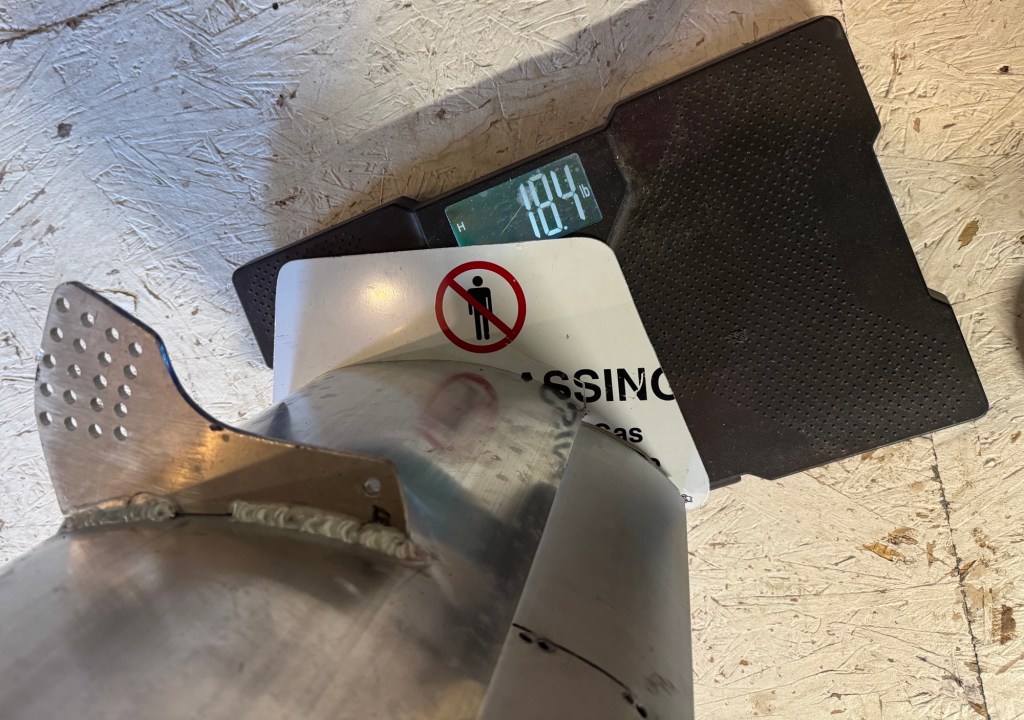
Completely assembled with bottom mounts, endplates, and center bracket, the 65” wing weighs 18.4 lbs.
65” WingLogic MSHD dual element is only 1.8 lbs heavier than the original 65” WingLogic single element!
Testing… soon
I’ll bring the dual wing to the A2 wind tunnel for testing when I have a chance, but until then, all I can do is track testing. Luckily I’m racing the Lucky Dog event at PittRace on October 25-26, and will hot swap the wing in the pits. This would normally be a terrible strategy for an endurance race, but the team I’m driving with (Rongway Racing) doesn’t particularly care about where they finish, and are just in it for the fun. They support doing aero experiments during my stint, and so I shall.
The car is the same Miata I brought to the wind tunnel, and has a 9 Lives Racing dual element on it right now. Swapping the wings during my session should be a good A/B test for subjective feel, and of course I’ll be collecting data. I plan to test the wing as a single element as well, which should be doubly interesting.
TL;DR Go get a Wing Logic MSHD wing right now. The wing is over 2.5 lbs lighter than the previous version, makes more downforce, and is just $350 for a 65” wing!
In my article on Car Wing Comparisons, I review many of the airfoils used in motorsports. The wings I researched for that article were mostly from the Airfoil Tools website, and designed as airplane wings. Of those, the best performing wing was the low-Reynolds high-lift Selig S1223.
But cars don’t need to get airborne, and so motorsports wings can be designed differently than airplane wings. In Enrico Benzing’s book Wings, he examines the various factors that make car wings different than airplane wings. I’ll do Benzing a great disservice and sum up his entire book in a sentence: car wings can have more camber and thickness, and the location of the maximum thickness is important.
Benzing’s research was groundbreaking 13 years ago when it was published. Since then, car wings have continued to evolve from high-lift airplane wings, to motorsports-specific designs. I built a S1223 wing and tested it in the wind tunnel vs two wings in Benzing’s book, and the S1223 airplane wing did not perform as well as either of the car-specific wings. However, the best performing wing I tested isn’t in Benzing’s book.
The wing that won my wind tunnel comparison test was a new airfoil called the MSHD. The 144-page thesis paper by Sriram Saranathy Pakkam goes into great detail on the airfoil’s design, and how it compares with other popular wings.
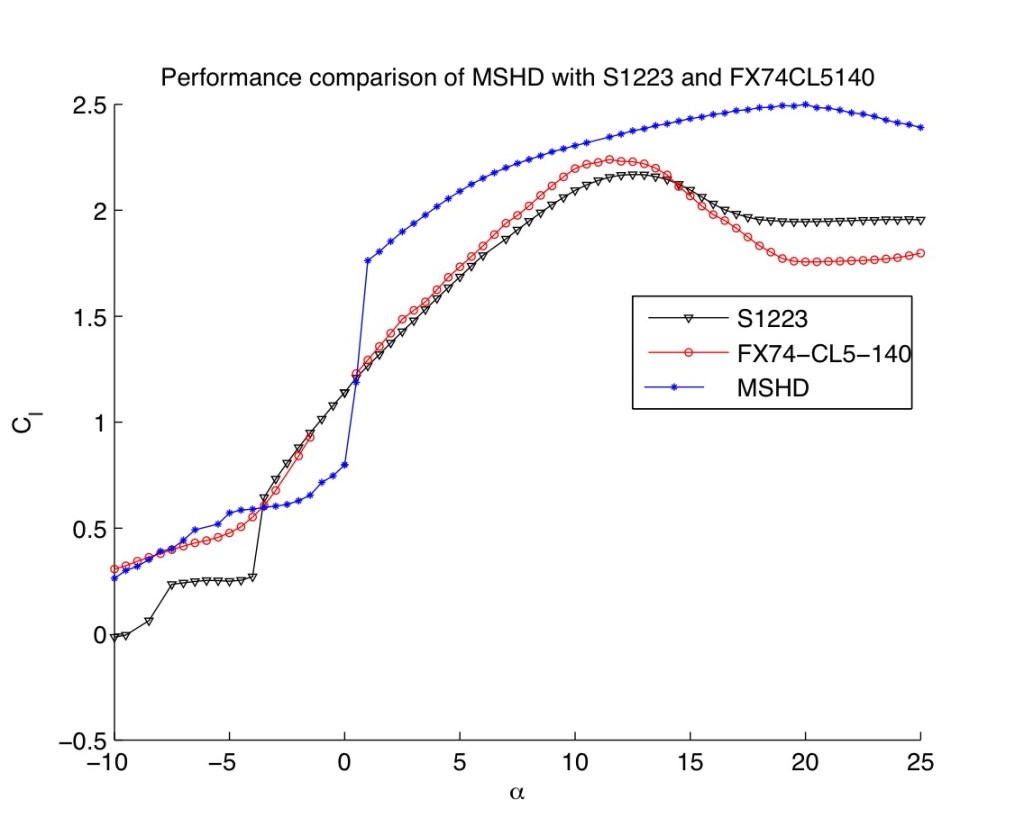
At 10-12 degrees AoA, which is where you’d set most wings for maximum downforce, there isn’t a lot of difference between MSHD and S1223. But at low angles or very high angles, the MSHD is in a class by itself.
It seemed too good to be true, so I had to build one, try it on my car, and test it in the wind tunnel. It outperformed my homemade S1223, a Procar Innovations wing (Benzing 183-185), and a 9 Lives Racing wing (Benzing 123-125). These results are in my first wind tunnel report.
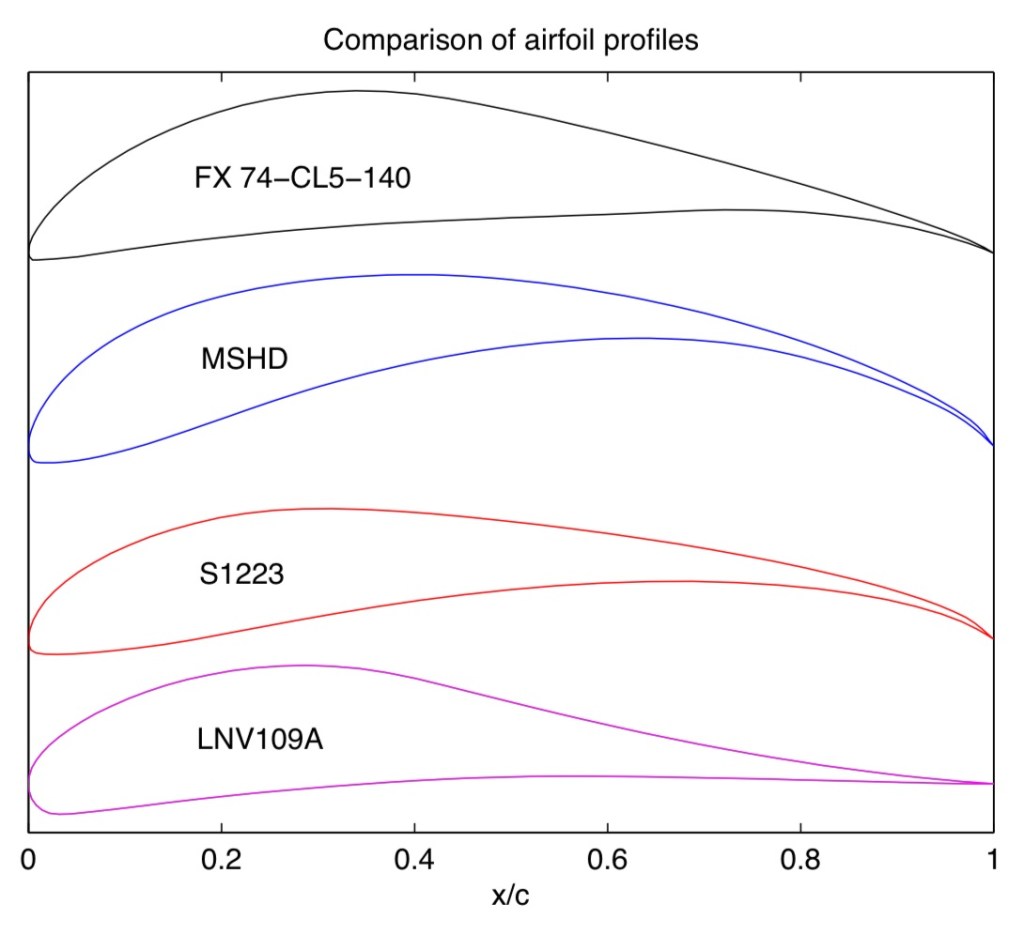
The shape of the MSHD looks a lot like a Selig S1223, but with more camber, and an absolutely wicked trailing edge. The trailing edge was difficult for me to build in foam and fiberglass, as it’s nearly impossible to get the edge thin enough and still retain some strength. So I’m pretty sure the performance of my DIY wing could have been improved if I made it in some other material.
MSHD compared to some other wings, from Pakkam’s paper.
Carbon fiber is the best material, but is banned in series like Champcar, and can be prohibitively expensive. A better way to build this wing for the average club racer would be to extrude it out of aluminum. This would allow a very thin and strong trailing edge that closely follows the ideal geometry. And if mass produced, it could drive the price down to where even cheap bastards like myself would buy one, rather than DIY an inaccurate copy.
Wing Logic
So now that you know the backstory of why the MSHD is the motorsports airfoil of choice, let’s move onto the part of the story of how this wing gets mass produced. It starts with Michael Jui, an entrepreneur who was already doing stuff in motorsports. If you’ve ever shopped for a new helmet and sorted on lowest price, you’ll see Conquer helmets at the top of the list. Conquer is one of Michael’s companies, and embodies his philosophy: high quality at a low price.
Michael contacted me and asked if I could test his extruded aluminum Wing Logic wing in the wind tunnel. That information is here on my site in the article Wing Logic vs 9 Lives Racing, and also more in depth in my second wind tunnel report. In short, the Wing Logic wing did pretty well for being based on an airplane wing. But the 9 Lives Racing wing made the same downforce for less area, meaning it was more efficient and also weighed less. In the end I opined that the 9 Lives was their better choice if price was no object, but that Wing Logic was a fine wing for the budget conscious.
After that test, Michael and I got talking about a new car wing, and I suggested he build one using the MSHD shape. I advised that he should make 10” and 12” chord sizes. Alyssa Merrill, who does all my computer designing and 3D printing, sent Michael the CAD file we used to 3D-print Steve Leo’s foam wing. And with that, Michael’s engineer got started on the two wing designs.
Weighty decisions
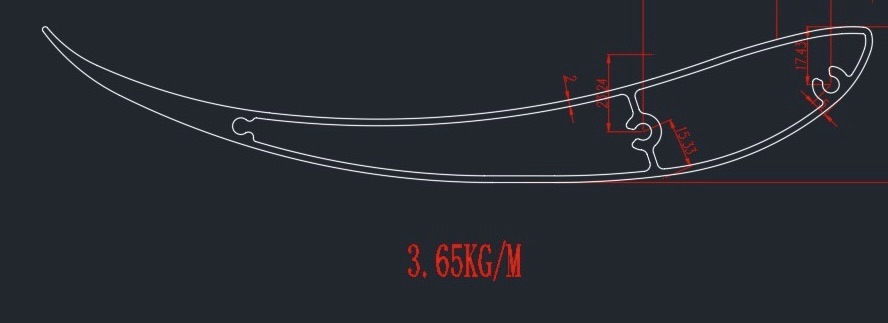
Michael sent me the engineer drawings for both the 250mm and 300mm wings. The larger wing was going to be almost 150% heavier, and I’m not sure how many people would want over 20 lbs high up above their car. The end result is that Michael has only the 250mm available at this time, and I think that was a good call.
Initial design of the 250mm (9.85”) chord.
Weight is an issue for aluminum wings, and so I asked Michael if he could have his engineer lighten it up and make it thinner? Not possible. The wing was already at the minimum thickness for making an aluminum extrusion. So I suggested reducing the number of end-plate bosses from four to three, and moving one of them to the rear of the wing. I also suggested removing one of the spars. This resulted in a minor weight savings of .166 kg per meter, or 1.785 ounces per foot.
On a typical 72” wing this is only a savings of 11 ounces. But as the saying goes, if you concentrate on the ounces, the pounds take care of themselves. Also, the location of that weight is important, as wings are typically the furthest distance from the center of gravity.
My tweaks included removing two bosses and one spar. The end result is less weight and wider support for the end plates.
I also felt the endplates on his original wing were too heavy. At 10” x 5.5”, there’s very little flex to them, and so there’s no need for such a heavy endplate. Thickness was originally around 9 gauge, and is now about 13 gauge, which is a savings of 7.3 ounces.
The Wing Logic endplates are rather small compared to what you see on most wings, and you might wonder how they perform. In my 2nd wind tunnel report I tested the standard Wing Logic endplate versus larger endplates, and the results were about even. There was slightly more downforce and drag for the larger endplates, and slightly less from the smaller ones. But the overall efficiency of the car remained about the same with both, and so small endplates are just fine.
Another decision not to be taken lightly is whether or not to put a Gurney flap on the wing. 9 Lives Racing has a slot in the trailing edge of the wing for a Gurney flap, and I advised specifically against this. The problem is that this adds weight, but more significantly, it changes the rear geometry of the airfoil. If you compare a Be 123-125 airfoil with a 9 Lives, they are identical… except for the trailing edge, which is far too thick on the 9 Lives.
How much does this change the performance? I don’t know. But if the wing performed better with that thicker rear section, we’d see wings designed like that from the get-go, and we simply don’t.
The other way to do a Gurney flap is to mold it in. This is what Michael did on his original Wing Logic, adding a 1/4” Gurney flap as part of the extrusion. While this is economically efficient for the customer, I advised against doing that on the new wing.
First, because it’s just so easy to tape on a Gurney flap. The flap is on the pressure side of the wing, and so simply using duct tape to fasten it down makes for easy application of any size wicker. Some people may want to use double-sided 3M tape or rivets for peace of mind, and I can’t argue with that. I use 1/2” aluminum angle for a Gurney flap, and don’t mess with different heights. Changing wing angle has about the same effect as changing Gurney flap height, and so nobody really needs multiple sizes; a slot for a custom-sized Gurney flap is just more gimmicky and expensive shit I can do without.
The other reason not to mold in a Gurney flap is it can be trickier to set up it up as a dual element. Gurney flaps can absolutely be used in a multi-wing setup, but the wing overlap and gap distance become crucial and finicky variables. You can read about that elsewhere on this site, but rather than having a customer suffer those headaches, I suggested to leave the trailing edge sharp.
So you might be wondering, how does the MSHD behave as a dual element? The maximum coefficient of lift goes from 2.3-ish as a single element to almost 4 as a dual element. Yowza. Also, there’s a very soft or non-existent stall. So as good as this is as a single wing, it might be even more remarkable as a dual. (I have one set up for a dual element, but more on that in a future article.)
Dual element CL at 300k and 400k Reynolds. For a 250mm chord wing, this is about 38 and 50 mph, which is very slow; wings generally improve with higher speed, so this looks great.
Unboxing
It took a year from concept to reality which is probably a short development time, but it seemed like forever. The wing came really nicely packaged, with protective foam all around. My first thought upon unboxing it was “holy shit that’s a lot of camber.” My next thought was “good lord that’s a wicked trailing edge!” And then I thought, “man, this is pretty light.”
I haven’t been this excited since Xmas in my jammies.
The chord measures 250mm, or about 9-7/8”. Available lengths are 60”, 65”, 71”, 72”, and 74”. Most racing series limit wings to body width, but if you are unbound by rules, wider is better. If you race in a series that has a 701 square-inch limitation, you’ll want the 71” wing.
250mm chord. Or 9 7/8” ish.
End plates are included in the box, and as stated earlier, they are the same size and shape as the old endplates, just thinner. They aren’t pre-drilled, but there’s an included template for that. The M6 bolts are stainless button-head, and thread quite deeply into the end of the wings, which I appreciate. (For reference, 9 Lives uses four M5 bolts, PCI uses two M8.)
Bottom mounts are included, but the holes are oddly large. I typically use M6 hardware for wing mounts, but these are much larger. Which is fine I suppose, just different. But since I’m going to do some back-to-back testing, I made up my own mounts using a 9 Lives pattern.
Original undrilled Wing Logic mounts (top), new pre-drilled MSHD mounts, and DIY 9 Lives pattern mounts (bottom).
I’m sure someone wants to know what the Wing Logic MSHD looks like next to the industry standard 9 Lives wing. MSHD has more camber, and a much finer trailing edge.
9LR top, WL bottom.
I weighed the 65” Wing Logic MSHD with endplates and wing mounts and it came in at an even 14 lbs. The original 65” Wing Logic was 16.6 lbs, so this is a significant savings over the old wing. Incredibly, the 65” x 9.8” MSHD weighs even less than a 9 Lives Racing 64” x 9.2” wing, which came in at 14.6 lbs with the same mounts and endplates.
Now this is the older 9 Lives wing that I weighed, and what is now sold as the “Express” wing. 9 Lives Racing has a newer wing, which is the same shape but has been lighten somewhat. I don’t have one, and so I can’t compare the weight on that.
65” wing with endplates and wing mounts (before welding) is an even 14 lbs.
I have to say, it’s really satisfying to have the Wing Logic MSHD in my hands. My role in helping bring this to market was very minor, but I’m chuffed to have had any input in this, and to see it IRL
It’s bigger, lighter, and has more downforce than any other aluminum wing on the market. And it’s currently on sale for $350 in a 65” wing!
CFD
A lot of wings get developed, sold and evaluated based on CFD alone, which is a highly suspect practice. CFD is a tool to get you part of the way there, and you to need to follow up with a wind tunnel or track testing. That’s how the F1 teams do it.
Unverified CFD results in ridiculous claims of downforce and efficiency, and optimizations that show up in the computer world, but not in the real world. I’ll give you an example: I tested some CFD-designed endplates that were supposed to increase downforce and reduce drag over a standard rectangular endplate. But in the wind tunnel, the CFD designed ones were actually worse than a plain rectangle I cut out of a street sign. (This data is in my first wind tunnel report.) Moreover, I flipped the CFD endplates backwards to see what would happen; the data showed very small changes to drag and downforce, but the same overall performance. So whenever I see something that is developed and marketed completely from CFD, I distrust it.
However, I do trust the CFD from Kyle Forster, since his CFD models are much more accurate, and he puts the wing on a virtual car, rather than relying only on free stream simulations. I’m not going to delve into the computer stuff here, but if you’re wondering how the old vs new wings compare, Wing Logic published the full CFD comparison of the original Wing Logic versus the new MSHD.
Yes, this is a lot of downforce. No, I don’t know why 4 decimal places are required.
Note that the MSHD CFD data stops at 10 degrees AoA, and as you saw from the original thesis paper, the MSHD can be run at even higher angles. And so while these numbers look great on paper, I believe they can get even better.
Based on the CFD, and more importantly, the testing I’ve done on my own DIY MSHD, I fully expect the new Wing Logic to outperform every other wing I’ve tested, and relocate all my other wings to the recycling bin.
Track testing and wind tunnel
I’ll schedule wind tunnel time later this year, and will test the MSHD as a single and dual element. I have some different endplate ideas, and a few secrets I’m not sharing yet that could be game changers. Subscribe to the blog, you don’t want to miss that.
I’ll also be track testing the wing on a few occasions. I’m racing with Lucky Dog at PittRace and will be able to A/B test the MSHD vs 9 Lives wings on the Miata I took to the wind tunnel. So that will be great to get real world data that I can use to compare with the wind tunnel data. And I have some other track tests scheduled for Watkins Glen and Pineview, before going back to PittRace one more time (the final time, ever).
In a previous article I examined Veloster N Cooling and Hood Vents. I bought a fiberglass hood with an extractor vent, modified the vent to be larger, and then tested that on track and in a wind tunnel. The results were great, with up to a 10-degree drop in water and oil temperature, reduced aero drag, and increased downforce.
That car was totaled, and now my new car needs hood vents. But this time I decided to install Race Louvers in the original hood, rather than use a fiberglass hood. The reasons for that are two-fold: I always felt like the black hood was a bit too boy-racer (boi ricer?) for me; Race Louvers makes the best performing hood vents in the industry.
I know that because Race Louvers publishes their test data publicly, and they’ve tried just about everything. I’ve also tested my own vents and others in the same wind tunnel, and Race Louvers make more downforce every time.
So I contacted Al Watson from Race Louvers and begged him for a deal. “I’ll put stickers on my car,” I whined. “I’ll write an article on my site,” I pleaded. His reply was something to the effect of, “Enh, don’t worry about it, I saw that your car got wrecked, I’ll send you whatever you want.”
No fucking way. Thanks Al.
We discussed which Veloster louvers on his site would work best on my car, and I confess I didn’t realize there was more to it than I thought. We decided on a center vent alone, because using the center and sides, or the new fancy CF Extreme louvers might actually be too much area. Two days later I had the louvers in hands.
Installing Race Louvers
The first thing you need to do is measure the distance from the front of the hood to the louvre opening. This should be directly behind the radiator. In the case of the Veloster, this is just about 10” to the back of the fan shroud.
Measure from the front of the hood to the rear of the radiator.
Next I used blue painters tape and a sharpie to draw two lines 10” back from each side. Because the hood is contoured, I used a thin piece of wood as a straight edge.
Next I connected the two sides and drew a line between them. This would be the front of the vent.
Center line and front edge scribed on blue tape.
Next I used the full-sized template to draw cut lines on the hood.
I then masked off the area some more to protect the hood when I cut it. Now I was ready to make the first cut. I used a grinder with a cutoff wheel to make the initial rectangle, but a jig saw was necessary to make the final cuts in the outside corners.
A cutting wheel makes fast work of this job.
Next I test-fitted the louvers and found some unsightly gaps in the hood. If you look from the side, you can see the support webbing layers. On a race car I wouldn’t care, but on a dual duty track car, I felt this looked sloppy.
Notice the bare sheet metal below my fingers. Yuck.
I figured if I put some aluminum flashing here, with a 90-degree bend on it, this would cover the side gaps. I don’t think there’s any performance gained here, this was just an aesthetic thing.
Aluminum flashing test fit, before trimming.
I made four pieces.
With that done, I could finally rivet the louvers into place.
Louvers installed.
From the side, you can see the aluminum flashing covers up those side gaps nicely.
Hey down there!
I did the whole operation without removing the insulation under the hood.
Hey up there!
I haven’t tested the louvers yet, but I’m betting they work slightly better than my FRP vent did. The total area on the Race Louvers is 158 square inches, which is 17% larger than what I tested in the wind tunnel. In addition, the louvers should add some differential pressure that should aid in both front downforce and heat extraction.
From start to finish this is about a 2-hour job, and was a fine way to spend a Saturday morning. Next I’ll make a custom cover for it, to keep leaves and water out of the engine bay. But autumn is a month away yet, and there’s a Hayabusa swap calling my name.