In a previous article, I go over the origin story of the MSHD, and the minor role I played in getting this wing to market. I have no financial relationship with Wing-Logic, and only met the owner Michael Jui last week, when I invited him to come to the wind tunnel to test his wing.
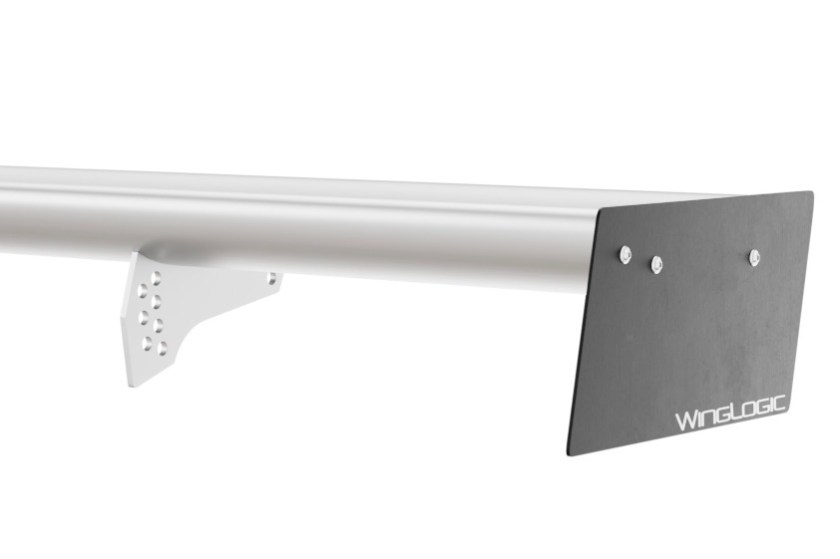
Wind tunnel testing is important because it’s real, accurate, and measures the entire vehicle. You see a lot of companies using CFD alone, often in free stream (not the entire vehicle), which is often misused as a marketing gimmick.
Professional race teams develop in CFD, but they struggle to get within 10% of reality. They then use wind tunnel and track testing to verify CFD. That’s because CFD is just a computer calculation. The simulation gets better and better with feedback from the real world, but if you’re not putting real data back into the feedback loop, CFD results in colorful pictures, wild claims, and aero balance figures that are laughably incorrect.
I don’t do CFD. I do track testing and wind tunnel testing. Only. There are enough people publishing CFD, and not enough doing wind tunnel testing, so I’ll keep doing the harder work.
At this point I’ve tested 40-ish car/wing combinations in the wind tunnel, including Pro Car Innovations (55”, 68”), 9 Lives Racing single (55”, 64”, 68”, 72”), and dual wing (64”, 72”), Wing Logic original (70”), APR GTC 250 (61”), S1223 (54×11), 3D MSHD 500 sq-in (63”), GLTC 250 sq-in, lots of my own DIY wings, and a few others that are sworn to secrecy. So getting the MSHD tested and compared against this database of knowledge was important.
I brought three Wing-Logic MSHD wings for testing: 71”, 68”, and 64”. I tested both bottom mounts and swan necks, and put 10 different endplates on them. The 64” wing is set up to be used as both a single wing and a dual wing so that I could test that as well. I’d put these wings on my Veloster N and a first gen BRZ, and get not only the data, but apples to apples comparison with other wings.
| If you’re wondering who pays for these wind tunnel tests, I do. It’s insanely expensive, and the only way I can offset the expense is by taking donations. There are no annoying adds or popups on my site, because you don’t like them either. Please consider buying me a coffee, which supports this and future wind tunnel tests. |
MSHD airfoil
MSHD stands for Motor Sports High Downforce and that’s what it was designed for. It has more camber and thickness than airfoils developed for aviation.
Which makes sense. A wing should be designed for a particular application and speed. Cars are not airplanes, and so putting an airplane wing on a car makes about as much sense as putting a car wing on an airplane.
As a motorsports airfoil, the MSHD needed to be useful not only as a rear wing, but also as a front wing (taking advantage of ground effect), and as a dual element. But primarily it needed to work at lower Reynolds numbers, which means lower speeds and smaller wings (less chord).
Someone recently sent me an Instagram reel about the MSHD being only useful for low speeds, since it was developed for FSAE cars, with Reynolds numbers of 300K. Doing your aerodynamic research on social media is eating other people’s vomit, but I’ll address that nonsense right away.
- Just because a wing was designed to work at low Reynolds numbers doesn’t mean it won’t also perform well at higher Re. Go to Airfoil tools and look up all the low-Reynolds high-lift wings and notice how they improve in efficiency the faster you go, even up to 2 million Re.
- The Wing-Logic MSHD has a 250mm chord, and 300K Re calculates to about 38 mph (61 kph). The A2 wind tunnel operates at 85 mph, which is around 680K Reynolds. So if the MSHD works well at over 225% of its designed speed (it did), rest assured that it will work at whatever speed your car goes (it will).
- And finally, if you need a wing for FSAE or autocross, then this is your guy.
MSHD vs 9 Lives and PCI
Probably what most people want to know is, how does the MSHD compare to industry standards, like the 9 Lives Racing Big Wang and Pro Car Innvoations (PCI) wing? So let’s start right off with comparisons. To even the playing field, all of the wings were tested with the same endplates, and not the ones that come in the box.
| Note that for all of the data that follows, I use 100 mph as the reference speed. This is lower than many manufacturers use, because people like large numbers. But I feel this is a more realistic speed, at least for my audience. For simplicity, I measure wing angle from the horizontal. But note that air comes down the rear window at an angle, usually around 5-7 degrees, such that a zero degree setting is actually 5-7 degrees angle of attack. Most wings will stall at over 12 degrees, and so I usually stop at about 5-6 degrees from the horizontal. Obviously the shape of the car, and the location of the wing (height and setback distance), also change the angle of incidence, and unless you know those exactly for every car, measuring from the horizontal is just a heck of a lot easier. |
First I tested a 64″ MSHD versus a 64″ 9 Lives Racing Big Wang. This is their original wing, which is now sold as the Express. I put these on my Veloster, which doesn’t work particularly well with wings, so it’s a great worst-case scenario.
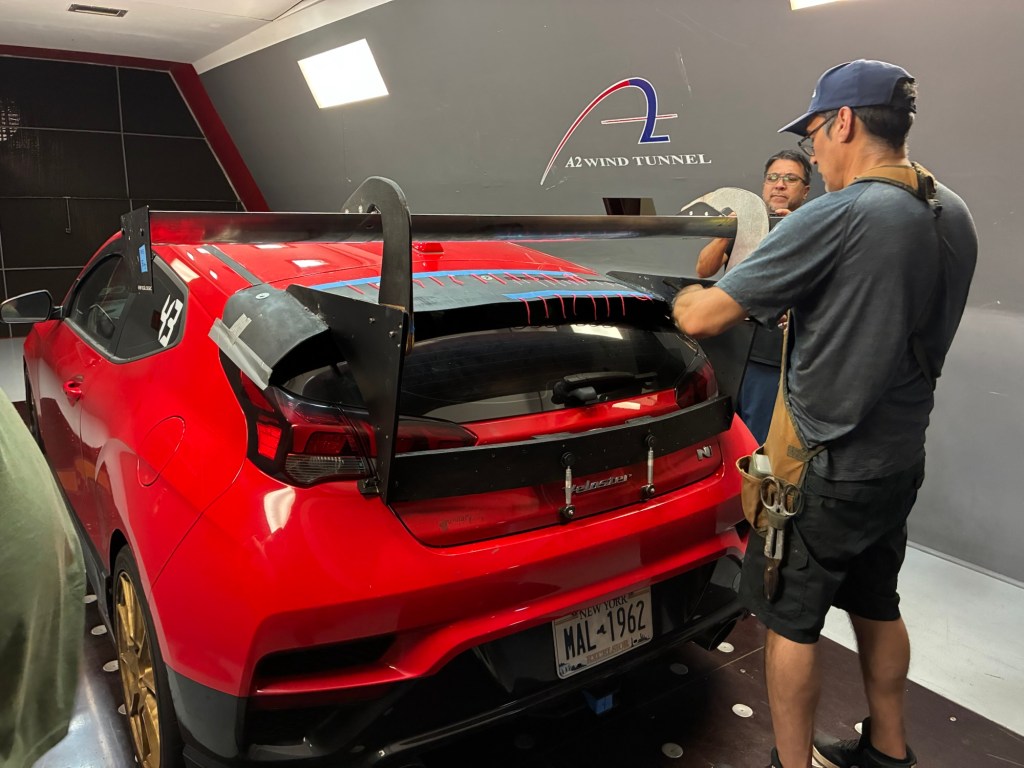
In the following table I list both the L/D ratio of the wing itself, and also the L/D ratio of the entire vehicle. This is an important distinction, because an ultra efficient wing that doesn’t make a lot of downforce won’t influence the overall aerodynamics of the car. It’s far more important to make a lot of downforce, which results in the vehicle having a better L/D. In the end, this is what matters.
Also, if you’ve read my other articles you may have noticed the L/D ratio of the wing is different every time. That’s because the shape of the vehicle has a lot of influence on the performance of the wing. The same wing on my hatchback might be 4:1 L/D, while on a Miata it might be 10:1, and on a 8th gen Civic Si, a magical 25:1. That’s yet another reason why looking at the L/D of the wing is less important, and what really matters is the aerodynamic efficiency of the entire vehicle.
| Wing | Downforce | Drag | L/D wing | L/D car |
| 9LR 0-deg | 130.9 | 30.2 | 4.334 | .53 |
| 9LR 5-deg | 157.6 | 38.3 | 4.116 | .61 |
| MSHD 0 | 148.4 | 37.5 | 3.961 | .58 |
| MSHD 5 | 191.1 | 49.2 | 3.884 | .72 |
| MSHD 9 | 210.5 | 57.7 | 3.651 | .76 |
As you can see, the 9 Lives Racing wing is more efficient, in the sense that it has less drag for the downforce that it produces. However, the MSHD makes significantly more downforce, and results in a better L/D ratio of the entire car.
Next I compared a 68” MSHD vs a 68” PCI on Raul’s first gen BRZ/FRS/86. This is a properly shaped fastback and a better test of rear aero.
| Wing | Downforce | Drag | L/D wing | L/D car |
| PCI 0-deg | 150.6 | 21.7 | 6.95 | .57 |
| PCI 6-deg | 170.1 | 25.8 | 6.60 | .7 |
| MSHD 6-deg | 191.7 | 28 | 6.85 | .78 |
On the BRZ we only ran the MSHD at 6 degrees, to match the high-downforce setting of the PCI wing. Again, you can see the MSHD results in a better L/D of the vehicle, and surprisingly the MSHD wing itself is also more efficient than the PCI at the same 6 degrees.
(If you’re wondering how a 9LR and PCI compare, see my first wind tunnel report, they were quite similar.)
Isn’t this just about more chord?
The Wing-Logic MSHD measures 250mm chord, which is 106.5% more chord than the 9 Lives wing, and 113% more than the PCI. If we just scaled up the 9LR and PCI to the same chord, wouldn’t they perform better, and maybe even beat the MSHD?
Possibly. For sure more chord is better, it means you can a) make the same amount of downforce with less wing angle, and b) wings are more efficient at higher speeds or larger chords (which are essentially the same thing), and so a wing with more chord is more better.
But one thing that sets the MSHD apart from really any other wing I’ve tested is that it can be set to absurd angles of attack. This is why we tried the 9-degree setting, and even at that, the wing wasn’t stalling yet. It’s likely that with a Gurney flap, we could have gone to 12 degrees or more. Which is crazy, because the roofline itself is adding 5-7 degrees to the wing angle.
But that’s one of the great things about the MSHD shape, is that it can use aggressive angles of attack. The wing won’t be especially efficient at high AoA settings, but it does mean you don’t necessarily need a 3D wing.
3D shapes, or twisted wings, are made so that the center of the wing doesn’t stall. This is because the air coming down the middle of the wing is effectively at a greater angle of attack than the air on the sides of the car. Twisting the ends down means the entire wing is at the same angle of attack. However, you can use a 2D MSHD wing and the center still won’t stall, getting much of the benefit of a 3D wing.
MSHD single vs a dual element wing?
Wing-Logic’s Michael Jui wondered out loud how his MSHD would compare to a 9 Lives dual element. I told him that the dual element has more chord and camber, and so there’s no way they can compete against each other. But for shits and grins, I’ll combine a couple data points from the wind tunnel to see how close we can get.
For comparison sake, I’ll use a 9 Lives dual element using standard bottom mounts, with the main wing set to zero degrees and the upper element to 35 degrees. This is about the maximum downforce setting, and very hard to beat.
For the Wing-Logic, I’ll use swan neck wing mounts, a 1/2″ Gurney flap, and set the wing to 5 degrees. (It would have been better to use 9-degrees AoA, but I didn’t run that angle with the Gurney flap, and I don’t want to guess at the values.)
| Wing | Downforce lbs | Drag lbs |
| 9 Lives dual, 0/35 | 284.2 | 76.4 |
| MSHD swan, 5-deg | 250.1 | 70.8 |
You can see the MSHD single falls short of the 9 Lives dual element by 34 lbs of downforce, but it also makes less drag. So the 9LR dual element is clearly superior to a MSHD single element for outright downforce, but I’m surprised how close the MSHD got. And I wonder about a higher angle of attack, and using higher downforce endplates (you can read about that in my next article, Time Attack endplates closed the gap to just 18 lbs between MSHD single and 9LR dual).
So the next obvious question is, what about using the MSHD as a dual element?
MSHD dual element
I already wrote up an article on how I built a MSHD dual element, and so click over there if you want the backstory. The upper element is eBay crap I cobbled together, and not a great wing. Nevertheless, the MSHD dual element worked great.
| ng | Downforce lbs | Drag lbs | Car L/D |
| 9 Lives dual, 0/35 | 284.2 | 76.4 | .97 |
| MSHD dual 0/30 | 314.0 | 97.0 | 1.00 |
| MSHD dual 5/35 | 331.3 | 111.2 | 1.01 |
That’s a lot of downforce, especially in the 5-degree setting, and also a lot of drag. For an autocross or low-speed track, where downforce matters and drag doesn’t, this would be pretty awesome. Michael Jui was so impressed by the results that he’s planning on making a proper MSHD extrusion for the upper element. More on that in the future.
Conclusion
I have no financial relationship with Wing-Logic, but I wish I did. Compared to the original Wing-Logic, the MSHD makes more downforce, even without the built-in Gurney flap of the original wing. The MSHD is also significantly lighter than the original wing, and a better product at the same price.
At the same length, the MSHD makes more downforce than any other aluminum wing I’ve tested. The end result is that a car with a Wing-Logic MSHD will have a higher aerodynamic efficiency than with any other wing. (I’m not including carbon fiber wings with 12+” chord, as that’s a different playing field, and market).
When I graph the downforce and drag of the MSHD at different angles of attack, and then compare the resulting vehicle lift-drag ratio with other wings, it’s clear that the MSHD results in better vehicle efficiency at all angles. Equally important, the MSHD allows you to use a higher angle of attack than any other wing, which obviates the need for a 3D wing. With a swan neck wing mount and a Gurney flap, the MSHD isn’t that far off the maximum setting for a dual wing, although I have to admit I’m looking forward to a proper dual element as well.
I tested a bunch of endplates and Gurney flaps on this wing, and I’ll get around to posting those results sometime soon. I’m also putting the dual-element on a Lancer EvoX for some real-world track testing. But stop reading now and jump over to Wing-Logic. Michael tells me he sold out his last shipment quickly, and I expect the latest batch to go fast as well.


Great data Mario,
I have a question on canard fences that you briefly discussed. I have a pair I made and has rather large fences. Was there an optimum size you found?
Cheers Reuben
>
LikeLike
Canards are so variable, with no standardization in size, angle, location, and shape… and then there’s the shape of the car itself. I could advise you on the height of the edge and it would be the least important variable. Email me asome pictures. mario.korf@gmail.com.
LikeLike
Excellent, ive been waiting for this test :). Thanks for addressing that IG dude, I tried to discuss that in his post without much sucess. Will there be some more wind tunnel data in a report or will you put it in articles here in the blog?
LikeLike
Thank you for the wind tunnel test, and for addressing that reel as well, this solidifies my decision to go with an MSHD. On a side note, I noticed on the earlier tests with the 9LR, the L/D ratio was closer to 10, is there a reason why it changed from test to test? Sorry for the very amateur question
LikeLike
The L/D ratio of wings has more to do with the car it’s attached to than the airfoil. The same wing on my hatchback is 4:1, on a Miata is 10:1, and a Civic Si is 25:1.
Don’t think about the L/D ratio of the wing, it’s all about the L/D ratio of the vehicle with wing attached.
LikeLike
Oh I see, I didn’t realize there was that much variability between cars. Thank you for the explanation!
LikeLike
Great stuff, Mario.
LikeLike