Driving Other People’s Cars in 2020

I was lucky to be able to drive a lot of other people’s cars this year.

I have Aim Solo data for most of these, as well. For each car I’ll give my quick thoughts on what I liked and didn’t like, and then go into a longer description. At the end I’ll put up a chart with lap times and other stats for comparison.

BMW Z3

What I liked: Great torque, soft rev limiter
What I didn’t like: Unsupportive seats, shift knob falls off

Pineview owns a 1998 Z3 with a hard top, which is used for rentals and instruction. It has all-season tires, which are slow but a lot of fun. The seats suck. The shift knob fell off twice, once at my feet (I found and put it back while at speed), and a lap later it went to the small of my back, where I left it as a lumbar support. The seats suck.

The Aim data shows this car has the same acceleration as my 1.6 Miata, and both cars have similar lap times on all-seasons. But the Z3 is softer everywhere, and has a lot of body roll. It’s a pity Pineview doesn’t have a spare set of wheels with good tires, because on RS4s, this car should be able to do a 1:16.

BMW 128i

What I liked: Snug cockpit, holds 4 tires, lots of power
What I didn’t like: Light switch power delivery

Napp Motorsports has a youtube channel where they test cars and build things, and in one of their episodes they got to track test Andrew Johnson’s modified BMW 128i at Pineview Run. I was there that day, and they were nice enough to let me try it.

Andrew’s modification list is long and includes swapped parts from other BMWs and the end result is a lot more power. As in 250 wheel horsepower . Andrew also added some kind of fancy diff. I don’t think it’s a Torsen or a clutch pack, but maybe some weird combination of the two. I’ve never driven a car that hooked up so immediately. I didn’t like it.

I don’t know if it was the diff or the power delivery, but this was the most difficult car I drove this year, it plowed into corners with understeer, and as soon as I got on the throttle it transitioned to massive oversteer. I like to play with throttle modulation, but this car’s power delivery is a light switch; on or off. I only did a few laps, and I had to completely change my driving style in order to get in a good lap. Stephan is a good driver, and also struggled to put in a good lap, so it wasn’t just me.

There’s a lot of potential in this car, and with a softer hit on the bottom, and maybe tuning the diff (or fuck it, an open diff), it would have been a lot faster. Maybe at other tracks it’s perfect, but at Pineview it was a handful. Weirdly, this is on the short list of cars I’d buy tomorrow. The cockpit is super nice, the seats fold down to hold four track tires, and 128s are a used car bargain.

Ford Focus RS

What I liked: 4WD and lots of power
What I didn’t like:
Felt like FWD

Steve Wilson’s Focus RS is a good looking car with rally roots. I like virtually everything about it, except it behaves a bit too much like a FWD car. There are different modes, such as Sport, Track, and Drift, and I drove it in the Track mode.

I only did three hot laps because when I drove by Start/Finish, I noticed Steve had both of his hands up to his head, like he was freaking out that I was going to crash it. But I think he was actually taking video on his phone, and I misinterpreted the gesture. Alas, three laps is enough to get to know most cars, and I set a decent lap.

For sure the car needs more camber, and the RE71Rs were just about spent, and had already been flipped once, so that didn’t help. I’d like to spend more time in the car to figure out how to rotate it. I got it to pivot on the nose once and it felt brilliant. If Steve lets me try it again I’ll throw it in Drift mode and see if I can drive it like a rally car. Either that or put some harder tires on the rear.

Steve and I looked at the Aim data, and if we combine the parts of the track where he’s fast with where I’m fast, this car is capable of doing 15s for sure.

Honda S2000 AP2

What I liked: Honda-ness, cockpit
What I didn’t like: Lack of torque

Melody and a couple friends came to Pineview to do an autocross experiment, and while we won’t be doing autocross at Pineview, we had a great time messing around in cars. I got to try Melody’s AP2, and loved it. Mostly.

I’m a Honda guy. My first motorcycle was a Honda, most of my cars have been Hondas, and I will probably have more Honda motorcycles and cars in the future. So it’s pretty hard to disappoint me in a Honda.

And yet while the car is Honda-perfect, the engine is a little disappointing. Even this longer stroke version that’s supposed to have more torque, well, doesn’t. The VTEC has a wonderful hit, but it happens so late in the game. In hindsight, I should have used 1st gear at least in the S-trap. At some other track I would be singing its praises, but not at Pineview. This car would be a predator at Watkins Glen. At Pineview, it’s prey.

Hyundai Veloster N

What I liked: Everything
What I didn’t like: 19″ wheels

I drove two Veloster Ns this year, Chris Gailey’s and Philip Milligan’s. I have Aim data for both, and they are similar, but not the same. This might because of the different driving modes you can program. I don’t recall what I used in Chris’ car but in Philip’s I told him “turn everything off.”

In hindsight, I should have left rev matching on. Not that you get out of shape by downshifting a FWD car, but it’s such a cool feature and it pleasantly surprises me every time the engine blips automatically right before I throw it in the gate.

The motor is a mass of torque, and it tempts you to short shift and ride the rising boost, rather than spin it to redline. In fact I created a Veloster in OptimumLap, and it also short shifts in the computer world. So don’t rev it, ride the wave.

I’ve driven 4WD cars that felt more like a FWD car than the Veloster. I’ve driven RWD cars that felt more like a FWD car than the Veloster! Mash the throttle in the corner and of course it understeers, but if you trail brake on corner entry and transition to throttle, it’s very neutral. The power, the balance, the shifting, this is as complete of a package as I’ve driven in a FWD car.

If I was going to buy a new car tomorrow I’d buy a Veloster N. This is coming from a Miata guy who was teetering on quitting racing and buying a ND2. Yeah, the Veloster is that good. I would roll the fenders flat and fit the widest 18″ wheels and tires that would fit, add a splitter and a wing, and fucking dominate.

NA Miata

What I liked: Miata everything
What I didn’t like: Miata power

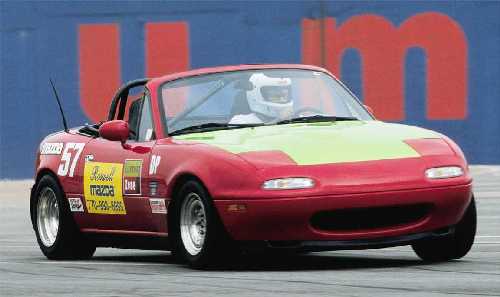
I have two NA Miatas, my cammed NA6 and my NA8 race car. They put out about the same power and both are solid little cars. When I jump in another NA Miata, I pretty much know what to expect. Sahir’s NA Miata has Vmaxx coilovers and 225 RS4s, and I had a good idea how it would handle. Which is why I found his NA8 a bit puzzling.

It was loose. Not just in the sense that it oversteered, but it also felt disconnected, and had more roll than it should have. On the first lap I spun the rear wheels in the Toe, T9 (the uphill 180 left) and in the S-trap. On the plus side, there wasn’t a lot of power, so the oversteer was easy to manage. In fact I probably made it through the S-trap faster in his car than mine.

But my overall sense was that this was a car that wasn’t quite the sum of its parts. Maybe it needs new suspension bushings, a stiffer front bar, an alignment, or shock adjustments, I don’t know. I managed a decent lap time driving around the problems (faster than I did in the K-Miata, ahem), but when this car is sorted, it’s a PV Cup class C4 killer. Oh wait, it already won that class. Class C3 beckons.

NB1 Miatas

What I liked: NB > NA
What I didn’t like: NB > NA

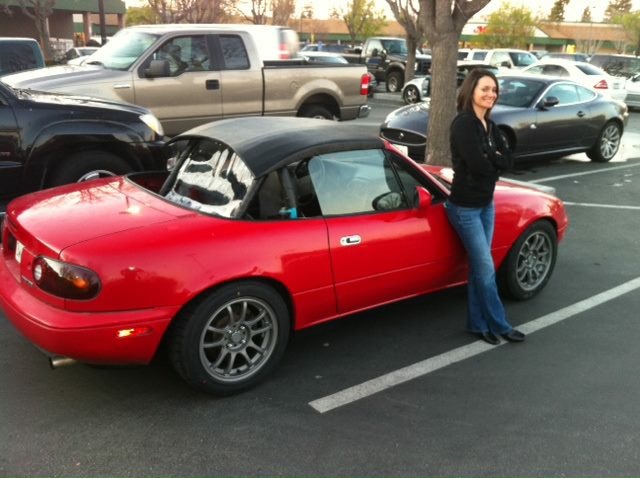
I was lucky to drive three different NB1 Miatas this year, from Davey, Clayton, and Alyssa. NBs are better cars than NAs, and if I was building a dedicated track Miata, I’d start with a NB. I have two NAs, and it’s taken me a while (and some tears) to come around to admitting this.

Davey’s Miata has stock suspension because he also uses it for ice racing, and ice is super bumpy. Therefore, his car lacks a bit of speed and grip compared to other track-modified Miatas. But it’s really fun to drive and reminds me that a stock Miata is a wonderful thing. I forgot what lap times I ran in his car, maybe low 21s? But by the end of the season Davey was doing low 20s on well worn VR1s.

Clayton’s NB1 is a bit more modified, with some bolt on performance, Tokiko shocks, and FM dual-duty spring rates and sways. When I drove it the alignment wasn’t fully sorted out, but it felt exactly like a NB should.

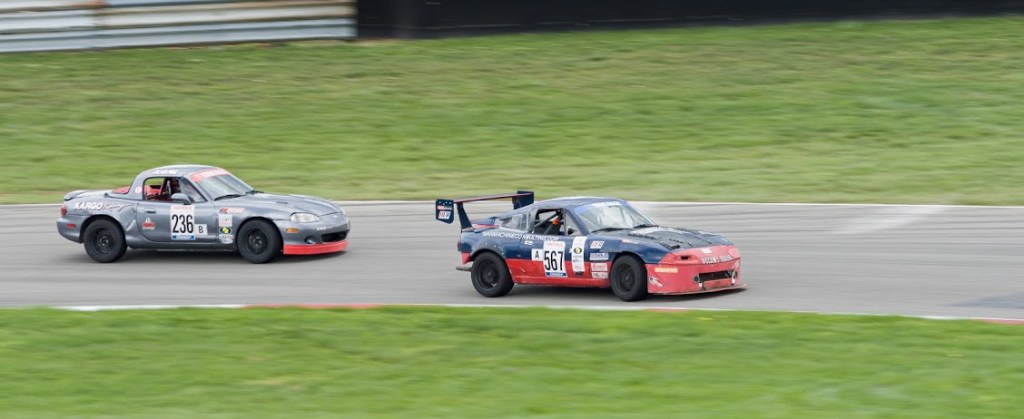
Alyssa Merrill’s NB1 is the quintessential budget Miata track car. It has Delrin bushings, Blisteins, 800/500 springs, 15×9 wheels, 245 RS4 tires, a chin airdam, splitter, and 9LR wing. The motor has the usual bolt ons, but still a stock ECU.

The interior is gutted and it has a race seat bolted down, and this was my only problem with it, I couldn’t adjust the seat or heel-toe shift. This isn’t entirely why I was 1 second slower than Alyssa, but I will hang onto every excuse I’ve got. I recall I did a low 16 that day, to her low 15. Later that year she’d do a 1:14.580 and move the goal posts to the near impossible.

Alyssa’s car is also a rolling laboratory, with sensors for wheel speed, throttle, and brake, with all that going through a 5 hz GPS device tracking the usual variables. There isn’t a better track-sorted Miata that’s been to Pineview, and she hasn’t really gotten around to the motor yet. Fawk.

K-Miata

What I liked: It’s a Miata
What I didn’t like: I wanted more from the engine and tires

Stephan Napp’s K-Miata was disappointing. It dynoed at almost 200 hp on Rick Gifford’s Land and Sea dyno (which reads like a Mustang) and on a Dynjoet this would be about 220 hp. That’s a lot of power for a Miata, and so it better have good tires. And it did: 225 Rival 1.5 S. I forgot what it’s got for suspension, maybe Xidas? It’s not lacking in any specification.

If you’d asked me before I tried this car, I would say the car should be doing 1:15s. I created a model of this car in OptimumLap and the computer says it should do a 1:15.32. And yet I could only get within 2.5 seconds of this time. What gives?

For one, I didn’t like the tires. I looked at data, and the peak Gs are great, they generated more grip than RS4s, which are my benchmark tires. But the Rival 1.5 S just doesn’t work with my driving style I guess. Alyssa or Josh might get a lot more out of the these tires, but I lacked confidence and couldn’t adjust.

I also didn’t love the engine: VTEC on top, nothing down low. Just when I got into the power I had to jump on the brakes. Like Melody’s S2000, this car might be awesome on a big track, but at Pineview, it’s a scalp for the taking. To put a point on this, both Stephan and I drove my 1.6 Miata about a second faster than we each drove his K-Miata. So this wasn’t a case of car familiarity, or lack thereof.

Stephan is boosting his K-Miata over the winter, and that’ll help the torque curve a lot. I’d like to get this back to Pineview, preferably on a different tire (I have lots, borrow mine!), and put this car into the 14s.

VVT Swapped NA Miata

What I liked: Best Miata motor ever
What I didn’t like: (this space intentionally left blank)

This car started as a 1.6, got a NA8 swap, and then later a VVT swap. The head is decked, ports cleaned up, standalone ECU, custom exhaust etc. It made 135 hp on Rick’s dyno (150 Dynojet), with lots of torque down low.

This is hands-down the best Miata motor I’ve ever driven. Instant throttle response, very tractable power, and perfectly suited to the Miata chassis. I don’t think a Miata needs (or wants) more power than this. When I look at the Aim data, the VVT has the same acceleration off the corners as the K-Miata, and if these two cars were on equal tires, my money is on the VVT, despite being down 70 hp.

Unfortunately they weren’t on equal tires, Dylan was running on S.Drives. I drove that tire all last year for giggles, and it makes nice noises, slides well, but doesn’t set very good lap times. We later fit some 8-year old Z214s to Dylan’s car and he went .5 seconds faster than he did when driving Stephan’s K-Miata. Not apples to apples, but there you have it, the VVT was faster than the K-Miata with the same driver.

Stephan obviously knows the recipe for a great VVT motor, and can make another one just like it. Anyone looking for an ideal Miata motor should get in touch with Napp Motorsports and specify the same build. I hear that Dylan is boosting his car this winter, and it won’t surprise me if it goes slower around Pineview afterwards. But he’s a street guy, and I’m a track guy, and so we have different priorities.

Mini R50

What I liked: Flickable, planted, sorted
What I didn’t like: Acceleration

When I met my wife she had a Mini Cooper S with sport suspension. It was love at first sight. So when Adam Gerken brought his Mini R50 to Pineview, I begged for a drive in it.

Adam did a lot of sensible upgrades, like later model aluminum control arms, brakes, some weight loss, and RE71Rs. I believe the motor was untouched, or at least if felt it. Yeah, slow. On the street it might feel peppy, but on the track it could hardly get out of its own way.

And that’s why it’s surprising to me how much I enjoyed it. In fact, I almost bought it! The steering is quick and precise, with a darty lively feel that people always say is like a go-kart, but I find it more like a Miata. Through the Knuckle I could lean on the power all I wanted and it was planted, without a hint of understeer. The brakes were strong, it shifted great, and the whole experience put a huge smile on my face.

For fun factor, this car was the biggest surprise for me, and I’ve been looking at R53s since (no sunroof, LSD, 20004 +).

Porsche Boxster 3.0

What I liked: Solid torque, solid chassis
What I didn’t like: Care and feeding

Dieter was there for the autocross testing day and let me drive his baby. Compared to Melody’s S2000 it felt torquey, more planted, and faster everywhere except the end of the straights. I didn’t have my Aim Solo in the car, and we were running an abbreviated track with cones, so it wouldn’t have mattered anyway. But in back-to-back testing, the Boxster was faster than the S2000. I really liked the Boxster, thanks Dieter!

Used Boxsters are cheap now, but I’m not in the market. Mostly I’m worried about maintenance and consumables. Oil changes, brake parts, and the other consumables are Porsche-money, and for a guy used to buying $20 rotors and $40 brake pads, uh-uh, no way.

Scion FRS, Supercharged

What I liked: Motor, chassis
What I didn’t like: Diff, shifter (v1)

Ronald Xheng has been really cool about me driving his car. I didn’t even drive other people’s cars much before this, but Ronald kept insisting I drive his, and this has led to me driving all the cars on this page. Thanks for getting the ball rolling Ron!

The first version of his car was a well tuned N/A making 190-ish hp, lots of weight reduction, good suspension bits, etc. I drove it on RS4s and it was pretty magical. People trackside could see my stupidly wide grin as I passed Start/Finish. Ron’s Aim Solo was in the car instead of mine, so I don’t have the data, but I believe I did mid 15s. There was a 14 in it, but I missed half the downshifts into 2nd.

If you pull the shifter all the way left, it gets caught in no-man’s land and won’t go in the gate for 2nd gear. Ron fixed that in V2 of his car, with an IRP shifter, which is short and buttery. He also got a clutch-style diff and a supercharger. I could take or leave the diff, and honestly the supercharger is a bit more power than I’m comfortable with, and I needed more laps, but then I broke an axle. Not my fault, this is the 3rd axle this car has broken.

Part of my lack of comfort was the Champiro SX2 tires, which I have no familiarity with. They are somewhere between a RS4 and ECS in grip, and start howling when you’re still thinking about corner entry. Lots of fun, and I could grow to like them, but I need more time, especially with the supercharger. Which is awesome. And I want one.

Toyota Yaris

What I liked: Familiarity of an old shoe
What I didn’t like: Speed of an old shoe

This was the first year in many years I didn’t race my brother’s Yaris. His is B-Spec prepared, handles well (if soft), but needs more power and a LSD.

I needed some FWD car data for the Pineview Cup, and so when I saw that Nick Dixon had just bought a Yaris, I asked him if we could test it at Pineview. Nick obliged, and the car came wisely shod on Conti ECS tires. I had a bunch of tires stored at Pineview, but the fenders weren’t rolled so only my 205 Toyo RRs on 15x7s fit it. For the most part the car felt like a Yaris (both good and bad), and handled better with the RRs, but it had issues.

The main problem was it kept cutting power out. I’d go through T2, ease off the brake and onto throttle, and then… nothing. It just fell flat on its face. If someone was close behind you, this is an accident waiting to happen. Nick later found out the problem was stability control, and when it engaged, you sat there for a full second while the ECU mulled things over. I’m not sure if it can be turned off or not, maybe there’s a fuse you can pull, but the car is miserable and unsafe on track with this feature on.

Volvo Wagon

What I liked: Turbo, 4WD, brakes
What I didn’t like: Sticky throttle, heavy, understeer

4000 pounds and a long wheelbase aren’t the recipe for going around Pineview quickly. But this Volvo wagon has the T5 turbo and 4WD, and puts the power down. It understeers a bit, and if it were my car I’d move the bias rearward with tire pressure, but The Family Truckster is fun as is.

The most disconcerting part was when I’d lift off the gas, the engine kept going! It’s only for half a second, but it makes transitioning from throttle to brakes a little weird. In a way, it’s like driving a Tesla for the first time, but you soon get used to it. By my second lap I had forgotten about this altogether and put in the necessary pause from throttle to brake.

The Firestone tires are every bit as good as people say they are, on par with Conti ECS in my book. They didn’t overheat despite the weight, and were predictable the whole session. The big Volvo also stopped really well, and overall handled better and was more fun than I thought it would be.

Summary Data

Here’s a summary of the cars I drove this year, with tires and lap times. I’ve included my 1.6 Miata on different tires, as a benchmark for performance.

86 Cup and Aero Options

If I didn’t have Miatas, I’d probably have a FRS/BRZ/GT86; similar philosophy, but in a coupe with better aero. My brother is thinking about a new car, and a 86 is on his list, so I thought I’d take this post out of the can and finish it. One of the reasons for owning this car would be to run it in the 86 Cup time trials, which seems like a cool series with a great rule set.

The 86 Cup rules has a Stock class, which allows you to take any modifications from an approved list. This is probably how I’d race one, but it doesn’t allow you to do much with aero. Since this is a website based on aero, let’s take a look at the aero options for the non-stock classes.

The rules allow you to modify the car, taking different amounts of points for each modification. The point total puts you into one of four different classes, which can result in different cars, with very individual builds. In the Street class, you’re allowed up to 4 points, in the Modified you get 7 points, and the Unlimited class is, well, unlimited.

PointsWhatNotes
.25Level 1 FrontAftermarket bumper, no splitter
.75Level 2 FrontSplitter, spats, canards, everything
.125CanardsQuack
.125Front spatsNot unless you increase track
.25Vented hoodWould help with splitter
.125FendersAftermarket or vented
.125Cut rear bumperPoor man’s diffuser
.25Level 1 DiffuserStarts behind rear axle
.5Level 2 DiffuserStarts in front of rear axle (but how far?)
0Underbody panelsAny year OEM underbody panels
.125Vortex generatorsPlease no
0OEM spoilerAny year OK
.25SpoilerAny non-OEM spoiler
1Level 1 wingUp to 55″ wide, 8″ stands
1.5Level 2 wingUp to 57.5″ wide, 10″ stands
1.75Level 3 wingAnything goes, I guess
Aero options in 86 Cup

That’s a lot of options to choose from. How do I think they stack up?

Front end

The aftermarket has turned out some interesting BRZ/FRS bumpers, but without an undertray and splitter (and hood vents if you’re doing those), I’m not sure any of them are better than stock. I guess if you have .25 points lying around, then why not.

A better choice is a splitter, it costs .75 points, but then you can use any bumper you want, wheel spats, and canards as well! Data from my testing showed that a splitter is very worthwhile, and so I’d take this option with side spats and maybe canards.

Underbody

If you study the YouTube videos from Kyle.Engineers, you’ll see that a diffuser doesn’t do that much unless you’re optimizing the underbody. That means first add a splitter, then side skirts, and then a flat bottom (or Venturi), and after all that, add a diffuser. Indeed, a flat bottom alone is superior to a diffuser, so I wouldn’t bother with a diffuser unless I’d done everything forward of that first, and still had points. Cutting the bumper also helps, but it’s such a negligible gain that I’d only do that if I had points to spare.

Spoilers and wings

The spoiler and wing options are interesting.

  • A spoiler costs zero points for OEM and .25 points for anything else. I’ve got a pretty wild imagination when it comes to spoilers, and I’d probably make my own adjustable spoiler if I was in the Street class. With more points to spend, or unlimited, I’d jump right up to Level 3 wing
  • There are two Level 1 wings that are whitelisted (SARD LSR and BRZ tS), and I’ve never seen the data on them. These might be a bargain, or a waste of points. From what I’ve seen, they need bigger end plates for sure.
  • The level 2 wing can be 2.5” wider and mounted 2″ higher than Level 1. I don’t know how much that would change the performance, but .5 points seems like a lot to spend on a couple inches.
  • If you need more rear downforce, Level 3 is obviously the way to go. It’s only .25 points more than a Level 2 wing, with no restrictions on width, height, or set-back distance. Go big.

Conclusions

A full aero package (level 2 front, hood and fender vents, level 2 diffuser, level 3 wing) is 3.5 points. That same number of points would also get you a Super 200 tire (A052, for example) on a 8.5″ wide wheel, or a built engine with forced induction.

It’s hard to say what would be the best build. On some tracks, power, on others, mechanical grip or aero. I wrote about that once before, and while some tracks favor one or the other, it would be difficult to modify your car between races. But it does appear that the 86 Cup rules strike a good balance, and it would take me a few hundred simulations to figure out which options I’d run. But at first blush the splitter and spoiler only cost 1 point, and seem like a good combo for a Street-class build.

Verus Engineering Aero Packages

Verus Engineering makes a lot of GT86 aero parts and if you dig around on their website you can find information packets, which gives you in-depth information on their aero parts. These informative packets also group some aero parts together in different “Ventus packages” that are supposed to work well together.

In a way I want to congratulate Verus on providing the customer such valuable data, but honestly… it borders on smoke and mirrors. The only thing I need is the drag and lift values, and after you wade through 29 pages of text, images, and tables, guess what they don’t give you? Drag and lift values.

It took a couple emails back and forth with their engineering department, but I finally got what I wanted. They claimed that drag and lift was confusing to most customers, so they no longer provide that. Well it’s not confusing to this customer, it’s the only two values I give a shit about.

Anyway, rant off, here’s how those Ventus Packages stack up.

  • Ventus 1 – This package has canards (dive planes), underbody panels over the transmission and rear suspension, and a diffuser. It’s interesting that they chose to use canards, which are very inefficient, together with underbody aero, which is totally unrelated. This would be .625 points in the 86 Cup, and have Cd = 0.372, Cl = 0.013.
  • Ventus 2 – This package adds a splitter and ducktail spoiler to the first package. People often think splitters and spoilers add drag, but here’s another case where you get more downforce and less drag. This would cost 1.25 points in the 86 Cup, with Cd = 0.355, Cl = -0.195.
  • Ventus 3 – This package adds endplates on the splitter, side splitters (side skirts), and a high-efficiency rear wing. It’s interesting that they chose to use both a spoiler and a wing on this package, I guess you’d have to take both for points. It looks like a Level 2 wing, and so this package would cost 2.25 points, plus whatever side skirts cost (not listed in the 86 Cup rules). Cd = 0.441, Cl = -0.499
  • Ventus 4 – This package exchanges the spoiler and high-efficiency wing for a bigger wing. Same 2.25 points as the Ventus 3 package, with Cd = 0.465, Cl = -0.633

Personally, I would not have done the packages in this way, because you’d get more benefit by going front to back. Meaning, do the splitter first, and the diffuser only after you’ve sealed up the sides and cleaned up the underbody. But Verus is trying to sell things to street-driving customers, and the splitter is not curb-friendly, and diffusers look cooler, so starting at the back makes financial sense. Likewise, canards are the last thing I’d do, but maybe the first thing a typical customer buys? Lame, but I guess it’s not what you can build, it’s what you can sell.

Verus Simulations

So you might be wondering which of those packages is fastest? Let’s run them through OptimumLap and find out. I usually factor in more drag and lift to simulate open windows, but this time I’ll use the Verus data as is. I’ve made the tire grip 1.2g across all configurations. I’ll simulate laps at Watkins Glen, NYST, and the 2010 Solo Nationals autocross track, to see what happens at different speeds.

Note that I’m a bit skeptical of Verus’s CFD values. The downforce (negative lift) is less than I’d expect. A GT86 with a splitter and a wing should be similar to my Miata with the same, which was measured at .41 drag and -1.2 coefficient of lift (with windows open, mind you). I don’t run a diffuser, flat bottom, canards, etc., and got way better values than Verus did. I don’t know why there’s this discrepancy, but anyway, I’ve added my car’s aero as the final entry in the table.

PackageCdClPointsWGINYSTAX
Stock.3.302:21.521:42.0962.74
Ventus 1.372.013.6252:21.591:42.0462.52
Ventus 2.355-.1951.252:20.631:41.4562.32
Ventus 3.441-.4992.252:21.281:41.1062.07
Ventus 4.465-.6332.252:21.341:40.9061.96
Occam’s.410-1.202.02:18.311:39.3061.40
Simulated lap times based on different builds

Based on OptimumLap simulations, the Ventus packages keep going faster as you add more of their doo-dads. This holds true at autocross and medium-speed tracks like NY Safety Track. However, at Watkins Glen, notice that the bone stock configuration actually went faster than Ventus 1, and the Ventus 2 package with a spoiler instead of a wing was the overall fastest. Watkins Glen is a fast track, and if you don’t have a lot of power, drag reduction is super important. Finally, the true potential of the aero packages might be closer to my car, which flat out stomps the CFD-generated numbers. YMMV.

My builds

After reading the rules and running some simulations, this is how I’d make a car for the 86 Cup.

Street class (4 points) – Splitter (.75), vented hood (.25), spoiler (.25), 9” wheels (1.25), GT Radial SX2 245/40-17 (-1). That’s 2 points, giving me 2 points for suspension or mild engine mods.

Modified class (7 points) – Splitter (.75), vented hood (.25), level 3 wing (1.75), 9” wheels (1.25), NT01 (1.0). Thats 5 points so far, and gives me 2 points for suspension or engine stuff.

Unlimited class (any) – All the aero, supercharger, wide tires and slicks, fully adjustable suspension, etc. I mean, duh, all of it.

Stock – (0 points) – But I’d probably race in the stock class, which allows front camber plates and camber bolts, rear lower control arms, oil cooler, cat-back exhaust, base trim spoiler, and updating/backdating to any OEM parts. I’d ride on 17×8 RPF1s with 225 SX2 and call it race ready. Sell my Miatas and get into this? Tempting.

Miata Suspension Calculator

I’m pretty green when it comes to car setup, and my understanding on things like front roll couple is notsomuch. But my teammate Alyssa sent me a link to the FatCat Suspension Calculator, and after playing with the tutorial for a while, I learned a thing or two.

Terms

  • Bounce frequency – Lower values are comfortable, higher values less so. A 1990 Miata has a bounce frequency of 1.15 front, 1.01 rear. Fat Cat suggests that higher than 1.7 hz is not suitable for the street. That’s about 360 lbs front and 275 rear.
  • Roll stiffness – Determines how much body roll the car has in a corner. You can change roll stiffness with sway bars, and it won’t affect bounce frequency.
  • Front roll couple (FRC) – A low FRC makes a car easier to steer, but stable at speed, and susceptible to oversteer. A high FRC makes the car more stable at speed, but harder to steer, and tends to understeer. Mazda engineers felt that about 59% FRC was a good balance. Fat Cat says Miatas are biased a bit towards oversteer, and they use a higher FRC.
Front Roll Couple Notes
Less than 58%Oversteer
59%1990 Mazda Miata
63%Track and high speed setup
65-68%Autocross
Front Roll Couple values

My Street Car

My street car has a Racing Beat hollow front sway bar, stock rear bar, and Tein Street Advance shocks with 7k/6 springs, which are the same shocks the calculator uses as an example. Luckily I did these all at the same time, but if I had done the shocks or sway bars individually, it would have ruined the handing.

ConfigurationBounce StiffnessFRCResult
Stock sways and shocks1.14, 1.0187258.9%Stock
RB front sway onlyStock129572.5%Understeer
Tein Street Advance only1.77, 1.88191050.5%Oversteer
RB front, stock rear, Tein shocks1.77, 1.88233459.6%Stock-ish
It’s easy to change FRC for better, and for worse.

Adding just the front sway bar would have made the car boring and push everywhere. Adding just the shocks, the car would have been loose mess, wanting to swap ends. But put all the parts on at the same time, and the car’s balance is very much like a stock Miata.

My Race Car

My 1994 race car is on Spec Miata suspension. When I bought it, the previous owner had disconnected the rear sway bar. That’s a front roll couple of 71.2%, which is a lot, but I didn’t know any better and anyway the car seemed to handle well like that.

But then I added a wing, which resulted in way too much understeer. This was how the car was set up during aero testing at WGI, and if you read about that, you know I also had some unfavorable negative chassis rake. All things combined, the car was an understeering pig.

Before racing at Mid Ohio last year, I reconnected the rear sway bar. This has brought the FRC back to 63.1%, which makes the car steer easier at low speed. And the wing adds progressively more rear bias, so the car transitions to understeer at high speed. The end result is a car that handles really well at all speeds. And that’s one of the cool things about aero, you tune a car so that it’s loose at low speed, and tight at high speed, just like you want it (or at least how I want it).

Getting Back 20 Points in Champcar

Champcar charges 20 points per aftermarket sway bar. I’m using a Spec Miata front sway bar. Is it worth getting 20 points back and using the stock sway bars?

Reverting the car to stock sway bars front and rear would reduce the roll stiffness by about 13%, but the FRC would be only 1.5% more. I don’t know if those changes are things I’d feel or not. However, there’s another option on stock sway bars: changing the spring rate to 850 lb front and 400 lb rear would bring the roll stiffness and FRC very close to where they are now. The only drawback is that bounce frequency would go up in this configuration, from 2.36/1.85 hz to 2.60/2.05 hz. Finally, I could leave the front spring as is, increase the rear spring to 400 lb and remove the rear sway bar, which would have the same FRC as a Spec Miata, but 9% less roll stiffness. In any case, there are a lot of options, and I can get 20 points back if I want to.

ConfigurationStiffnessFRC
Spec Miata 750/325, 24mm/15mm sways295263.1%
As above, no rear sway bar275071.2%
Spec Miata, stock sway bars258164.6%
Stock sway bars, 850/400# springs296362.9%
No rear sway, 400# rear spring264563.1%
Sway bar options on the race car

NB Miata Rear Suspension

I was reading one of Keith Tanner’s books on Miatas, and he states that NB Miatas have slightly different suspension geometry than an NA, and consequently different motion ratios. On equal springs, an NB has softer rear suspension than an NA. So if you have an NB, multiply your rear spring rate by .87 to get the equivalent to an NA spring on the FatCat calculator.

With that knowledge I ran some numbers on my team mechanic Clayton’s 1999 NB. It has 318 lb front, 233 lb rear springs, and Flyin Miata sway bars 1″ front and 5/8″ rear. The previous owner had disconnected the rear sway bar for some reason, giving a FRC of 71.4%. That’s a lot of front bias. Connecting the rear sway bar brings FRC to 58.8%, which is almost identical to a 1990 Miata. With this suspension setup, bounce frequency is just below the 1.7 hz comfort threshold, and roll stiffness is 2.4x more than a 1990 Miata. Sweet.

DIY Modifications to a Cheap eBay Wing, Part Deux

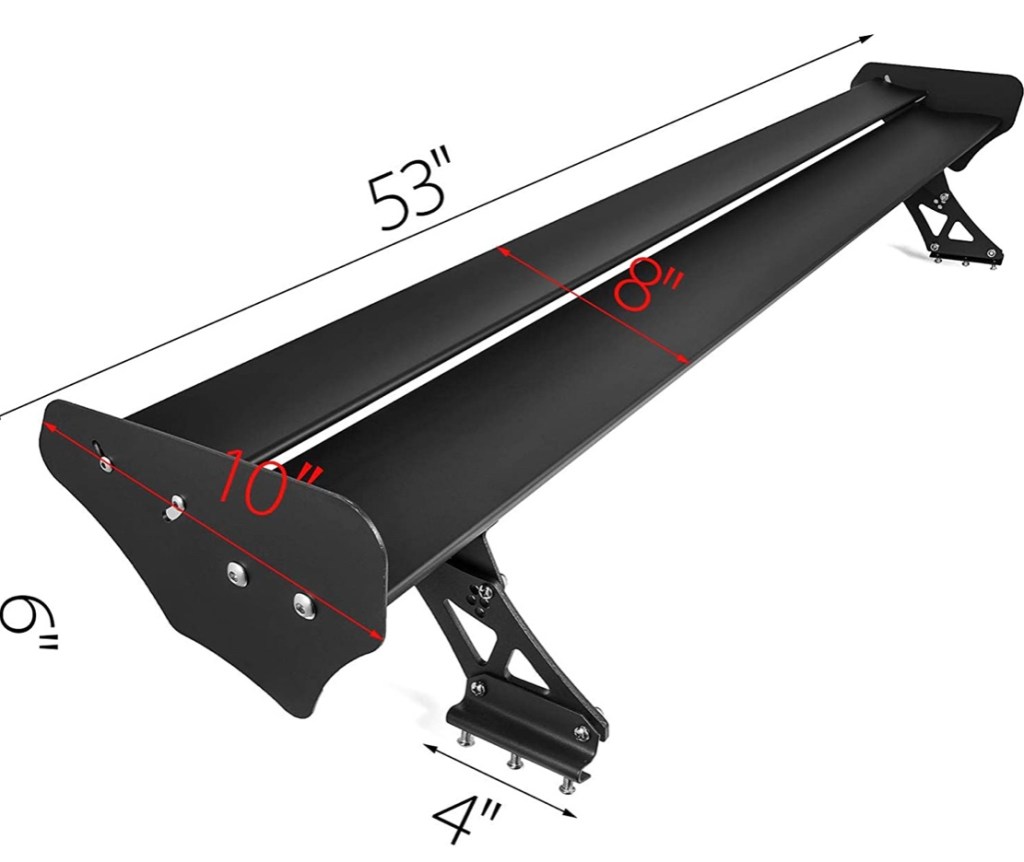
You can buy a cheap wing on eBay, Amazon or whatever for as little as $50, or a double decker for $75. I’ve previously written about the testing I did on this wing. Let me be clear about this: it was a piece of junk right out of the box. At a minimum you must make new endplates (see previous blog post) and get the wing higher.

The mighty Mophon wing.

I made those and other modifications and it performed better than I expected. The 53″ wing created almost as much downforce as the 60″ 9LR wing! But also a lot more drag, which negatively affected front downforce. You have to think of aero as a system, and as a system, the 9LR wing with OEM hard top had a Cl of -1.01 and a Cd of .48 for an aero efficiency of 2.11. Whereas the eBay wing in the same configuration had a Cl of -0.56 and a Cd of .55, for an aero efficiency of 0.90.

While the eBay wing system was worse than the 9LR, the drag and lift values showed that my car would go faster with the wing than without it. Even my very slippery fastback without a wing was slower in a race simulation than the eBay wing with a hard top. Even cheap wings can be good!

Just the same, the eBay wing has been sitting unused. I got tired of looking at it and decided it was time for some new development efforts. Before I get to that, I’ll recap all of what I did previously, and then get onto version 2.0.

Wing stands

The janky mounts that came with the wing might work on a hatchback, but are far too low to be efficient on a Miata. You need to get the wing higher, where the air is less turbulent. I made my wing stands out of a square piece of 1/4″ aluminum plate, 12″x 12″, which I simply cut at an angle to make two matching sides.

I bolted the stands through the trunk gutter with three bolts per side. Note that the trunk gutter isn’t parallel or plumb, meaning that once the stands are bolted in, I had to pull on them and bend them to be near vertical. This bends the trunk gutter into shape.

Pro tip: If your wing stands are slightly sprung (meaning there is tension between them, and you have to force them into a vertical position), it makes the wing stands stiffer. So don’t fret about getting them vertical, just pull them into position about 40″ apart at the top when you mount the wing.

End plates

The end plates were the next things to go, not only because they were too small, but because they didn’t allow me to set the convergent gap and secondary wing angle correctly.

Slots for upper wing adjustment didn’t allow for correct gap and angle. End plates way too small.

Convergent what? Basically, the gap between the two wings must accelerate air as it passes through. In order to do that, the gap at the front edge has to be larger than the gap at the back. The factory end plates have two arcs cut into the end plates, and pivoting the upper wing through this arc is supposed to allow you to set the angle and gap distance. But if you do that correctly, then there’s no overlap.

The top wing should overlap the lower wing at about 4% of the chord, which is about 0.3″ in this case. I measured that distance and drilled a single front hole to use as a pivot, and then three holes further back to provide a range of adjustment. This gives me the proper overlap and gap, and I can set the upper wing angle easily.

Upper wing modifications

The upper wing is flexible, and if you set the proper overlap and gap to the lower wing, the upper wing will vibrate and hit the lower wing. So I added a stop in the middle of the lower wing, which will support the upper wing as it bends. The stop is just a piece of aluminum with a couple rivets to hold it in place. You could duct tape a piece of rubber tubing and it would work (did that for the first race).

I also riveted a Gurney flap to the upper wing. This stiffened up the upper wing a little, but based on the test results, I think it was too large, and part of why the wing had some much drag.

So this is where the 2.0 developments being. The first thing I did was cut the Gurney flap down to half the height, as shown below.

Small Gurney flap. Is it necessary on the upper wing?

However, I’m not 100% sure the upper wing needs a Gurney flap. The gap between the wings is supposed to accelerate air, and that should be enough to keep air from separating at the trailing edge. Also, the trailing edge of the upper wing is round and thick, and just looking at the camber across the chord makes me think the wicker isn’t helping. At some point after taking this picture, I removed the wicker altogether.

Curving the underside of the main wing

The underside of the main wing is flat and has two mounting grooves that span the length of the wing. This conveniently allows you to mount the wing at any width, and makes the main wing a good deal stiffer. The compromise is less than optimal flow under the wing, not only because of the flat shape, but the grooves.

The profile of the wing is much better without the large flat spot along the bottom. .

I could have simply filled the grooves, but if you’ve been following my blog then you understand I like to go a bit overboard. So I bought a piece of pine baseboard at Home Depot, glued this to the bottom of the wing with epoxy, and sanded it to a rounded shape. If you decide to do the same thing, you need to know exactly how far apart your wing stands are before you do this, as there’s no adjusting the width afterwards.

Pine baseboard, glued and sanded.

Note for Grid Life Touring Cup (GLTC): I was looking at the rules for Grid Life Touring Cup, and noticed they don’t count points for wings that measure 250 square inches or less. The lower wing measures 244 square inches, so you could use this wing without the 3% penalty! You can buy the lower wing alone for about $50.

Finishing touches

All that was left was to sand and paint it, and I think it looks pretty cool. You can still see some of the wood grain beneath, which is either a shitty paint job, or a DIY detail to appreciate, depending on your point of view.

Before shaping the underside, the wing and end plates weighed 7.6 lbs. After shaping the underside, the ensemble weighed 8 lbs. Pine boards are light. I’m not 100% happy with the end plates, they need to be larger, but I can continue to mess with that.

Test results

To see how the wing performed I took it up to my usual testing grounds, Pineview Run. Now this is not the ideal place to test aero, because at lower speed, aero is not as pronounced. I don’t have Man and Machine Consulting’s telemetry equipment, so lap times is the best I can do.

Those excuses aside, my teammate Alyssa tried the 60” 9LR wing back to back with my new modified wing and somehow the double wing went faster. We did nothing to control variables such as wind speed and temperature, so let’s not call this a conclusive test, but for sure it’s an improvement on the 1.0 version of this wing. Will I race with it? I might use this wing at a Lemons race, or on a short track like Pineview, but for any real racing, I’ll be using the 9LR wing for sure.

What’s Your Excuse for Not Using Aero? Ow!

This website is full of data that supports why cars (Miatas) should have aero. Nevertheless, I meet people all the time that say they don’t want to use aero. Fine, don’t. But don’t justify that with bullshit excuses or claims you can’t back up with data. That just gets you a dick punch for being a moron.

What are the most common excuses I hear for not using aero?

Alyssa’s car has evolving aero, built to a budget.

“My car doesn’t make enough power to use aero”

This is the dumbest one. I wrote about this previously, and it’s just plain wrong. Miatas have terrible aero, and the normal aero things one does to a Miata reduce drag (freeing up power) and add downforce (increasing grip). There’s simply no downside to using aero on a Miata.

  • Drag reduction – Airdam, splitter, flat bottom, low spoiler: all of these reduce drag. Explain to me how the fuck it takes more power to use aero?
  • Wing drag – A single-element wing has about as much drag as your side mirrors. Move the mirrors inboard and shut up. Or just ignore the mirror drag and stand agape as you gain 2-3 seconds per lap.

“I’m not a good enough driver to use aero”

This is my second favorite saying. As if the self-admitted “not-good enough driver” has aerodynamic knowledge, but not driving skill? The fact is, adding grip and stability is not going to make you a worse driver, it’s going to make you a safer and better driver.

  • Understeer is safe – A wing will generate more and more downforce at speed, shifting the balance of the car to the rear, causing the car to understeer the faster you go. This is especially good for people who claim they aren’t good drivers.
  • Easy to tune – Not everyone is schooled in setting up suspension. Conversely, changing the angle of your wing is child’s play.
  • Braking – If you look at data, you’ll see that aero helps braking more than it does for cornering. Drivers who identify as “not good” will benefit greatly from better braking.
  • Stability is good – A stable car is easier to drive at high speed. Cars without aero suffer from aerodynamic lift, which makes the car unstable at high speed. Downforce makes a car easier to drive, and better for noobs. Lack of aero, and instability, require a better driver. Not the other way around.

Obviously a pro driver will get more out of a car that has a lot of downforce, but a rookie driver will also benefit greatly from aero. Saying that there’s some skill level requirement to a car that has less drag and lift is fucking asinine.

“I don’t like the way aero looks”

If you’re choosing your performance based on looks then you’re not serious about performance and shouldn’t be reading my website. For a street car, you have a leg to stand on, but for a race car, notsomuch.

My brother is one of these “I don’t like the way aero looks” people. It’s infuriating because he races a Yaris. Somehow he thinks a splitter and wing are going to ruin its wonderful lines?!? Dude, this is not a Giugiaro masterpiece! Aero all the things, brother.

I finally got Ian to throw a $50 wing on the Yaris and he was able to flat-foot Thunderhill Turn 1 for the first time ever. So at least he’s been partially converted. I’d like to see it with a splitter, flat bottom, barge boards, and diffuser, but I’ll take this small victory for now.

“Aero costs too much”

OK, I don’t really hear people say this one so much as see it. People will dump money into every aspect of performance except aero. They’ll run A052s and change them every 5 hours. Or they’ll do an engine swap or turbo. All the grip and power things cost money, and then keep costing money. On the other hand, once you do aero, you’re done. Aero is way cheaper for the same performance.

  • Tires – Teams that run Super 200s for endurance racing are spending 3x more on tires. Sure, they are getting a second or two a lap, but also paying for tires (and mounting) 3-4 times more often.
  • Power – Everyone wants more power, but for Miatas without fuel cells, you’re limited by the fuel you can carry. Some motor swaps, like Ecotecs, are pretty frugal on fuel, but more power means more gas. Gas costs money, pit stops cost time, do the math.
  • Aero – Do it once, forget about it. I’ve done a lot of OptimumLap simulations on different tracks, and while some tracks favor one or the other, grip, power, and aero often balance each other out. Over time, aero is simply the cheapest way to get the same lap times.

What’s your excuse for not using aero?

If your racing series doesn’t allow aero, obviously you can’t. But if you’re not using aero for some other reason, tell me why. But be careful… and cover your junk.

Tracks That Favor Power vs Grip vs Aero

Some race tracks are power tracks, and some are grip tracks. At the extreme ends of the spectrum, compare a salt flat to a skid pad. On the salt flat, there’s no cornering, it’s all about power. Likewise, on a skid pad, it doesn’t matter how much power you have, it’s all about grip.

leaf-skidpad | InsideEVs Photos
Some tracks are all about grip.

However, you also have to consider the aerodynamic factors of drag and lift. On a salt flat, drag could be a huge factor. On a large diameter skid pad, aerodynamic lift (downforce), could also weigh heavily (pun intended).

Most race tracks are neither salt flats nor skid pads, but somewhere in between. Some favor grip, some power, and some aero. I thought it would be interesting to run a bunch of simulations in OptimumLap to find out which tracks favor power, grip, or aero.

For the simulator car I used a Miata (surprise!) with 100 hp, 2400 lbs, tires at 1.0g grip, andvCd 0.5, Cl 0.5. These are very low, round numbers, meant only to illustrate the differences. Moreover, the low power and grip values create larger gaps in the data, which makes it more obvious which tracks favor which attributes.

I ran this base car on 12 different race tracks that range from an autocross course to the fastest closed-course race tracks in the USA. There’s a good mix of tracks in OptimumLap, but I also added the map my brother made of New York Safety Track, because it’s local and awesome.

NY Track Info
New York Safety Track (NYST). Dumb name, great track.

After the initial base simulation run, I then added 10% grip and re-ran the group. The lap times dropped across the board (especially at the autocross course), and I logged the data.

I then removed the additional grip and added 10% more power. So at this point, we’re back to the base car, this time with 110 hp instead of 100. Lap times fell again, but not always in the same order.

Finally, I removed the extra power and changed the coefficient of lift from -0.5 to +0.1. This is not a drastic change, one could easily get this from an airdam and small spoiler. I left the drag (Cd) the same, as it probably wouldn’t change much (it would actually have less drag, but I chose to concentrate only on downforce).

The table below shows the base lap time, and then what happens when I added more power, more grip, and minor aero. I ordered the table by tracks that favor power at the top, in the middle are tracks that favor aero, and at the bottom of the table are the tracks that favor grip.

TrackBaseGripPowerAeroFavors
VIR154.73152.7151.85153.10Power
Mid-Ohio112.57111.26110.99111.06Power
Watkins Glen157.30155.33154.97154.97Power and Aero
Summit Pt93.9392.7692.6992.35Aero
NYST112.71111.70111.68111.02Aero
Big Willow109.46107.98108.18107.11Aero
Lime Rock71.0670.0170.2269.60Aero
Thunderhill 142.71140.60140.74140.59Aero and Grip
Gingerman118.76116.82117.26117.34Grip
Thunderbolt107.01104.91105.87105.21Grip
Waterford87.3285.4986.6786.08Grip
Autocross68.1166.8367.8567.49Grip
Start by looking at the Base column, which is the lap time before I modified any values, and then look across for the time in bold, which is the fastest lap.

Race tracks with long straights favor power, and so it’s not surprising to see VIR and Mid-Ohio at the top of the list. Likewise, an autocross course, or a smaller technical track like Waterford, are grip tracks. Finally, some tracks are fast and flowing, and suit aero.

Not every track was definitively a power, grip, or aero track; some tracks are a mix of two. Watkins Glen favors both power and aero, while Thunderhill (3 mile) favors grip and aero.

I then re-ran the simulations using a Miata in a higher state of tune. I left the weight the same, but gave it 120 whp and 1.2g grip, to see if the relationships would change at all. Nope, they stayed the same. Astute readers will cite that a high-power car like a Corvette rarely benefits from more power at any track. But this isn’t a site about Corvettes….

Note: As I stated earlier, the coefficient of lift value (Cl) for the aero car is 0.1, which is pretty low. A Miata with an airdam, splitter, and wing has a Cl of 1.0, which is way better. If I re-ran all the simulations using that value, then it would show that every track is an aero track, and that wouldn’t tell me much about the nature of the track. So I purposely chose a low Cl value that would illustrate which tracks are more favorable to power and grip, and put the aero into equal perspective.

DIY Tire Spats

I’ve been de-aeroing my street car this year. What?

Last year I was experimenting with aero and I made an airdam and splitter on my 1993 street car. The airdam was a vertical 3″ extension under the stock lip, and the splitter was simply the forward part of the undertray. I built an adjustable spoiler to balance it out.

September 2019. Small airdam, splitter, adjustable spoiler (the black plastic part can be moved up or down into three different heights).

It went pretty well until I stuffed it into the weeds. The splitter dug in hard, bending the mounting brackets, the undertray got shoved underneath the car, and I sheared some bolts and plastic. It wasn’t pretty.

Oops. Shoved the splitter/undertray back and broke my side spats.

So like I said, I’m de-aeroing my car. My hope is, that if I go off track into the weeds again, the car just glides over them, rather than the splitter ruining my day.

The front end is now the popular R-package front lip. The brake ducts aren’t really functional, so I covered them up. Underneath, I still use a full undertray so I can duct the radiator and whatnot, but the front edge terminates right at the R-package lip.

One of the things I don’t like about the NA front end is that it doesn’t have enough tire coverage, and so I built some front spats to deflect air away from the tires.

R-package front lip with plywood undertray and covered brake duct. From this angle, it looks like the wheel spats cover the whole tire, but they don’t.

Last time I made spats out of extra HDPE plastic I had lying around from making the airdam. This time I decided to use metal, so I could pre-form the shape. It was pretty easy to mock up in cardboard, then bend it over and get the shape right.

I fastened the bottom of the spats to the undertray, sandwiching them between the undertray and the front lip. At the top I folder over the extra material, drilled a hole, and used the standard fender mounting bolt.

Angle aluminum wickers on each side.

Finally I added some 1/4″ angle aluminum to the edge of the spats. These required a bit of effort to form. I had to clamp it in a vise as I bent the arc slowly. If I hadn’t clamped it down, the whole piece of aluminum would have come out bent in more than one dimension.

The purpose of the angle aluminum is to act as a wicker (Gurney flap), and fool the air into thinking the spats are wider than they are. As air moves around the front end, it encounters this raised edge which deflects air around it, effectively making the spats wider.

Wicker helps deflect air around the tire.

I suppose the angle aluminum also makes the outer edge stiffer, but I’m not sure if that was an issue, these are pretty strong and very light. I don’t know if they can handle any serious grass cutting, but at least it’ll just be the spats I lose next time, and not the whole shebang.

Wind Tunnel Testing

Back when I wrote this article, I hadn’t done any wind tunnel testing. Since that time, I’ve tested tire spats as well as spoilers, and I was on the right track back then. For all the details, purchase my Miata Wind Tunnel Report and you’ll receive a download link.

The wind tunnel report has a lot more than just spoilers and tire spats, it also covers the following.

  • Splitter diffusers and spill boards.
  • Canards in various locations and combinations.
  • Closed windows versus open, plus modifications to reduce drag and turbulence from the open windows, including wickers, mirrors, and venting the rear window in two different locations.
  • Singular hood vents fender vents.
  • Brake ducts, NACA ducts.
  • OEM hardtop with and without a rear window spoiler, versus a CCP fastback.
  • Blackbird Fabworx spoiler at different angles/heights.
  • Wings from 9 Lives Racing, Wing Logic, and a couple prototypes.

DIY Gas Can Mods and Speed Test

At our last race we had two different fuel jugs, VP and Hunsaker. Both jugs hold about 5.5 gallons. The Hunsakers have unleaded fuel nozzles and pour a lot slower, but they have a convenient venting system that keeps you from getting gasoline on your race shoes.

I was curious how fast each can could dump its contents, so I filled them up with about 5 gallons of water and did a little test. But first, let’s see the contenders and how I modified them.

Hunsaker

My Hunsaker jugs have the small diameter nozzles that fit a standard unleaded restrictor plate. This has been useful for the Lemons team I race with, since their car (minivan), is street legal. The small nozzle’s .59” inside diameter (ID) restricts the amount of fuel that can flow, and makes fueling take a lot longer.

Unleaded nozzle on the left, DIY on the right

But my race car doesn’t have the unleaded restrictor plate, and so it’s kind of silly to use the Hunsaker cans as is. However, if I remove the nozzles, the large diameter tubing on the Hunsaker is too large to fit in my filler tank neck. So I made new nozzles that were as large as I could fit inside the clear tubing. I bought 1.25” aluminum tubing which has a 1.12” ID.

VP Jugs

We typically use the VP jugs for fueling because the hose is a larger diameter and they dump faster. The VP caps have a screw-in plug, and if you remove it, you can thread in a brass adapter that fits a 1” tube. Add a piece of tubing and a hose clamp and you’re done. The inside diameter of the brass adapter is 3/4”.

At the last Lemons race, my teammate Dieter modified one of my VP jugs with a Hunskaker-like air vent. This seemed to work pretty well, as no fuel escaped the vent or got on our shoes. I bored out the vent tube a bit to give it freer breathing, it looks like this:

Poor-man’s Hunskaer

Speed test

First up is the standard Hunsaker with unleaded nozzle: 44.4 seconds. That’s with the small air valve popped open. My teammate Pat always removes the entire vent cap from the Hunsaker jugs, instead of just opening the vent. I always thought that was silly, but I wanted to see what the difference was in dump time: 38 seconds. Huh, he wasn’t wrong about that.

Next up is the standard VP jug with homemade nozzle: 25.4 seconds. Having seen the benefit of a larger vent hole, I opened up the vent on the VP can. This can also has the “poor-man’s” Hunsaker vent, which is basically a long piece of tubing on the vent hole so you can invert the can and no gas drips out. This one dumps at 22.5 seconds, better still!

Finally, I tested the Hunsaker fuel jug with an aluminum 1-1/4” tube in place of the unleaded nozzle. Having already seen the benefit of the unscrewing the vent cap, I did that: 10 seconds. Woot!

Fuel Can ConfigurationIDSeconds
Hunsaker, unleaded nozzle, small vent.59″44.4
Hunsaker, unleaded nozzle, unscrew cap.59″38.0
VP with standard air vent.75″25.4
VP with larger vent and tubing.75″22.5
Hunsaker with 1-1/4″ aluminum nozzle1.12″10
Final results

I was actually unprepared for how fast the last configuration dumped the fuel, and could be off by a second when I fumbled to time it. It doesn’t really matter anyway, the point is to use the largest diameter nozzle you can, and don’t neglect the size of the air vent.

I Don’t Want a 1.8 Swap, Part Deux

I previously blogged about all the reasons I wasn’t going to swap a 1.8 engine into my 1.6 Miata. I’ll sum it up with the phrase “I’m not building a better car, I’m building a better Miata.” The goal is to accentuate everything that made the 1.6 different, and more Miata, than the later 1.8s. Part 2 of this blog is my progress report. Where am I at?

  • Higher compression ratio – Done. I bought a spare head on eBay so I could do all the work on the bench. I got the head decked .035″ for $50, and the engine should have about 10.3:1 compression now. I also put in Supertech +1mm oversize intake valves. I didn’t do the exhaust valves because I was trying to save a bit of money, and my understanding is the intake-to-exhaust valve diameter ratio is still good. I went with OEM valve guide seals after reading multiple cases of how much the Supertech valve seals leak. I did a simple DIY porting job, mostly just knocking down casting flash and blending. My teammate Alyssa Merrill’s landlord is a retired machinist and does heads in his spare time. He does top-notch work at a very reasonable price.
  • Hotter cams – Done. Kelford 203-B cam, 264/264 degree camshafts with 9mm lift. This is a medium cam with a lumpy, but streetable idle. I’m still using stock valve springs and retainers, nothing radical. Note that there is a normally-aspirated version of this cam, which has a bit less duration on the exhaust cam. I got the forced-induction cam with an eye on the future.
  • Higher redline – Done. The 1.6 has a shorter stroke, and so it’s safe to rev it a little faster. 7000 RPM on a 1.8 is the same piston speed as 7125 RPM on a 1.6. It’s easy to set it anywhere I want with the Megasquirt PNP2. I have it set to retard the timing at 7200 rpm, which is stock, and cut fuel at 7500. Also worth noting, I got a Speedy EFI variable TPS sensor.
  • Lighter flywheel and clutch – Done. Fidanza 7-lb flywheel and Exedy stage 1 clutch. The flywheel feels great when rev matching, but I’m having a bit of buyer’s remorse on the clutch. It works great, I’m just thinking I should have gone for a heavier clutch in case I go forced induction in the future. This clutch is good for 145 ft-lbs, which is fine for anything normally aspirated.
  • Less weight – Done. I removed the A/C (needed to be recharged and messed with my idle), and added lightness here and there. My already svelte car is down to 2100 lbs, and that’s with an OEM hard top, Hard Dog roll bar, full carpet and interior, tow hitch, and half tank of gas.
  • Shorter final drive – Punt…. After a lot of number crunching and simulations, I decided to go with a 4.1. It’s an hour drive to Pineview Run, and some of it is on the interstate, and I just didn’t want the engine buzz. As a side benefit, the speedometer is now accurate. However, if I was hardcore about sticking to my principles, I would have shortened the gear ratio. If a 4.625 or 4.778 comes up at the right price, I still might do it. (Edit – I now have the 4.625 in my car thanks to Torb!)

Another place I punted on the 1.6 theme was retaining the 6-inch ring gear. These are known to fail under stock power, and only people hamstrung by STS rules actually wants one. So I swapped in a 7″ ring gear and Torsen from a later model, which required new axles and drive shaft.

I took the car to Rick Gifford for tuning. He sees a lot of Miatas and Megasquirts and has been known to work a bit of magic. He has a Land and Sea dyno (DYNOmite) mounted flush with the floor, it’s a neat drive-up experience. The dyno measures low numbers, like a Mustang in terms of power readings. I multiply by 112% to get a Dynojet number.

On Rick’s dyno, I got 129.7 hp. Power maxes out at 6800 RPM, which is only 300 RPM more than stock, so the cam didn’t make it a peaky powerband at all. The engine made 109 ft-lbs of torque at 5300 rpm, without any big dips, and a fairly flat curve. Check it out.

Apples to Apples to Oranges

Let’s compare my 1.6 build to other Miatas and engine swaps. A stock 1.6 engine would put out about out about 83 hp at the wheels on Rick’s dyno. My 130 hp is 156% more power. This is about 145 hp and 122 torque if measured on a Dynojet. Woot!

On the same day we dynoed Clayton’s NB1 with a gutted cat, Cobalt exhaust, and cold-air intake. It made 117 hp and 108 torque. That’s about 131 hp, 121 torque on a Dynojet. Of course it could be further improved with a header and standalone ECU, but even using the stock ECU, this is good power, and that’s why people swap 1.8s instead of tuning 1.6s.

But if you’re going to do a 1.8 swap, may as well use the later VVT engine for a bit more grunt. Coincidentally, right around the time I was getting my engine work done, Napp Motorsports was filming a multi-part YouTube series with their two Miatas: the first a VVT swap and the second, a K-swap. Stefan Napp also takes their cars to Rick Gifford for tuning, so this gives me a chance to do an apples-to-apples comparison.

Some background on the Napp cars. Dylan’s car started as a NA6, and, not satisfied, he did a NA8 swap with an exhintake cam. It dynoed 102 hp on Rick’s dyno, and in Dynojet terms that’s more like 114 hp. That’s not a very strong NA8, but it was choked by a 1.6 wiring harness including the AFM flapper valve. In the end, Dylan decided a VVT swap would be better.

But Stefan Napp didn’t just swap Dylan’s motor, he decked the head .040″, did some port polishing, and got a good valve job. The engine now has 11:1 compression, and exhales through a custom fabricated exhaust system. It has a standalone ECU, and on 93 pump gas it put out 135 hp and 126 ft-lbs of torque. In Dynojet numbers that’s a strong 151 hp and 141 torque. (Side note, it only made +5 hp on E98. Booo, corn.)

When you compare my 1.6 to the 1.8 VVT, the bigger motor makes 5 more hp and 17 ft-lbs more torque. The 1.6 has always been gutless in terms of torque, and right there you see it.

Stefan’s personal Miata has a K24Z3 swap, which is a 2354cc 4-cylinder used in an Acura TSX and other cars. This is the easiest way to get a Honda engine in a Miata. It initially made 175 hp on the dyno, but after further tuning, Rick managed 197 hp, and 150 torque. Wow.

EngineHp / TqDynojetHp/ Liter
1.6 – Stock83 / 6693 / 7458.2
1.6 – Mine, with cams, etc.130 / 109145 / 12290.7
Dylan’s NA810211462.1
NB1 – Clayton117 / 108131 / 122171.2
NB2 – Dylan135 / 126151 / 14182.1
K24Z3 – Stefan197 / 150220 / 16893.4
Hp/Tq is from Rick’s dyno. I multiplied by 112% to get Dynojet-like numbers. The Hp/Liter values are based on the Dynojet number.

In terms of efficiency (hp/liter), my little 1.6 kicks ass on the VVT motor, but gets beat by the Honda engine. Not that Hp/Liter is important, but it’s a good measure of the state of tune. Dylan is planning future mods to hit the elusive 100 hp/liter, so his 1.8 may yet surpass my 1.6.

Where’s the power come from? What did it cost?

I have a spreadsheet where I’ve entered data from various dyno charts I’ve found on the web. By looking at the parts that were used and the total output, I can make a fair guess at which parts produce how much power. Based on that data, this is what made what, and how much it costs.

ModPowerTotalCost
DIY cowl intake5%105%$40
ECU, tuning15%120%$1400
Cams, cam gears15%135%$700
+1 mm intake valves + seals, valve job4%139%$500
DIY port and polish2% 141%$0
.035″ head shave6%147%$50
Raceland header4%151%$170
Hi-flow cat1%152%$90
Cat-back exhaust4%156%$350
$3300
My best guess as to where the power came from, and what it cost me.

By running a standalone ECU (MS PNP2), I was able to get rid of the restrictive flapper valve (AFM). This is really the first thing anyone should do to a 1.6, and it makes all the other mods tunable. But it’s not cheap, and when you add in $600 for dyno tuning, this comes to nearly $100 per 1% power. That’s my ceiling for my “worth it” calculation, and I like to be closer to $50 per 1% (or $50 per hp, if you think that way). But the ECU makes all the other things better, so you have to start there.

The cams added about the same amount of power as the ECU, and were a big bang for the buck. I probably didn’t need the adjustable cam gears, but I decked the head and thought it was a good idea to get the cam timing back to stock. I still haven’t played with the cam timing, so there’s probably a bit more power there.

Keep in mind that these individual power gains are all guesstimates, I certainly wasn’t going to dyno and tune each part as I put it on. In all I spent roughly $3300 to get 56% more power. That’s $63-70 per hp, depending on the dyno.

As you can see, modifying a 1.6 engine isn’t the best use of money, but almost nothing car related is. Common wisdom is to just drop in a VVT and be done with it. I can’t argue with that, especially after driving Dylan’s car (future blog post). But if you have a low-milage 1.6 and feel like it’s dumb to swap a perfectly good motor, or if you just want to buck the motor-swap trend, then tuning a 1.6 can be pretty rewarding.

I feel like the project has been a total success. I’ve improved everything that made the early cars better Miatas. In terms of power to weight ratio, the car is about 16.1 lbs/hp, with me in it. That’s about the same as a new ND2 Miata, and in that light, a downright bargain.

But it’s no rocket ship. When I hit a long straightaway, I’m still patting the center console giving her the giddy-up: “C’mon baby, let’s GO!” An underpowered is still part of the Miata charm, after all.

I got to track test both of the Napp Motorsports Miatas back to back to back with my NA6. I’ll report on that after their video comes out.

Fitting a Miata to the Aerodynamic Template

There’s a nerdy site and forum called Ecomodder. Most of the site is focused on fuel economy, but some of it can be applied more appropriately to racing. In this post I’ll see how we can apply Ecomodder’s aerodynamic template tool to a Miata.

Aerodynamic template

The aerodynamic template refers to the shape of a car that has the lowest possible drag. It’s basically a tear-drop shape on wheels and looks like this.

Aerodynamic template of the ideal low-drag shape.

The Ecomodder site has an online tool that allows you to superimpose the aerodynamic template over a picture of your car. I’ll do this with a NB Miata using a simple line drawing I found on Google images.

NB line drawing is easy to work with.

I’ll superimpose the aerodynamic template over the car, resizing one or the other so that they fit. The zero mark on the template should line up with the highest part of the roof, which I’m putting in the middle of the door handle.

Aerodynamic template superimposed.

While this is the ideal shape for lowest drag, it doesn’t mean that air will become detached if you don’t follow the shape! Sub-ideal shapes will result in a thicker boundary layer, or maybe even some turbulence, but lots of shapes will work just fine without separation.

Likewise, it isn’t necessary to extend the tail to a point. Wunibald Kamm found that cutting off the tail resulted in minimal increase in drag, because the wake region converges to mimic the effect of a fully tapered tail. The so-called Kammback shape is quite efficient at 50% of the cross sectional area, which in this case is the second vertical line past the rear bumper in the picture above. That’s way the heck back there!

A more realistic stopping point is at the end of the trunk, which has the roof at an angle of about 14 degrees. At that length, the roof is still quite flat, and has a shape like a Honda CR-X, CR-Z, or a Hyundai Veloster. And like a lot of SUVs, damnit.

Backlight angle

Most cars these days have rooflines that slope gradually, just like the aerodynamic template, but if you look at older cars, the roofs are often flat, and the rear window comes back at a fixed angle. The backlight angle refers to the slop of the rear canopy, which is often the rear window. The ideal angle is around 15 degrees. It’s not intuitive, but the worst angle is 25-35 degrees. Guess what a Miata’s backlight angle is?

Drag vs backlight angle, 25-35 degrees is the worst.

If you extended the rear window of a Miata to the trunk lid, this would make about a 20-degree angle. This isn’t ideal, but still a lot better than an OEM hard top. Adding a spoiler would be an easy way effectively achieve a better backlight angle.

Image result for miata fastback diy
A pragmatic way to make a fastback

Boat tailing the sides

So far I’ve only been considering the two-dimensional side view, but the aerodynamic template is a 3D shape that tapers on the sides as well. The side taper is referred to as “boat tailing”.

Miata rear end tapers nicely.

You can see that the Miata rear end fits pretty closely to the aero template. Extending the length of the rear quarter panels to the full length of the car (even with the rear bumper) would reduce drag. Although it wouldn’t be necessary to go any further than that. (Note that the end of the bumper is right at the 50% line.)

Streamlining the canopy

The Miata canopy is wide and short, and to reduce drag you need to make it longer. In other words, a fastback. If you’re thinking about building one, bring the sides of the fastback all the way to the end of the trunk lid and you’re at about the right angle. You’d have to figure out a way to relocate the fuel filler, as the fastback goes right over the top of it. But you would save some weight by getting rid of the trunk lid.

Boat-tailing the canopy into a fastback.

My fastback is considerably narrower in the hips, and this allows a more efficient rear taper. This wouldn’t work well on a street car (it creates big gaps behind the windows where water would get in), but a fastback built like this would have less drag, and uses the existing gas cap location.

Diffuser

The final piece of the puzzle is the air going underneath the car. You’ll see the aero template shows a 10-degree diffuser. I’m not sure why this is a fixed angle, I’d imagine a continuous curve would be better.

I had to shrink the aero template to fit the diffuser under the rear bumper, and so this is no longer the ideal shape for the roofline, as it’s too short and the angles are thus too steep.

10-degree diffuser

Ecomod all the things

I also race 24 Hours of Lemons with The Awkward Corner, in a Honda Odyssey minivan. It’s had a few different themes, but if it were my car, the next theme would be a gigantic Honda CRX, following the lines of the aero template.

You can reverse the template and outline color.

I race my brother Ian’s Yaris from time to time. I drew a version of his car with a really long tail that was inspired by the aero template and Porsche 930.

Yaris long-tail

Ian also used to track a BMW E30, which is now with WinSome Racing. I’ve cropped the template to show what it would look like as a shooting brake.