Watkins Glen Test #1: Veloster N Spoiler and Wing

I plan on doing a few tests at Watkins Glen International this year, and this is the first of (I hope) several reports. WGI is 25 miles from my house, and I have a lot of opportunities for free track time with groups I instruct for (Chin, HoD, MT, NASA, PCA, SCDA). The Glen is convenient for testing, and the corner speeds are high, making it a good place to test aerodynamic downforce. But the straights are also quite long, and so drag matters a lot here.

However, as a testing venue, WGI is only so-so because it’s a popular track, and so there might be 40+ cars in your run group. It’s not just the traffic that’s the problem, but highly variable weather, and virtually no runoff. So it’s not uncommon to lose a session due to rain, fog, or because someone hits a wall. For this reason, I may need to use sector times and predicted laps in order to get good data.

But on April 13th we had decent weather and lots of space on track with Mass Tuning, and so I was able to test different things and get clean laps. But because I made aero changes each session, and was also playing taxi (guest rides), I wasn’t able to string together many hot laps, and so there are only three decent laps from each aero configuration.

Another reason for the lack of hot laps is it takes a full three laps to get my tires up to temperature. I start them at 27 front and 30 rear, and at the end of the session they are properly at 37 F and 36 R. But I lose a lot of time early in the session, braking and accelerating hard to get the temps up, while keeping corner speeds low. If I’m impatient and corner hard at less than 32 psi, the tires roll over and I cord the outer edge. I learned this the hard way last year, getting only about 1/3 of the life out of my tires.

In the future, I may start the tires at 30 psi, which should put the tires out of the danger zone after one lap. This would result in the front tires being 40-42 psi for most of the session, and while this won’t return the best lap times, I should be able to normalize the data better.

The long warm-up times are probably the result of not enough negative camber. In fact I never hear the tires working hard, they just make a low-frequency moaning sound, not the screeching howl I get out of my Miata on the same tires. The Veloster sits on lowering springs and has one set of camber bolts, and this maxes out the camber at -1.8 degrees. With offset bushings (or slotting) it’s possible to get -2.5 degrees, but any more than that and I risk blowing the OE struts. This is still a street car, and I’m not going to ruin it by turning it into a track car with coilovers, stiff sway bars, and solid bushings. Well, not yet anyway.

OE N wing 2:17.4

In the wind tunnel, the OE wing (or it could equally be called a spoiler) made 30.8 lbs of downforce at 100 mph. This cancelled out the rear lift on the base model hatchback, giving the car a slightly negative coefficient of lift. This is very rare in a street car. In my article Thinking in Aerodynamic Coefficients, I show that most cars have positive lift of around Cl 0.1-0.2. Cars that have zero lift or even some downforce are rare, and usually an exotic sportscar. But the Veloster N is one of those unicorns that has downforce straight from the factory.

The OE wing does a good job of stabilizing the rear of the car, and I felt none of the rear instability issues I felt when testing the car with the base model roof extension (meaning no wing). That was a test I ran at NYST, and the rear lift made the car twitchy under braking going into T1 and T5. But at WGI where I was 30 mph faster, the N wing felt stable under braking, and so the OE wing is definitely an improvement on the base model’s featureless roof extension.

The N wing also had the least drag, and posted the fastest top speed of 132 mph on the back straight. But the OEM wing also had the least downforce, and you can see this on the speed trace below, where I compare the OEM wing (red) to the same wing with a Gurney flap (blue). Note the difference in speed through the esses, it’s huge. But also note the vMins in each corner that I’ve circled. Not only are the vMins higher, they are shifted to the left, indicating that I’m backing up the corner better when the car has more rear downforce.
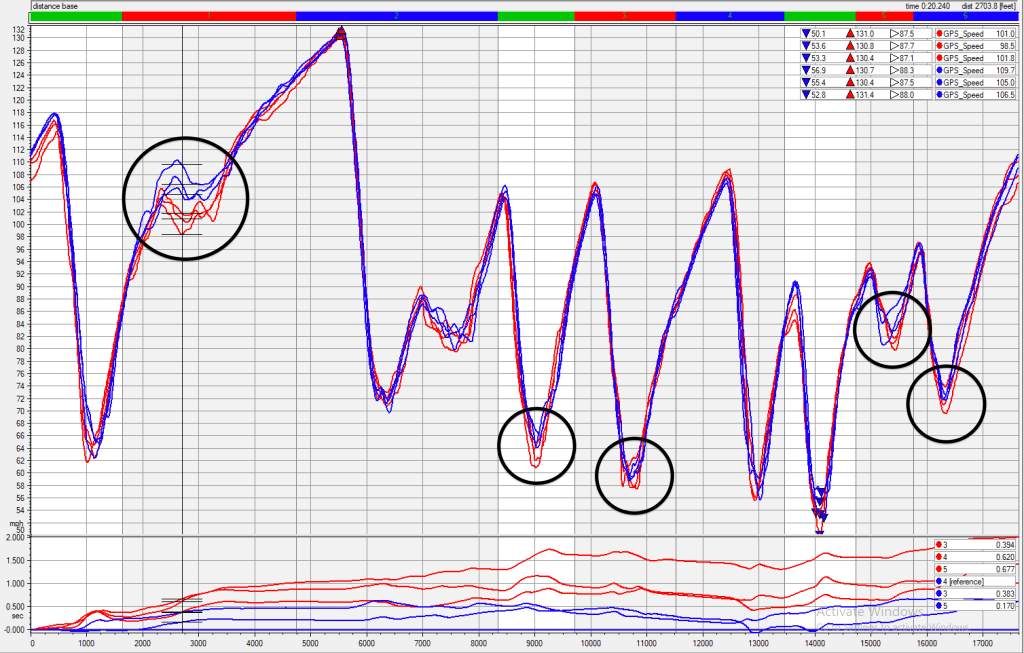
Red is OEM wing; Blue is the same wing with a Gurney flap.

Wicker kicker 2:16.4

I put a 1” tall Gurney flap (wicker) on the trailing edge of the N wing, and in the wind tunnel this made 114.7 lbs of rear downforce and 8.9 lbs of front downforce. The fact that this made front downforce means the wing is behaving more like a spoiler than a wing, and the combined 123.6 lbs of downforce is a lot more than I would have thought from adding a simple Gurney flap. When I add a Gurney flap to a wing I usually get 150-170% more downforce, not over 400% more! With an increase in downforce, there’s more drag, and 8.3 hp is lost at 100 mph.
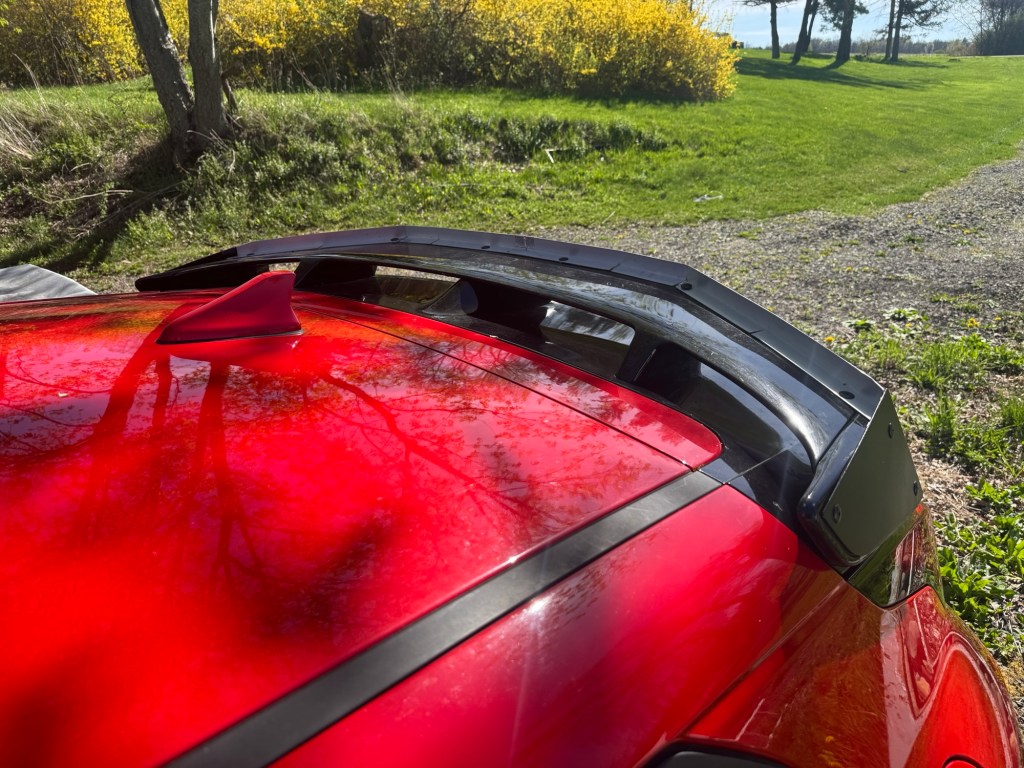
Wicker-kicker Gurney flap thingy.

But the extra grip through the esses is worth it, and by the time I get on the brakes for the bus stop, the max speeds are identical with or without the wicker. Around the rest of the lap, the modified OE wing has more grip, and the lap times are 1.1 seconds faster, lap after lap.

I uploaded a video of three consecutive laps, and I apologize in advance for the shitty audio. I use an original SmartyCam with an internal mic, and I can’t figure out how to make it less terrible. Anyway, I do a brace of identical 2:17.031 laps (down to the thousandth of a second!), on either side of a 2:16.415.

Three laps, turn the audio off.

S1223 54×11 wing 2:16.8

In the wind tunnel, my DIY Selig S1223 wing made 179.5 lbs of rear downforce at 100 mph, and 31.6 lbs of front lift. Wings are located higher and further rearward than spoilers, and so it’s normal for wings to lift the front end through leverage. As a practical matter, this is why people typically use a splitter and a wing together, but a spoiler can often be combined with a simple airdam, or just used on its own.

The wing’s total downforce of 147.9 lbs, divided by 45.3 lbs of drag force, returns a 3.27:1 L/D ratio, which is about the same as the OE wing, but not as good as with the Gurney flap. The drag amounts to 12 hp at 100 mph, and on the back straight of Watkins Glen, the wing is 2 mph slower than the other options.

One of the reasons the wing isn’t very efficient is because it has a span of only 54”. This is problematic for two reasons: first, wing-tip vortices have a detrimental effect on the wing’s overall performance, and so the greater the aspect ratio, the better the wing performs; second, most of the wing is in the silhouette of the hatchback roofline, and so very little of the wing is in clean air.

The reason the wing is 54” is because I wanted a cheap way to test a dual element wing, and bought a $35 extruded wing as the upper wing. The dual wing worked well at Pineview Run and NYST, setting the fastest laps (.8 seconds and 1.0 seconds faster than the single wing, respectively). But after seeing the initial results from the single wing at Watkins Glen, I didn’t even bother attaching the upper wing, as I’m sure the dual wing would have been the slowest.
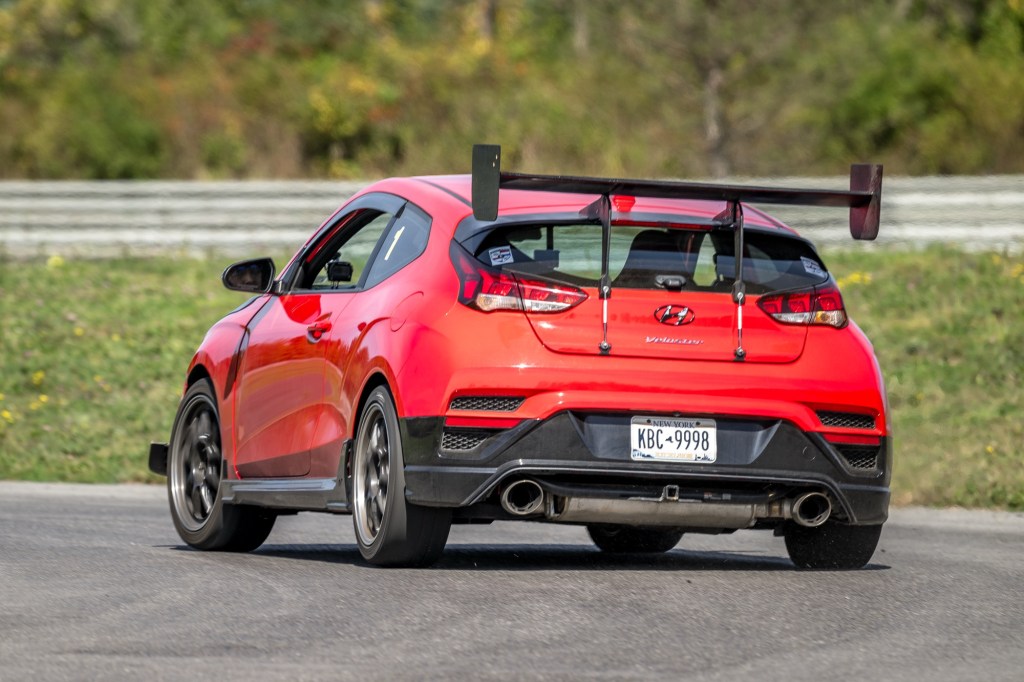
Single wing has rather tall end plates, as they are used to hold a second wing element. I didn’t try the dual wing option at WGI.

Under most racing rules, wings are allowed to be body width, which in the case of the Veloster N would be 71.7”. I tested a 70” Wing Logic wing in the wind tunnel, and it made the same amount of total downforce as my 54” DIY wing, but with 44% of the drag. The resulting 7.4:1 L/D ratio shows how important it is to get the wing tips as far apart from each other as possible, into clean air, and away from the hatchback roofline. I may test this on track in the future.

Conclusions

Based on testing the single wing at Pineview Run (.7 seconds faster) and NYST (1.5 seconds), I felt for sure the S1223 single element wing was going to be worth 3 seconds at WGI. The fact that it was only worth about 1 second has me tail spinning into the D-K pit of despair. Let me think about why that may be….

One reason for the lack of performance may be the aero balance. As mentioned, the wing adds rear downforce with a lot of leverage, and so it was the only one that lifted the front. The result is the car may have too much rear aero bias, and not enough grip for turning in. Perhaps when I put a splitter on the car, I’ll see better results.

But note also that the aero balance was even worse at NYST and Pineview. The fastest rear aero on those tracks was the double wing, which I didn’t measure in the wind tunnel, but certainly has the most downforce and drag.

Another reason the wing underperformed could be the driver underperformed. I don’t believe I was cornering hard enough, and just barely edging into the performance envelope where aero is adding to what the tires alone can give. With more laps and coaching, we may see the driver perform better, and with that, the results may change.

Of course drag is a factor at Watkins Glen, and the 54” wing had the most drag. If I swapped to a 70” Wing Logic wing, I’d gain the equivalent of 6.7 hp (at 100 mph).

But as it sits now for both car and driver, the easiest and cheapest way to go faster in a Veloster N is to put a 1” Gurney flap on the OE wing. The performance of this modification was one of the biggest surprises in the wind tunnel, and it’s nice to see that reflected in real life, as well.

Three hot laps from each configuration went like this:

ConfigBest lapAveragePredicted
OEM wing2:17.4342:17.912:16.841
OE + wicker2:16.4152:16.832:15.783
54″ wing2:16.7952:17.022:16.284

While I have some work to do to get faster, I’m a consistent driver. Watkins Glen is a long 3.38 miles, but my lap times are usually within a couple-three tenths of the previous lap. That’s around a 0.3% difference, and probably similar to the noise you’d see in other variables that change throughout the day, such as air and track temperature, wind speed and direction, etc.

<brag>On a track that I have more laps on, like Pineview Run, I’m a metronome. Here’s six laps in a row with 0.372 seconds between all of them. If you throw out the fastest and slowest, I do four laps separated by 0.076 seconds.</brag>
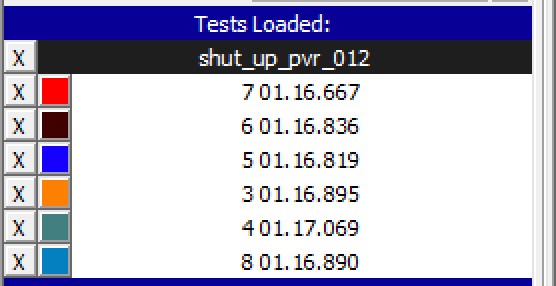
Consistent laps matter for testing.

I mention this not just so that I can thump my chest, but to throw some validity on track testing aero components. There are a lot of variables that change throughout the day, or even within a single track session. As those tolerances stack up, lap times can vary a lot. However, my driving is probably less of a factor than you might think, and I just want to point that out so I can deflect some of the “you’re driving like shit” comments. (Which are true, but at least I’m consistently driving like shit.)

Future tests

For Watkins Glen to be useful as an aero testing venue, I’ll need to fix my attitude, and turn my frown upside down. I’ve never gotten along well with this track, and I have to get to the point where I enjoy driving here. With some help from Gregg Vandivert (Omega 13 Coaching) and many more visits to the track, perhaps I can flip this script.

[sigh emoji] I hesitate to list the tests I want to do in the future, because the best laid plans of mice and men usually amount to the same dung heap of disappointment. But if things go as planned, I’ll test the following:

  • Driver mod – I’m curious to see how much time I can lose from professional coaching alone. In order to A/B test myself, I’ll need to use the same baseline setup and pray for days with similar weather.
  • Splitter – I didn’t use a splitter in any of these tests because I was matching the same setup I already tested at Pineview and NYST. But now that I’ve done those tests, I can put a splitter back on my car and see how this compares to the wind tunnel, and how getting more front aero load helps the overall balance. Naturally I’ll need to test the splitter at various heights and angles of attack, and so this could be a whole day of testing on its own.
  • Canards – I tested canards in the wind tunnel on two different occasions, and now it’s time to take the best results and see how they do in the real world.
  • OE wing modifications – The 1” wicker worked great on the OE wing, but I’ve only tried the one size. Next I should try 1/2” and 1.5” tall, and see what happens. Also, I believe that getting the OE wing a little higher may increase performance, and with that, I could also add some angle of attack. This should be as simple as installing a few shims beneath the wing.
  • Ducktail spoiler – I tested a DIY spoiler at Pineview and the results were similar to the single wing. But WGI has already proven to be quite different than other tracks, and so I should test this one.
  • Bigger wings – The wind tunnel already showed me how important wing span is, and so a 71.7” wing will be a lot more efficient. I’m building a big wing now, and shall test this for sure.
  • Active aero – I wrote an article on active aero, in which I did racing simulations at Watkins Glen. Now it’s time to put my money where my mouth is and do the same experiments in real life. The easiest active aero to fabricate would be a DRS spoiler, so I may start with that rather than jumping straight to a dual wing.
  • Diffuser – I tested a diffuser in the wind tunnel and it was pretty lousy, losing about as much front downforce as it made in the rear. But the A2 wind tunnel doesn’t have rollers for the wheels and so the effect of the underbody can’t be 100% trusted. So I should probably test the diffuser IRL and shoot myself up with another dose of disappointment.

vMins and driver performance

If you saw my previous post on vMins, you may wonder how well I performed on the vMin table. I put the OE wing on the Street table, and the modified wings on the Track side.

The red circles indicate my vMins with the OE wing, and you can see that I’m OK, but not great. My T7 may be a bit high, or more likely, all of my vMins can come closer to that level. However, when I add rear aero, I park it in the bus stop! I’m probably using the same braking marker, and then just over-slowing the car with the extra downforce and drag. I expected my vMins to be a lot worse than this, so I’m pleasantly surprised that I’m not driving like shit. And at least I know what to work on next time.

Gran Turismo nerds

I prepared for my Watkins Glen weekend by doing some laps in Gran Turismo 7. GT7 doesn’t have a Hyundai Veloster N in the game, so I’ve been using a Scirocco R. Now that I have data to refer to, I can modify the car to be as close as possible to the real world.

In the game I set the car weight to 3000 lbs and the horsepower to 244 (buy the lightweight modifier and add ballast weight and a power restrictor). This approximates the dry weight of my car (I have lighter wheels and the rear seats removed) and what my car puts out on the dyno (my engine is bone stock, not even a cold air intake). More importantly, this also gives me a realistic speed of 132 mph on the back straight. (I’m sure you could use a heavier car with more power, but this is just what I landed on.)

I also fitted the non-adjustable Sport suspension because I have lowering springs, and added the Sport brake pads (which do nothing in the game, but I’m trying to match the car IRL). I added a rear wing so that I can adjust the rear downforce from low (OE N spoiler) to high (single wing). GT7 doesn’t simulate aero accurately anyway, but I added no other downforce because I’m not using any. I use Comfort Soft tires, which puts the corner speeds in the right window for Hankook RS4s with painfully not enough negative camber.

If you have GT7, make a Scirocco R like this and play along. The PP value should be 492 with the wing maxed out. You can drop a comment here or contact me if you want to compare notes.

With the Scirocco R set up like this, I can click off low 2:14 laps regularly, and get the occasional 2:13 at WGI. That’s 3 seconds faster than I’m doing in the real world, which seems about right seeing as I can drive much harder in the game than IRL. As I get better in the real world, I expect the lap times to get closer to GT7. We shall see.

If you made it this far, thanks! If you’d like to support more content like this, hit the Buy Me a Coffee link. If you’d like the Veloster Wind Tunnel Report, it’s just $25 and goes through a ton of stuff you can do to make your car faster.
Veloster N Long-term (Track) Report

I’ve had my Veloster N for a year and a half, and with two track seasons finished, it’s time for a retrospective. I’m not going to get into daily driver details, just going to review the important things; race track things.

Wheels

Most people downsize the OEM wheels from 19” to 18” because aftermarket wheels are much lighter, and 18” tires are usually about 20% cheaper. The big challenge is fitting wider wheels and tires; unless you cut the fenders and install flares, the Veloster N can’t fit wide tires. When you compare the wheel and tire sizes to other cars, the Elantra N can easily fit 245 on 9”‘ wheels, while a Civic Type R can fit a 265 on 10”. It’s just not fair.

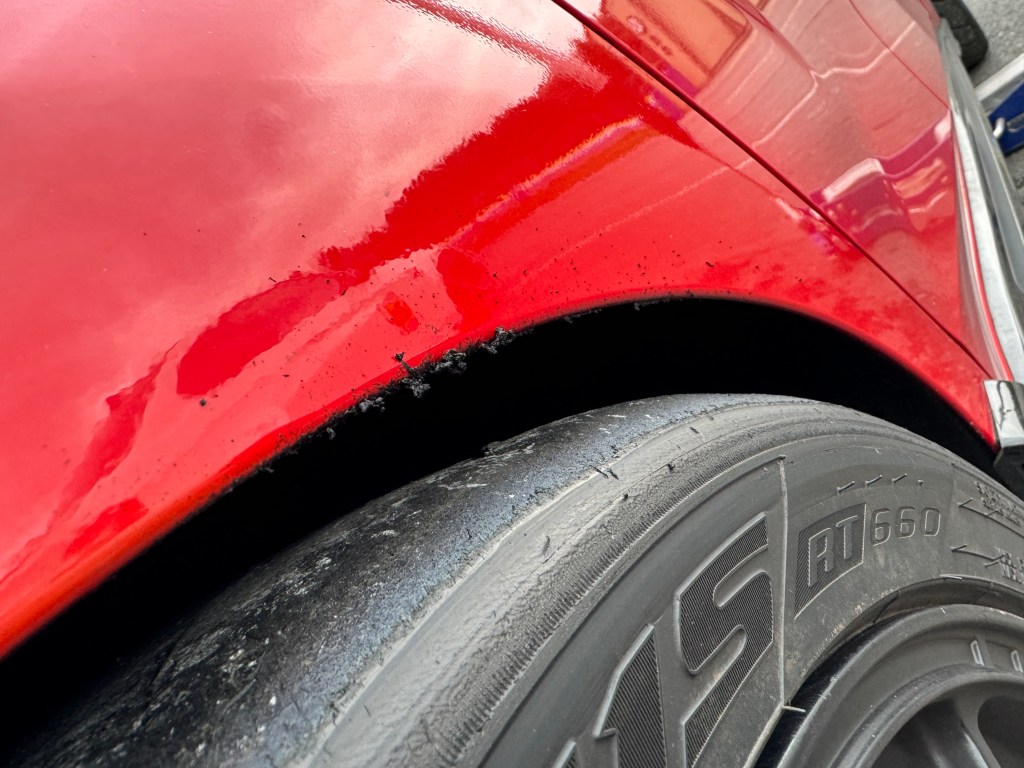
Ergo, VN track drivers typically fit a 235 tire on 18×8.5 +45. My buddy Chris was able to fit a 245 RT660 on a 8.5 +50, but he was at stock ride height. I tried the same tire on a 8.5 + 45 with 1” lowering springs, and it rubbed front and back.

On 1” lowering springs, a 245 RT660 on 18×8.5 +45 rubs front and rear. The same tire on 18×8.5 +50 will clear with stock springs.

I have three sets of wheels:

  • OEM 19×8+55 – Theres nothing to like about the stock wheel, it’s narrow and weighs over 29 lbs. When I wore out the OE Pirelli PZ4 tires, I put $65 Linglong Crosswind tires on these wheels, which is better rubber than they deserve.
  • Konig Countergram 18×8.5 +43 – I bought these because I like the black center and polished aluminum lip. They were about $300 at Fitment Industries and weigh 19 lbs. I have only used these for Kumho V730s, and they fit fine.
  • Motegi MR140 18×8.5 +45 – These are a bargain at $173 from Phil’s Tire. The only downside is the mounting holes are super narrow, and even 17mm lug nuts won’t fit, so you need to use spline (tuner) nuts, which I fucking hate. Anyway, the wheels are cheap and at 19.1 lbs, quite light. I used these for the 18” PZ4, Blu Trac Race, Pilot SS, and RT660.

I’ve read somewhere that reducing rotating weight is 3x more important than weight elsewhere on the car. So taking 10 lbs off each wheel is a huge benefit for acceleration and braking. Being unsprung weight, this also helps handling.

Tires

I put camber bolts in my Veloster N, and it maxes out at -1.8 degrees of camber. I understand that the DCTs can get more camber than the 6M versions, but I don’t exactly understand why. In any case, this doesn’t allow my car to get the most out of a proper track tire, and so the difference between an all-season and a super 200 is less what it should be. Or another way of putting that is that my car goes well on shitty tires.

At this point I’ve track tested eight different tires, from cheap all-seasons, to max performance summer tires, a few 200s, and a premium 100 treadwear. All of these were properly abused on the same race track, and I dutifully collected data for comparative analysis.

I’ll list them in the order I drove them (including two tires on a friends Veloster N), and sum it up with a report card.

  • Pirelli PZero PZ4 – I’ve had these in the OE 235/35-19 on 8” wide wheels, and 235/40-18 on 8.5”. I felt they were decent rain tires, but otherwise just average. You need to keep the pressures high to keep them from rolling over, and rotate them frequently, as they deteriorate quickly on a dry track.
  • Falken RT660 – I drove these in a wider 245/40-18 on my buddy Chris’s VN, and came away solidly impressed. On an otherwise stock VN I was only .25 seconds off Pineview’s all-time FWD record. Chris’s car doesn’t have a lot of camber, but he had the tires heat cycled before delivery, and thus experienced none of the center delamination or tread splice issues that others have reported.
  • Maxxis VR1 R2 – The Hankook RS4s used to be my favorite dual duty tire, but it’s not always available, and rarely on sale. Maxxis VR1s are pretty close in performance, and a great second choice. I used this tire on Chris’s VN and went a little slower than I did on the RT660. On the other hand, Chris didn’t like the feel of the Falken’s and went faster on Maxxis. This goes to show you that it’s not always the outright grip that matters, and you might turn a faster lap on a tire with less grip. Feel, feedback, and confidence are important.
  • Linglong Crosswind UHP All Season – I bought these because I needed something (anything) to put on my 19” OE wheels after the PZ4 wore out. At $65 on sale, I didn’t expect much more than round and black, but I took them to the track just the same. The sidewalls were mush and they howled like a chorus of tone-deaf banshees, but the performance wasn’t terrible. Three different drivers flogged them all day long, and the budget 400 TW tires earned some respect.
  • Kumho V730 – This is a good dry track tire, but worthless in the wet. It has a NT01 feel, with great feedback and grip that’s good down to the cords. While searching for more grip, I aired them down too low and corded the outside shoulder with half the tread remaining. I can’t start these at less than 32 cold, which means they’ll come up to 41 psi hot, and so I have to pit once and air them down, which is a PITA. They are cheaper than most 200s, and if the car could get more camber, I’d use nothing else.
  • Armstrong Blu-Trac Race – Armstrong left the e off of Blu and the k of off Trac and the grip off a 200 TW tire. And yet this was the most fun tire I’ve tried so far. They break away very early, but are super easy to control when sliding. You can get them with a money-back guarantee, and they go on sale a few times per year. This tire puts the E in HPDE.
  • Goodyear Eagle Supercar 3R – I admit that I often order food looking at the right side of the menu, and so it’s not surprising that I buy tires by price. But this summer I decided to spoil myself for once and get a premium tire and set some PB laps. The grip of the SC3R was incredible, if inaudible, and the turn-in was so insanely quick, it felt like I was driving a completely different car. All the ingredients were there, but the lap times never materialized. The tires made the car feel like I had all the nannies on, and took the fun out of driving. In the end, I went a second faster on V730 than I did on SC3R. I recently traded them away for a used set of RT660s. I’ve also had the devil of a time getting my rebate, which is part of why I bought them in the first place. I’m done with Goodyear.
  • Michelin Pilot Super Sport – These were the OE tire on the base Veloster N (non-Performance Pack), and came in a smaller 225/40-18 size on that version. I got them for free on Facebook Marketplace with half the tread remaining. They are easy to drive at the limit, but have an unusual sound, more of a protesting whine than a painful howl. The PSS are a generation older than most 300 TW tires, but were within a second of the V730 or SC3R. I corded the outside shoulder, just like every other tire. Man I need coilovers.

The following table is how I’d rank the tires on my Veloster N. I’ll probably get some disagreements here, but I like a playful tire that lets the car dance, and lap times matter don’t as much to me as having fun.

TireGripLongevityPriceFunGrade
SC3RA+DD- ($325)DC-
PZ4CCB ($175)CC+
RT660ACC- ($250)CC+
Crosswind DCA+ ($65)CC+
PSSCBC+ ($175)BB-
VR1BBC ($230)B+B
Blu TracDAB+ ($165)AB
V730ABB- ($200)B-B
Tires by grade.

In the future I have two choices: get coilovers so that I can use better track tires, or switch to endurance tires with a symmetrical tread pattern. RS4s are the easy button, working well with camber challenged cars, and allowing me to flip them once, after I wear the outside shoulders.

The more expensive choice is to buy coilovers, which allow more camber and corner balance the car, and that would reorder my tire list completely. The negative camber would also allow the wheels to tuck under the fenders better. With that I might be able to fit 18×9 +45 wheels and 245 tires.

But… this is still a street car and I’ve ruined other cars in the past making them too track focused. I’ll revisit this conundrum in 2025.

Brakes

Muzafar Umarov manages the N Track and Autocross group on Facebook, and is a knowledgeable source on all things N. From him I learned that the Veloster N brake bias starts at roughly 70% front, but changes dynamically based on slip. Brake bias is controlled electronically for each wheel, and can shift to as much as 93% front if the rear wheels are locking.

This is both good news and bad news. If you’re accustomed to using the rear brakes to rotate the car on corner entry, you’ll be disappointed. The system essentially prevents corner entry oversteer, intentional or not. This infuriated my brother, who swore the traction control was on, even though it was turned off in the custom settings.

This also means that putting higher friction brake pads on the rear is a waste. Just as the dynamic brake bias system won’t help you turn the car on corner entry, it also won’t stop the car any faster. The sticky rear pads will just transfer more bias to the front brakes sooner. As a result, even the very serious folks at GenRacer are still using the OE rear brake pads.
And for that reason I’m also using OE rear pads, and will be for the foreseeable future. They are inexpensive, wear is imperceptible, and there’s no reason to use anything else. Life can be just that simple.

The OE front brake pads are reported to be quite good as well, and can do autocross and light track duty as long as you use the OE tires. But they are a little expensive, and the cheap hack is to use the Elantra N pads, and reuse the Veloster N shims.

But I don’t know about that, since once you upgrade the tires, you’re going to want better than OE pads. Knowing this, I switched the front brake pads to Porterfield R4-E immediately upon delivery.

This is a pad I have racing experience with, and as someone who’s never had antilock brakes on a track car before, I typically prefer pads with a lower friction coefficient. I believe the R4-E (E is for Endurance) come in around .46 mu, which is quite a bit lower than most serious race pads. As a result, they probably require more brake pressure. But I like the way they feel as I release the brake pedal, and that’s more important to me than initial bite or maximum stopping power.

Another reason to use a less aggressive pad is that several Veloster N owners have reported getting ice mode when using higher friction track pads. This can overwhelm the stock calipers and ABS system, and send the car into a panic. And so there are at least a few reasons for me to use the R4-E (the E is also for Economy).

The pads cost $210, which is $100 less than what you’d pay for most hybrid street/track pads, and half the cost of a dedicated track/race pad. I leave the R4-E on for daily driving, and they stop fine when cold and don’t squeal annoyingly like an aggressive track pad. (Although I understand some people like that.)

The way the R4-E work on both street and track remind me of the old Stoptech 301, before they switched manufacturing plants. That was a true dual duty pad, but it lasted about half as long as a R4-E. Still, they were less than half the price, and I used them without complaint for years.

Admittedly, I don’t experiment much with brakes, but Gregg Vandivert has done a ton of brake pad testing on his Elantra N. He had a problem using the Porterfield R4 (not R4-E) compound; the pads cracked and separated from the backing plates. The reason this happens is because Hyundai uses a cheap single piston caliper, and so the backing plate needs to be ultra stiff, or it flexes.

Gregg says Porterfield has two thicknesses of backing plates available, and you can special order pads with the thicker ones. Well, my R4-E pads have not cracked or separated, and so perhaps the E pads come with thicker backing plates to begin with? I will need to ask the folks at Porterfield at some point.

In any case, the brake pads are just fine for street and track driving, and they held up for over a year of both. Eventually the brakes started to fade on track, and I figured it was time to change them out. When I pulled them off I noticed they wore evenly inside and outside, and I had used 99% of the friction material without getting into the backing plates. I got lucky there.

I got everything out of them.

Moving on from pads to rotors, I’m now just onto my second set. The service limit is 28mm and that’s where mine are at the outside edge, but down near the center they are 27.2mm.

It looks like I’ll need to replace rotors every two sets of pads, but if I get pad-curious then I’ll do both at the same time so they bed in properly. I paid $140 at Parts Geek for the front rotors, while my local Hyundai shop wanted $400 for essentially the same thing. Areyoufuckingkiddingme?

Two sets of front pads and one pair of rotors works out to $540, and that covers maybe two years. I don’t know how long the OE rear pads and rotors last, but certainly longer. That’s some serious economy, and it surprises me that Veloster brakes are as cheap as Miata brakes.

Fuel and engine modes

The Veloster manual says to use 91 octane, but I use 93 most of the time, because that’s what’s available. However, many of the pumps here only have non-ethanol 90 for Premium (lots of boats and such in this area). I don’t know what the power difference is between 90 non-ethanol, 91, and 93, but it may get more power out of 93 because of the higher octane. I don’t know if the VN has the “octane learning” feature of the EN, but I’m pretty sure the ECU will pull out timing when it senses lower octane. But then again, ethanol burns at 80k BTUs, while gasoline burns hotter with 118k BTUs, and so maybe I should be running non-ethanol?

I get exactly 7.0 mpg on track at Pineview and NYST. Every time. My friend Chris is only a couple tenths of a second slower than me on Pineview’s short track (45 second lap) and gets 2 mpg more than I do. So it’s interesting to see the diminishing returns on driving the car harder. At Watkins Glen I get a miserable 6.0 mpg. In practical terms, this means emptying a 5-gallon jug every track session.

On the highway I get mostly 32-33 mpg with the N wing, and I lose maybe 1 mpg with the ducktail spoiler. With a wing on the car, it gets just under 30 mpg, which is kind of surprising, because I thought that ducktail would have more drag. I haven’t done an accurate two-way test over a distance though.

The Veloster N has four different pre-set driving modes that change engine response, exhaust note, suspension stiffness, steering quickness, traction control, rev matching, and the electronic limited slip diff. I only use one of the pre-set modes, Normal. Economy mode doesn’t do shit, and the performance modes are a collection of settings I’d never use together.

Thankfully Hyundai made a N Custom mode that allows you to adjust each setting individually and save it as a custom setup. Mine has the suspension set to soft, and a quiet engine note with none of the pop and burble nonsense. I turn all of the nannies off, including rev matching, and max out the eLSD. I haven’t decided which of the three steering modes I like best, but I can change that on the fly using the touchscreen.

I use the Normal driving mode when I’m on the street, or when I am on track and it’s raining a shit storm. Compared to my N Custom mode, Normal is about a second faster in the wet and about 1.5 seconds slower in the dry. So I definitely appreciate having the options.

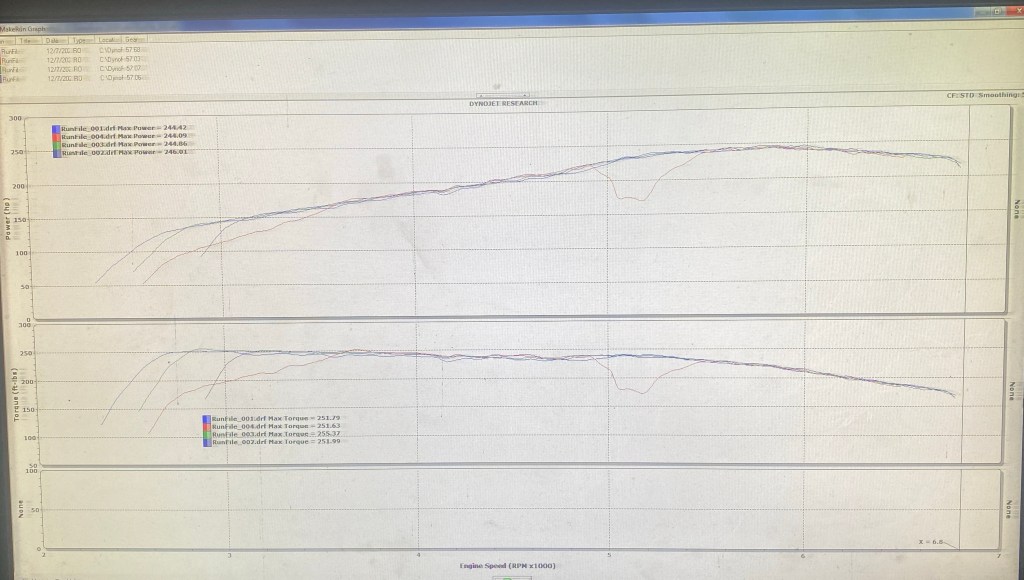
I dyno tested all the engine modes and they put out the same power. Eco mode is supposed to limit boost pressure, but it doesn’t make a difference on my car. I got 244 hp at the wheels on a Dynojet, and that’s 10 more than I expected.

Someone said the different engine modes don’t change power, they change how the engine responds. But given how the modes are identical on the dyno, I’m skeptical, I’ll A/B test engine response on track and see what the stopwatch says.

Finally, there was a recent software update that changes a bunch of things in the N Custom mode. I like the new layout, and appreciate that Hyundai is still making updates to a car they discontinued. I keep the updated software on a keychain USB drive in case I meet someone with a EN, KN, or VN that hasn’t made the update yet.

Track warranty

Arguably the best reason to buy a Hyundai is for the 10-year powertrain warranty. I bought mine as a Hyundai-certified pre-owned car, and so I’m covered until November 2032. I also upgraded to full bumper to bumper coverage, and so if anything goes wrong with my car in the next eight years, someone else is fixing it. And because this is a N car, the warranty extends to track use.

In fact, I’ve already used the warranty. The engine blew up on track at Waterford; Hyundai picked it up at the track, fixed it, and delivered it to me 500 miles away. They even paid for the rental car to get me home. I suspect in the next 8 years I will be using the warranty again.

Hatchback life

There aren’t a lot of sports cars that have enough room to transport a set of tires inside the car. Of course most 4-door sedans can do this, with two in the boot and two on the rear seats, but how many proper track cars can swallow a set of slicks? The Subaru-Toyota BRZ-86 was apparently designed to carry a set of track tires in the back, and I’ve seen four tires disappear inside a BMW 1-series. So I imagine that most BMW coupes can manage this as well.

Hatchbacks have the advantage here, and when you fold down the rear seats, even a diminutive MINI Cooper can carry four tires inside. But can you name any track car that can transport eight tires inside? With the space-saving Modern Spare in the well and one on the front seat, that’s actually nine!

Shocker! Seven in the back and one in the front.

The first time I went down to the A2 wind tunnel, I transported three splitters, five wings, two spoilers, a diffuser, boxes of tools, spares, and other parts inside the car and drove the 10 hours to Moorseville. Try that in any other car you’d actually take to a wind tunnel.

That’s a lot of junk in that trunk!

And if this wasn’t enough space already, I added a trailer hitch so that I can use a cargo tray or small trailer. The Veloster trailer hitch was designed for the base model Veloster, and required some modifications to fit my car.

Aerodynamics

My Veloster has been to the A2 wind tunnel twice, and now I know more about hatchback aerodynamics than I ever dreamed I would. The OE body has a drag of .416 and makes a tiny bit of downforce, which is pretty surprising, since most cars make lift.

Front downforce was easy to get, and even a flat splitter made 135 lbs of downforce at 100 mph. My curved splitter made 195 lbs, and coupled with upper and lower canards and hood vents, total front downforce was north of 300 lbs. And this is without cutting vents into the fenders or extracting air behind the wheels, which you would do on a proper race car, but I may never get around to on a daily.

At the other end of the car, wings didn’t perform as well as I expected, and even the Kamm-back shape is a compromise over a proper coupe or fastback. As such, most wings up to 55” span had lift-to-drag ratios less than 4:1. A 70” Wing Logic gave the best results at 7:1, which is more a function of the wingspan than the shape of the wing; it’s obviously important to get the ends of the wing into clean air where they can get away from the hatchback roofline.

If wings were disappointing, spoilers were a revelation, as they made both front and rear downforce. (Wings reduce front downforce through leverage; Spoilers aggregate pressure over the l roofline, and some of that is in front of the rear wheels.) Spoilers can’t get as much total downforce as a wing, but they work surprisingly well if you’re not going to add a splitter.

The biggest surprise was that adding a 1” Gurney flap on the OE N spoiler gave a better L/D ratio than all but the largest wing.

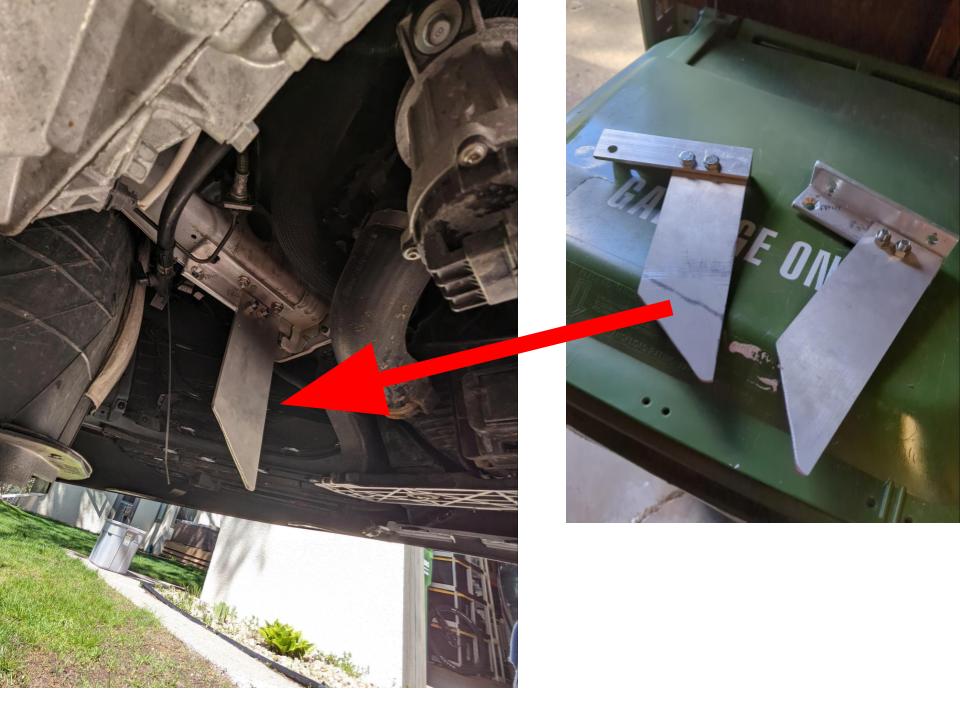
1” angle aluminum Gurney flap. In the wind tunnel I used duct tape, here it’s fastened with rivets, and in the future I’ll drill those out and use rivnuts for easy on/off. Notice I also added slightly taller end plates, but I didn’t do that in the wind tunnel.

At 100 mph, the OE wing makes 30.8 lbs of downforce and loses 2.5 hp due to drag. With the wicker-kicker it makes an astonishing 123.6 lbs of downforce and uses 8.3 hp. (These numbers are compared to the base model, which has a roof extension, but no wing).

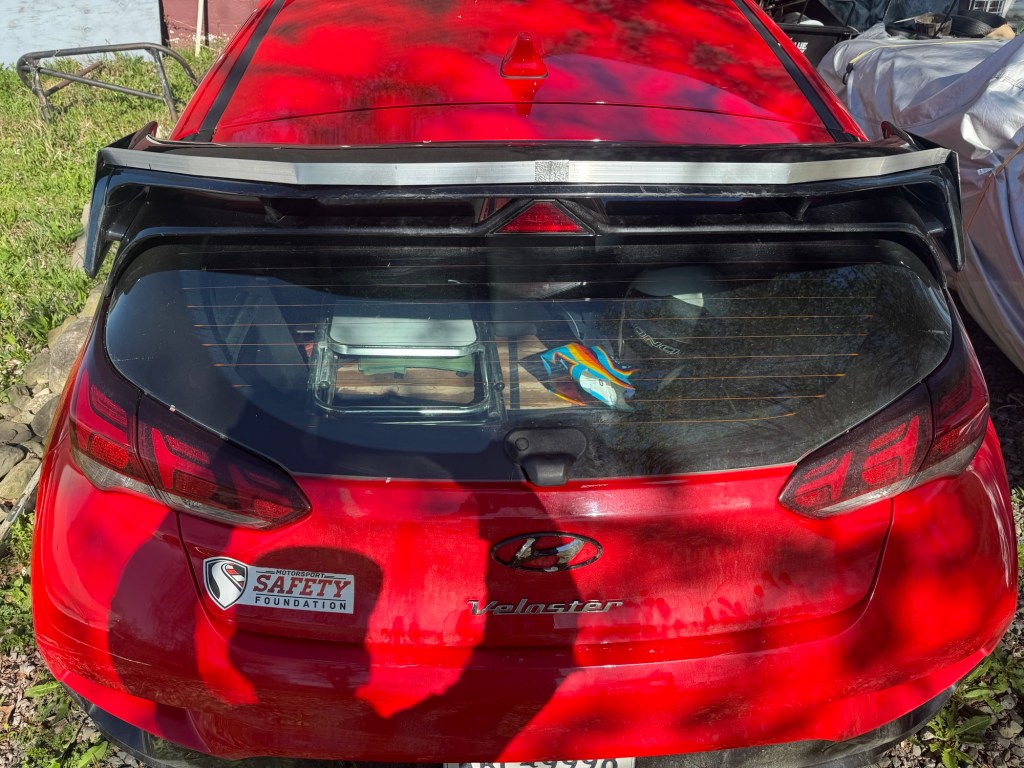
Rear view of wicker, kicker, Gurney flap. I’ll probably paint it black at some point in the future.

The Gurney flap information isn’t (yet) in my wind tunnel report, but there’s over 50 pages specific to the Veloster N, going nose to tail on aerodynamic parts, simulated lap times, and a lot of discussion.

I also did some practical testing of wings and spoilers at Pineview Run and NYST. The short story is that my Veloster went 2.5 seconds faster with rear downforce alone. Given that, I wouldn’t even bother adding front downforce unless you have a really significant wing to balance it out.

Conclusion

In the past year and a half I’ve done probably 30 track days in my Veloster N; I’m still smiling. It’s got enough cargo capacity for everything I bring to the track, and a comfortable ride that makes long-distance track treks a pleasure. It has adequate power, and handles better than it should. Even on track like Pineview, which has a lot of long corners and uphill switchbacks that punish FWD cars, it’s fast and fun to drive.

As track cars go, it’s economical. It doesn’t need expensive brake pads or ultra grippy tires, and seems to work just as well with mid-performance items. If you want to keep the warranty, you can’t modify engine parts or tuning, which leaves very little to spend money on. Except gas, as it is pretty thirsty.

The funny thing is, I’m actually looking forward to when the car is out of warranty, and I can install a bigger turbo. With a larger turbo, all the bolt ons, and a ECU tune, it might get down to a 10:1 lbs/hp ratio. Then I’ll gut it, cage it, and race whatever dumb series will have me. But I’ve got 8 years of wringing the snot out the stock engine, and I’m not at all disappointed with that.

I daresay I’m forming an emotional attachment to this car! It’s the amalgamation of so many cars I wanted and never bought: It’s the Honda CRX I pined for in college, but modernized and powerful; It’s the later CR-Z with double the power and nearly the economy; It’s the 3-door cousin of a MINI Clubman JCW, but with better aerodynamics; It’s as weird as the M Coupe “clown shoe” I nearly bought, but easier to live with.

And it’s so much fun! I love tossing the car into an early apex, forcing it into a four-wheel drift, and then digging it out with the front wheels. It’s Miata like, in its combination of economy and ability to bruise egos everywhere it goes. If you have a BMW M car, Corvette, or Porsche, you’d better be a decent driver, because the hurt machine is coming though!

This is probably the last car I buy that isn’t an electric self-driving killjoy mistake, and so I’m going to continue to modify it for more fun. I’ve already removed the rear seats and put in a flat cargo floor. Next I’ll install a harness bar and race seat. Sometime this winter I’ll figure out a DRS dual wing, because hitting a button on the straights is a plus one to fun. And maybe I’ll hook that up to an adjustable splitter as well. Let’s see what happens in 2025.

As if the car needed more space.

Veloster N Lowering Springs, Splitter, and Diffuser Undertray

Earlier this year I installed ARK lowering springs, which lower the car 1.25” front and 1.15” rear. I chose ARK springs because they are only slightly stiffer than OE springs (134% stiffer front and 125% rear), and that should allow me preserve the Veloster’s decent road manners. Most lowering springs have a higher spring rate than ARK’s 263 F and 336 R, and would beat the shit out of me on potholed New York roads.

I chose lowering springs over coilovers mostly for the price ($250 on FB marketplace), but also because I like messing around with the OE shock settings. I set my N Custom mode for medium stiff suspension when on track, but can quickly soften the suspension on the touch screen, for rain or street.

Lowering springs alone can reduce roll stiffness and increase bump steer, so they aren’t always a performance benefit. So I also installed the Whiteline front roll center bump steer correction kit. As near as I can tell, the combination of lowering springs and Whiteline kit have improved the handling, and I don’t feel a hint of bump steer or any negative handling traits.

I tested the lowering springs in the A2 wind tunnel, and it resulted in less drag and less downforce than when the car was on OE springs. If you’ve read my wind tunnel report, you’d know the Veloster makes a little bit of downforce, straight from the factory. With the lowering springs, this turned into a small amount of lift, mostly on the rear. That was surprising, as I expected that lowering the car would increase front downforce, but the front also lifted a little.

Lowering the car also reduced drag, which was probably a result of less frontal area and less air going under the car. It’s not a huge change (.014), but the result of both drag and lift shows a very, very slight aero advantage over the base car.

One caveat is that I didn’t use the same wheels and tires on my second trip to the wind tunnel. I made a mistake and had my track wheels and tires (18×8.5 +43 with 235/40R18 tires) rather than the OE wheels I used on my previous trip to the wind tunnel (19×8 +55 with 235/35R19 wheels). This put the tires 18mm (3/4”) wider on each side, and could account for some of the difference in lift, but not drag reduction.

New splitter mounts

I also improved the splitter mounts both in front and in the rear. I placed the support rods further apart on the bumper, which reduces the angle of the rods. The rods are turnbuckles from the Lowe’s racing department, allow easy height adjustment, and with 3/8” bolts, are plenty strong.

I also made a new aluminum rear undertray and added a full width piano hinge to it. Thus, the entire splitter can be adjusted via the splitter rods, which changes the height and angle of attack on the splitter.

Splitter has wider support rods and a hinged undertray.

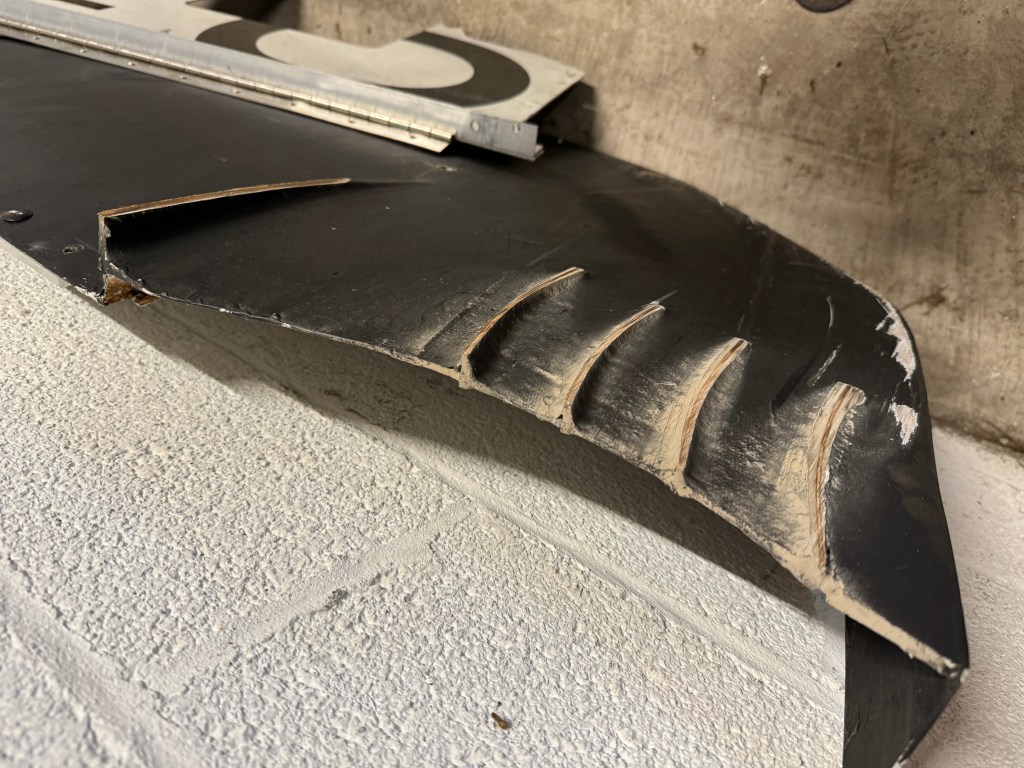
But the lowering springs are too soft or too low, because the splitter touches down on bumps and compression turns. In fact the vortex strakes I put so much work into have now been ground down to insignificance.

Vortex strakes clearanced out on the asphalt grinder.

I figured I have three choices going forward:

  • Revert to OE springs – The lowering springs aren’t much of a performance benefit, and if I had to do it all over again, I wouldn’t.
  • Coilovers – Digressive coilovers with heavier springs would swallow hard bumps on the street and curbs on track, while allowing stiffer springs. I’d also be able to corner balance the car, and change ride height. And I could still change suspension compliance, just not from the touch screen.
  • Remove the splitter – It’s been grounding out on steep driveways and on track, so I could just remove it. But I want more front downforce, damnit! Can I have my cake and eat it, too? What if I made a front undertray that fits exactly the same as the OE undertray, but has a built in diffuser? Hm….

Diffuser undertray

Digressive coilovers are the obvious choice going forward, but for the sake of experimentation and another DIY project, I decided to make an undertray with a diffuser. This won’t make as much downforce as a splitter, but it’s also completely tucked up and won’t hit anything, and invisible from the outside.

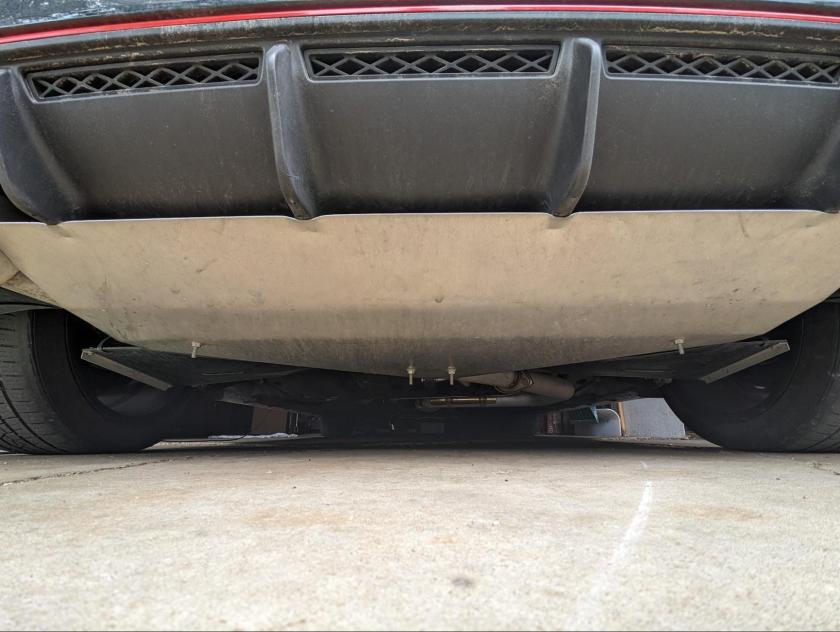
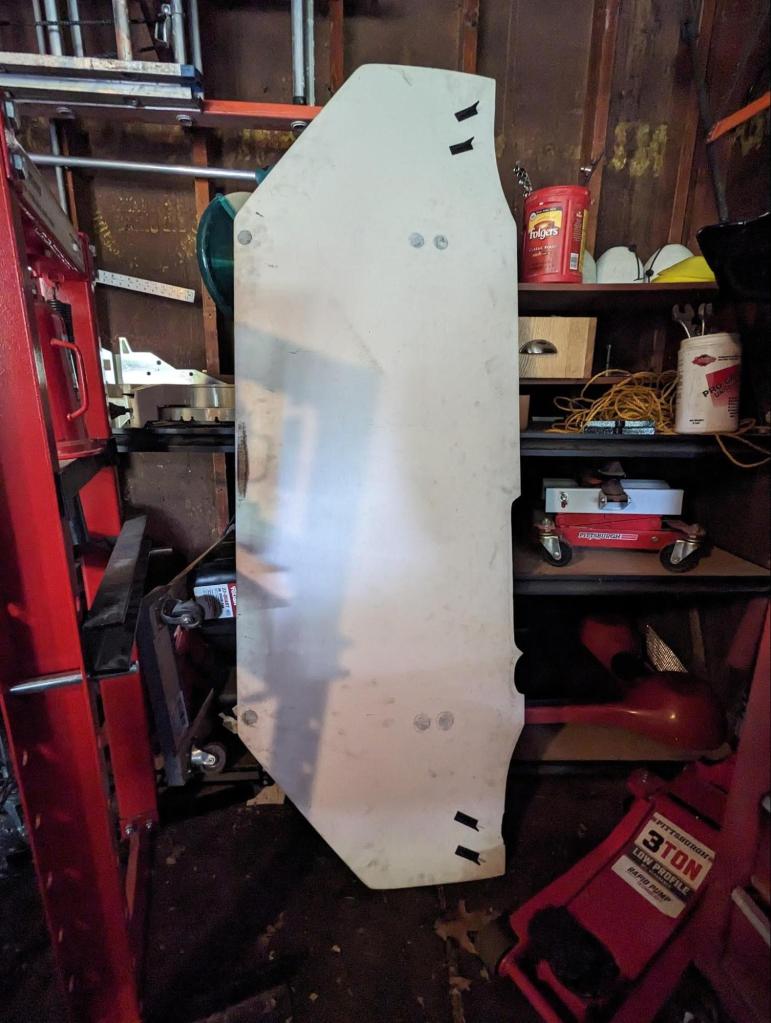
I started by tracing the OE undertray onto scrap aluminum. A single piece of aluminum would have been best, but I didn’t have anything 63” wide, so I pieced together three street signs. I get street signs from my local metal recycler for $1 per pound, and so this represents about $10 in materials.

I then cut out the general shape and drilled the mounting holes. To create the curve of the diffuser, I clamped the aluminum down to the table and alternately leaned on it and tapped with a hammer to create a curve. It looks like a single bend in the picture, but it’s actually three bends, with a gradual radius.

Diffuser kick is gradual.

There are little aluminum ramps, sort of a Z-plate, that connect the flat portion in front of the wheels to the curved section in the middle. You can see those little triangles in the previous (blurry) image. These are fastened with rivets.

Aluminum signs riveted together.

I guessed at the shape and length of the diffuser, and guessed wrong. It took a few tries to get the shape of the trailing edge, because the oil pan and intake plumbing are in the way. While doing that trimming, I also decided to add a hole for oil filter access. I later taped over this, and so accessing the oil filter is as simple as removing the tape.

Final shape of undertray, compared to OE.

The undertray attaches at the OE mounting points, but I replaced the plastic pop fasteners with 6mm speed clips. I used long countersunk Allens for the four bolts that attach to the radiator bracket. It’s fuggin solid.

How will it work? It’s hard to say, but I’ll make a guess. A flat splitter was 132 lbs of downforce at 100 mph, while the curved splitter was 163 lbs. So the diffuser portion alone might be 30 lbs of downforce, and when coupled with the differential in front pressure… let’s call it 60 lbs of downforce.

Splitter curvature (and/or vortex strakes) also contributed to a significant reduction in drag (.019) that resulted in a gain of about 3 hp vs the flat splitter. So the diffuser undertray may have some drag reduction, as well.

As DIY projects go, this was a satisfying one. It cost me $10 in materials and was finished by lunchtime. It weighs only 2.5 lbs more than the OE plastic, and is just as unobtrusive. The diffuser likely confers a performance benefit in both downforce and drag, and would probably pass scrutiny for a street (unmodified) class. I’ll take that as a win.

There are some racing rules that specify a flat splitter, but say nothing about the undertray (SCCA STU, for example). A clever person could add a flat splitter in front of this type of undertray, and get the full benefit of a fully curved splitter, while also adhering to the written rule. Likewise, there are some racing rules where a splitter costs some performance points, but you can add an airdam and (unspecified) undertray for less. Undertray diffusers FTW!

Veloster N Aero Success Story

This is a guest post from Dan Ayd, chronicling his adventures in performance driving and aerodynamics.

I love tracking my Veloster N. However, the specter of losing control, either by incompetence or mechanical failure, terrifies me. So over the past three years I’ve been gradually improving my car’s aero, and my driving skills. 

I primarily participate in an annual high performance driver education (HPDE) hosted by the Minnesota BMW CCA chapter at Brainerd International Raceway (BIR) using the 13-turn competition course. This club runs an extraordinarily safe and well structured event over the course of three days in the first week or so of June in northern Minnesota. 

The first year, 2021, I had just gotten this car and my goal was a two minute lap measured by my Apex Pro. In 2022 I upgraded tires from the 300 treadwear OEM Pirelli PZero rubber to Nitto NT05. These are old technology, but a tried and true weekend-warrior 200TW tire, back when that rating actually meant something.I also had an alignment done changing front from 1.5° to 2.5° negative camber, and zeroed toe both front and rear toe. These changes brought my my best lap down to 1:58. 

In 2023, I got down to a 1:56.42 with only the addition of a 22mm Whiteline rear anti-sway bar. It’s unlikely this addition was responsible for a 2 second improvement so I will chalk this up to an excellent instructor, Rory Lonergan, who is an outstanding FWD-car driver, for making inroads on my skills. 

In 2023 I also started exploring car aerodynamics, mostly because of Turn 2, a flat, high-speed right-hand sweeper. I tried focusing on braking points, turn in, apex, and track out, but I found myself highly inconsistent with entry, maintenance, and exit speeds. I’m sure this is in large part due to my lack of practice–only coming to this track for two days of lapping a year isn’t enough to really improve, except in qualitative aspects like comfort with speed, noise, flags, traffic, etc. Despite the data showing manageable G forces, I simply didn’t trust the car, so I’d arbitrarily brake and/or lift at a safe speed below 100 mph. 

Turn 2 Bugaboo.

The data showed only 0.7-0.8 lateral Gs and I knew from looking at other corners, the car was capable of much more than that, more like 0.95. I never looked down at the speedometer to know how fast that was, but looking at the lap data I usually arrived at that turn around 116-117mph. There was so much going on still on the track that I didn’t have the mental currency to focus on details. I felt that by adding some aero, I could not only reduce the speed by increasing drag, but also increase lateral grip to the point that the turn would become no-lift. As in, I could floor it from the exit of turn 13 and not decelerate until braking into turn 3 almost a mile later.

I was only familiar with aero in terms of making the car slippery, but not how to use downforce to increase grip. After watching some YouTube videos by Julian Edgar I bought his book and was inspired to make a flat floor beneath the lumpiest part of my car, the rear third. 

The Veloster N comes with a front undertray that’s quite smooth and it joins up to a center section at the passenger footwells that are also quite smooth. Once past the fuel tank the exhaust and suspension are hanging in the wind followed by a stupid cosmetic “diffuser” that is probably only good at acting like a parachute. I felt that Julian’s MPG-chasing aero concepts could help here at little cost and almost zero impact to weight and aesthetics. 

I purchased sheet aluminum and wrapped the entire muffler and extended it over the edge of that parachute. I also fashioned some ABS sheet plastic covers over the control arms, and included a strake to maybe keep air going straight. I picked up a couple miles per gallon in subjective highway fuel economy, but I saw no improvement in Turn 2. 

Everyone who follows Julian Edgar’s advice wants to make a flat floor; they also seem to get the same flat results.

I shared my mods with the forum on www.velostern.com, and one of the members pointed out to me that someone he knew was buying a Veloster N and would be writing about it on his blog while he “aeroed the shit out of it.” Through this networking I met Mario Korf, and when he began writing about his Veloster N, I started following his Occam’s Racer website, reading all of his posts, messaging him directly, and listening to his guest spots on club-racing podcasts. 

What I started learning was that most street cars, especially hatchbacks, create lift rather than downforce. However, the folks at Hyundai poached Albert Bierman from the BMW M division, and with his guidance, they created a car that actually creates downforce, right from the factory. 

The use of the flat undertray and the wing-like OE spoiler resulted in car that didn’t lift at speed, and had minor amounts of downforce. Based on his session at the A2 wind tunnel in North Carolina, Mario opined that there would be huge gains to be had with a big, properly designed splitter and a wing out back and up in clean air. 

Ok, I’m in, but how do I make this stuff? I hadn’t a clue. After purchasing his wind tunnel report, reading his blog entries from the archive, and peppering the poor guy with hundreds of texts I began formulating a design based on his wind tunnel splitter.

I started by getting a 4×8 foot sheet of 5mm Meranti plywood from a local boating store. I set to work measuring, cutting, and gluing three layers together and cutting the laminated structure overnight under the weight of my car in a curved shape to resemble a wing. This was Mario’s theory of making the entire width of the splitter a diffused surface. 

Laminating the splitter and adding thickness to the leading edge, so that it can be properly rounded on the underside.

Once dried solid, I used a belt sander and began sculpting the underside of the leading edge to be rounded to keep air attached and flowing smoothly. I tapered the end to combine with the curve to reach about 13° of upward rake under the car mirroring his least draggy splitter design. It measured 67” wide and 24” long. 

The trailing edge sweeps upwards at about 13°.

I used Professional Awesome normal 6” long quick release brackets connected to custom rear vertical supports I made using clevis-cotter-pin quick releases of my own making along with their carbon splitter rods up front. These were extremely secure and allowed a small amount of angle and height adjustment.

Custom splitter brackets use Pro Awe quick release mounts.

I set it to have an upward tilt of 0.6° at the front and a height of about 4” from the ground. I initially tested the splitter in daily driving, and it seemed to reduce drag by about 10%. According to Mario’s data, it should be good for about 150# of downforce at 100 mph.

The Veloster N is aerodynamically balanced from the factory, and so adding front downforce alone would be a disaster on track; I had to add a wing. Getting a wing high enough or far enough back to get into something resembling clean air on this car isn’t easy. With the sloped glass and weak plastic shroud there’s not much support for 100 pounds of downforce without drilling holes in metal to support gaudy uprights, and I prefer a cleaner, less Ricky Racer aesthetic. 

Mario and I passed ideas back and forth as I iterated in my head. When I was in upstate New York for work he invited me to join him at his home track, Pineview Country Club, for a coaching session in his car.

Dan flogging Mario’s car at Pineview Run. You can read about that in How Experience Level Affects Lap Times.

Upon finishing, he surprised me with a gift of the wood prototype roof piece he made for a wing mount. When I got home I needed to modify it slightly to ensure air would separate cleanly above the rear window so I added a layer of Meranti plywood, sculpting and smoothing the enlarged structure so it would look good enough to make Mario proud. Now I needed to mate metal to wood attaching the wing to the car with solid and reliable uprights.

Hatchback roof extension is bolted in place and holds the wing securely.

After several rounds of mental iteration I settled on plate aluminum uprights like an F40 Ferrari with a Performance Car Innovations (PCI) V2 airfoil 48” in length. At the height I selected, 9” at the rear, 7” up front I expect it will produce around 80 lbs of downforce at 100mph. This was one of the wings featured in Mario’s wind tunnel report although slightly shorter. If I needed more downforce, I could add a 1/2″ Gurney flap and get around 120 lbs. Those figures are based on his wind tunnel testing, and should be pretty accurate.

Because the Veloster roof slopes downward, I needed to verify the proper wing angle. The folks at PCI said the wing would start stalling at around 10°. So I did tuft testing on the wing and discovered that the 3.5° angle of attack resulted in some stalling at the rear edge of the wing. So I slotted the rear holes and flattened the wing to 2.7° from horizontal, and the wing now has full attachment. 

Tuft testing to find the maximum angle before separation.

The Veloster N has about 65% percent of its weight on the front wheels, and the typical formula is to match aerodynamic balance with chassis balance. However, you’ll recall that I added a thicker rear sway bar and significant amounts of front camber, and thus moved the mechanical grip further forward. This is not good for a doofus like me, on a track that has a 100 mph turn! 

By biasing the aero at 55/45, the car transitions more to understeer the faster I go. This makes me feel safe and helps me focus on braking, turn-in, apex, and track out. Since my track car is my daily driver, this is extra important. 

Overall, the car looks pretty badass in my opinion, and the aero parts are sturdy. I can stand on the splitter. I can lay on top of the wing. This homemade crap is strong, even if it seems a bit weird to put plywood on a car!

Looking great on the track and on the street.

And at the track, the shit actually worked. Over the course of 8 sessions, or almost a hundred laps, I felt increased confidence in turn two, and the data bore this out. Lap times plummeted from 2023’s best of 1:56.42 to 1:52.42, a staggering drop of 4 full seconds. Mario predicted about 2.5 from aero alone so let’s say the additional seat time and coaching (it was a driving school after all) was responsible for the other 1.5 seconds. 

Looking closer at the data between 2022 (pre-aero) and 2024, my minimum speeds are still very inconsistent, but there are glimpses of what a new personal best if I could string them together. Slow, difficult turns like 3 and 13 were a mixed bag, and aero has little impact. The biggest benefits of aero seem to occur at turn 2, where I’m going 8 mph faster, and turn 4, where I have an additional 6 mph. In the S-turn (turns 10/11) I picked up sometimes 8 mph. I’d wager there’s another 2-4 seconds, but we’ll see next time out on the track.

T2,and T10/11 are the biggest wins.

This adventure in aerodynamics has been a huge success. My car is faster and safer, and along the way I’ve gained a friend in Mario. I’ve learned new skills in woodworking, and stoked a desire to fabricate with metal as well. Time at the track has added other friends and given me great memories, so anything that extends that is great in my book. Cheers to aero!

Veloster N Engine Modes Dyno Tested

The Veloster N has three power levels and three exhaust sound settings, which you can customize to your liking. There is also an economy mode that limits boost pressure and should provide better fuel milage. But how much do these modes differ in power output?

The N Custom mode shows the engine and exhaust sound have three settings each.

I wanted to know, so I went to Overdrive Automotive in Johnson City and had them dyno my car. (Side note, if you are in Central or Southern NY, I would highly recommend Overdrive for tuning your Megasquirt or whatever, they know Miatas really well.)

The rollers are at ground level, so the car is lifted up for dyno testing.

I didn’t test all the modes, figuring it was most important to get the data for the lowest and highest power settings.

  • Eco: This mode is supposed to limit boost pressure to 6-7 psi and return better fuel milage. I believe this is a separate setting than the lowest engine mode available in N Custom mode, so I selected this mode from the preset modes on the steering wheel button.
  • Normal: This is the lowest setting in N Custom mode, and probably the same as choosing Normal mode from the presets. This is the mode I use for all street driving (or when I’m on track and forget to turn on N Custom).
  • Sport: I didn’t test the tune in between Normal and Sport+. I didn’t test the middle exhaust setting either.
  • Sport+: This is the highest engine setting, which I initially set with the quietest exhaust, because I don’t like pops and bangs or loud pipes.
  • Sport+ with exhaust: Same as above, but with the exhaust in the loudest setting. This mode has the burble tune and exhaust valve open, and should show the highest power output.

Note that this test was done on a DynoJet, and so all readings are corrected for elevation and temperature. The engine is bone stock and has about 4000 miles on it (it was replaced once under warranty).

Shockingly, the dyno recorded virtually identical power output in each mode. Even in the green Economy mode, which is supposed to limit boost pressure, the dyno read 244 hp and 251 ft-lbs.

244 hp, 251 ft-lbs

Notice there’s a dip in the chart at one point, the dyno operator said this was likely the ECU pulling timing for a second to deal with heat. The engine was in Eco mode on this pull, but you can see that just a second later the engine picked back up again and posted identical numbers to the other modes.

244 hp is about a 12% drivetrain loss, which is better than I expected. But note that the car was going into winter storage, so I filled the tank with ethanol-free 90 octane, and it may make more power on 93, and even more when the engine loosens up.

What do the engine modes do?

Given that all modes made the same amount of power, the next question is, do the engine modes do anything at all? Knowledgeable people in the N world have stated that the different tunes change the engine’s responsiveness and boost targets in the mid-range, rather than max power. Other sources suggested that the engine modes are only different at partial throttle.

Maybe that’s true, but what about Eco mode? From every account I’ve read, nobody is actually getting better fuel mileage in Eco mode. One source claimed Eco mode only works in the UK. Or that Eco mode is different on different platforms, and limits Velosters to 12-13 psi, but Elantras are limited to 6-7 psi. Well one thing is for certain on my car, either there is no low-boost mode, or all modes are low boost.

Next let’s talk about the tunable exhaust. It did add loudness, but without adding power, I don’t see the point. I like to hear my tires working, it helps me drive at the limit. And so louder pipes just limit my driving.

Finally, there’s the pops and bangs of the burble tune. Internet pundits claim this is to keep the turbo spinning, so that there’s less turbo lag between shifts. I can’t confirm or deny this, as dyno pulls are done in one gear, and so lag (or the lack of lag) doesn’t show up on the dyno. I have a manual transmission, and so I could see this being useful if I missed a shift, but for someone with a 8-speed DCT, I’d question the usefulness of the Rice Krispies soundtrack.

Next year I’ll test the different modes on track and see if I can determine any difference in the data. It may be difficult to ascertain that through the noise of driver error, but we shall see what the Aim Solo data logger says.

At this point, all I can say for sure is that there’s no difference in power or torque in any engine mode or exhaust setting.

Novice vs Advanced: How Skill and Experience Level Affects Lap Times

I recently had an opportunity to put three drivers of different experience levels in my Veloster N, and have them drive the same track on the same day. I logged the data on my Aim Solo, and by interpreting that in Race Studio we can see exactly how each driver went about their business.

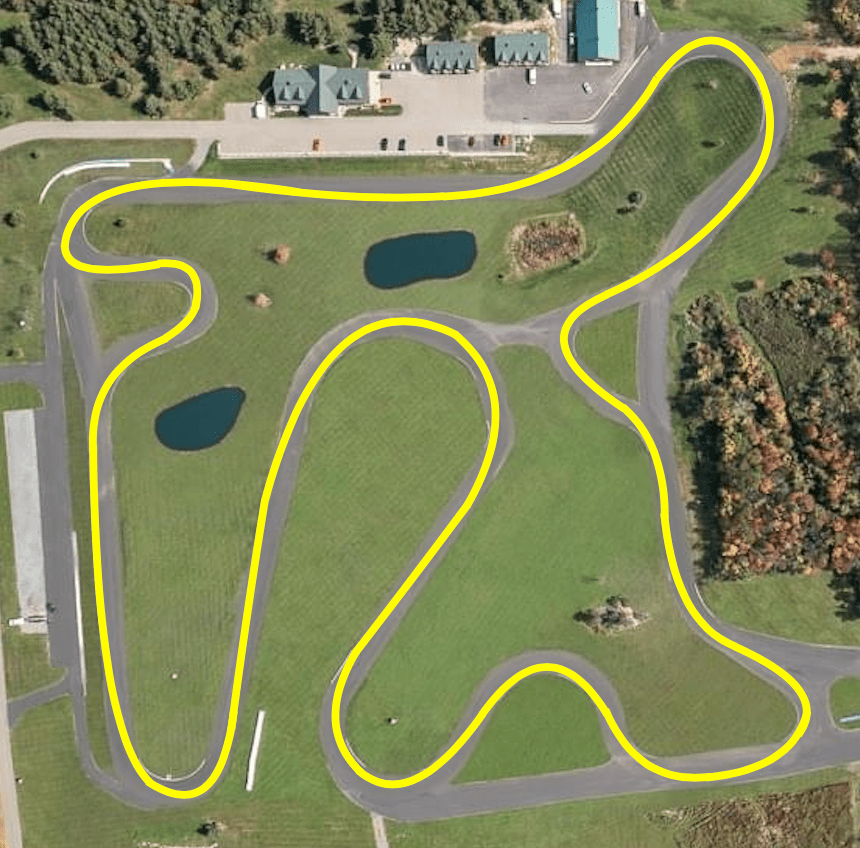
The track is Pineview Run’s short course, and on the driving line, this is just shy of a mile long. Most race tracks are going to be double the size, so keep that in mind when I talk about time deltas.

Pineview Run short course.

The car is my Veloster N, completely stock except for the base model’s roof extension, rather than the Veloster N’s spoiler. I removed the spoiler for scanning purposes, and it wouldn’t change any of the results here. Because it was late in the season, I’d put the my track tires in the basement, and so the car was on Linglong Crosswind all-season tires. I don’t believe this affected anything in the test, but it would be interesting to see the results on a proper track tire. Maybe next year.

The drivers

Let’s meet the drivers:

  • Green – Dan is a novice driver who has done a couple HPDE weekends, as well as a couple Track Night in America events. He’s recently been signed off for solo driving, and after looking at his data and watching him drive, I can confirm he was ready to graduate. His threshold braking is pretty good, and he has acceptable inputs and awareness. Dan also has a Veloster N, and so it was easy for him to get in my car and go quickly. The track, however, is all new to him, and so it took him a few sessions to throw in a hot lap. In the data, Dan has the green lines because, well, he’s green.
  • Red – Jack is an advanced level driver who races in Champcar. He’s an aggressive driver, and so I’m giving him the red colored lines in the data, to signify the red mist. Well, it’s not really red mist, it’s just a driving style that’s reminiscent of a couple other teammates, Ben and Danny. All three of them break traction early in the corner, and then make multiple fast steering corrections to optimize grip, trajectory, and acceleration out of the corner. This style looks aggressive (and exhausting) on video, because it requires many quick inputs, but it’s actually a very calculated and effective way to go fast. Jack has also never been to this track before, and he’s also never driven a FWD car on track, either.
  • Blue – I’m the blue lines on the speed trace, because blue signifies cool. Not because I’m a cool cat, but because I drive with a cool head and have a smooth and economical driving style. I admit that the aggressive drivers I’ve mentioned (Ben, Danny, and Jack) are all a bit faster than I am over the course of one lap, but during an endurance race stint, my style is much less abusive on the car, tires, and driver. Because of that, I get into less trouble than anyone I know (3 black flags in 11 years/26 races, and only one was my fault; pat-pat). My big advantage versus the other two drivers here is that I know the track well, because I literally wrote the book on it.

So now we know who the drivers are, we can ask these questions:

  • How much does driving experience affect lap times? If we compare the Green and Red drivers, we’ll see that the advanced driver goes three seconds faster than the novice. This is mainly down to three factors, which I’ll explore below.
  • How much does track familiarity affect lap times? For this we’ll compare the Red and Blue drivers, and see that track knowledge (and car familiarity) makes a difference of 1.35 seconds.

Novice vs advanced

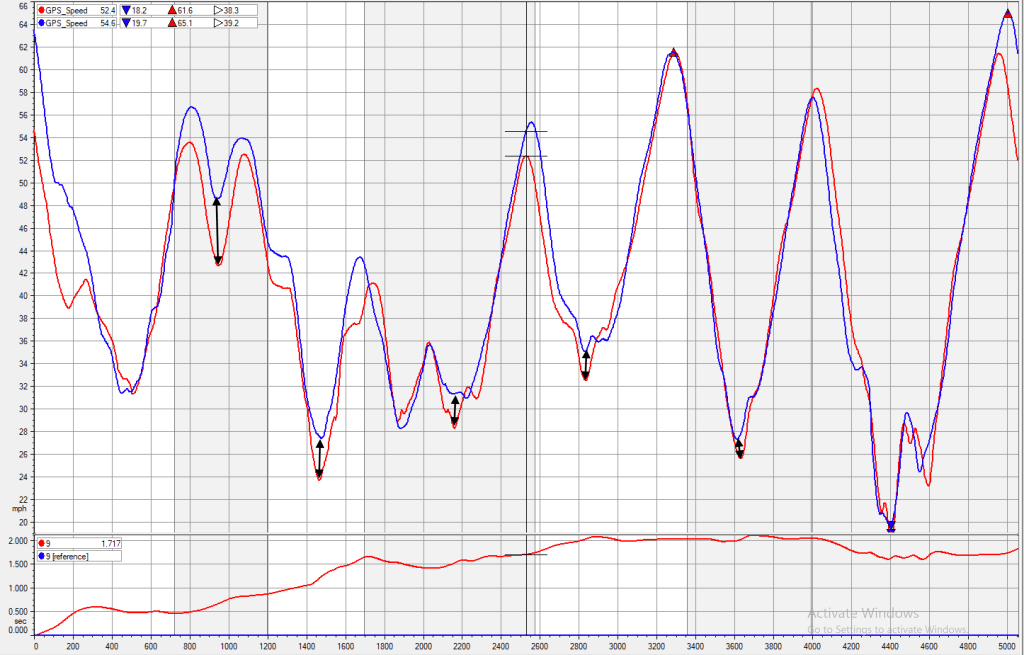
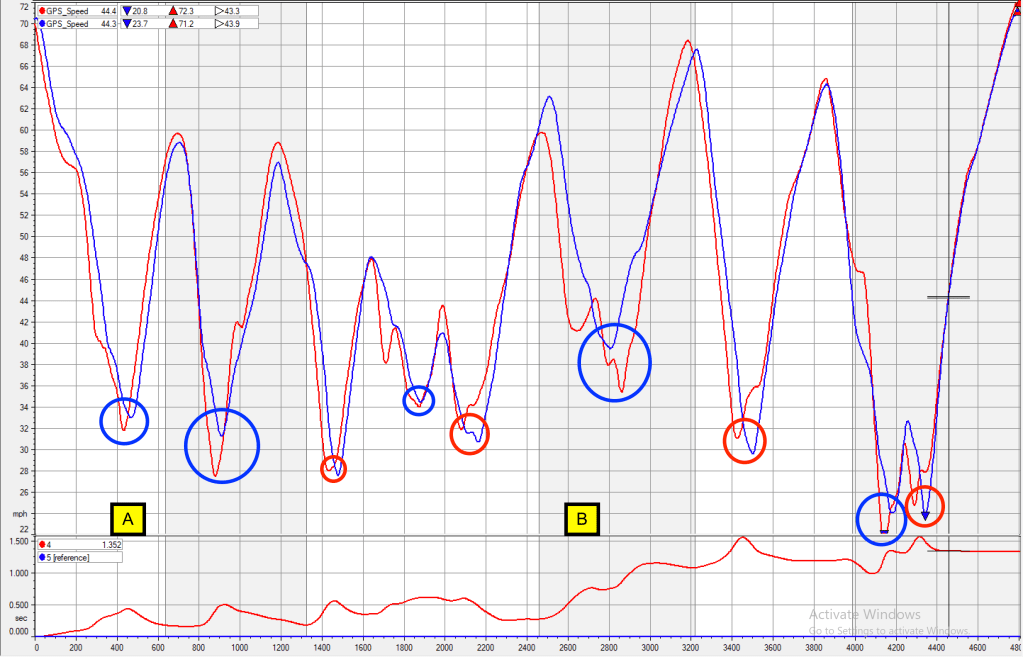
The first thing we’ll take a look at is how a novice (green) and advanced (red) driver approach a track that’s completely new to them. I’ve put three callouts on speed trace.

Novice = Green; Red = Advanced

A – Novice drivers are taught to brake in a straight line, and so the speed trace shows straight lines on deceleration. As drivers progress in skill, they learn to release the brakes while they turn in. This is called trailbraking, and results in a speed trace that has a “hockey stick” shape. You can see this at point A. Trailbraking picks up a small amount of time in the braking zone, but more importantly, it allows the car to be pointed down track earlier, so the driver can get on the gas earlier.

B – Another trait of advanced drivers is that they “back up the corner.” This means that braking and turning are done earlier, which allows them to get on the gas earlier. On the speed trace, I’ve drawn green and red vertical arrows that show the point where the driver has committed to full throttle. In most corners, you’ll notice that the advanced driver is to the left of the novice driver (backed up). The best example of this is at the 2200′ mark, where the advanced driver is at full throttle 100′ earlier than the novice driver; that’s over 7 car lengths earlier! The result of this is that the advanced driver gains 6/10ths of a second before the next braking zone.

C – Another telltale sign of an advanced driver is a higher minimum speed, or vMin. I’ve drawn two horizontal arrows here, and in this spot the advanced driver is going 5.5 mph faster than the novice driver, at the slowest point in the corner. If you think about it, this is really an 11 mph difference, because the novice driver slows down 5.5 mph more, and then has to accelerate 5.5 mph more just to get back to where the advanced driver started. Novice students are taught to throw away corner speed for the sake of safety (“in slow, out fast”), but advanced drivers know to keep their minimum speed as high as possible.

Finally, it’s worth noting that the advanced driver not only had never driven a FWD car on track, but he only drove one 15-minute session. On the other hand, the novice driver owns the same car and did four sessions. This shows just how much skill and experience level matter. But before we move on, let me point out this novice driver is better than most novices, given the amount of track time he has. Put a first-time track driver in the car, and my novice is going to put six seconds between them, easily.

Advanced knowledge vs advanced

Next let’s take a look at how two advanced drivers go at it. As mentioned earlier, Jack (red) is probably a little faster than I am, but I have car knowledge (my car), and track knowledge (my country club).

There isn’t really that much difference between us. I have a slight advantage going into Turn 2, and hold that while we trade corners back and forth. Going into and out of the Turn 11 (2500′-3000′) is where I gain all my time. With a couple more sessions to figure out that corner, Jack would be a couple tenths off me. Take a look:

Youth and skill (red) vs old age and treachery (blue)

A – I’ve put a color-coded circle around each corner indicating which driver had the higher vMin. I have five to Jack’s four, but two of my corners are considerably higher.

B- Jack brakes too early, too deep, and gets on the gas 50′ later than I do. He loses about a second going into and out of The Knuckle. There’s more difference between us in this one corner than the rest of the track combined.

It’s really just that one corner that makes a difference, and it reminds me of another person who is faster than me everywhere but Pineview: my identical twin, Ian. You might know him from You Suck at Racing (blog | book). One reason he’s the fastest on the team is he’s always the fastest through the corner that matters the most. What we’re seeing here is the exact opposite, which is that if you blow an important corner, you blew the lap.

There is one other wrinkle here, which is that Jack was in the passenger seat on my run, but he did his runs without a passenger. Jack is about my size and build (5’11”, 180cm), and I would have gone a bit faster without 180 lbs of ballast. But I’m just grasping at straws here, and with more track time, Jack would eventually surpass me.

Conclusions

In the end, there’s a difference of over four seconds between the three of us, and this on a track that’s only a mile long. On most tracks, it’s safe to say the delta might be 8-9 seconds. Of all the mods you can do to your car, driver mod is the most important mod. And as you can see from the data, you bring that with you, to unfamiliar cars, and to tracks you’ve never driven.

All drivers compared.

Veloster N Driving Modes on Track

The Veloster N has five driving modes: Economy, Normal, Sport, N, and N Custom. Er… I think I have this right, I don’t know, because I only use two.

  • Eco – Economy mode limits boost pressure, but from what I’ve read online, it’s not any more economical. So I don’t use this.
  • Normal – I use Normal mode on the street.
  • Sport – I’ve never tried this, I don’t see the point.
  • N – I don’t use this, the suspension is too hard, and the pops and bangs of a burble tune annoy this shit out of me.
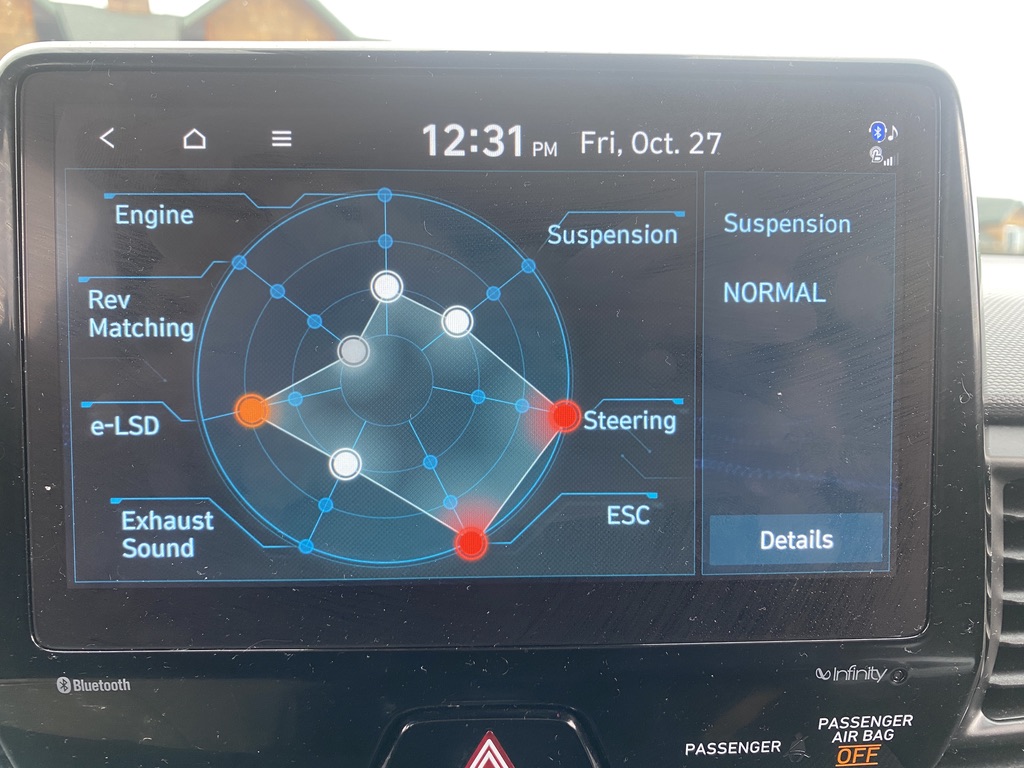
  • N Custom – I use this mode on track. I have the eLSD and steering on full, but pretty much everything else is turned off or on the lowest setting. No rev matching, soft suspension, no stability control, and the exhaust as quiet as it’ll go. For some unknown reason, I’ve also had the engine in the lowest setting all year, which should be a nice surprise when I select full power next year (actually, I later found out there’s no difference in peak output).
My N Custom settings.

I’ve driven my VN on track in both wet and dry conditions, and on good and bad tires. Now that I’ve had a chance to look at some comparative track data, I can answer some questions, such as:

  • Which driving mode is fastest on a wet track?
  • Which driving mode is fastest on a dry track?
  • How do all-season tires compare to a proper track tire?

Dry track: Normal vs N Custom

Since I only use the Normal and N Custom modes, I wanted to see how they compared on a dry track. My N Custom mode was 1.9 seconds faster. Woof.
Subjectively, the Normal mode sucks ass on the track. It takes the fun out of driving. The stability control is probably the main culprit, and switching to the N mode (on the fly) resulted in instant smiles from me and a “whoa” from my passenger. The way the car behaves is night and day different in N Custom mode. It’s astonishing.

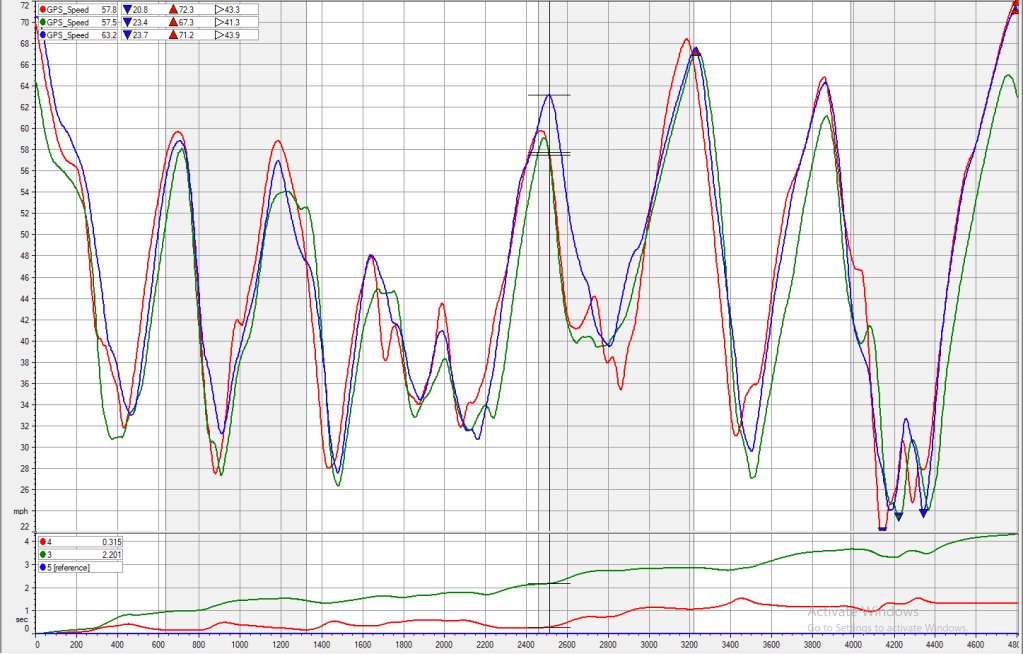
This immediately changed the way I drove, from trying to maintain a higher vMin, to backing up the corner. I don’t mean to throw jargon at you, so let’s take a look at the data and I’ll explain those terms. I’ve highlighted the the three most significant differences with letters.

Red is Normal mode, Blue is N Custom (nannies off).
  1. This is Turn 2, a right hand turn onto a short straight. You can see that the Red line has about 2 mph higher minimum speed (vMin), but when I get on the gas, the nannies nerf the acceleration and I only get .31 Gs of acceleration. The Blue line has .5 Gs of acceleration, which results in about a .4 second gain. This is entirely down to the car’s intelligent systems getting in the way of my driving.
  2. This is T9, another right hander, this one cresting a hill. By turning off the nannies I can rotate the car, which allows me to get on the gas 95 feet earlier than in Normal mode. We call this “backing up the corner,” and it means that I’ve done my braking and turning earlier in the corner. This allows me to get to full throttle earlier, and gains half a second.
  3. Notice here how the Blue lines are to the left of the Red lines, again this is backing up the corner, and doing that in the final turn is worth almost three quarters of a second as I cross the finish line.

What’s really interesting about this graphic is that I had no idea I was in Normal mode at first. I was driving with a passenger, chatting, and totally forgot to switch modes. Then suddenly I realized I hadn’t changed the driving mode. The Veloster N allows you to do this on the fly, and so part way through the lap I switched modes.

This allowed me to drive the car in a completely different manner. I could immediately feel the difference in the way the car behaved, and was able to extract a higher level of performance, and go 1.9 seconds faster. But I wasn’t aware of how differently I was driving the car until I looked at the data just now.
Wet track: Normal vs N Custom

I also got to try both modes on a cold, wet day. This was the same track with a slightly different configuration to avoid one of the big puddles. It was raining the entire time, and there was a lot of standing water on the track.

In N Custom mode, I spun the wheels a lot on acceleration, and had to short shift to third in a number of places. My best lap was a 1:28.838. In Normal mode, I managed a 1:28.592, but was still getting some wheel spin cresting a hill. So then I left it in third gear and did a 1:26.994. That’s a difference of 1.84 seconds, which is almost exactly the same difference the two modes had in the dry.

So that’s the ticket to going fast in a torrential downpour, put it in Normal mode and drive a gear taller.
The data below isn’t super exciting, the thing to notice is mostly the difference in vMin (or minimum corner speed). I’ve drawn little black arrows to show what I mean. When the nannies are on, I can maintain a higher speed in the middle of the corner, and this results in a faster speed down the next straight. The acceleration curves are about the same in N Custom and Normal, which I find a little surprising, and so I suspect that it’s the stability control more than the traction control that’s helping in the rain.

Red is N Custom, Blue is Normal mode (nannies on).

All-season vs track tires

I have three sets of wheels and tires: 235/40R18 Kumho V730 on Konig Countergram 18×8.5 +43 (42.3 lbs); Pirelli PZ4 235/40R18 on Motegi MR140 18×8.5 +45, (42.0 lbs) and Linglong Crosswind 235/35R19 all-season tires on 19×8 +55 OEM wheels (55.3 lbs).

The only reason I bought the Crosswind tires was because the OEM tires were worn out, and I was looking for the cheapest possible tire I could mount in the winter, while my summer tires are hibernating in a heated basement. I found the Crosswind tires on sale for $65 at Walmart, and expected absolutely nothing from them.

Just the same, I wanted to see what they would do on track, and I’ve been pleasantly supersized. They don’t suck. Because there’s not a lot of grip, they break away gradually, and slides are easy to control. Once sideways, the tires howl like a banshee, which helps you know how much you’re working the tires. Or overworking.

I’m leaning on these $65 tires so hard, they look like they want to come off the bead!

I haven’t tested the Crosswinds back to back with the V730, but I put down a 1:19.1 on the all-seasons, which is about 2 seconds slower than the Kumhos did on a previous occasion. This is surprising, because you’d expect the 200TW to be a lot faster than 400TW. For example, my 1.6 Miata is about 6 seconds faster on RS4s than it is on all-season tires. This all fits in with previous data I hand that shows that FWD cars lose less performance in low-grip situations (such as rain, dirt, snow, or shitty tires).

Red is Crosswing, Blue is V730. Not the same day, and my wife was in the car on the V730, but only a 1.9 second difference.

All said, I’m having Miata-levels of fun on these $65 tires. Had I known this was possible, I wouldn’t have three sets of wheels. With a better all-season tire, like a Michelin Pilot Sport A/S 4, I think you could do everything from daily commuting to track days on one set of wheels. I know a lot of people feel they need track tires for track driving, I’m just not one of them.