I wrote this post a while ago, and since then I made it back to the wind tunnel and tested a lot of things. Sadly, Falconet wasn’t ready for that trip, and so instead I took a Miata with the full 9 Lives Racing medium downforce kit. I was able to test everything that’s been modeled in CFD, and the entire 9LR catalog, as well as many other options, such as fastback, hood and fender vents, and various things to reduce drag and add downforce.
I’m going back to the A2 wind tunnel this summer and I’ll test a bunch of stuff on my Hayabusa-swapped Miata, Falconet. Wind tunnel testing is expensive, and it’s an 11-hour drive each way, so I need to be ultra prepared so that I’m not wasting time and money.
As part of that preparation, I want to know what other people are curious about. Do you have some parts to test? Send them to me and I’ll send them back when I’m done. Do you have some ideas you want to test, but can’t implement? Maybe I can cobble something together in time. Please drop me a comment at the bottom or use my contact form to email me, and I’ll do my best to test what’s important to the Miata community.
One of the benefits to wind tunnel testing is the parts don’t have to be race spec, they just need to survive a couple runs. So a lot of parts go on with the minimum number of fasteners and the maximum amount of duct tape. This allows me to do so a lot more fabricating and testing than would normally be possible.
Anyway, here are some things I’ll be testing.
Canards
I’ll be the first to admit I was wrong about canards, and so this is one area where I’ll be spending a lot of time money. Before I tested my Veloster N in the wind tunnel, I thought canards were poseur junk, but after finding out that changing the height by 8″ made a 700% increase in downforce, I realized I knew jack shit about canards.
I’ll test height to find out the optimal position on the lower canard. I’ll also test size, shape, angle, profile (blade vs airfoil), and end treatment (wicker sizes).
I will not be testing these canards.
Splitter
On my Veloster I tested flat vs curved splitters and found massive gains (150% more downforce) using a splitter that curved upwards at the trailing edge. This is essentially that same thing as using splitter diffusers, but instead of diffusing air into the wheel wells, the air is diffused over the entire width of the car. So I’d like to test this vs a flat splitter with splitter diffusers.
Laminating a splitter with a full width diffuser on the trailing edge.
I also added vortex strakes in front of the wheels and this reduced drag quite a bit, but because those strakes were only on one splitter, I didn’t do a proper A/B test. So I’ll test these again on the same diffuser to see how worthwhile that is.
I’ve seen some online conjecture on the drag from splitter rods, and it doesn’t make a lot of sense to me. I’ll double the number of splitter rods (they’ll be fake) and see what happens.
There’s already published data on splitter length, but I might test this if enough people are hungry for that data. Likewise splitter height has been tested and published (but not on a Miata). Just the same, it’s easy enough to put blocks under the tires and test changes to height and rake, and how that affects downforce and drag.
And I might get around to testing an airdam with an undertray and no splitter lip. I think I can get the undertray to make a lot of suction, even without a splitter lip. This test isn’t a high priority for me, because I’m not personally going to set up Falconet like this, but with enough community whining, this test could go higher up the list.
Underbody
When it comes to underbody aero on touring cars (especially Miatas), I’m a confirmed naysayer. But, just like it was with canards, I might find myself eating my own words after this test!
Some of the things I’ll be testing are a flat bottom, a partial flat bottom (trans tunnel exposed), barge boards, and at least one diffuser. Falconet uses a motorcycle transmission, and so that whole transmission tunnel is open. I’ll diffuse some air into that area and see what happens.
Vents
Al at Race Louvers has some of the best wind tunnel data on the web, and I see no reason to duplicate his efforts. But I have some ideas to get more extraction out of the wheel wells, and these haven’t been tested by him yet. I’ll also be testing a hood extractor vent, which is specific to Falconet, but the data may be interesting to others.
Wings
I’ve already tested and published wind tunnel data on five wings, four end plates, and Gurney flaps, but I have a few things still to test.
I have an oddball wing I made with a short 41″ wingspan with 16″ of chord. It seems absurd, but the additional chord was shown to be very efficient in previous testing, with a clear top-speed advantage. I want to try this as a single and dual element.
There are big wings and big wings. This is the latter.
I’ll compare that wing to a Wing Logic, and that in turn to the industry standard 9 Lives Racing wing. Wing Logic appears to be a CH10, which has less camber and thickness than a Be 123-125 (which is about what the 9LR wing measures). If both wings were the same size and had the same Gurney flap, I’m fairly certain the 9LR would outperform Wing Logic. But this isn’t apples to apples, since the latter has more chord and a built-in Gurney flap. Anyway, interesting comparison.
I may also test my MSHD wing as a dual element. It’s designed as a 3D wing, but unlike many, the trailing edge is a single flat line across the span, and so I can add a second element pretty easily. And I kinda want to make a 2D MSHD, this one will be 63.5 x 11 with a built-in 1/2″ Gurney flap.
MSHD 3D 500 sq-in outperformed all other wings in my testing.
Tops
I tested the first version of my fastback at Watkins Glen, and I’d like to correlate the results from real-world track testing to wind tunnel testing. So I’ll bring an OEM roof and trunk with me and I may as well do one run without the top as well. I wish I still had a Chop Top, that would be worth testing again.
The one time I tried my race car’s fastback on my street car, the engine dropped a valve. But notice how narrow it is at the B pillar.
Open windows
Open windows add drag and reduce downforce, and so I’d like to test various things that may help. I’d like to test a wicker or vortex generator on the A pillar, smoothing airflow out the B pillar, using a longitudinal strake along the top of the window, and large NASCAR-style window nets (which are mostly fabric and not a lot of holes).
Mirrors and mirror stalks are another thing that might affect open windows, or downforce in general. By forcing air downwards, it’s possible to move air away from the windows (and wing). Conversely, moving air upwards may add downforce. And how would these trick mirrors compare to OEM mirrors or no mirrors at all? Gotta find out.
And you?
So that’s at least $4000 worth of testing and I haven’t started on your tests yet. What’s keeping you up at night?
As someone who is building a car to fit into multiple racing classes, I need to keep up with the aero rules in different series. It’s important to know not only what is allowed in each class, but how various aero components are weighed vs other performance modifications. I gave a broad overview of several aero rules in Aero Rules… but OMG the Fecking Rules!, but wanted to dive deeper in one area.
Through this journey, I’ve leaned that most rules are written by people who have a Childs understanding of car aerodynamics. That’s not a typo; let me explain.
I used to read the Jack Reacher series of novels by Lee Childs, and in every book the author would make a dumb technical error relating to firearms. I know firearms because I was a nerdy reloader for several years, and in this field, where things can literally blow up in your face, as Jack Reacher would say, “details matter.”
As a character, Jack Reacher understood this, but his creator did not. After the author incorrectly referred to a trio of Thompson submachine guns as “grease guns” I emailed Lee Childs and said that while I enjoyed his writing, he needed a technical editor. I offered to copyedit his next book for free.
Not the same.
Note #1: The M1928A1 “Tommy gun” and M3 “grease gun” fire the same ammunition and perform the same role, but they look nothing alike and even someone who knows nothing about firearms wouldn’t confuse the two. I mean, one of them looks like a tool for squirting out grease, the other one is in gangster movies.
Note #2: Writing the author directly and offering my services may seem like a bold move, but this is exactly how I became a globe trotting motorcycle journalist for Moto-Euro magazine.
I wasn’t surprised when I didn’t receive a reply from Mr Childs. And so I also wasn’t surprised when he fumbled again in a later book referring to to a rifle as a “M14 Garand”. <sigh>
There’s no such thing as a M14 Garand. I own a M1 Garand, and I’ve shot a civilian M14, and while they are similar rifles, they don’t even use the same cartridge. Calling a rifle a “M14 Garand” is as idiotic as saying that Reacher’s new car is a “Mustang Corvette.” Yes, it’s that stupid.
To make matters worse, in the same story Reacher gets a ride from a woman in an enormous pickup truck. Astounded by the size of the truck, Reacher notes that it’s a Honda. Come on now!
Honda doesn’t make an enormous pickup truck, and now I was certain about two things: Childs knows as much about firearms as he does trucks. These are man’s-man topics, as baked into Jack Reacher’s DNA as the fisticuffs he engages in. After these two gaffes I let out a guffaw and could no longer read anything from that charlatan.
Let’s bring this back to aero rules. It’s difficult to write a racing rulebook, it takes the input of specialists with specific knowledge on suspension, tires, safety, engines, and aero. For whatever reason, rulebooks, like the Reacher books, get published with a Childs understanding of aero. And this results in some silly rules.
Of all the nonsensical rules I’ve seen, from banning fastbacks on convertibles, to equating wings with spoilers, to allowing diffusers but not flat bottoms… the most Childs-like rules are the splitter rules.
Flat splitter nonsense
Splitters separate the air above and below the splitter blade. They create downforce via a high pressure zone on top of the splitter blade, and a low pressure zone below it. You know what else creates downforce in the same manner? A wing.
Just like a wing, a splitter creates much more downforce through suction than from pressure. You can vastly improve the performance of a splitter by adding camber. Most people do this by installing splitter diffusers (splitter ramps), which add curvature over a small area in front of the wheel wells. Time attack cars often curve the entire rear of the splitter’s trailing edge upwards, thereby creating a splitter diffuser across the full width of the car. And some cars also curve the front upwards as well.
However you do it, adding curvature creates a Venturi, accelerating air under the lowest part of the splitter. This in turn drops the pressure, resulting in suction and downforce.
Given that this is how a splitter works, it’s surprising how many rulebooks specify that a splitter must be flat (or horizontal, or without curvature). A rule that states that a splitter must be flat is akin to a rule that states that a wing must be flat! I think we can all agree just how well a wing like that would work.
Class legal; shit performance.
Splitters without side plates
Because splitters behave similarly to a wing, they also benefit from some attention paid to the outer edge. Look at any wing and you’ll see end plates. Look at any pro-level race car with a splitter, and you’ll see various things on the end of the splitter, which I’ll collectively refer to as side plates. These devices trap high pressure air, change the stagnation point, promote extraction, or in other ways improve the splitter’s functionality.
If there’s room on the end of your splitter blade, side plates are a no brainer. And yet, how many racing rules state that splitters can’t have anything on the ends of them? Many of them! Just for fun, I’ll pick on the SCCA autocross rules:
Front splitters are allowed but must be installed parallel to the ground… The splitter must be a single plane with the top and bottom surfaces parallel… A front splitter and its associated features shall not function as a diffuser… Splitter fences or longitudinal vertical members that serve to trap air on top of the splitter by preventing it from flowing around the sides of the car are not allowed.
You see the same verbiage from NASA, SCCA road racing, and numerous other club racing rules. Given that the splitter rules don’t allow side plates, I find it surprising they allow wings with end plates. I mean, it’s the same damn thing.
Splitter width and length
Time attack cars don’t race wheel to wheel, and so rear wings and front splitters are often much wider than the car. For example, in the Global Time Attack rules, in the Limited class, you’re allowed to use a splitter that extends 10″ in front and is 14” wider than the body.
Looks like it could fly.
On the other hand, most wheel to wheel racing rules limit the span of wings and splitters to body width. This is understandable, as you don’t want aero parts to hit each other on track. However, there’s no standardization on the length of the splitter lip. When you consider how few racing rules mention the chord of a wing, it’s amazing how many rules there are on splitter length. Again, this is the same thing! Here’s a smattering of splitter lengths:
12” Champcar
6″ – NASA ST1-ST4
5″ – SCCA Time Trials Nationals, SCCA GT1, GT2
4″ – NASA ST5
3″ – Grid Life Touring Cup, SCCA STU
2″ – SCCA STO, GT3, Super Touring, T1
0″ – SCCA Street Prepared
I’ll make fun of the SCCA autocross rules one more time, because it’s such low-hanging fruit. Did you see that last item on the list? The SCCA autocross Street Prepared rules allow you to have a splitter, but it can’t stick out past the bumper. Here’s the exact wording:
“A spoiler/splitter may be added to the front of the car below the bumper. It may not extend rearward beyond the front most part of the front wheel well openings, and may not block normal grille or other openings, or obstruct lights. Splitters may not protrude beyond the bumper. “
WTF? You can have a splitter but it can’t protrude beyond the bumper? How is that possible? Perhaps when this rule was written (1973?), all cars had underbite bumpers, but show me a modern car that you can fit a splitter to that doesn’t extend beyond the bumper!
You could fit a splitter to the Mustang Corvette on the left, but not on the right.
I don’t want to just pick on SCCA autocross rules, because splitter rules across most car racing rulebooks show a misunderstanding of how splitters work. Whoever is writing these splitter rules could have easily written the following rule for wings: “Cars may use a rear wing, but the wing must be completely flat, installed horizontally to the ground, and with no curvature. Vertical members that serve to separate air above and below the wing are not allowed.”
I’m curious, who was the first rules lawyer that decided to castrate splitter performance? I feel like they have a lot to answer for. Some may argue that cost cutting is the reason, but you can make splitter diffusers and side plates for $10. Heck, you can make a fully curved splitter for free by selecting a warped piece of plywood!
But in the end, I guess it doesn’t matter who started this, because virtually every other rules writer copied and pasted the same absurdity into their rulebooks. That’s on all of them for having a Childs understanding of aerodynamics.
There are a lot of racing organizations that have rules which allow cars to have a diffuser, but don’t allow a flat bottom. If you don’t understand how a diffuser works, you might think this is some kind of advantage. If you understand how a diffuser works, you might take a hard pass. So how does a diffuser work?
A diffuser helps air to expand both within the chamber, and in the wake of the car. As a result of this, the air in front of the diffuser drops in pressure and increases in velocity. The result is downforce. Contrary to popular belief, the diffuser itself isn’t where downforce is made; downforce is located where the greatest restriction is, in front of the diffuser.
So, if you have a car without a flat bottom, what’s in front of your diffuser? On the minority of cars, the manufacturer has done a good job making everything smooth, and it can almost replicate a full flat bottom. However, on most cars, and certainly my cars, there’s a shit ton of stuff in the way: transmission, differential, exhaust piping, suspension components, fuel tank, hoses, brackets, exposed frame members, etc. When air hits all of those pieces under the car, it creates local flow separations and drag. Accelerating air through that maze of parts doesn’t create downforce, it creates turbulence.
Diffusers help air expand, accelerating the air in front of it. What’s in front of your diffuser?
Clean airflow makes the most downforce, and thus turbulence is the enemy. Let me give you an example using wings, because I have solid data on that. My Miata has a DIY fastback that provides clean airflow to the rear wing, and it makes 390 lbs of downforce. If I use an OEM hardtop, which has more turbulence around the sides of the canopy, the downforce drops to 300 lbs at the same speed. If I then add AirTab vortex generators and thicken the boundary layer over the roof, the wing makes only 216 lbs. And finally, if I remove the top altogether so that the car is a convertible, the wing makes just 120 lbs of downforce. (These figures come from my testing at Watkins Glen report | data).
So while you can make downforce in turbulent conditions, clean airflow is obviously better, and the situation underneath the car is no different than on top. This is why proper race cars with diffusers have a flat bottom or tunnel under the car, so that they can get clean airflow.
But on a car that must to adhere to rules that don’t allow a flat bottom, the area in front of the diffuser is often a total mess. Moreover, because the diffuser has to begin before the rear axle, any downforce you create is only on the rear tires. Unless your diffuser has a better L/D ratio than your wing, why would you do it?
Maybe that’s a difficult question, let me explain first. On a proper racecar with a flat bottom and diffuser, the throat of the diffuser (where the downforce is located) is often ahead of the rear wheels, around the middle of the car. This means that the downforce is created equally over the front and rear tires. Some diffusers extend even further forward, making more front downforce than rear. Typically front downforce is harder to attain than rear downforce, so this is sort of the holy grail of underbody aero, the way I see it.
Conversely, if your car doesn’t have a flat bottom, and your diffuser begins at the rear axle, you are creating downforce over the rear tires only. A car with a rear wing already creates a lot of downforce over the rear tires, and it does so very efficiently. So unless your diffuser is more efficient than your wing, adding more wing is often a better way to make rear downforce (more wing angle, bigger Gurney flap, more planform area, greater coefficient of lift, etc..).
Nature abhors a vacuum
Let’s play the fantasy game where, without a flat floor, you somehow manage to create a low pressure area in front of the diffuser. Fact: the air everywhere around it is at higher pressure. Because nature abhors a vacuum, the air outside wants to invade the area inside, to balance the pressures as it were.
With great suction comes great responsibility, and so defending that low pressure area becomes your life’s work. There are many ways to seal off the area under the car, such as side skirts (barge boards), or by creating vortices on the sides of the car using canards, or under the car using strakes.
Having done all of that, you also have to attend to what’s happening with your wheels and tires. The most significant problem is that as your tires roll forward, they compress the air underneath them, like a supercharger. This tire squirt sends a high pressure jet of air out both sides of the tire, directly in front of your diffuser! You’ll recall that a diffuser only works because it creates low pressure, and so a jet of high pressure air is a significant problem. It’s less important, but air also intrudes through the spokes of your wheels, and lower caketin covers are required to block this air from going under the diffuser as well.
So as you can see, if you want to make downforce using a diffuser without a flat bottom, the odds are not in your favor. The air under the car is likely turbulent to begin with, and mother nature herself is actively working against you. You have to protect the area of suction as best you can, and if everything goes 100% to plan, you’re still only making downforce over just the rear wheels. When all is said and done, rear downforce is usually gained much more efficiently using a wing.
But I have CFD proof!
But wait, you say, I’ve seen CFD that proves that a diffuser works without a flat bottom!
In the Verus Engineering blog they did a neat CFD study called Is a Flat Underbody Necessary for a Rear Diffuser to Function? The data shows that, compared to a car with a dirty bottom, a diffuser without a flat bottom reduced drag by 26.2 lbs and made 10.2 lbs of downforce. Anytime you can reduce drag and gain downforce, you take it, so this looks like a clear win.
But you could also read their data in a completely different way. Note that the flat bottom alone (without a diffuser) made 23% more downforce than the flat bottom with a diffuser, and only gained 3.5% drag in doing so. So based on this CFD data, one could conclude that this diffuser reduced the effectiveness of a flat floor.
Now that’s a pretty strange conclusion, because I would imagine that any diffuser would help a flat bottom work better. It makes me wonder if the CFD model is too simplistic. Let me not be too critical, because Verus and everyone else publishing CFD is doing us all a favor showing us this data. Computers are simply tools, and with a refinement of those tools, we’ll get better and better data. Let’s just keep moving ahead.
Next, I’ll take a look at Kyle Forsters videos. He has two CFD videos examining flat floors and diffusers, using a NC Miata:
Cut bumper vs Diffuser – Kyle’s first video is just a cut bumper vs diffuser. He didn’t test a flat floor, and the muffler got in the way a bit.
Flat Floor vs Diffuser – In the second video, he uses a flat floor and gets different results.
I watched the videos, and made the following notes. (The downforce and drag values are at 180 kph, or about 112 mph.)
A cut bumper added 6 kg downforce and reduced drag by 1 kg.
A diffuser with the muffler in the way made 4 kg downforce and 4kg more drag. This is not as good as the cut bumper.
Improving the diffuser by removing the muffler added 11 kg downforce, but drag remained the same. Based on this, the cut bumper is still better than the diffuser without a flat bottom.
A flat floor with a cut bumper made 49 kg of downforce and reduced drag by 15 kg.
A flat floor with a diffuser made 50 kg of downforce and reduced drag by 18 kg.
Gleaning this data was a bit difficult, because the comparative data is split across two videos. There are inconsistencies as well; In one video he says the diffuser is 3x more effective at creating downforce than a cut bumper (both with flat floors), and in another video the cut bumper data is virtually the same as the diffuser. So, just like with the previous CFD, there are inconsistencies with the tool, or the operator, or the person interpreting it (mea culpa).
I’ve taken Kyle Forster’s course on aerodynamics, and there’s a lot of CFD on underbody aero, but not much without a flat bottom. However, I’ve had some private consultations with Kyle, and in one of those he showed me a hush-hush diffuser from overseas that was designed to work without a flat bottom. He wouldn’t go into details on the design, and when I asked him how many points that was worth, he shut me down quickly, saying that was private information. But know this, it is possible for a car manufacturer and surely an F1 aerodynamicist to make a diffuser work without a flat bottom. The question is, can you or I modify our cars to do that?
My DIY diffuser
I wanted to know if a diffuser without a flat floor was worth it, so I built one and tested it in the A2 wind tunnel. It’s actually quite neat looking and follows basic aerodynamic principles of vertical and lateral diffusion. With it mounted on the car I was like… damn, that’s cool looking!
Obviously the results in this section apply only to this diffuser on this car, and your results will certainly differ. If you are building your own diffuser, you might take some of my build details and do them differently. (Or better yet, do something else with your time.)
The diffuser is as wide as I could make it between the wheels and extends to the rear axle. It has about 3″ of ground clearance at the front, and the leading edge angles up slightly. My thinking here was to make the area of least restriction (where the downforce is located) within the diffuser itself. I thought this was pretty clever, but this might have been a mistake.
Test fitting my diffuser and setting the height.
I added strakes that diverge from the centerline. These are supposed to spin a vortex off the trailing edge, which should help defeat some tire squirt, by sealing off the center compartment. Thus, the outer chambers of the diffuser are mostly sacrificial in nature, allowing the center tunnel to do most of the work.
The strakes are 3″ off the ground, because at least two of the rulebooks I was looking at state that the minimum ground clearance was 3″. Perhaps the diffuser would have worked better if the strakes were closer to the ground, but rules be rules.
Another detail that didn’t work in its favor is that I made a quick-release diffuser that attached to the car via the trailer hitch and two zip ties. On the upside, I was able to remove the diffuser in one minute. On the downside, there’s a longitudinal cross member behind the muffler that blocks air moving rearward above the diffuser. See the image below.
Quick release splitter mounts to the trailer hitch.
Is this significant? I don’t know. I was mostly concerned with air going under the diffuser, and reckoned anything that snuck between the muffler and top of the diffuser wouldn’t be important. If I had to guess, this probably added some drag, but might have also kicked up some air like a spoiler or big Gurney flap. I’ll have to retest this on my Miata in the future, with topside designed so that air can travel cleanly on top and below.
So how did my DIY diffuser work? If you buy my wind tunnel report you’ll get the full story, but the abridged version is the diffuser made about 15 lbs of rear downforce at a cost of about 3.5 lbs of drag (at 100 mph). That’s not a lot of downforce, but a favorable lift/drag ratio. Except that isn’t the whole truth.
The front of the car lost 14.5 lbs of downforce (when you push down on one end of the car, it goes up on the other), and so the net gain was only .5 lbs of downforce for 3.5 lbs of drag. The data shows that the diffuser would make the car slower. Yuck.
The loss of front downforce is normal, but for whatever reason, the ratio is really bad. I tried 16 different rear aero options in the wind tunnel (5 wings, 3 Gurney flaps, 4 end plates, 2 spoilers) and they all added rear downforce at the expense of front downforce. But all of them did so much more favorably than the diffuser. (In fact one spoiler added both front and rear downforce, but that’s a story for another day.) I don’t know why the diffuser lost an equal amount in front, it’s downright puzzling.
Part of the problem may be the wind tunnel itself. The wheels don’t spin, and the boundary layer grows as air moves along the tunnel. I don’t know if this makes things better or worse for the diffuser, but it’s worth noting.
I’m an amateur aerodynamicist, but I’m well studied, and I have good DIY fabrication skills. I generally feel like I know what I’m doing, but I made a diffuser that made my car slower. But this was my first stab at a diffuser, and I can only improve on this. I also didn’t throw all the tricks at it, and I’m sure that side skirts could have helped.
But even if I could have made the diffuser work better, I’m still only making rear downforce, and losing front downforce in the trade. In my mind, the entire game of budget touring car aerodynamics is getting more front downforce, that’s the real limiting factor in an aero package. From all of this I can conclude one thing, which is that a diffuser without a flat bottom is fuggin useless to me; it’s much easier for me to gain rear downforce by adding more wing angle, a larger Gurney flap, or using a larger wing.
Rules and reasons
Given this, why do the people who write racing rules allow a diffuser, but ban flat bottoms? I can think of three reasons:
Cost control – Rule makers are trying to reduce the cost of a full-scale aerodynamics war. Enh, I guess that’s a concern, but compared to engine mods and tires, aero is the cheapest way to get performance, and a flat bottom is dead simple. I mean, it’s flat.
Give the people what they want – Rule makers don’t want to restrict people from bolting on parts that look cool. This one I sort of understand. If someone likes the look of a diffuser, they should be allowed to use one. Even if it makes the car slower. But what if someone likes the look of a flat bottom? I mean, give the people what they want, right?
Copy/paste – Rule makers are lazy or don’t know any better, so they copy and paste someone else’s rules. We’ve all been there.
Given those reasons, it’s understandable that some racing rules allow a diffuser, but not a flat bottom. Which rule sets are we talking about? I’m sure there are many more, but here’s a quick look:
Grid Life – Street Modified
NASA Time Trials – TT4
Ontario Time Attack – All classes
SCCA Time Trials Nationals – Max classes
But… not all cars are created equal. Some manufacturers have done a great job fairing and flattening the underside, and a diffuser will work well on those cars. Whereas on many cars, a diffuser without a flat bottom is going to be totally useless. For parity across different cars, I feel that any rules that allow diffusers should allow a flat bottom. Full stop.
Next stop… flat bottom
Despite failing miserably in the wind tunnel, I think my diffuser design is pretty good, and so obviously the next thing to test is how the diffuser works with a flat bottom. But this time I’ll test it on a proper racecar, not my Veloster. In the Spring, I’ll trailer Falconet down to A2 and test every combination of underbody aero including flat bottom, diffuser, side skirt, etc. And maybe I’ll acquire some diffusers manufactured by various companies and test those. Finally, I’m really curious about side skirts with no other aero, that should be an interesting one to throw into the mix.
If you value this kind of content, and want to support future aerodynamic tests and articles, please buy me a coffee.
This article was originally spread out over several different pages. I’m not sure what I was thinking at the time, but I’ve reorganized this as a single (rather lengthy) article now.
For the full story on how I performed these tests, see Testing Miata Aerodynamics at Watkins Glen. This article is essentially Part 2 of that one, so I can deep dive on the test results of the various aero options.
Summary data.
While datapoints like pounds of downforce at 100 mph, or horsepower consumed, are things we can wrap our heads around, it’s difficult to translate that into the only thing that matters: lap time. Therefore, in the following sections, I also include lap time simulations using OptimumLap.
Testing Miata tops
The first thing I wanted to test was the largest knowledge gap, roofline shape. This meant I had to have different options, that would come on and off quickly, using the same brackets. The four options were an open top, an OEM hard top, a Treasure Coast Chop Top (which should approximate a hard top with the window removed), and a fastback of my own design.
I built the fastback before I had the notion to do this test, or I would have built it differently. The main problem is that I made long brackets along the bottom edge, and this required removing the trunk lid. This meant I didn’t get to test any of the other tops with an OEM trunk lid. Instead, I bolted a plywood cover over the trunk cavity. This new trunk lid is about 3.5” taller at the back than a stock trunk. It’s hard to say exactly what the effect of this was, but it’s likely a reduction in drag and lift, akin to adding a spoiler. So when you look at the data later, note that none of the tops used an OEM trunk.
Open top results
Miatas are meant to go topless, let’s start there and address some burning questions:
What happens when you use a wing with an open top?
How much does an open top affect a wing’s performance?
At autocross speeds, is it better to remove the top or leave it on?
Take a look at the following table, and you can see that an open-top Miata generates about 40% of the downforce as one with an OEM hard top (Total Cl field). Of all the options, this was the worst at creating downforce.
It might be a little confusing that the coefficient of drag (Cd) is better with an open top than with a hard top. This is likely the result of running the tests with the windows open, which turns the hard top cabin into a parachute.
Top
Front Cl
Rear Cl
Total Cl
Cd
L/D %
HP @ 100mph
Open top
-0.20
-0.23
-0.43
0.43
1.01
47.16
Hard top
-0.17
-0.84
-1.01
0.48
2.11
52.78
Let’s plug these numbers into OptimumLap and see what happens. I’ll use three different tracks to represent a range of speeds. These tracks are already in OptimumLap.
Top
Watkins Glen
Waterford Hills
2010 SCCA Nationals
Open top
2:24.02
1:20.97
1:03.88
Hard top
2:22.96
1:19.95
1:03.34
The hard top is worth about one second at both Watkins Glen and Waterford Hills, and just over a half second on the autocross course.
OEM hard top with plywood trunk lid, a concession to the fastback.
For these simulations, the car weight was kept the same. Someone will point out that the top weighs 45 pounds, and that OptimumLap doesn’t factor in the change in center of gravity. Both true. But I can calculate how much weight you’d have to remove from the open top car to match the autocross time of the hard top, and it’s 210 pounds. I’m not sure how high you’d have to place 45 pounds above the car to equal 210 pounds, but it’s probably pretty far up there!
But running an open top car with a wing has two advantages. One, it looks cool. Two, an open top car with this wing beats any top without a wing, every time. That’s kind of jumping ahead in the data, but it’s worth noting.
Let’s get back to the real world and the test at Watkins Glen. Alyssa reported that the car was more difficult to drive with the open top. She had to brake before entering Turn 10, and then had to manage a car that was oversteering badly. With a hard top, she could mash the throttle from the exit of Turn 9 to the exit of Turn 10. That kind of confidence over an 8-9 hour race can mean a lot more than a second per lap.
Chop Top results
Treasure Coast Miata sells their “Chop Top” for budget endurance racing. It’s an economical and lightweight top that does the job of enclosing the roof. This has two benefits: better aero, and you don’t have to wear arm restraints when racing (the car is no longer considered a convertible). I fabricated mounts that attach to the hard top brackets, and with those the total weight of the Chop Top was a scant 7 pounds.
There is a persistent myth in Miatadom, that removing the rear window from a hard top is aerodynamically better. So I put two small Lexan covers on the sides of the Chop Top, closing in the sides. This made the chop very similar to a hard top without a rear window. Let’s add this data to the open top and hard top.
Top
Front cL
Rear cL
Total cL
cD
L/D %
HP @ 100mph
Open top
-0.20
-0.23
-0.43
0.43
1.01
47.16
Chop top
-0.20
-0.33
-0.53
0.45
1.19
49.40
Hard top
-0.17
-0.84
-1.01
0.48
2.11
52.78
As you can see, the chop top allows the wing to work a bit better than an open top, with an increase in downforce. But it’s not as much as you’d think.
However, once you add a wing, the Chop Top performs barely better than an open top. This is interesting, because you’d think airflow over the roof is considerably smoother than an open top. However, it’s what’s happening on the underside of the wing that’s more important, and the Chop Top roof can’t defeat the turbulence coming from the open sides of the cockpit and going beneath the wing.
Chop Top with plywood trunk cover. Note clear lexan and clear gas line, so we can see if the gas is about to overflow.
Next I’ll do the same track simulations, and what I find interesting here is that the Chop Top isn’t really that much different than an open top at any of the tracks. Not enough to really make a difference.
Top
Watkins Glen
Waterford Hills
2010 SCCA Nationals
Open top
2:24.02
1:20.97
1:03.88
Chop top
2:24.04
1:20.82
1:03.79
Hard top
2:22.96
1:19.95
1:03.34
Nevertheless, for those racing with an open top and a wing, the Chop Top is worth a look for a bit of weather protection and not using arm restraints. In addition, we’ve finally dispelled the myth that removing the rear window is more effective. It isn’t. At least when used in conjunction with a wing.
OEM hard top
All along I’ve been citing the data for the OEM hard top without really discussing it. It’s the status quo in racing, looks great, and performs its duty.
In the data, the OEM hard top generated more drag and lift than what I expected from published data. This is likely due to the open windows and wide canopy, which turns the cabin into a parachute. The drag is supposed to be around .38 with closed windows, but we measured over .5. Lift is also supposed to be the high .30-somethings, and we measured .55 (with vortex generators, I don’t have the raw data without).
The hard top with airdam, splitter, and wing made a killer combo: .48 Cd and 1.01 Cl. Those are good numbers. Racing numbers.
Fastback results
The front of my fastback uses the Treasure Coast Chop Top, and the rear fastback section bolts on and slopes back at about 14 degrees. So essentially the roofline is the same as OEM to about the rear window. Starting with the Chop Top made building the fastback fairly easy, and it was also easy to add and remove for this test. (You can see construction photos this and other tops I’ve built at the end of this article.)
An older photo, but the top is the same.
The Chop Top plus fastback weighed 17 pounds less than the stock hard top, and to equalize the two I bolted 8-pound lead weights to the top of the seat belt towers. This was the only time I made adjustments to the weight of the car, and so the open top and Chop Top configurations were a bit lighter.
The fastback significantly reduced drag, and helped the wing create more downforce. Compared to the OEM hardtop, downforce increased 129.7%. Another way of thinking of that is that the fastback turned a 60″ wing into a 78″ wing. Or you could say that the OEM hardtop is so bad that it made a 60” wing behave as a 48” wing….
The large gain in rear downforce was offset by a small loss in front downforce. Essentially, the wing was so effective with the fastback that the front end lifted, changing the height and angle of the splitter, reducing its effectiveness.
Top
Front cL
Rear cL
Total cL
cD
L/D %
HP @ 100mph
Open top
-0.20
-0.23
-0.43
0.43
1.01
47.16
Chop top
-0.20
-0.33
-0.53
0.45
1.19
49.40
Hard top
-0.17
-0.84
-1.01
0.48
2.11
52.78
Fastback
-0.12
-1.09
-1.20
0.41
2.97
44.81
In addition, the fastback reduced drag by 15%. This in itself is pretty surprising, and not only helps top speed, but fuel economy. Combined, the downforce and drag created a lift/drag ratio that was 50% better than the OEM hard top with a wing. Astounding.
Note that the .41 coefficient of drag is actually quite good when you consider that the wing made the most downforce in this configuration, and just as in all of the tests, the windows were open.
But all was not rosy with this setup. Both Anthony and Alyssa commented that the car understeered badly in this configuration, and was boring as shit to drive. Given time, Jeremiah would have changed the mechanical grip by adjusting the front roll couple, by means of spring and/or stabilizer bar. This would have helped balance the vehicle at speed.
Let’s do another simulation in OptimumLap. The fastback gains 1.9 seconds at WGI, and about half that at Waterford, which is pretty spectacular.
Top
Watkins Glen
Waterford Hills
2010 SCCA Nationals
Open top
2:24.02
1:20.97
1:03.88
Chop top
2:24.04
1:20.82
1:03.79
Hard top
2:22.96
1:19.95
1:03.34
Fastback
2:21.06
1:19.02
1:03.12
Vortex generators on an OEM hard top
The shape of the Miata’s canopy is abrupt, and if you look at wind tunnel tests, you can see smoke trails that are turbulent, and then separate, as air moves over the top. Vortex generators (VGs) create a thicker turbulent layer of air, which keeps air from separating completely. This should result in less drag, and may also help interaction with a wing.
Most vortex generators you see are cosmetic fakery and don’t create vortices. I bought the real deal from AirTab. Made of thin plastic, they go on with double-sided tape, just peel and stick. The manufacturer says they should be mounted no closer than 4” apart. I set them at 5” on center, and so that made 9 for the roof.
If you do some research on VGs, there’s good data that they work. They’ve been used on semi trucks, RVs, the underside of race car wings, and many places where flow separation can occur. For cars, take a look at the four-part series on Autospeed, where they tested VGs on a Prius and Insight. Even better, check out Hi-kick Racing’s blog on adding VGs to a Miata. VGs decreased his lap time from 1:02.8 to 1:02.1. Here’s a photo from his site.
AirTab vortex generators.
Nevertheless, my expectations were low. If vortex generators are the cat’s meow, then every cat would have them, right? As you can see in the table below, VGs made things worse. Total downforce decreased by about 20%, and drag increased substantially. Take a look at HP consumed at 100 mph and you’ll see you have five less ponies at that speed.
Configuration
Front cL
Rear cL
Total cL
cD
L/D %
HP @ 100mph
Hard top, splitter, wing
-0.17
-0.84
-1.01
0.48
2.11
52.78
VGs, splitter, wing
-0.20
-0.61
-0.82
0.52
1.57
57.58
And this is how those values affect lap time in OptimumLap.
Vortex Generators
Watkins Glen
Waterford Hills
2010 SCCA Nationals
Hard top, splitter, wing
2:22.96
1:19.95
1:03.34
VGs, splitter, wing
2:24.32
1:20.42
1:03.54
We placed the VGs at the trailing edge of the hard top, but it’s possible that moving them forward may have helped some. Or perhaps we used too many? I followed the instructions and they were supposed to work.
The double-sided tape was difficult to remove, and so experimentation with the number and location of VGs wasn’t possible. The only lasting impression the VGs made was the adhesive, it was a bitch to remove and so all further tests would use the OEM hard top and VGs combined.
Miata top conclusions
Different tops change airflow over the roof, and this affects how a wing works. It’s unclear how much of this is is based on turbulence, or because of a change in downwash angle as air hits the wing. It’s likely a combination of both, but we didn’t have time to experiment with wing angle and this mystery remains.
In addition, our data revealed a rolling rake angle that changes ~ ½ degree depending on rear wing configuration, and this impacted front downforce and distribution more than expected. By adjusting chassis rake and splitter angle, it’s likely the total downforce and Lift/Drag efficiency would have been higher, and this may have reduced rolling-rake changes as well.
We can make the following general conclusions about using a wing with different tops.
An open top reduces a wing’s effectiveness by about 2.5x. Or, if you thought you were getting 200 lbs of downforce, you’re getting 80.
A Chop Top performs marginally better than an open top.
The OEM hard top is actually quite good with a wing. But don’t remove the rear window. And don’t use vortex generators.
A fastback allows a wing to perform the best, increasing downforce, while also decreasing drag.
9 Lives Racing Big Wang vs cheap dual wing
The low price and availability of aerodynamic car wings are making them more common in crap-can endurance racing. You can buy a cheap extruded aluminum wing on eBay, Amazon, or other online retailers for $50, but are they good for anything?
I broke the piggy bank and purchased a 53” double-decker wing for $75, shipped. This wing is sold under a variety of brand names like BestEquip, Mophorn, Neverland, etc, and I’ll refer to this as the eBay wing, because that’s where I got it.
Immediately upon unboxing, I knew I’d have to make some modifications. Like most budget items from China, it came with trunk mounts too low to allow airflow to go under the wing. I trusted the supplied mystery-metal hardware as far as I could throw them, which was directly in the trash.
The main wing felt light, yet surprisingly rigid. The stiffness is partly from the dual horizontal mounting rails, which allow the wing to be mounted at just about any width. However, the exposed slots and flat underside of the wing can’t be great for keeping airflow attached. In the future, I may add some curvature here.
The upper wing felt like a noodle, and I feared it would vibrate and hit the lower wing at speed. So I riveted on a Gurney flap of 1/4” aluminum angle to stiffen it up. I also added a small stop in the middle of the lower wing to limit downward movement of the upper wing.
The end plates had to go, not only because they were too small, but they didn’t allow the upper wing to pivot into the correct position. According to McBeath in Competition Car Aerodynamics, the upper wing should overlap the lower wing at about 4% of the chord (.3” in this case). In order to accelerate the air, the gap must be larger at the front than at the rear. With those two factors set, the slots in the supplied end plates, which support and locate the upper wing, wouldn’t allow us to pivot the upper wing into a useful angle.
Since I couldn’t get the correct spacing and wing angle with the supplied end plates, I made my own from 12”x10” sheet metal, and drilled new upper wing mounting slots. All done I paid a little over $110 for the wing and modifications, and a couple hours figuring all that out.
The car was set up with -1 degree of negative rake, meaning the back was lower than the front. Ideally it should be the other way around, but we got lost debugging what we thought was a clearance issue with a front sensor and didn’t correct the angle.
I set the lower wing angle to 3 degrees, but because of the chassis rake, the main wing was closer to 2.5 degrees. I set the upper wing to 12 degrees. Measured over the entire chord, this created a total camber of about 14 degrees, which is right in the middle of the values that McBeath cites in Competition Car Aerodynamics. Given more time, I would have experimented with the angle of attack of the upper element, as well as the entire wing. However, not knowing how the wing would perform, I chose middle-of-the-road values from a published text, and figured it was more important to avoid a stall condition than maximize downforce. The wing weighed 7.6 pounds altogether, which is very light.
60″ 9 Lives Big Wang vs 53″ eBay double wing.
The wing I used through all the other testing on at WGI is a 60” 9 Lives Racing “Big Wang”. The standard Miata wing is 64″, but my eventual plan was to end-plate mount this, like a Ferrari F40. I never did get around to that, so the wing is a bit smaller than you’d see on most Miatas. (But as you already saw above, the fastback made it behave as a much larger wing.)
When I took the wing out of the package I was immediately impressed by the sturdy construction. When there are only cockroaches left in the world, there will also be 9LR wings. I made my own 12” x 12” end plates and mounting brackets, and had a local shop weld the mounts underneath. The entire setup was about $500, and weighed in at double the double wing, at 14.4 pounds.
I set the wing angle at 5 degrees, but with chassis rake the actual wing angle measured 4.6 degrees. If you look at the 9 Lives CFD open air data, this is right in the middle of the wing’s working range. I knew the downwash angle would change with every top, and that this would change the effective wing angle. But due to intermittent track closures, I didn’t get a chance to sweep the wing angles, and left it where it was.
For both wings I used the same wing stands, which I cut from aluminum plate. Many racing series limit wings to roof height, so I made sure the highest part of the wing was level with the roof. I bolted the base of the wing stands through the sides of the trunk gutter, and while this seemed strong enough, I added another L-bracket on top of the rear fenders, and this stiffened things up considerably.
Wings compared
So let’s see how these wings compared. In this first chart, we’re looking at front and rear downforce using GPS speed alone. It looks like the eBay wing (red) creates more rear downforce as the 9 Lives Racing wing (blue), and when combined with the front, the total downforce is pretty close.
However, the weather had changed during this run, and we had an 11 mph headwind. After correcting the wind speed detected by the pitot tube, a clearer picture developed. See the bar graph below. Here we can see that the eBay wing generated less downforce than the GPS speed would have us believe. This is why you can’t trust testing using GPS speed alone, and why you hire a guy like Jeremiah.
When you add downforce on one end of the car, you can expect to lose downforce on the other end. This is the natural see-saw effect of pushing down on one end. What’s interesting here is that the 9 Lives Racing wing not only made more rear downforce, but it also had more front downforce. How can this be?
The most likely reason is drag. The eBay wing creates more drag, and this rear-biased force lifts the front end. Whatever the case, front downforce, and thus total downforce, is a lot less with the eBay wing.
Take a look at the following table and you can see the corresponding values for coefficient of lift (which we’ve been familiarizing as “downforce”), and drag. We already saw that the 9 Lives Racing wing practically doubled the total downforce, and here you can see it did that while creating 15% less drag. If you look at the final column in the table, you’ll see that the drag reduction alone equals an extra 8 hp at 100 mph.
Wing
Front cL
Rear cL
Total cL
cD
L/D%
Front Load
HP @ 100mph
9LR
-0.17
-0.84
-1.01
0.48
2.11
16.76%
52.78
eBay
0.03
-0.58
-0.56
0.55
0.90
4.43%
60.79
If we divide the total coefficient of lift by the coefficient of drag, you get the L/D ratio, which tells you how efficient the entire aero package is. Here you can see the 9 Lives Racing wing contributes to a setup that is over 230% more efficient at creating downforce.
The data from testing other tops shows that the 9LR wing changes the coefficient of drag by about .03 across all tops, from open top to fastback. By contrast, the double wing changes the Cd by .10. Yowza, that’s a lot.
One final calculation is the front aero load distribution percentage, which gives you an idea of how much the car will understeer (a low percentage) or oversteer (a high percentage). The low values here indicate that with either wing, the car would understeer badly. This is partially due to the negative rake of the chassis and negative splitter angle (both setup mistakes that should have been corrected before testing). However, even with these setup details corrected, the eBay wing would produce a car that understeers more.
As usual, let’s see what happens in OptimumLap. To spice things up, I’ll also add the data from the 9LR wing with an open top.
9LR vs eBay
Watkins Glen
Waterford Hills
2010 SCCA Nationals
Hard top, 9LR
2:22.96
1:19.95
1:03.34
Hard top, eBay
2:25.71
1:20.99
1:03.81
Open top, 9LR
2:24.02
1:20.97
1:03.88
The 9 Lives Big Wang outperforms the cheap eBay wing in every way. In fact, the 9LR wing with an open top out performs the eBay wing with an OEM hard top on any track that isn’t autocross. 9 Lives Racing is a small, made-in-the-USA business with employees who race cars, and you can feel good about supporting them.
But if you’re racing in 24 Hours of Lemons on a $500 budget, you might find that a cheap wing suits your janky crap-can just fine. The wing could have performed better with more fine tuning, but it’s clearly a case of “you get what you pay for.” If you purchase this wing, you might want to take similar steps that I did to limit movement of the upper wing, optimize the convergent gap and wing angles, and get the wing about 6 feet above your roofline. It is Lemons, after all.
Wing vs no wing
For most of the test I used a 60″ 9 Lives Racing wing, but I wanted to see what would happen without it. The coefficient of drag went down by .03 for all configurations. This is rather interesting, because usually when downforce goes up, so does drag. But this wing had the same drag in all configurations.
When I removed the wing, total downforce took a nosedive, and for the first time in the test, the car generated lift instead of downforce. This was an appropriate time to test the hardtops and see how they did without a wing.
First we threw the Chop Top back on and did a run. Then we attached the rear section, making it into a fastback again. And finally we tested the OEM hardtop. Unfortunately the OEM hard top still had the vortex generators attached, so I’ve made an educated guess on the Total Cl and Cd values below (these are in italics in the table below).
Configuration
Front Cl
Rear Cl
Total Cl
Cd
L/D %
HP @ 100mph
Hard top, VGs, no splitter, with wing
0.18
-0.64
-0.47
0.53
0.88
58.75
Hard top, VGs, no splitter, no wing
0.22
0.38
0.59
0.49
-1.20
54.53
Chop top, no splitter, no wing
0.11
0.20
0.31
0.48
-0.64
52.93
Fastback, no splitter, no wing
0.16
0.18
0.35
0.38
-0.80
42.00
OEM hard top, no splitter, no wing
.50
.45
What’s surprising here is that without a wing, the chop top has the best L/D ratio. This is largely because it creates the least lift. Remember that negative lift values are what we’re looking for (downforce), and the chop top’s .31 Cl has the least lift. The fastback creates more lift than the chop top, but it does so with less drag, and in the end, this is makes a faster car.
Unfortunately we didn’t get data for a bare OEM hardtop (without VGs, wing, or splitter), so we don’t know if it’s the shape of the OEM roof, or the VGs that create so much lift. But the total Cl value of 0.59 is quite a bit worse than either the chop top or fastback. Based on the data we obtained doing the wing tests, a bare OEM hard top should have a CD of about .45. It’s hard to imagine the vortex generators adding more than 10% lift, and that would put the total lift around .50.
Let’s see what happens in OptimumLap when we remove the wing.
Wing or no
Watkins Glen
Waterford Hills
2010 SCCA Nationals
VGs, no splitter, 9LR wing
2:25.65
1:21.12
1:03.89
Hard top, VGs, no splitter, no wing
2:29.14
1:23.14
1:04.91
Yikes, that sucks! The wing is worth 3.5 seconds at WGI and even 2 seconds at a short track like Wateford? Amazing.
Now let’s just compare the different tops without wings.
Tops without wings
Watkins Glen
Waterford Hills
2010 SCCA Nationals
Hard top, VGs, no splitter, no wing
2:29.14
1:23.14
1:04.91
Chop top, no splitter, no wing
2:27.74
1:22.85
1:04.63
Fastback, no splitter, no wing
2:26.51
1:22.42
1:04.63
OEM hard top, no splitter, no wing
2:28.17
1:22.87
1:04.80
Here we can see that the fastback is still the fastest configuration, but it’s not a huge difference unless you’re at a high-speed track like WGI. Without a wing, I’d be happy to use a Chop Top at most tracks for the light weight and convenience of strapping in the driver and accessing things like a cool suit, radios, cameras, etc., in the cockpit. And on performance, the Chop Top beats the OEM hardtop, even without factoring in the 38 pound weight difference.
One thing that’s conclusive here is that if the rules allow it, use a wing. This probably even applies to classes like NASA ST6/TT6 that carry a substantial penalty for running a wing.
Airdam and splitter
For most of the test we used a 4″ splitter. This was bolted to a flat undertray, flush with the airdam. I wanted to see what removing the 4″ splitter extension would do. We expected a loss in downforce, but I wasn’t sure if drag would go up or down. You see it both ways online, with CFD data showing that a splitter reduces drag, and the occasional internet expert claiming that drag goes up.
Splitters
Front Cl
Rear Cl
Total Cl
Cd
L/D %
HP @ 100mph
VGs, splitter, wing
-0.20
-0.61
-0.82
0.52
1.57
57.58
VGs, no splitter, wing
0.18
-0.64
-0.47
0.53
0.88
58.75
Score one for the CFD team, the splitter reduced drag slightly. When I removed it, the drag went up from .52. To .53. More importantly, we lost a lot of front-end downforce. Our raw data showed a loss of 69 lbs on the back straight, which calculated to a .38 delta in front coefficient of lift. Let’s see what that’s like in OptimumLap.
Splitters
Watkins Glen
Waterford Hills
2010 SCCA Nationals
VGs, splitter, wing
2:24.32
1:20.42
1:03.54
VGs, no splitter, wing
2:25.65
1:21.12
1:03.89
Obviously, if you’re running just an airdam, and the rules allow it, add the splitter. It’s significant. It’s also worth noting that this was just a plain splitter with no rear curvature or splitter diffusers. Knowing what I know today, the splitter would be twice as effective.
Endurance racing simulations
For endurance racing it’s important to know the amount of energy used per lap, because that determines how far you can go on a tank. You can get this data from OptimumLap simulations. From the energy used, you can determine the length of each driver’s stint, as well as how many laps they can complete in each stint. This can be very important for pit strategy, especially in longer races. Note that simulations are exactly that, and aren’t intended to be exact. But they are useful for making direct comparisons.
The configurations I used for the simulations follow this key. Note that the “B” group has less aero: it uses an airdam, but not a splitter, and no wing.
1a – Open top, wing, airdam, splitter
2a – Chop top, wing, airdam, splitter
2b – Chop Top, no wing, airdam, no splitter
3a – OEM hard top, wing, airdam, splitter
3b – OEM hard top, no wing, airdam, no splitter
4a – Fastback, wing, airdam, splitter
4b – Fastback, no wing, airdam, no splitter
In the table below, the Energy value in the table comes straight from Optimum Lap, and I’ve simply taken a value of 16,500 energy units divided by the energy used to get the number of hours per tank. The Miatas I’ve raced have burned about 7 gallons per hour, so these values aren’t far off.
Config
Cl
Cd
WGI Lap
Energy
Hours per tank
Pit stops
Laps in 8 hours
1a
-0.43
0.43
144.02
9087.53
1.82
4
174.98
2a
-0.53
0.45
144.04
9141.08
1.81
4
174.95
2b
0.31
0.48
147.74
9183.12
1.80
4
170.57
3a
-1.01
0.48
142.96
9223.37
1.79
4
176.27
3b
0.5
0.45
148.17
9078.14
1.82
4
170.07
4a
-1.2
0.41
141.06
9031.23
1.83
4
178.65
4b
0.35
0.38
146.51
8911.28
1.85
3
174.05
Take a look at the first two, this is the open top vs Chop Top, and it’s interesting that they turn almost exactly the same number of laps. The OEM hard top beats those by a lap and change.
But the fastback configuration 4a is the clear winner here, turning 178 laps, two more than the OEM hardtop with the same aero. Make this into a 24 hour race and the fastback wins by seven laps. Notice the Energy column, the fastback with wing is not only turning the fastest laps, but it’s using less gas than any other configuration, save the fastback without the wing.
In the non-aero B-group, the fastback (4b) wins by three laps over its wingless brothers. This is partially because the fastback can take one less pit stop. If I re-run the data with a larger gas tank so that all configurations have the same number of pit stops, then the fastback wins by only two laps.
But once you add a wing, the race is over. In fact the worst combination with a wing (open top) beats the best performing top without a wing (fastback) by a full lap, even though the fastback does one less pit stop.
If you want to check my math, I have a spreadsheet with these values, and for simplicity, I’ve removed a lot of the variables in this table. You have to keep track of things like yellow flags and time taken for each pit stop, which determines the actual driving time per race. The 8-hour race I’ve simulated uses 420 minutes of racing time instead of 480 minutes. Yellow flags at Watkins Glen take longer, and I’ve also subtracted 5 minutes per pit stop.
For shits and grins, the eBay wing again
Let’s see what happens when we use the airdam, splitter, OEM hardtop (without the vortex generators) and the cheap eBay wing. This is configuration 3c in the table below. Look above and compare.
Config
Cl
Cd
WGI Lap
Energy
Hours per tank
Pit stops
Laps in 8 hours
3c
.56
.55
145.71
9393.39
1.76
4
172.95
The eBay wing (3c) loses to every configuration that uses the 9 Lives Racing wing. Yup, even the open top car with a 9LR wing is going to be the hardtop with a cheap wing. However, the eBay wing beats OEM hardtop without a wing (3b) in both a sprint race or an endurance race. So it’s worthwhile running a cheap wing if you have nothing at all.
The biggest difference is the Energy field. Compared to the lowest drag version (4b), the eBay wing uses 5% more gas on every lap. That may or may not be a consequence, depending on how long you’re in the car.
It wouldn’t matter in a sprint race; the eBay wing (3c) would win against the fastback without a wing (4b). But in an endurance race, it would depend on the tank size and driving stint time. If I change the data so that they all take the same number of pit stops, then the eBay wing wins. If I leave the gas tank size as it is, then the fastback without a wing wins.
Wind tunnel testing
I wrote an article called The Dunning-Kruger of Car Aerodynamics, wherein I examine the steps most people go through on their aerodynamic journey. It was lucky that I met Jeremiah online and was able to do these real-world tests, and jump right past the pit of despair.
I’m sort of backsliding on the D-K chart by doing wind tunnel testing now, and who knows, I may slide further backwards towards CFD. But in the future, my ‘Busa swapped fastback Miata, Falconet, will have a full onboard system with strain gauges, pitot tube, and all the works so that I can do the same kind of testing I started with.
Back when I wrote this article, I hadn’t done any wind tunnel testing. Since that time, I’ve tested a Miata in the wind tunnel with the full 9 Lives Racing medium downforce kit, as well as everything in their product catalog. In all, I tested a lot of things:
Splitter diffusers, spill boards, and tire spats.
Canards in various locations and combinations.
Closed windows versus open, plus modifications to reduce drag and turbulence from the open windows, including wickers, mirrors, and venting the rear window in two different locations.
Singular hood vents fender vents.
Brake ducts, NACA ducts.
OEM hardtop with and without a rear window spoiler, versus a CCP fastback.
Blackbird Fabworx spoiler at different angles/heights.
Wings from 9 Lives Racing, Wing Logic, and a couple prototypes.
After payment, you’ll get a link to download the report. It was a lot of work to put together, and so I appreciate the support, it helps this website stay alive, and future testing.
The following article is made up of excepts from my wind tunnel report. You’ll get a more cohesive story, and a lot more data on many more aerodynamic parts, if you buy thereport and read it end to end.
End plates on wings are necessary; they separate the low-pressure region under the wing from the high-pressure area on top of the wing. The suction side of the wing is what does most of the work, so by keeping the high pressure side from bleeding into the suction side, the wing makes more downforce.
The shape of the low-pressure region under the wing is different for every airfoil. However, for most wings designed for motorsports, you’ll find that the low-pressure region is at the front of the wing and often extends ahead of the wing. The low-pressure area extends about a chord’s distance below the wing as well.
The shape of the low-pressure region below the wing depends on the airfoil. I inverted the images so that it relates to car wings. This image is from Race Car Aerodynamics, and I highly suggest you buy the book.
Given that information, and after looking at the preceding image, you might conclude that a good endplate should be shaped to exactly cover the high and low pressure regions of the wing. And from that, you might surmise that a good endplate for a 10” chord motorsports wing should extend 10” below the wing, and should have a lot of surface area concentrated at the front. And that’s how I see it as well. However, some end plates have most of the area towards the rear of the wing, and I can’t say I understand that. But aerodynamics is full of weird contradictions, and perhaps some of those end plates work.
With the amount of companies selling improved end plates with different shapes and sizes, you’d assume there was something to be gained over a plain rectangular end plate. And because some of these fancy end plates cost a couple hundred dollars, and boast CFD-designed pedigrees, they must be doing something useful, right?
CFD and wing efficiency
Some of my wind tunnel data conflicts with published CFD (computational fluid dynamics) data. This isn’t surprising, as CFD is just a computer calculation, and not real-world data. Manufacturers typically test wings in free-stream CFD, meaning that the wing is suspended in mid-air, as only a computer simulation can do. This is the best way to calculate what happens when you change wing angle, add Gurney flaps, or change the shape and size of end plates. Free stream CFD is essential, because it eliminates everything in front of the wing. This is really the only way to compare one thing to another.
But when you put a wing on a car, everything in front of the wing affects its performance. Wind speed and direction, cars in front of you, and open windows can make a huge difference. Plus there’s the shape of your car, the angle of the windshield, aerodynamic devices on your car, like splitter, canards, hood vents, vortex generators, GPS antenna, wing stands, … you name it, every single thing that’s in front of your wing changes how it performs. You’ll never get the same amount of downforce from your wing as the free stream CFD data shows. Not even close.
You can research wings on Airfoil Tools or Bigfoil, or use tools like Javafoil and CFD, and you’ll find wings that have a 14:1 L/D ratio, or better. But when you put the wing on the car and adjust the angle of attack, you’ll be stoked when your wing has half of that.
For this reason, anything you do to improve the efficiency of the wing in free-stream CFD is meaningless until you put it on the car. For example, modifications to wing end plates can reduce drag, and this shows up in CFD as a gain in wing efficiency. But when you put the wing on the car, the drag of the wing is inconsequential to the total vehicle drag. Touring cars are essentially huge rounded bricks, and wings are tiny streamlined objects by comparison, and so you can understand that the drag from the wing is essentially nothing compared to the drag of the vehicle.
In reality, the only thing that matters is the aerodynamic efficiency of the entire vehicle, and you typically get that by going after as much wing downforce as possible. Modifications to the end plate that reduce drag might increase free stream wing efficiency, but they do that by reducing wing downforce. And this makes the L/D ratio of the car worse, and the car goes slower. Ergo, it’s utterly worthless to optimize wing efficiency in free stream CFD by reducing drag. If you use CFD for anything, it should be for optimizing the wing for maximum downforce.
Testing end plates in a wind tunnel
Before I get to the testing data, let me tell you exactly how shit stupid I am. My aerodynamics sensei Kyle Forster had these things to say about end plates:
Use a rectangular shape. Adding vents, cuts, and other tricks are more likely to reduce the performance of the wing than improve it.
Optimizing the performance of the wing end plates is the least important part of the entire vehicle’s aero package.
You might think I would take Kyle at his word. He worked for the Mercedes Formula 1 team as an aerodynamics engineer during the manufacturer’s most dominant years. But I’m also a stubborn, pig-headed ass who believes in getting his own data. So I took three end plates (four if you count that I turned one backwards) to the A2 wind tunnel and spent my hard-earned money to see if he was right.
I tested four wings in the wind tunnel, but when I got around to testing the end plates, they were all swapped onto a 55″ (1397 mm) 9 Lives Racing wing. This is the benchmark motorsports wing for many good reasons, so I figured why not go with the industry standard.
I first tested the basic rectangular end plate, which is made from an aluminum street sign that I simply cut in half, rounded the corners, and called it done.
Sorry about the image quality, these are stills from the video monitors in the wind tunnel.
I then swapped those for a popular CFD-designed end plate. I’ve always found this design to fly in the face of reason – why is there a big cut out right where the low-pressure region is?
CFD end plate with a pressure relief cut on the top, and a large radius cut into the leading edge.
I then turned the end plate backwards and tested that. From my point of view, it seems like the end plate might perform better with more surface area facing forward and less at the rear. It wasn’t a great fit, though.
The CFD end plate didn’t fit very well when I flipped it around backwards. I got two of the holes to match up and called it good enough.
Finally I tested an end plate of my own design. It’s in some ways the opposite of the CFD end plate, having a lot of surface area forward and tapering towards the rear. There’s a very small relief cut on the upper back corner that’s supposed to reduce a vortex there (er… so I’ve read). But more significantly, this end plate has a very small wicker on the trailing edge.
My Occam’s Racer end plate with more area forward and Gurney flap. This is the same end plate in the cover image.
Let’s see how the end plates performed:
End plate
cD
cL
Vehicle L/D
Rectangular
.467
-.382
.82
CFD
.475
-.386
.81
CFD backwards
.474
-.385
.81
Occam’s Racer
.480
-.398
.83
Coefficients of drag and lift with various end plates. cL is a negative number because it’s showing downforce; more negative is more better.
Wind tunnel data
So let’s unpack the coefficient data and translate that into more common figures, like pounds of downforce and horsepower consumed.
Rectangular – Vehicle L/D ratio .82
Baseline to compare with other end plates
CFD – Vehicle L/D ratio .81
+1.8 lbs total downforce
4.1 lbs drag = 0.4:1 L/D ratio for end plate
+1.1 hp used from drag
CFD backwards – Vehicle L/D ratio .81
+1.5 lbs total downforce
3.5 lbs drag = 0.4:1 L/D ratio for end plate
+.9 hp used from drag
Occam’s Racer – Vehicle L/D ratio .83
+8.8 lbs total downforce
6.9 lbs drag = 1.3:1 L/D ratio for end plate
+1.8 hp used from drag
The first thing you’ll notice is that the CFD end plate increased downforce by almost 2 lbs at 100 mph. That’s more than the rectangular end plate, but not much. As a consequence of that additional downforce, there’s a bit more drag.
Turning the CFD end plate backwards resulted in less downforce, but also less drag. Overall, the CFD end plate performed the same forwards as backwards. Surprising.
Another surprise was that my Occam’s Racer end plates gained 8.8 lbs of downforce over the rectangular plate. Not surprising, this also resulted in more drag. However, these end plates resulted in the best vehicle L/D ratio.
Racing simulations
Those numbers are all very close, and you might be wondering how they affect the only thing that matters: lap times!
To find out, I put the coefficient of lift and drag values into OptimumLap and ran them around two race tracks, the autocross course from 2010 SCCA Solo Nationals, and Lime Rock Park. I typically use these two tracks because they are close in lap time, but are completely different with respect to speed. I’ve also included my local track Watkins Glen, because it’s very high speed and should spread the results out more. (My wind tunnel report shows lap time comparisons for every part that I test, as well as some useful combinations.)
End plate
cD
cL
Autocross
Lime Rock
WGI
Rectangular
.467
.382
61.79
61.03
134.74
CFD
.475
.386
61.79
61.05
134.81
CFD backwards
.474
.385
61.79
61.05
134.81
Occam’s Racer
.480
.398
61.78
61.04
134.81
Lap times
On the autocross track, my end plates won by a whopping .01 seconds. At Lime Rock, the rectangular street signs won by the same insignificant margin. At Watkins Glen, the “No Skateboarding” sign went .07 seconds faster than either of the fancy end plates.
Discussion
The CFD-designed end plates were a disappointment, and put an exclamation point on my rant at the beginning of this post about using free stream CFD. Look, I’m not at all doubting that these end plates worked better in CFD and returned exactly what they calculated. But overall performance didn’t change facing either way, and shows how useless free stream CFD can be in the real world.
The custom end plates I designed are based on a hunch that I should put most of the area low and forward. More significantly, these end plates have a small Gurney flap on the outer edge, and it’s likely that the shape of the end plate was no better than the others, and it was simply the addition of the wicker that gave this end plate the most downforce. Most downforce doesn’t mean best, as it wasn’t terribly efficient and only returned a 1.3:1 L/D ratio above and beyond the rectangular plate. Using these end plates would make the car faster on a tight track, but slower on most race tracks.
In the end, there really is nothing wrong with a rectangular end plate. If you don’t have the means of CFD testing your entire vehicle and optimizing the end plates to your entire car, then a rectangular end plate is your best bet. I make mine from street signs that I buy from my local metal recycler for $1 per pound. And so both end plates are less than $2 and come with amusing graphics. It astonishes me that people will pay much more for something that performs worse.
But let’s face it, no matter what you do to the end plate, it’s not going to make it significantly worse, either. End plates with cuts and vents are a great place for personalization, they are a source of many silly conversations, and they throw competitors off the scent. In the end, I say do whatever you want, it won’t matter much anyway.
But if you want to hedge your bets and do the least work, just stick to a rectangular end plate. Learning this lesson cost me $300 plus a lot of time and effort, and it proves I should just have just believed Kyle Forster.
But it wasn’t a total waste of time and money if that keeps other people from making the same mistake. So if this article saves you money, please consider buying me a coffee, or if you want 50+ pages of the same kind of data, then buy my wind tunnel report. It’s only through contributions that I can afford to do wind tunnel testing and continue the lord’s work. Thanks!
Postscript
After posting this article, I got a bunch of great comments on the Professional Awesome Technical Forum on Facebook. This group has a wealth of knowledge that surpasses my own, so please see this post, scroll through the comments, and benefit from the global knowledge base.
Canards, also sometimes called dive planes or dive plates, are little winglets on the front bumper fascia. They are mysterious pieces of aero, because the shape, size, curvature, and mounting locations are all over the map. There’s no standardization at all. What they do depends on a combination of factors, and also who you ask.
I really like the explanation of dive planes on the Verus Engineering site: “Dive planes, also referred to as canards, allow you to shift the aero balance forward, possibly aiding you and your setup in balancing out a large rear wing or diffuser. Dive planes also help seal the sides of the car and help evacuate air from the wheel well, further reducing lift and drag in some cases.”
I love how much conjecture is in that description, and if you read between the lines, you’ll see that they might not help your car at all. I would sum it up like this: “Sometimes canards will make your car faster.”
The reason canards might make your car slower is because they are at the leading edge of the car, so they affect everything behind them. Airflow down the sides of the car, underbody, wake, and especially the rear wing could all be negatively affected.
Size matters?
Canards don’t have an airfoil shape, and so they create downforce through pressure, rather than suction. In Race Car Aerodynamics, Katz examines dive plates, and gives them a Cl of .03 and Cd of .01. That 3:1 lift/drag ratio is like a spoiler rather than a wing, which makes total sense all things considered.
You might use canards under the following circumstances.
If you have an older car that has the front tires exposed to airflow (Miata, etc), then canards can help deflect air away from the tires.
If you have a car with a flat bottom, canards may help seal the sides of the car via a vortex, which may help the underbody creates more downforce.
If you have a splitter and aren’t using spats or other tricks to extract air sideways, then canards can be beneficial when placed low on the bumper fascia. I’m going to dig into this one in more detail.
DIY canards
The Velsoter N bodywork has a lot of vents, swoops, and hard angles, so there aren’t a lot of options on the size of the canards, their shape, or where to mount them. Effectively, the bodywork itself dictates the dimension and locations of the canards.
The vents and bumper fascia elements make it difficult to mount canards. There were only three logical places to put them.
I made my canards out of aluminum street signs, which I get at the local recycler for cheap. I shaped them to fit the bumper fascia and curved them so they would fit where they would. All of the canards are identical in shape and curvature.
The top canard mounts just below the headlight. The headlight has a flat spot below and in front of it, and by putting a canard below that, I essentially increased the amount of planform area for free. (More area means more area for high pressure to form.)
Upper canard alone fits below the headlight and utilizes the extra planform area of the bodywork.
I placed another canard 5” lower than the top canard. It sits on top of the air curtain duct on each side of the car, so there’s no way to mount it any lower. I’ve several aero companies put their canards in this general location, so I figured it should work there.
Double canards.The canards are duct taped on, because that works fine for wind tunnel testing.
I also placed one canard down on the bumper fascia as far as it would go. This was an audible call made by AJ Hartman during the wind tunnel test. I hadn’t planned to put a canard there, but I’m glad I did, the results were astounding. This is why you bring a professional with you to the wind tunnel!
Middle canard moved to the bottom position.
Test data
Recall that all of the canards are identical in size and shape, and so the primary thing I was testing was the location of the canards: top, middle, and bottom. It’s important to note that the car has a splitter and a wing, because canards will interact with both.
In the table below, front downforce is listed as a positive value, while rear downforce is negative. This is the normal see-saw effect of pushing down on one side of the car, the other goes up. But also, there may be some loss of rear wing downforce via turbulence from the canards. The Total downforce is obviously the two added together, and this is important when we look at Lbs of drag.
The next columns are drag, and if you divide the total downforce by the drag lbs, you get the L/D ratio, or how efficient the canard is. The top canard is the most efficient at 3.91:1. Finally the last column is HP, which is how much power is consumed by the canards at 100 mph.
Downforce @ 100 mph
Drag
Front
Rear
Total
Lbs
L/D
HP
No canards
0.01
0.05
-0.04
-0.04
0.89
0.04
Top only
15.18
-2.17
13.11
3.35
3.91
0.95
Mid only
11.13
-1.91
9.21
3.30
2.80
0.88
Top and mid
26.30
-4.08
22.32
6.64
3.36
1.82
Bottom only
85.61
-17.76
67.95
28.98
2.34
7.78
Top and bottom
100.79
-19.94
81.06
32.33
2.51
8.73
The top canard was the most efficient, probably because it’s mounted below the headlight where the extra planform area effectively adds to the canard’s surface area.
The middle canard has exactly the same drag as the top canard, but because it didn’t have the extra bodywork area to work with, it made less total downforce. The 2.8:1 L/D ratio is quite close to what Katz cites. When I look at canards from various manufacturers, they usually put them in about this location, but you can see it’s the least effective of all.
Using both the top and middle canard together was simply additive. Meaning, the data doesn’t show any effect of the canards working together to create more downforce than either one did individually. It makes me wonder why canards are usually mounted in pairs.
Take a look at that bottom canard, it made over 700% more downforce than the canard that was just 8″ above it. Drag also went up by a lot, but that’s an acceptable tradeoff for this much downforce.
Finally, I added the top and bottom canards together to combine the better L/D ratio of the top canard with the high downforce from the bottom. This gives just over 100 lbs of front downforce, and when matched with more rear downforce, would provide a lot more grip.
Discussion
I didn’t expect much out of canards, and I’ve often slagged them off as poseur junk. I was wrong about that. If AJ hadn’t prodded me to try the canard in the bottom position, I’d have missed some very useful information.
Canards aren’t an airfoil shape, and don’t create suction underneath like a wing does. The top surface is theoretically limited in the amount of downforce it can create via pressure to less than cL 1.0. But since the surface area of the canard and the angle of attack was identical in each position, then the canard itself can’t be making more downforce.
Suction is really the only way to explain a gain of this magnitude, and it’s not the canard that’s doing the heavy lifting, it’s the splitter. The canard must be extracting air from the wheel wells, and/or from the sides of the splitter, which is creating more suction under the splitter.
As a consequence of that, the bottom canard also makes so much more drag. Drag is a normal byproduct of downforce, but the canards in either of the other locations were much more efficient than the bottom.
One possible explanation is that when placed this low, the canard creates a much stronger vortex. Vortices take a lot of energy to spin up, and a bigger vortex makes more drag. Or perhaps it’s simply that canards are an inefficient way to create downforce, and drag increases at a higher rate than downforce? In any case, the location is obviously a very important factor in canard placement, and I’ve only played with one variable at this point, height.
Sometimes you see a canard with end plates, or a vertical outer edge. That kind of thing might help a canard create more local downforce, because it should hold more pressure on top of the blade. But this may not be ideal for the lowest canard, as the whole point of that one is to spin a vortex off the outer edge and suck air out from below the car. Or it might work better. Further testing is required.
It’s worth noting that you shouldn’t apply these downforce numbers directly to your car, unless you have a Veloster N with the same splitter and wing. If I’ve learned anything from this test, it’s that canards are finicky. About the only thing you can conclude from this test data is that height matters. And that’s only one variable that’s been isolated, with angle of attack, size, shape, fore-aft location, and wicker edge yet to be determined.
Pre-production test model
Before I sign off on this one, I’d like to go back to my statement that “Sometimes canards will make your car faster.” AJ recently stated in the Professional Awesome Technical Forum that canards have improved the L/D ratio of every car he’s tested in the wind tunnel. Well this is because he’s a professional aerodynamicist! He knows where to place canards, and what angle to run them at. The average aero enthusiasts buying appearance-grade canards and placing them where they look cool is a performance crap shoot. Good luck with that.
If you enjoyed reading this article, check out my wind tunnel report. It’s over 50 pages of similar data, but goes over many more pieces of aero, and to a much greater depth.
Updated 8/2023 to add Benzing wings and correct an assumption about the Douglas LA203A from Wingmen Aerodynamics.
Airfoil Tools is an amazing website, and was once the primary way I researched wings. When I look at wings, the most important factor to me is the coefficient of lift (Cl); I’m only interested in airfoils that have a Cl 1.5 or higher.
I also look at the efficiency of the wing, which is the coefficient of lift divided by the coefficient of drag (Cl/Cd). Wing efficiency is less important than downforce, because the only thing that matters is the efficiency of the vehicle, and that is typically achieved by using a wing with the greatest downforce. Even if wing efficiency isn’t that important, I wouldn’t use a really draggy wing, so I look for a Cl/Cd of 100 or higher.
So, lift should be at least 1.5, and efficiency should be at least 100. Those are nice round numbers, and easy to remember. I look at these two values at a Reynolds number (Re) of 500,000, because that represents a normal-sized wing at a realistic car speed. For a 9″ wing, 500k Re is 73 mph. For low speeds (or small wings) I’ll look at Re 200k, and for huge wings or really fast speeds, I’ll look at 1 million. But there’s really no reason to look outside of the 200k-1M Reynolds numbers and 500k is a happy medium.
I also set the turbulence value to Ncrit=5 because Airfoil Tools doesn’t allow me to set it any lower (in some cases there’s data for lower Ncrit numbers, but it’s rare.) The default setting in Airfoil Tools is Ncrit=9, and that replicates what the wing would experience in a wind tunnel, and doesn’t represent the turbulent nature of air flowing over a car, nor what’s happening in a race, behind other cars, with cross winds, open windows, and other factors.
The next important factor I look at is how the wing deals with stalling at high angles of attack. I look at this for two reasons. 1) Most cars will go faster with the wing set to maximum downforce rather than maximum efficiency, and 2) car roofs are often cambered and this means air hits the wing at different angles across its length.
For example, on my Miata, if I mount the wing at roof height, the ends of the wing are at 0 degrees, but the angle changes from -5 to -7 degrees along the roofline. If I mount the wing closer to the trunk, that angle increases to nearly 15 degrees. You can read about that and see a video Visualizing Airflow.
Given that air hits a wing at different angles of attack across the wing, at some point along its length, a wing may be stalling. When wings stall, they lose downforce and gain drag. Some wings do this gracefully, with a very gradual falloff in downforce, and others stall dramatically, with downforce crashing and drag spiking way up.
An obvious way around this is to use a wing with a 3D profile, so that air hits the wing at the same angle across the entire wing. You can read about that in my article on 3D wings.
Airfoil Comparisons
Now that you know my criteria for looking at wings, in the rest of this post I examine different wing profiles and give my thoughts on them. I’ve ordered these by Cl, which is how much downforce they make, At the end of this post I’ve included a table with summary values and some parting thoughts.
With all of that front matter and grey matter out of the way, let’s check out some wings!
Clark Y
The Clark Y airfoil (airfoil tools, wikipedia) is distinguished by a flat bottom, or when used upside down on a car, a flat top. Most wings are cambered on both sides, but the flat surface can make it easier to manufacture, and for an airplane, it’s good for training because it has gentle stall characteristics. But as a car wing, the flat top means more drag and less downforce than a wing with a cambered topside. As such, the Clark Y doesn’t quite meet my downforce threshold of 1.5 Cl at 500k, and the efficiency (Cl/Cd) is below 100 as well. Personally, I wouldn’t use this wing, but it would be easy to build.
Clark Y flat top.
NACA 6412
MacBeath often cites the NACA profiles as examples in his books, and for good reason, they are easy to understand. The first number in 6412 means percent of camber relative to chord (6%), the second number is where the camber occurs (4 means 40% of the chord), and the third number is thickness (12%). NACA 6412 meets my criteria for a good car wing with a Cl over 1.5 and a Cl/Cd over 100.
NACA 6412 looks good.
I like NACA profiles for another reason: they allow me to change the variables and see what happens to lift, drag, and efficiency at different Reynolds numbers and angles of attack. For example, I’ve read that maximum lift on single-element wings occurs at 12% thickness, and after experimenting with different NACA profiles that are identical in other respects, I know this to be true.
You can also use the NACA 4-digit generator to create your own wing profiles. For example, this is a NACA 9512. I’ve maxed the camber allowed in the tool (9.5%), set the camber further rearward (50%) to increase lift, and used the max lift thickness of 12%. I’m certain this would be a good car wing.
NACA 9512 looks great.
Cambered Plates
Probably the easiest way to make a wing is to cut a metal pipe lengthwise into strips, and then lay two of the curved pieces on top of each other. Put a semi-circular nose on it and weld the three pieces together. This is a cheap and easy way to make blades for small wind turbines, I don’t see why you couldn’t do the same for a car wing. It’s so DIY I want to make one for 24 Hours of Lemons.
The simplest of wings, two cambered plates connected together.
You can make these wings in different thicknesses, and at 12%, it has a high Cl of 1.7. However, this wing has a lot of drag and so the efficiency is quite miserable, less than half of my threshold value of 100. Still, for a low-speed wing where drag is inconsequential (autocross), this would totally work. And for 24 Hours of Lemons, it’s better than a snowboard, skateboard, angled plywood, etc.
LNV109A – NASCAR COT Wing
NASCAR flirted briefly with car wings, but after 93 races went back to spoilers.
The airfoil they chose was the Douglas/Liebeck LNV109A high lift airfoil. I don’t know what decisions went into that choice, but the numbers don’t excite me. I mean, it would be cool to have one for historical reasons, but I’m not actively searching eBay for one.
If you look at the Cl vs Alpha chart (which you can think of as how much downforce the wing makes at different angles of attack), you can see the wing has a max Cl of 1.7. Downforce peaks at 12 degrees and then falls off drastically. Compare this to the Clark Y above to see what I mean.
Next, take a look at the efficiency of the wing. Most wings have a bell-shaped curve with maximum efficiency in the middle of the range (say 5 degrees). What’s interesting here is that max efficiency occurs at 10 degrees, with a Cl/Cd is 117. Maybe that’s why NASCAR chose this airfoil shape? If you want a wing that creates close racing at high speed, this would be a good choice. But if your agenda is low lap times, I think there are better choices.
FX 72-MS-150A
I have three different made-in-China wings, one came as a double wing, the other two are single wings. They are fun for experimenting with, cheap, and disposable. Whoever designed them chose a similar profile for all of them, which is akin to the Wortmann FX 72-MS-150A.
Made in China wings.
Some of these wings are sold as “universal” and so they are flat on the bottom with two mounting rails underneath. I modify these by adding wood to the bottom and rounding it.
MIC wing modified.
By the numbers, this is a decent airfoil for a car, it makes a lot of lift (1.8) and is very efficient (121). The only drawback is when this wing stalls, it falls out of the sky. This isn’t a wing that you want to set for maximum downforce. Make sure you take into account the downwash angle on the roof.
Douglas LA203A – Wingmen Aerodynamics
Wingmen Aerodynamics makes a wing based on this profile. I originally thought it was a Clark Y, but was corrected in the comments section. I’ve seen this wing at a couple different races, and I was immediately impressed with the build quality. It looks very light and feels stiff and strong.
Wingmen Aerodynamics. Sweet.
With a max thickness of 15.7%, the wing is on the thicker side, but oddly, it also has less topside camber than most motorsports wings. At around 1.75 Cl, the LA203A, doesn’t make the most downforce, but it’s the second most efficient wing in this article. It also has a very gentle stall characteristic, and should work well behind a cambered roof line, or lower on the trunk lid where the center and ends of the wing are at very different angles of attack. Nice choice, Wingmen.
Very efficient.
GOE 464
This is a very thin airfoil, almost potato chip in profile. The only reason I find this aIrfoil interesting is because APR makes a carbon fiber wing using a similar profile. APR’s GTC-300 wing has more camber, but the GOE 464 is close enough to look at some numbers.
Potato chip profile.
The GOE 464 has a max Cl of 1.85, which is a lot of downforce, and the efficiency at 500k almost reaches 100. It’s an interesting wing, but the numbers aren’t blowing me away. Also, it’s so thin that it would be difficult for me to build and make rigid enough, and I feel there are better choices.
GTC-300 is not unlike GOE 464
Better airfoils
The previous airfoils were all interesting in one way or another, and some can be bought or made pretty cheaply. But all of the following airfoils have superior numbers, and I feel would be better choices for a car wing. Choosing between them is difficult, as there’s always a trade off between lift, drag, and stall. Each airfoil has a niche where it outperforms the others, and I’d be happy with any of them.
Church Hollinger CH10
Any wing that makes around Cl 2.0 is in the category of ultra high lift. The most efficient of these is the Church Hollinger CH10. At 500k, this wing has a Cl/Cd of 132, which blows away the others.
Get thee to church. Church Hollinger, that is.
If you look at the data, peak downforce is around 10 degrees. Max efficiency (Cl/Cd) occurs at around 3 degrees, which is where I’d set the wing on a Miata. This would put the angle of attack at 8-10 degrees over the roof, and 3 degrees at the wing ends. Perfect.
I believe that the Wing Logic extruded aluminum wing is a CH10, and if you think it looks a lot like the 9 Lives Racing wing, it’s because they are close cousins in shape. Both airfoils have their maximum thickness at 30% of chord, and their max camber at 50% of chord (measured from the nose of the wing). The difference between them is the 9LR wing has two degrees more camber and 2% more thickness.
GOE 652
The first thing you notice about this wing is the thickness of the leading edge. It carries that thickness over much of the wing, and the 17% chord thickness is unusually phat. The purpose of that (I think) is to keep air attached at steep angles of attack.
She thicc.
The 652 has a very gradual stall, and should tolerate being set at too steep of an angle. For this reason, I believe this wing would be a good for a car with a highly cambered roofline, or where you have to mount the wing closer to the trunk. In both cases, there are large changes in apparent wind angle across the wing, and this wing won’t care as much as other wings.
This isn’t a particularly efficient wing, and even though it exceeds my threshold value of 100, it does that at a very low angle of attack. However, the high lift of Cl 2.0 puts this wing into elite company. I’d wager this would make a good upper element for a dual-element wing, not just the because of the shape, but because the added thickness would make it stiffer in a smaller chord. I’m definitely making one of these someday.
Eppler 420
The Eppler 420 isn’t as efficient as the CH10, but has slightly more downforce and a gradual stall. It’s a good all-purpose shape, and because it’s thicker, would be a strong contender for either element in a dual-element wing. As an all-purpose wing, it’s hard to choose between the CH10 and E420. The former is more efficient, the latter makes more downforce.
Eppler 420 is a solid all-around choice.
It’s also a pretty good wing for low Reynolds (low speed or small wing). The Porsche Cayman R has a tiny rear wing, and it’s probably not a coincidence that the profile looks a lot like the Eppler 420.
Porshe Cayman R wing looks like an Eppler 420 at 5 degrees.
Wortmann FX 74-CL5-140
This airfoil wasn’t on my radar, but in writing this article I looked at every airfoil on the Airfoil Tools site. Glad I did, this one is a keeper! With a Cl that’s nearly the same as the Selig wings, and an efficiency closer to the CH10, this wing sits in rarefied air.
It’s nice, I like.
You don’t get something for nothing, and the tradeoff is a steep drop when it stalls. If you want to go after maximum lift with this airfoil, mount it high where the angle of wind doesn’t change much. I’m not sure what’s happening around zero degrees, but I wouldn’t set it there anyway.
I have more to say about this wing after reviewing the next wings. I’m tempted to build one, so stay tuned on that.
Selig 1223 and 1223 RTL
The Selig 1223 and the Selig 1223 RTL are Downforce Royalty. The RTL version is slightly thicker, which results in higher lift and drag. The RTL can be set to 15+ degrees and approaches a Cl of 2.5. That’s huge.
Selig 1223 (red) and 1223 RTL (green).
Both airfoils make a lot of downforce, but also a lot of drag, and their Cl/Cd efficiency is less than 100 at all angles. Ergo, I would use this airfoil for low speed or for a car with a lot of power. Those are also usecases for a dual element wing, which might be a better choice if your racing rules allow that.
AeroDesign wing from Australia appears to be Selig-ish.
Let’s compare the two Selig wings to the FX74. These graphs are from Re 1M because I plan to use these for a larger chord wing. In the comparisons you can see how the S1223 wings are clear winners in downforce, but the FX74 is far more efficient at Cl 2.25 and below. I’ve drawn a blue dashed line at 2.25 Cl, and you can see that the FX74 has a sweet spot where’s it’s making a lot of downforce without much drag.
Re 1M, Ncrit=5
This is how five of the airfoils stack up at 500k Re. I didn’t include the RTL because that’s in the previous charts. I’ve pointed out a few areas that differentiate one wing from another.
How the players stack up at 500k Re.
Motorsports wings
All of the previous airfoils are aviation wings that have been adapted to motorsports use. Cars don’t (or shouldn’t) fly, and they have much lower Reynolds numbers, and so it makes sense that car-specific wings would be shaped differently.
Indeed, Enrico Benzing did a bunch of research and came up with a lot of different designs specifically for motorsports use. None of these would be particularly good at flying, but they are better choices on cars.
Similar to the NACA wings, the Be-series of numbers tell you about the shape:
The first two digits are the thickness of the wing, relative to the chord. Aviation wings make maximum downforce around 12% thickness, but cars wings are often thicker.
The next number is the location of the thickness. Many of Benzings wings have the maximum thickness at 20-30% of the chord. This is supposed to add more downforce.
The first two numbers after the dash are how much camber the wing has. If you use the Airfoil Tools NACA generator to make your own airfoil shapes, you can’t enter anything higher than 9.5%, and Benzing’s wings are all more than that.
The final number is the position of the maximum camber, in tenths. More rearward camber generally means more downforce.
Be 183-176 – TCR Wing
As I stated in the NACA wing details, downforce typically increases as you increase thickness, up to about 12%, at which point that trend reverses. But that’s not true for motorsports wings, but even so, this is a very thick wing, the chubbiest in the Be series. This is also extreme camber, I haven’t seen an airfoil with this much.
The TCR regulations state this wing must be 1380mm x 250mm (54.3″ x 9.8″) and you’re not allowed to use a Gurney flap. From the wind tunnel testing I’ve done, I can tell you that a wicker would absolutely help this wing, maybe to the point where it works.
Make your own wing using these coordinates.
Knowing what I know about wings, I wouldn’t use this one unless I was forced to. Unfortunately, like the LNV109A was with NASCAR, this wing is a homologated part, and all the TCR cars are forced to use it. Worse still, you need to mount it (including brackets and endplates) below the roofline. On a hatchback.
My buddy Josh and I inspected one of the hatchbacks at a wet Grid Life race, and the water left streaks that were like flow-vis paint. You could clearly see where the air was separating on the back third the wing. In my opinion, this airfoil is too thick, it has too much camber, and air can’t stay attached along the entire surface, causing a loss of downforce and increased drag. I could be totally wrong about the TCR wing, and may have to eat my words. One day I’ll test one in a wind tunnel to be sure.
I wrote some additional comments about this wing in my Grid Life recap, and I’ll copy the most salient one here. “Leave it to the people that fucked our asses with diesel-gate to bugger a racing series with a wing that stinks of shit.”
Be 123-125 – 9 Lives Racing Big Wang
Probably the most popular motorsports wing is the 9 Lives “Big Wang”. The shape is essentially a Be 123-125, but with a modification to the rear geometry to support a Gurney flap. The shape is conservative compared to other Benzing wings, and measures in with numbers closer to aviation wings. Never mind that, because it’s a fantastic motorsports wing.
Big Wang with Gurney flap slot cut off for experimentation with chord.
In my wind tunnel testing the Big Wang was second best to the MSHD, and outperformed my S1223. This surprised me considering the amount of research I’d read on low-Reynolds high-lift airfoils; I predicted the S1223 would be a clear winner. Nostradamus I ain’t.
In a research paper on multi-element wings, this shape (or rather a very close cousin of this shape, the 122-125 with thickness 10% further forward) was the best performing main element. So if you are looking at a dual-element wing, this is the best off-the-shelf choice. Or even if you’re looking for a single element wing, it’s pretty hard to beat this on performance.
Be 183-155 – Procar Innvoations
Procar Innovations makes a wing that looks like the TCR, but it has less chord and is less extreme. I measure it up at 183-155, meaning it’s just as thick as the TCR wing, but it has less camber and the location of the camber is 10% further forward.
PCI makes a fine wing.
I tested this wing in the wind tunnel and it was really good, on par with the 9 Lives Racing wing. The end plates fasten with two 8mm bolts instead of four 5mm bolts, and could easily support a double element. The PCI wing doesn’t have a slot for a Gurney flap, but I would rivet on a wicker. My wind tunnel testing confirms that wings with a lot of camber really like a wicker, and this one gained 165% downforce with a 1/2″ piece of angle aluminum taped on top.
MSHD
I didn’t know about this airfoil until recently, as it doesn’t show up in Airfoil Tools, Bigfoil, Enrico Benzing’s Wings, or any other text I own. Because of that, I can’t display the same charts, but I can describe some of the advantages.
There’s a scientific paper on this airfoil making a direct comparison to the S1223 for use in low-speed motorsports applications. The main advantages of the MSHD over the S1223 is an even higher Cl value, softer stall characteristics, and a large range of AoA. To my present knowledge, this airfoil makes the most downforce of any wing listed here. If the Selig wings are the royalty in a deck of cars, then the MSHD is the ace of spades.
Familiar S1223NKOTB MSHD
Shape-wise, the airfoils are not that much different, but the MSHD has more camber. It almost looks like someone took the S1223 and kept pushing the middle downward until they got flow separation. To plot the wing you can use the values in the spreadsheet.
In my wind tunnel testing this wing produced the best numbers. It also did very well with a Gurney flap. It was fairly easy to build in foam and fiberglas, and I did a DIY writeup on that in another article, but it was hard to get the exact shape because of the thickness of the fiberglass.
Update: An aluminum extruded MSHD is now available from Wing Logic. See my article here. This is the wing to get!
Summary Data
Here are all the wings sorted by cL. For each wing, I’ve also listed the max efficiency, and the angle where that occurs. Note that the fastest way around the track is often right around max downforce, not max efficiency. But efficiency is somehow important for marketing, even if that doesn’t really matter.
This article is theoretical in nature, and lacks real-world testing results. Back when I wrote this article, I hadn’t done any wind tunnel testing. Since that time, I’ve tested many different wings in the wind tunnel, and the results have been… unexpected. For example, I’ve tested the exact same wing on three different cars and have had lift/drag ratios that range from around 3.5:1 to 25:1. So there’s obviously a lot going on here other than just the shape of the airfoil.
The wings tests span two wind tunnel reports, because a Miata and a Veloster N are quite different. Click the button, fill out the form, and you’ll get a link where you can download the reports.
My twin brother wrote an article on You Suck at Racing about tire grip, and I’m going to steal some of that content to explore how tire grip and aero are related.
Braking, cornering, accelerating: everything depends on grip. Understanding how rubber tires create and lose grip is therefore fundamental. Let’s start with some theoretical laws of friction.
Amonton’s First Law: The force of friction is directly proportional to the applied load. If this law is true, then a 4000 lb car should stop in the same distance as a 2000 lb car. It weighs twice as much, but it also experiences twice as much friction, so theoretically, the weight of the car doesn’t matter.
Amonton’s Second Law: The force of friction is independent of the area of contact. This means that it doesn’t matter how wide your tires are. Skinny or fat, they have the same amount of grip. And grooves wouldn’t matter either.
Coulomb’s Law of Friction: Friction is independent of velocity. Which means you should have the same amount of grip at all speeds.
Finally, static friction is always greater than kinetic friction.
You might not believe these laws, because you’ve experienced that tires don’t really follow these laws of friction.
If weight doesn’t matter, then why do lightweight cars like Miatas out-handle bigger cars?
If tire width doesn’t matter, then why are wider tires faster? And by the same logic, given the same amount of rubber area, why are slicks faster than a tire with grooves?
If static friction is always greater than sliding friction, why is it faster to have slip angle through a corner?
Four important graphs
In order to understand how tires work, you have to understand the following four graphs. Introductory physics assumes that the coefficient of friction, Mu (μ), is a constant, and that may be true for a block sliding against a table top, but when it comes to tires, μ is not a constant.
Tires generate grip from molecular adhesion, mechanical keying, and hysteresis, and those factors are based on a combination of variables. In each of the graphs below, the coefficient of friction, Mu (μ), changes due to load, temperature, speed, and slip angle:
Graph A shows μ as a function of load (weight). If doubling weight doubled grip, then the line would be flat. But when you double the amount of weight on a tire, there are diminishing returns. When cornering heavily, the outside tires experience more load, and because of that, heavier cars lose more grip than light cars.
Graph B shows μ as a function of temperature. Every tire has an optimum temperature. Both cold and hot tires have less grip than one in the optimal range. If your tires are too wide, they may never get up to optimal temperature, and a narrower tire may heat up more favorably. For this reason, wider isn’t always better.
Tire Rack did a great test where they tested a bunch of wheel and tire widths. The fastest tire wasn’t the widest. And when they went to a wet track, the fastest lap was the narrowest tire.
One thing that contributes to heat is grooves. Squirming tread blocks are a major source of heat. As a result, grooved tires heat up more quickly than slicks. One reason for using slick tires is to spread the load better, but an even more important one is to prevent the rubber from overheating.
Graph C shows μ as a function of speed. The faster the car goes, the less time there is for keying; the ability for rubber to change shape and interact with the road. Under wet conditions, where adhesion no longer applies, grip is highly affected by speed.
Graph D shows μ as a function of slip angle. Every tire has an optimal slip angle. When a tire is twisted, which it always is to some degree, some parts of the contact patch are experiencing static friction while others are kinetic. This mixed state isn’t really addressed by any of the laws of friction, but it doesn’t make this any less real.
Ian made a drawing of what is happening between the road and the surface of your tire, which can help you further understand how tires grip.
Visualizing grip
The following image shows the surface of the road as a jagged green line on the bottom. (If the road surface was perfectly smooth, then the line would be horizontal. But because asphalt has imperfections with peaks and valleys, the road surface is represented as a jagged line.)
Panel A represents a tire (squiggly line) at rest, pressing into the surface of the road (jagged line).
Panel B is what happens when you add load: the rubber goes deeper into the surface, creating more grip. But there’s only so far you can push the rubber in. This is why doubling the load on a tire doesn’t double its grip. Panel B could also be softer rubber or hotter rubber. In both cases, the rubber conforms more easily to the surface, and with more contact, you get more grip.
Panel C shows what happens at high speed. The rubber doesn’t have as much time to change shape, so it doesn’t deliver as much grip from keying.
Panel D shows what happens when a tire overheats. The rubber comes apart, providing less contact with the surface. If the rubber gets hot enough, it may liquify or sublimate, creating a slippery layer between the surfaces.
This visual model isn’t perfect, as it doesn’t give why slip angle matters so much. But hopefully it helps you visualize the interface between your tires and the road, and why some factors add grip, and other factors take it away.
Aero and tires
So that’s how rubber grips the road, but there are other dynamic factors at play here, namely the aerodynamics of the vehicle.
Most cars without aero lift at speed, because the curved surface of the top of the car is longer than the bottom. In other words, cars are shaped like airplane wings, and like wings, they generate lift. The higher the air speed, the less traction there is.
Most cars have a coefficient of lift of around 0.3. Cars with a lot of curvature, like a fastback, have more lift than a three-box sedan or hatchback. By nature of their shape, most cars generate more lift over the rear tires than the front tires.
Cars also generate lift when in yaw, so if your car is pitched slightly sideways in a corner, it has even less traction. Nissan did some tests on this and found there is a fairly linear relationship between yaw angle and lift, and so the more sideways you get, the more the car lifts.
This means as you corner faster and faster, your rear tires have less and less rear grip. You already saw in graph C and panel C that tires have less grip at speed because they have less time for keying. So if you combine the keying losses with the lift and yaw losses, you get a car that’s lost a lot of grip on the rear tires.
And this is why it’s so important for race cars to have spoilers and/or wings.
Aero and lap times
To put some numbers on it, let’s take a look at a few NASA classes at Watkins Glen.
NASA Spec3 is a class for stock-bodied (no aero) E36 BMWs on Toyo RR tires measuring around 14.5 lbs/hp. The Spec3 lap record is 2:13.6.
NASA also has the ST5, class, which is a similar lbs/hp ratio to Spec3, but allows a splitter and wing. The ST5 record is 4.3 seconds faster: 2:09.27.
NASA also has a time trial class, TT5. TT5 and ST5 are the same formula, but the ST5 cars are racing wheel to wheel, whereas the TT5 cars are in a time trial situation with less traffic. Therefore, the TT5 laps are usually faster, but in this case, a surprising two seconds faster: 2:07.202.
If you compare the Spec3 lap record to ST5/TT5, can see that aero (splitter and wing) are worth about 4-6 seconds at Watkins Glen. Let’s call it 5 seconds for simplicity. This isn’t a difference in tire grip, as most cars are on Toyo RRs, but some cars are on Maxxis RC1 for the same lbs/hp (or Hoosiers at a significant penalty to lbs/hp).
Let’s take a look at where the difference is. On the front and back straights, there isn’t a huge difference in top speed, so the cars are pretty similar in lbs/hp. In Turn 7, where aero doesn’t make much difference, the minimum corner speeds (vMin) are pretty similar, and so we’re looking at cars with equal grip, as well. But take a look at Turn 10, the aero cars are going about 10 mph faster!
Lap
Front
Back
T7
T10
Spec3
2:13.6
121
126
62
87
ST5
2:09.3
118
1277
63
96
TT5
2:07.2
123
128
62
98
Now I’m making some pretty big assumptions on driver skill and track conditions being equal. So I’ll do some simulations in OptimumLap, and see if the computer world agrees with the real world.
I’ll start with the Spec3 car using drag and lift values of .44 and 0.3 which is probably in the right area. With these values I get a lap time of 2:13.82 which is pretty close to the Spec3 lap record. I’ll then add a splitter and wing to bring the Cd to .47 and Cl to -0.8 which are pretty fair values for the added aero. Doing only these aero mods on exactly the same car, I get a 2:08.84 lap, which is right in the middle of the 5-second delta we saw in the real world.
So that’s a pretty good verification of aero being worth about 5 seconds. So next I want to take a look at Turn 10 and see how much aero helps here, and if there’s really a 10 mph delta.
Turn 10 Watkins Glen
For the OptimumLap simulations, I’ll use four cars instead of two cars to get more granularity. I’ve given them the same tires with 1.2g of lateral grip, but different aero packages.
No aero – This is the Spec3 car with a coefficient of lift of 0.30, and is represented by the red line.
Zero lift – This car has some minor aero like a spoiler, which cancels out lift, and so the Cl is zero. This is represented by the orange line.
Mild aero – This is the kind of lift and drag you’d see from a spoiler and airdam done professionally (NASCAR level). This is represented by the blue line.
Good aero – This is a car with a splitter and wing, and is represented by the green line.
I’ll examine the grip in the middle of Turn 10, at the 16000′ mark from the start/finish line. This is not quite the minimum speed in the corner, but shows a high lateral load and is as good a place as any to look at G forces. There are a lot of spikes in the graph (like you’d see in Aim Solo data), so imagine it’s more of a smooth arc.
Lateral Gs in Turn 10 on the same tire.
Starting at the bottom of the graph, notice that the car represented by the red line is pulling only 1.14 Gs. Recall that I gave all the tires the same 1.2g of grip, but because of aerodynamic lift, they are losing traction at speed. This is a normal situation for a street car or spec racer with no aero. What the simulation doesn’t show is that most of the grip is lost on the rear tires.
The orange line is a car with a spoiler, which mostly cancels out lift. Lateral Gs are very close to the the static 1.2g value.
The blue line has more than 1.29g grip because tire load is increased with downforce.
The green line is even more dramatic, with 1.4G grip. This is significantly more grip than the car with no aero.
You might be wondering how an increase in lateral Gs plays out in speed through the corner, which is the next graph. I’ve chosen the same 16000′ spot on track to measure the speed, and you can see it’s a difference of almost 10 mph between fastest and slowest.
Turn 10 is a very fast corner, and you’d see a smaller delta on a slower corner, but this is still pretty remarkable. By increasing the load on the tires, tire grip went from 1.14 to 1.4 Gs, and the car with good aero went about 10 mph faster in the middle of the corner.
Downforce and tire wear
Most people imagine that aerodynamic downforce will make your tires wear out faster. More grip = more wear, right? No. Oddly, downforce makes tires last longer.
Tires wear by abrasion; from sliding or spinning. Have you ever flat spotted a tire? Then you know that sliding a tire can wear it out in a couple seconds! Aero increases the load on the tire, giving you more grip, which makes it less likely to spin or lock up.
Aerodynamic downforce also loads the tires more equally. When cornering, the outside tires get loaded more, as a normal byproduct of mechanical grip. However, aero loads are based only on air, and is balanced across the car, left to right, helping to balance the car better.
One could even imagine an active aero device that would split the wing in half and only load the inside tires. Or rudders or vanes that help the car turn using air alone, and use the tires even less.
But let’s jump back from fantasy land… in reality, you get more aerodynamic downforce from rear aero than front aero, and this helps a lot in braking zones, increasing rear load and rear grip. The same is true in acceleration, and more rear grip reduces tire wear (on rear wheel drive cars).
Another way aero increases tire life is when you drive under the limit of the tire. For example, take Turn 10 at Watkins Glen again. Miatas can usually go through at full speed or with a slight lift on entry, and that’s because there isn’t much of a straight between Turn 9 and Turn 10 and Miatas are dog slow. If you’re going through at 85 mph without aero and on the limit of traction, you’ll go through it with aero at the same speed, but well under the limit, and you’ll wear the tires less.
The uphill esses are another place where a Miata is flat out while cornering. You can’t ever reach the limit of lateral grip because the car can’t accelerate fast enough to get there. So you slip less and use less tire.
Now this isn’t going to be true at every race track, most of the time when you have a higher limit, you fuggin use all of it. But sometimes there’s a corner or two where aero now puts you under the limit, and in a long endurance race, this can be the difference between changing tires mid race, or simply saving money. The point being, aerodynamic downforce can make your tires last longer if it keeps your car from sliding.
A good real-world example is the 2000-2002 Corvette SCCA cars, which went from a 315 rear tire in 2000 to a 275 tire in 2001. To increase grip, a rear wing was added in 2001, but it wasn’t enough and tires would only last about 4 laps before starting to go off. After optimizing the aero in a wind tunnel to create more downforce, the same tires in 2002 would last an entire race.
Aerodynamic balance
At this point I’ve only looked at how aerodynamic downforce affects grip and longevity due to increased tire load. But there are other aero factors at play that are important.
Earlier in this way too long blog post, I by mentioned that cars without aero lose rear grip from lift and yaw. In truth, the car loses both front and rear grip, but it loses more rear grip. As a consequence, as the car goes faster, it transitions more and more to oversteer. Most people find this an unsettling situation.
Personally, I don’t mind if a car oversteers at low speed, in fact, I like it. But if it does that at high speed, it scares the shit out of me. Ideally, I like a car that rotates easily at low speed and then transitions to understeer at high speed. This is ridiculously easy to do: add a big wing, and then tune the amount of understeer by adding or removing wing angle.
This is the magic of dynamically balancing the load on your tires using downforce. It’s so easy, and it’s so tunable. However, rear wings and end plates also increase stability by increasing the static margin.
Static margin is the distance between the center of gravity and the center of pressure. Anything that adds rear drag increases the static margin, sort of like streamers on a kite tail. In addition, horizontal areas on the back off your car, like big end plates, shark fins, or even bodywork like a hatchback or station wagon, increases the static margin through sideways resistance to air.
A greater static margin makes the car harder to turn, but also makes the car more stable. When a car goes over the limit of grip, the driver must make steering corrections. Cars that have a higher static margin require fewer steering corrections to bring the car back into line, which is easier on the driver. This also ends up being easier on the tires, and can make the car faster, if a bit less exciting to drive.
Conclusions
Tire grip is arguably the most important factor on a race car. Understanding how tires make grip is therefore one of the most important things a racing driver needs to know. Aerodynamic downforce can greatly influence the balance and grip of the tires at different speeds, and can be used for tuning the car’s handling and ultimately make the car turn faster lap times, and/or stay on track for a longer duration.
I saw a car last week with some of the worst front-end aero I’ve ever seen. No, this wasn’t a crapcan shitbox at a 24 Hours of Lemons race, it was a Porsche 911 GT3 at Watkins Glen.
The car didn’t come from the factory this way, these were user-modifed alterations. The mechanic who services the car does the aero, but he clearly doesn’t understand the fundamentals of how air moves around a car. The owner also doesn’t know anything about aero, and so he trusts the mechanic.
The first thing I notice about the car is it has canards… but doesn’t have underbody aero or a diffuser. Canards are useful for spinning a vortex on the side of the car, which helps the underbody aero work better by sealing the sides, so that air doesn’t intrude underneath. But this car has no underbody aero.
So I asked the mechanic why he put canards on his customer’s car, and he said because it’s been known to fix understeer on BMWs. Wait, what?
What BMWs are we talking about? Unless we’re talking about a half-million dollar 50-year old BMW M1, it’s going to have the engine in the front, and so it won’t have nearly the same weight distribution as a rear-engined 911, and so the baseline aero would be totally different. The standard formula is to balance aero with chassis aero, and on a 911 that means more rear downforce, not more front.
I’m curious if these BMWs were understeering at slow speed or high speed or both? If it’s at slow speed, this isn’t a problem you can fix with aero. If only at high speed, there’s a much easier fix.
There are so many ways to fix understeer on BMWs (or any car) I find it surprising that fitting canards is the preferred method. I wonder if it was the canard manufacturer who started this trend?
This particular 911 GT3 has only has one canard per side, which is also highly suspect, because a pair on each side is more effective at creating a vortex. If you look at a proper race car that is designed to use canards, they are mounted two to a side, one on top of the other.
I’ll take four of these, please!
Anyway, the jump from “fixes BMWs” to “fixes GT3s,” is more of a leap of faith than sound reasoning. I must admit that the simplicity and universality of this solution is very Occam’s Razor, and in this manner I fully support it.
Except for this one thing: canards don’t make a lot of front downforce because they don’t have an airfoil shape. Wings create downforce from pressure on the top side, and suction underneath, and the suction side does the most work. Wings are also highly efficient with a lift/drag ratio of 10:1 or greater. Canards are super draggy and have a L/D of 3:1 or worse (Katz).
Because canards aren’t a proper airfoil, only the pressure side of the canard creates downforce, the air on the back side just detaches and causes drag. Also, there isn’t much planform area, and being so narrow, a disproportionate amount of that area is in the boundary layer, which is stagnant. So whatever downforce they make isn’t much. You could get the same front grip without the drag penalty by putting a 20 pound sack of potatoes in the frunk.
So if canards are truly fixing understeer on BMWs, it’s not by creating front downforce, it’s by the vortex they create. This propagates downstream as turbulence and reduces the effectiveness of the rear wing. That’s right, you didn’t fix understeer by adding a bunch of front grip, but by reducing rear grip. It seems pretty obvious to me, but I guess I’ll mention it for the canard crowd: adjusting the wing for less angle is a much better way to reduce rear downforce at speed. And as a consequence, it also reduces drag.
Anyway I wrapped up that conversation about canards and it left me wondering if the mechanic knew anything about aerodynamics. What I noticed next made me certain that he didn’t. He completely removed the front undertray.
The undertray is essential; it reduces drag, aids in cooling, and most importantly, it’s what provides the front end downforce! Well, no wonder the car understeered, you took away all the suction and gave it a bunch of front end lift!
I looked under the car and right away I noticed a sharp edge where air will separate. After detaching from the front lip, the air then has to rise an inch or so to stay attached to the underside, and it can’t change direction so quickly, so it remains detached, creating drag.
Air detaches at the front lip.
The next thing I see are a trio of holes under the car where air exits the radiator. Guess what? All that air going through the radiator now creates drag and lift underneath the car!
Air exits the radiator and goes under the car….
One thing that surprised me was that the car comes from the factory with splitter diffusers. Well played, Porsche, well played. These diffusers help air expand, which accelerates the air in front of them, creating more downforce. Unfortunately on this car, there’s no undertray, so the splitter diffusers accelerate the air over a dirty, detached surface. I mean, there’s even a hole in it.
Splitter diffusers from the factory doing absolutely nothing for downforce in this sorry state.
Fixing this
I could fix this car’s front aero and it would go a couple seconds faster at Watkins Glen. As I mentioned at the end of The Dunning-Kruger of Car Aerodynamics, aero is largely the following principles: attached flows, changing the direction of air, maximizing suction, managing tire wakes, and manipulating vortices. What did I mean by that?
Starting at the front, I’d put a piece of Meranti BS6566 under that front lip. I’d cut it to fit snug and round the underside of the front lip, so air stays attached.
I’d then hinge the undertray at about half distance and slant it upwards to join with the splitter diffusers. By angling the entire rear half of the undertray, it would force the air to change direction and expand. This is essentially a diffuser running across the full width of the car. This will maximize suction in front of that area, and make a shit ton of downforce.
I want to keep all that suction in there, but there’s a jet of air that squirts sideways from the front tires and shoots directly into the low pressure area. As the tire rolls forward, it compresses the air underneath, and when combined with the velocity of air hitting the tire, you get a phenomenon called tire squirt.
To minimize that effect, I’d use a trio of strakes (similar to canards) to spin a vortex and smash it sideways into into the face of the tire. Vortices take energy to spin, and so this takes away energy in the air hitting the tire, which reduces tire squirt. The vortex spins outboard which aids extraction from underneath, increasing suction.
The top side of the splitter has exposed ends doing nothing. I wrote about that in Your Splitter Sucks, and rather than using something like an air fence, I’d either make vertical spats in front of the tires to create more local downforce on top of the splitter blade, or add just a simple piece of angle aluminum to kick air up and out and create more suction underneath.
Then I’d vent the fenders, first by pulling the back edge away to create a gap. You’ll recall that the car already has splitter diffusers dumping behind the wheels, and the venting is necessary to allow the air from the wheel wells to escape. This helps the splitter create more downforce.
I’d also put a vent on top of each fender, The purpose is similar to the vent behind the wheel, but with the added benefit of extracting air upwards. Air moving upwards pushes the car downwards.
There’s already a vent on the top of the bumper behind the radiator, and I’d tilt the radiator forward, and duct and extract the air upwards. Apparently later model GT3s have this style extractor vent from the factory. Sending air upwards instead of underneath the car makes downforce instead of lift.
The extractor vents on the fenders and the radiator would both get a wicker on the front edge. This holds local pressure on the upwind side, and locates a higher stagnation point on the downwind side. This change in pressure and change in direction creates more downforce.
There are probably a few smaller things, but these modifications would cover most of the front end. Oh, and the first thing I’d do is remove the fucking canards.
If you’re serious about downforce, use a wing; it can generate more downforce, and is more efficient than a spoiler. It begs the question, why would anyone want a spoiler?
Spoilers are usually cheaper than wings.
Some racing rules don’t allow wings, but allow spoilers.
A small spoiler can reduce both drag and lift.
Wings are often gaudy on a street car, but spoilers almost always make a car look cool. Not only my opinion, but NASCAR fans as well.
I tested a Blackbird spoiler in the wind tunnel, and it performed much better than I expected, and in some ways, better than a wing. You can read about that in my Miata Wind Tunnel Report. I finally had an opportunity to test my large-chord, small wingspan S1223 wing in a wind tunnel, as both a single wing and as a dual wing. The results were not what I expected. I go over all of the details in my Miata Wind Tunnel Report, which is available for $35.
I didn’t just test spoilers, I also tested several wings, splitter diffusers, spill boards, tire spats, canards, hood and fender vents, NACA ducts, brake ducts, and even a fastback, which has a built-in spoiler. You can read about all that in the report, but let’s get back to the topic on hand, which is Miata spoilers.
How a spoiler works
Cars are basically shaped like airfoils, and as air moves over them, it creates lift. The faster the car goes, the more lift and instability is generated. A spoiler, as the name implies, “spoils” the airflow coming over the top of the car, fooling the air into behaving as if the car has a different profile. This cancels some lift, and often reduces drag as well.
A spoiler also concentrates high pressure air on the rear deck lid. Pressure is akin to weight, and so this adds downforce to the rear of the car.
A spoiler also moves the center of pressure rearwards, and like a streamer on a kite, this promotes stability.
Spoiler height
How high should a spoiler be? Let’s take a look at what the pundits say. In Race Car Aerodynamics, Katz shows two different graphs for spoilers. The first is based on spoiler height alone, at a fixed angle of 20 degrees from vertical, or what I’d call 70 degrees.
I’ve put some pencil marks on the graph and drawn some conclusions.
A low spoiler about 1″ tall reduces drag the most. It also adds a bit of downforce. From a drag and downforce perspective, it’s a win-win!
A 3″ spoiler doesn’t add drag (compared to no spoiler), but doubles the downforce of the low spoiler. In other words, you get something for nothing!
A taller spoiler adds downforce and drag, but downforce increases more rapidly than drag. The gift that keeps on giving!
So no matter what height spoiler you chose, it has a benefit. Based on theory alone, we should all have low spoilers on our street cars, and taller spoilers on our race cars (rules permitting).
Note that the previous image shows a loss of front downforce at all spoiler heights, but in my testing, spoilers have increased front downforce by a very small amount.
Spoiler angle
Katz includes another graph on spoiler angle, this time using a fixed-height spoiler. Confusingly, this time the angle is measured from horizontal, not vertical, and the 70-degree angle from the previous graph isn’t included.
Some observations of this data:
Drag increases fairly linearly with angle (meaning height).
Lift-drag ratio seems best at a very shallow angle, but this may simply be the low overall height of the spoiler. Also note that L/D ratio is at best 3:1, whereas in my testing I’ve seen 11.5:1 L/D ratio using a 5” spoiler on a Miata.
Increasing spoiler angle to 60-degrees or more increases downforce, but at a diminishing return.
Spoiler height and angle combined
Next I’ll look at my other favorite reference, Competition Car Aerodynamics. McBeath cites CFD work done on NASCAR spoilers, in which they changed both the spoiler height and angle. Now we’re getting somewhere.
I’ll use the above results to compare spoilers of different lengths and angles that result in a similar total height above the deck. Which in turn allows me to figure out the most efficient spoiler angle.
160mm spoiler, 20 degree angle, 54.7mm total height
80mm spoiler, 40 degree angle, 51.4mm total height
60mm spoiler, 60 degree angle, 52mm total height
It’s a bit difficult to see in this graph, but a 60mm spoiler set at 60-degrees is slightly better than a 160mm spoiler set at 20 degrees, even though the longer spoiler is a little bit taller. In other words, a higher angle works better. But it’s only by a small amount.
Based on Katz and McBeath, here is my simplified conclusion: The total height of the spoiler is the most important factor, and the more vertical, the better.
NASCAR spoilers
NASCAR used rear wings for a short period of time and then switched back to spoilers. Not because they could get better performance from a spoiler, but because the series is always looking for ways to make racing both closer and safer, and the wing did neither. In addition, the fans didn’t like the look of a wing. To be fair, the CoT wing was hideous, see for yourself.
Yuck.
So we can’t look to NASCAR for the most effective spoiler design, because we know their priorities lie in close racing rather than outright speed. But it’s worth noting a few things about NASCAR spoilers.
NASCAR probably knows more about spoiler design than any other race series, and they still don’t settle on one design. In fact, the regulations change almost yearly. Looking only at the height, in 2016 it was 3.5″, in 2017 2.375″, and in 2019 8″.
Some years the spoilers were adjustable for angle, some years they were fixed, and there have been different heights, widths, and shapes throughout the years.
NASCAR uses the spoiler to balance not only the overall aero package, but as a way to balance the performance between different cars, and at different tracks.
When NASCAR reverted from rear wings to spoilers, they set the spoiler angle at 70 degrees. In 2019 the fixed angle remains 70 degrees. Interesting.
The 2019 spoiler is flat across the top, but different shapes have come and gone.
Curvy, almost bat-wing style.Convex top edge.
The size and shape of Miata spoilers
So now that we’ve looked at spoiler theories and real-world examples from NASCAR, let’s get down to what matters: Miata spoilers.
Miatas have a roofline that is peaked in the middle, and you might imagine that the ideal spoiler shape has a matching convex arc to it. Although like all things aerodynamic, this could be totally false, and maybe the sides should be taller.
The rear edge of the trunk is curved and so a curved spoiler would look more natural, and could be an easier DIY project as well. Also, a curved spoiler would be more rigid than flat. However, some race series say that the spoiler must be flat, with no curvature. Booo!
There’s no reason to “spoil” the air coming along the sides of the car, and so a spoiler much wider than the rear canopy seems like a waste. Although the exposed spoiler ends are probably adding downforce. Albeit not very efficiently, and at probably a different angle than is ideal for spoiling the roofline shape.
Miata products
This IKON spoiler is an attractive design, with a convex top edge and curved profile. It would be neat to see something like this with a flat extension that’s adjustable for height.
The Rocket Bunny spoiler is flatter across the top, taller, and with a steeper angle. I’d guess it’s slightly more effective than the Icon, but it has a tacked-on look that doesn’t really appeal to me.
And then there’s this JSP spoiler that looks like a wing, but isn’t (air isn’t going to flow under it, hence not a wing). The shape follows the curvature of the sides and roof, and this may be an efficient design. But meh to the looks.
Of course all of these spoilers have a fixed height and angle, so there’s no way to adjust the aerodynamic balance. On the other hand, the Blackbird Fabworx spoiler is large and adjustable for angle. I’m also not a huge fan of the way this one looks, but the beauty lies in the function.
Spoiler done right.
DIY spoiler, testing height
I made my own spoiler, it’s about 3.5″ tall and has some curvature to it that follows the trunk shape. It’s made of plywood and fiberglass, and there are 6mm T-nuts so I can add an extension.
With the low spoiler (without any extension), I ran very consistent 1:22s at Pineview Run. And by consistent, I mean 1:22.03, 1:22.05, 1:22.07, and in my second run, 1:21.99, 1:21.99 and 1:21.93. This was a hot day, and if I compare the times to previous ones, the track was definitely slower than normal.
With a 3.5″ extension (total 7″ height), my lap times were less consistent, most of them around 1:21.5, but my fast lap was a 1:21.03, almost a full second faster. But that one was an outlier, and if I average the five fastest laps, the taller spoiler was about .55 seconds faster than the lower spoiler.
The following table is an average of four back-t0-back runs, two with the spoiler extension, and two without. I’ve averaged the top six fastest laps.
Configuration
Avg Lap
Simulated
HP
Lbs
Cg
Cd
Cl
Low Spoiler
1:22.0
1:21.11
112
2400
1.00g
.44
-0.25
Tall Spoiler
1:21.45
1:20.63
112
2400
1.00g
.45
+0.20
I added .01 to the Cd as a guess, but drag isn’t that consequential anyway. I came about the Cl figure by changing that value in OptimumLap until I got the .55 delta in lap time. It seems absurd to think a spoiler can make a .45 swing in Cl, but that’s what the simulation says. Interestingly, this is also the value cited for a 8″ tall spoiler in MacBeath’s Competition Car Downforce.
In Race Car Aerodynamics, Katz cites several examples of spoilers, but none that go as high as 7″. In his examples, the relationship between height and coefficient of lift is nearly linear, and from 0″ to 4″ there’s a change of about .4 in Cl. So if I extrapolate those values from a 3.5″ spoiler to 7″, I’d only expect to see a change of .4 Cl, which is again pretty close to the test result.
Whatever the case, a 7″ tall spoiler works on a Miata. Now I have to make a taller one and test that.





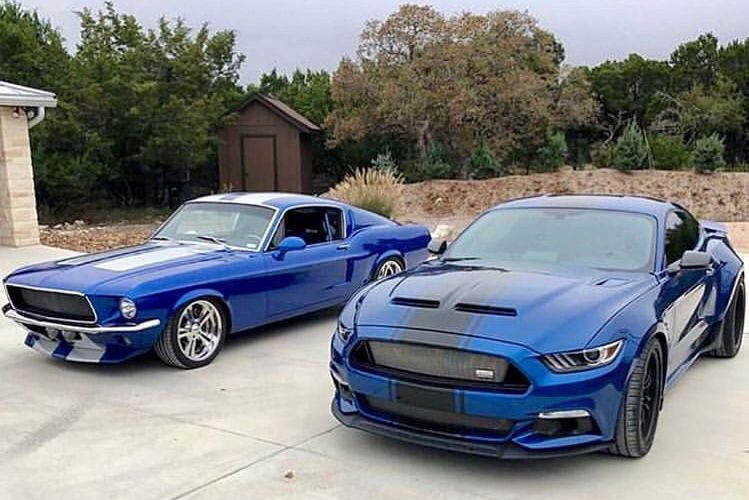


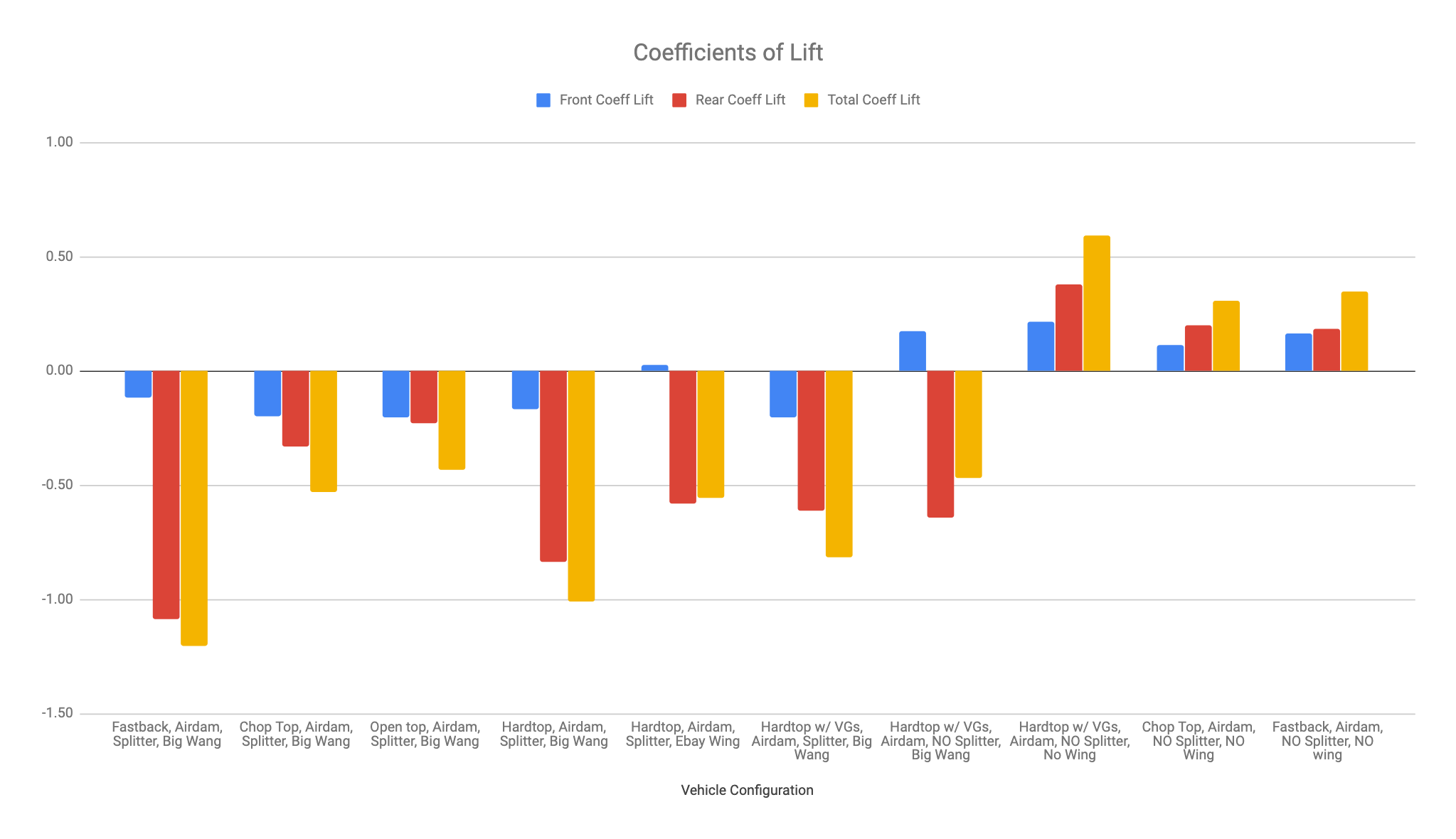


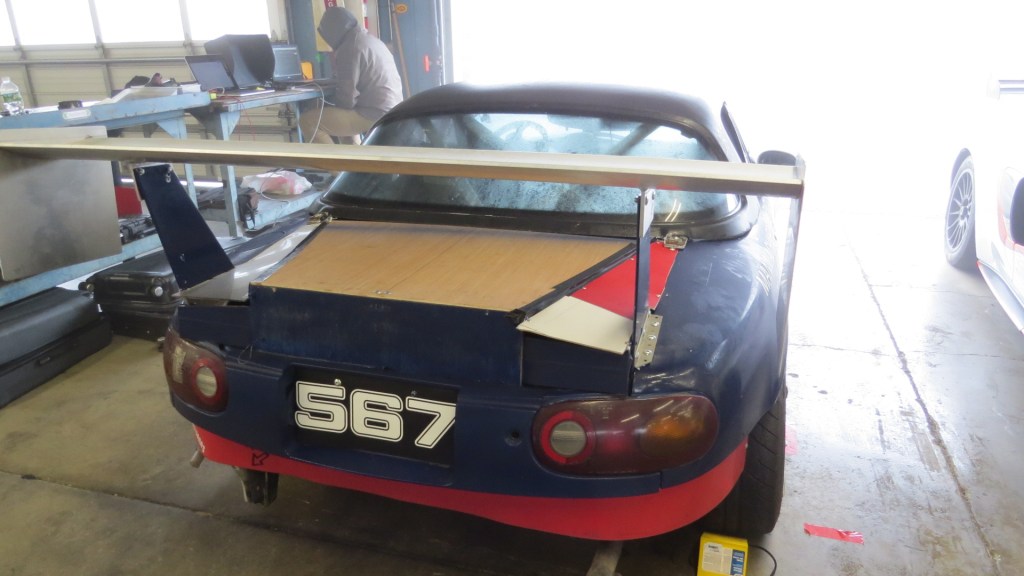
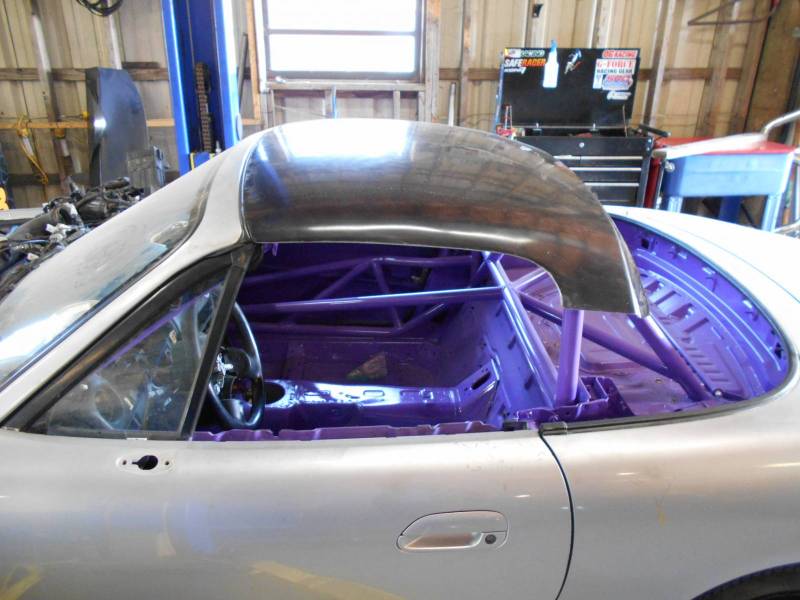


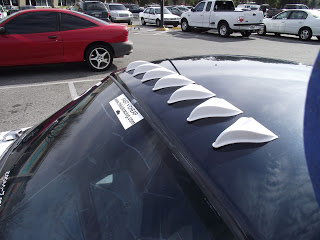

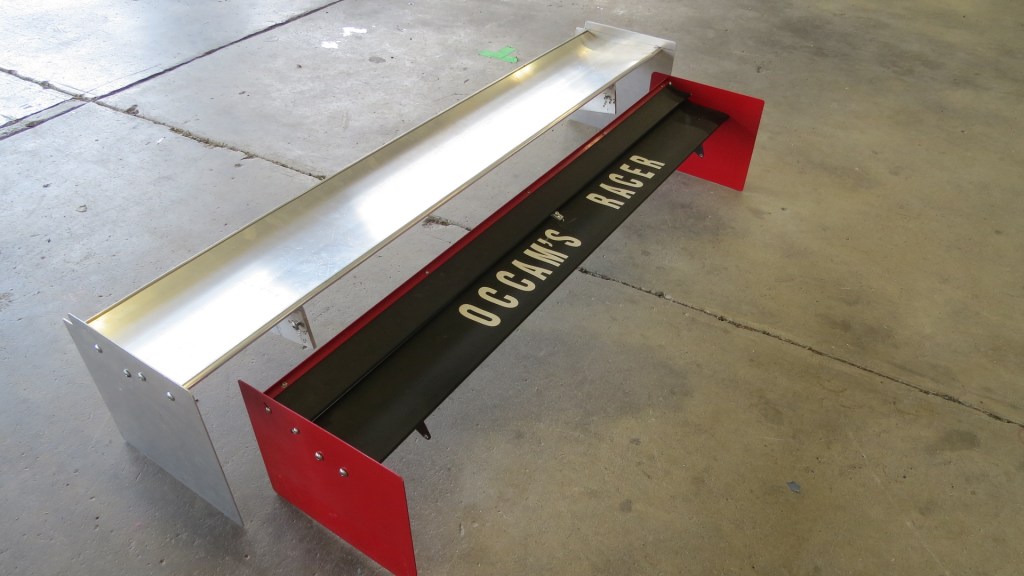

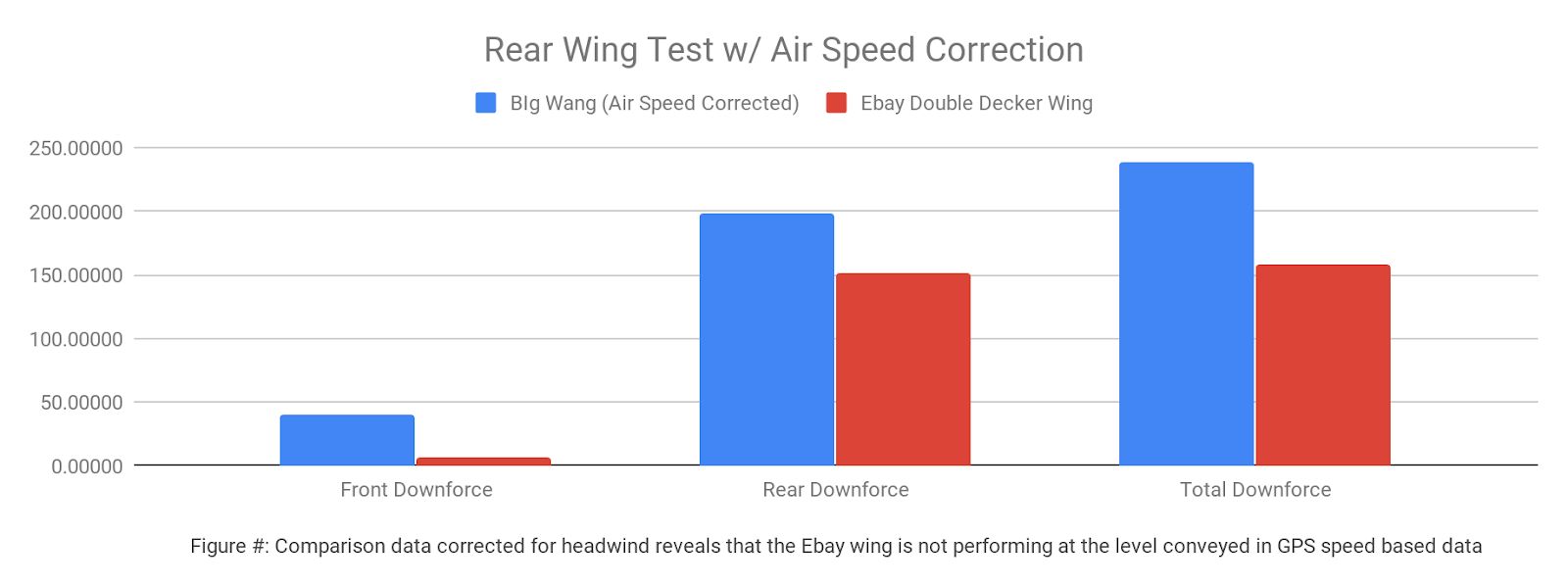
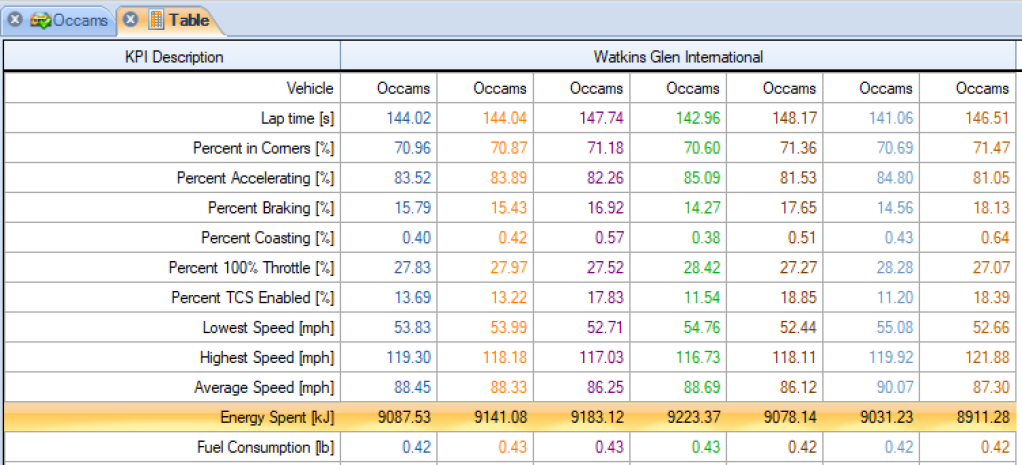


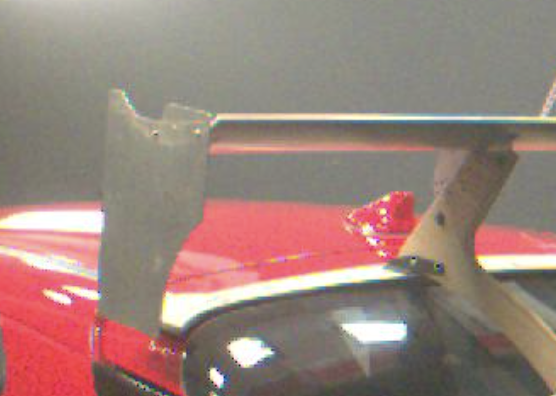

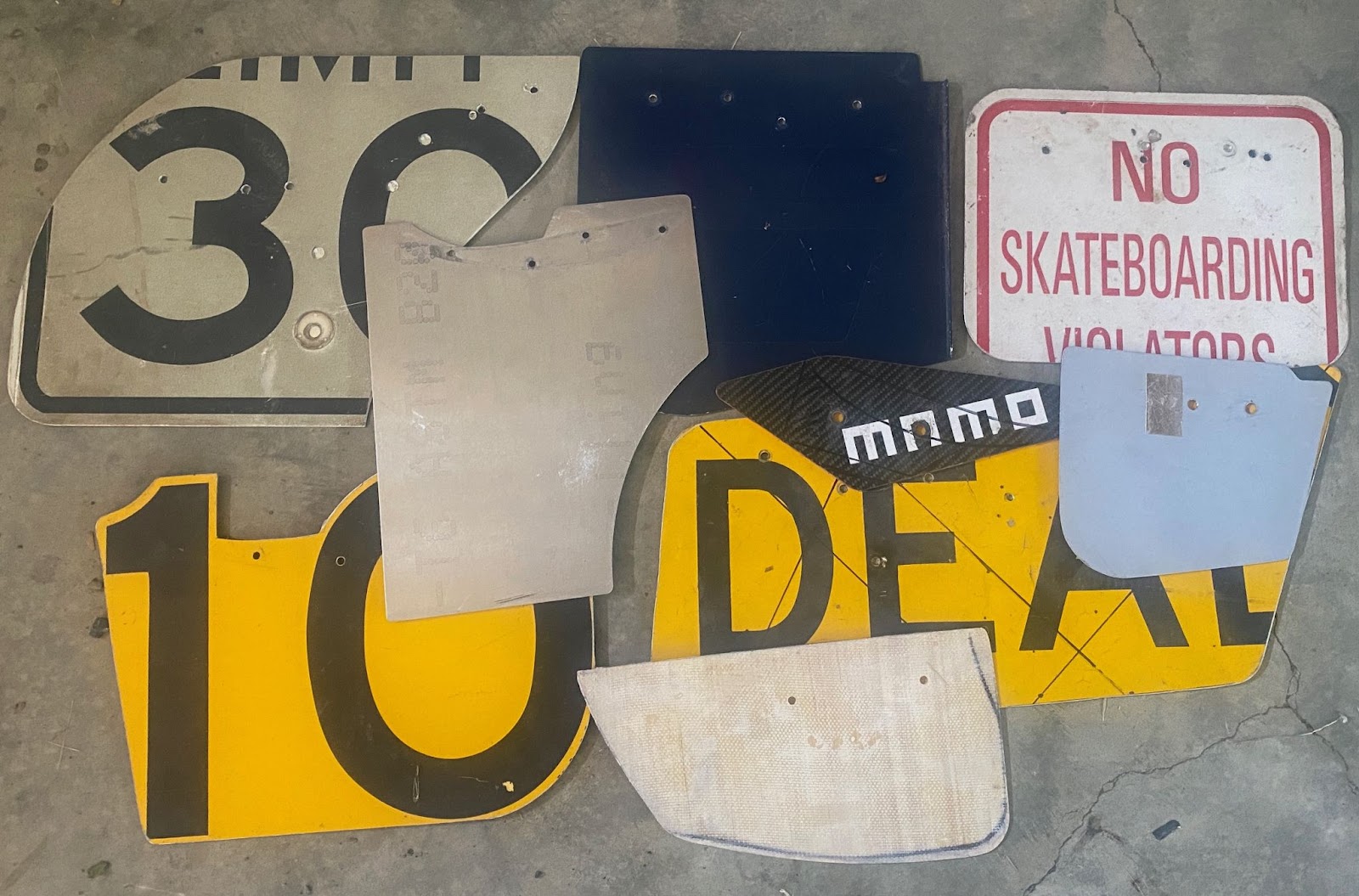
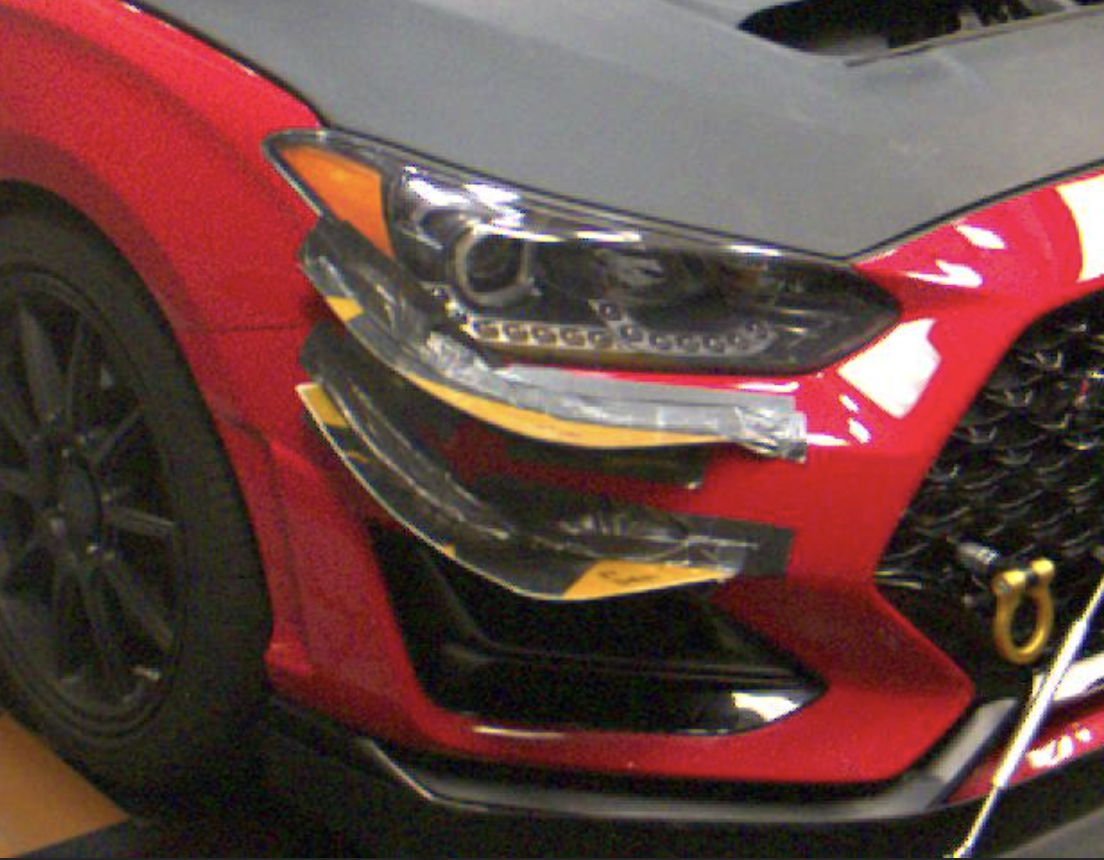


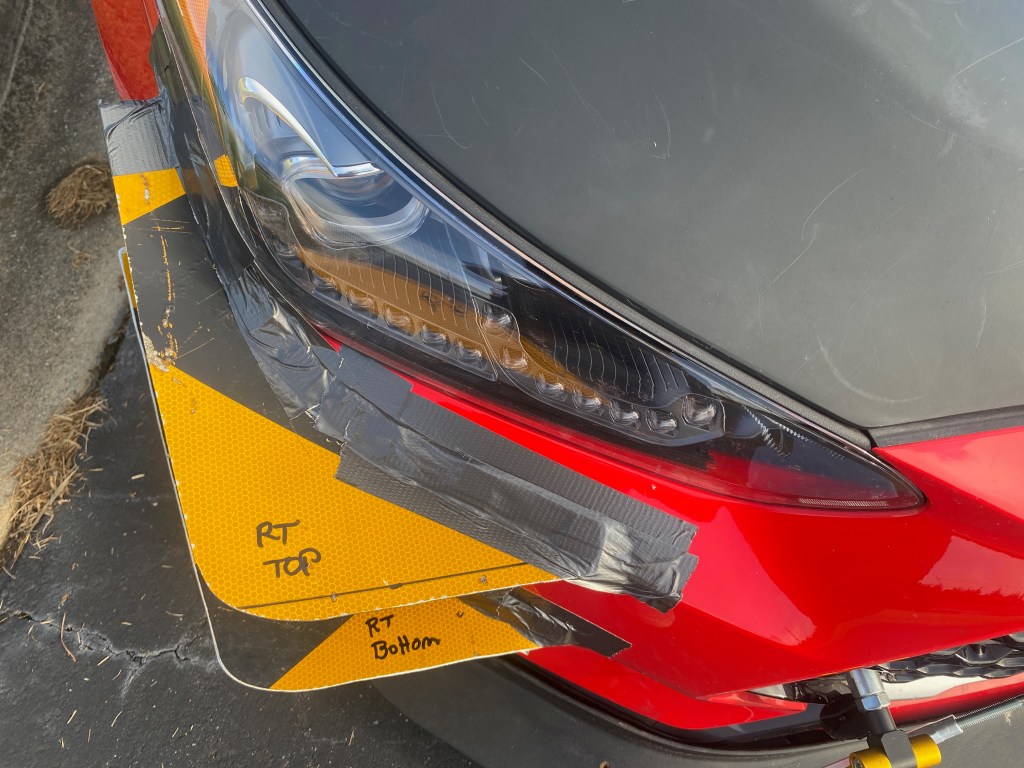
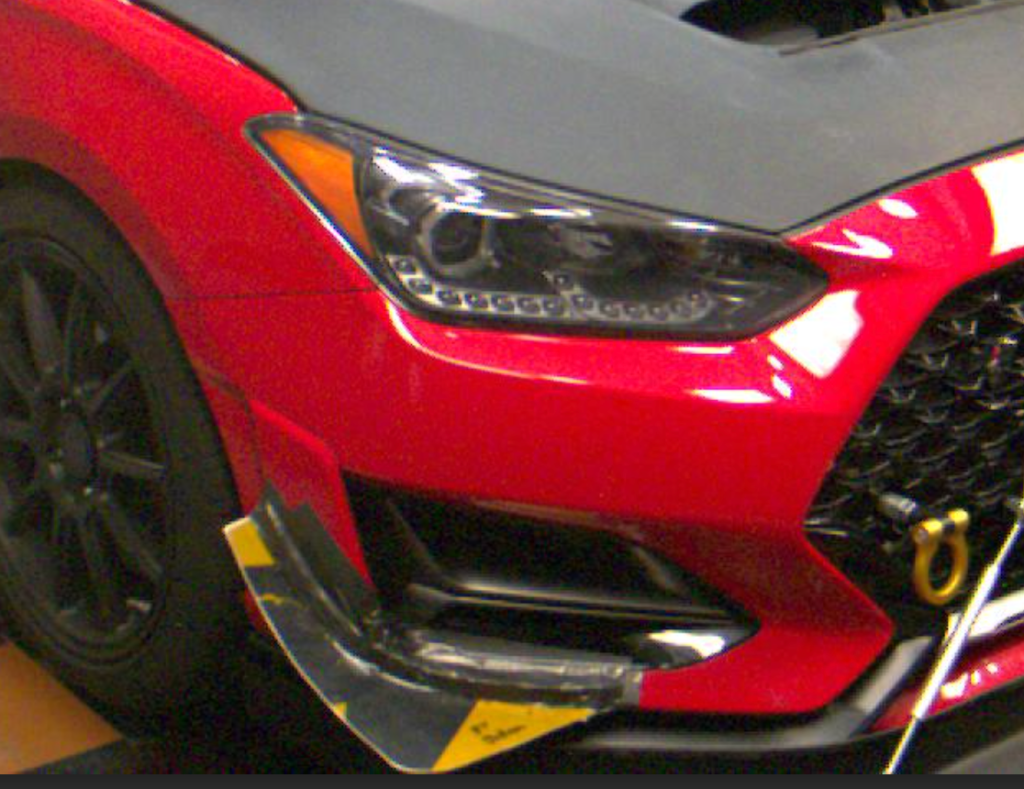
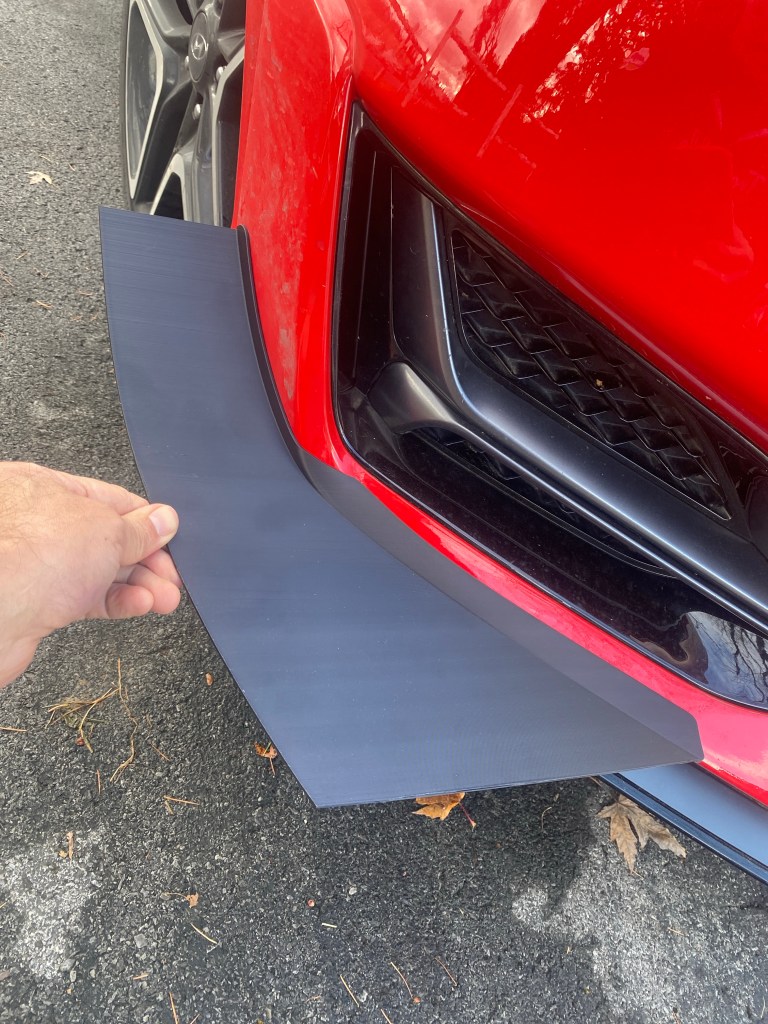
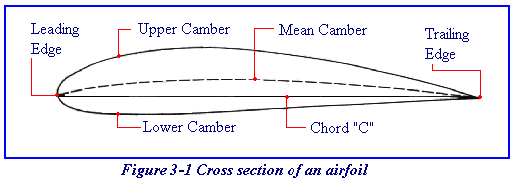


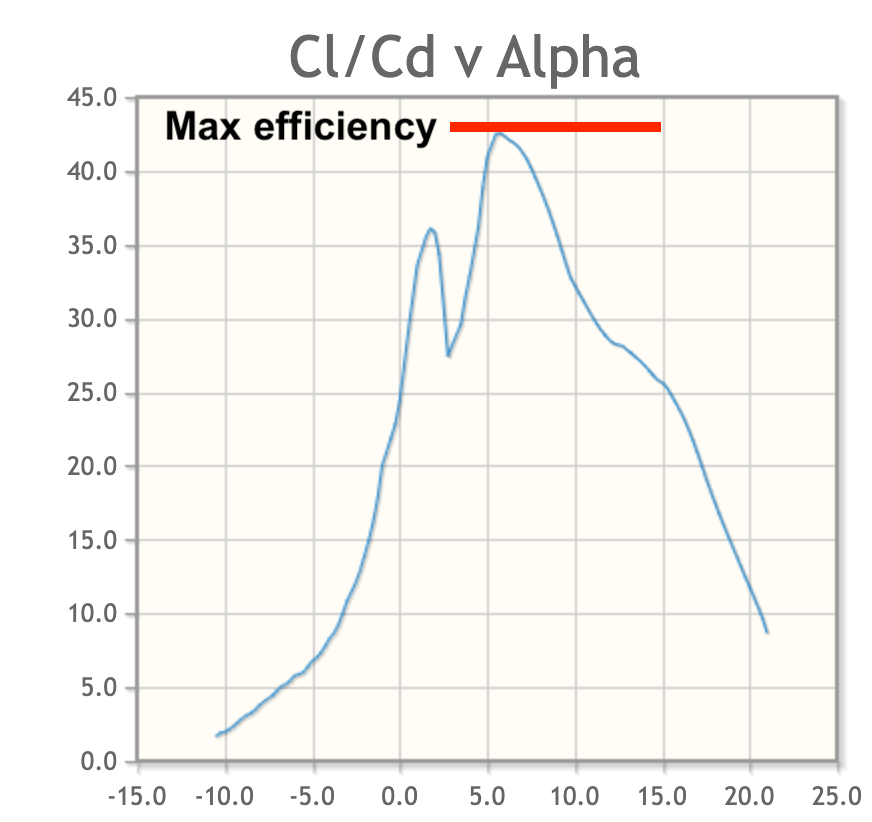

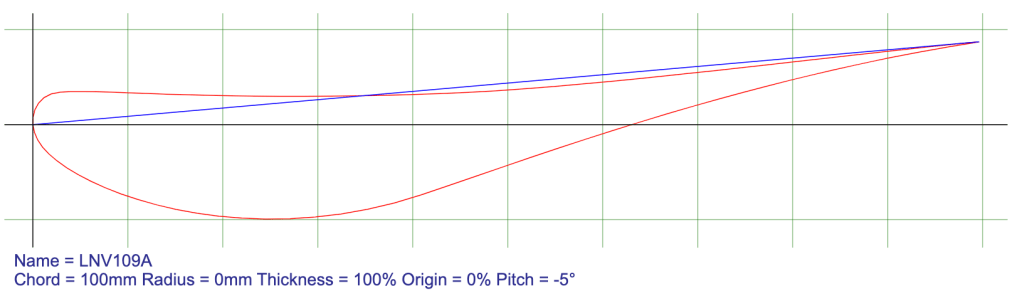


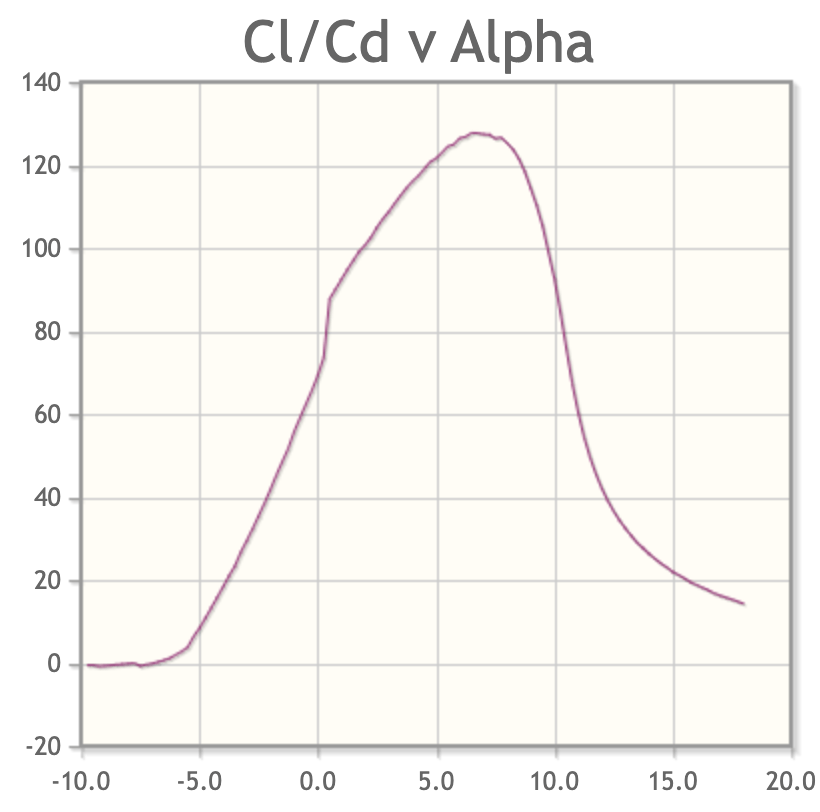


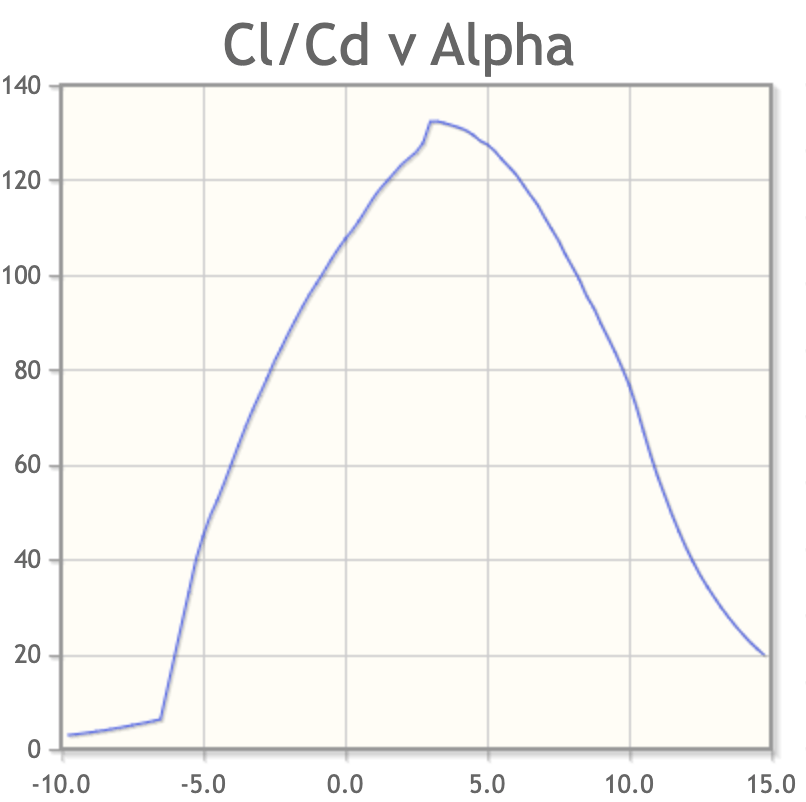
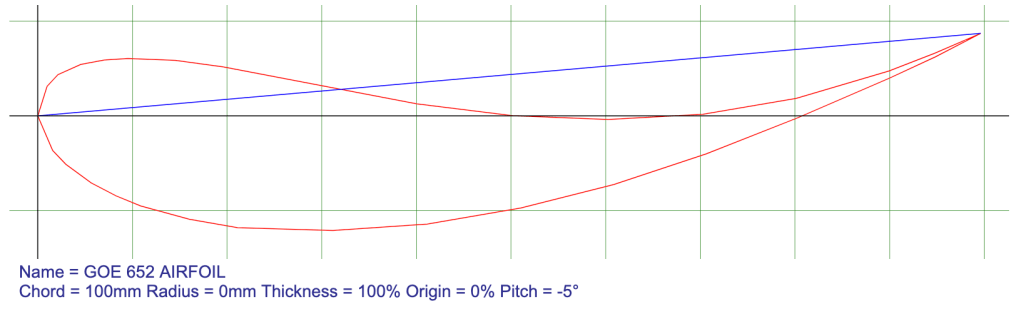

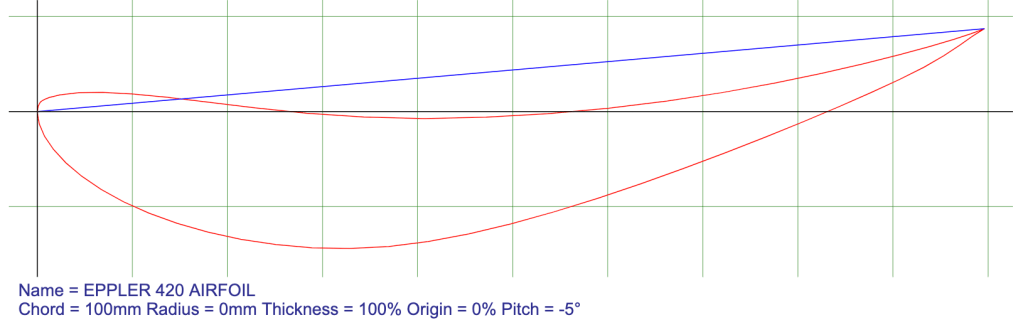
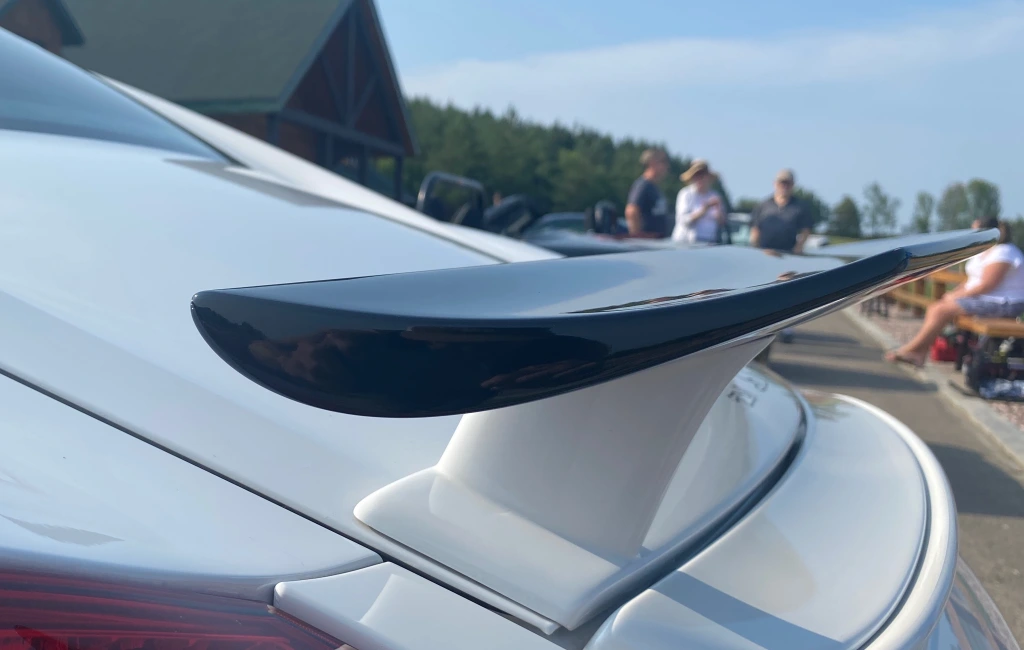
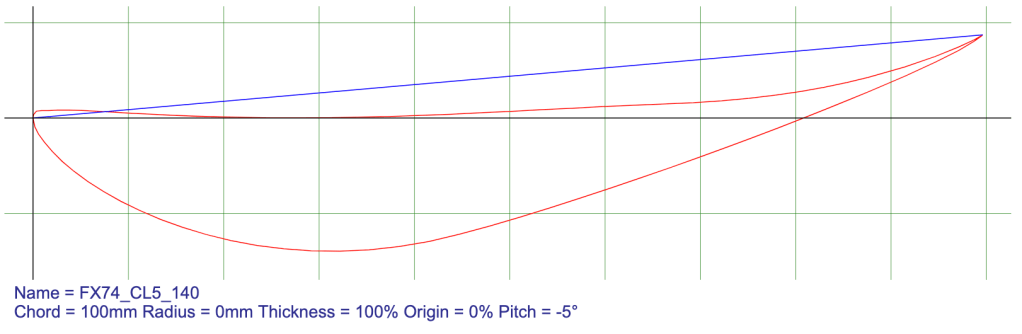



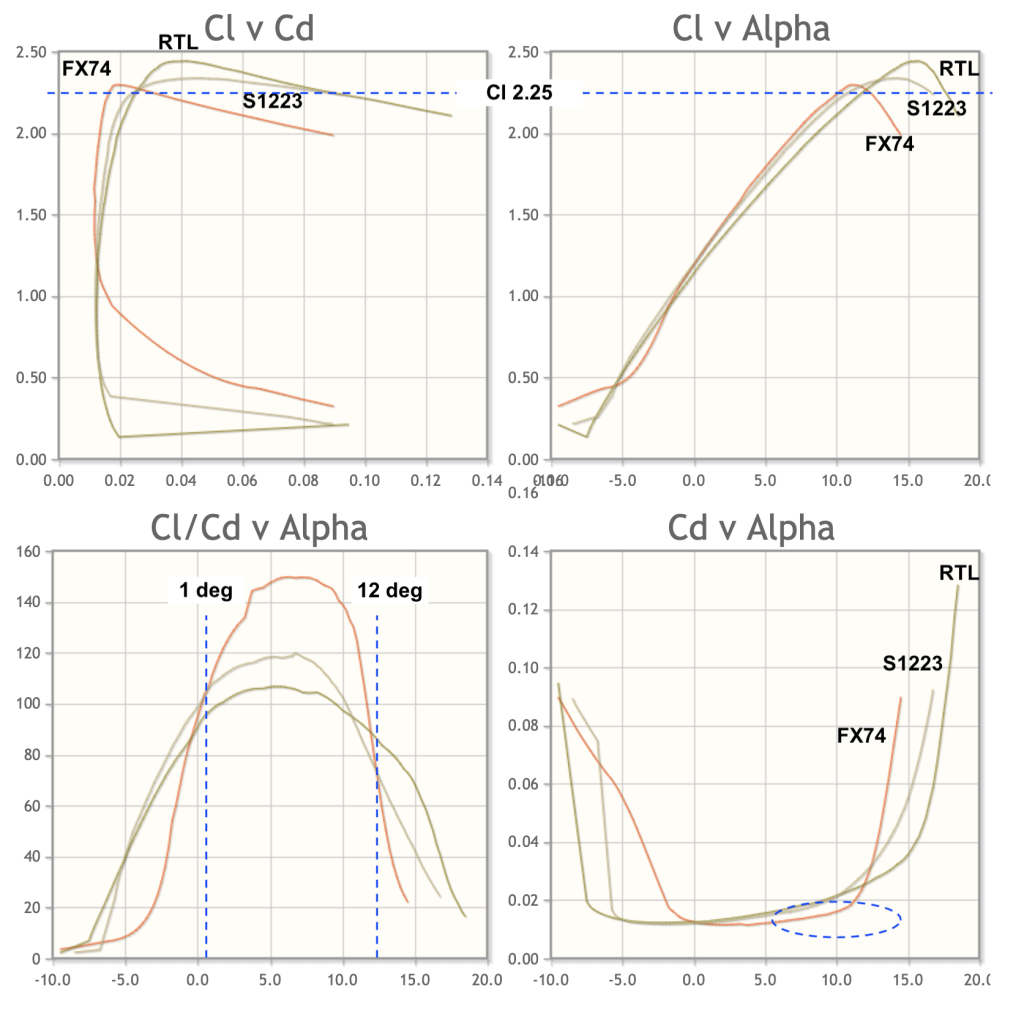


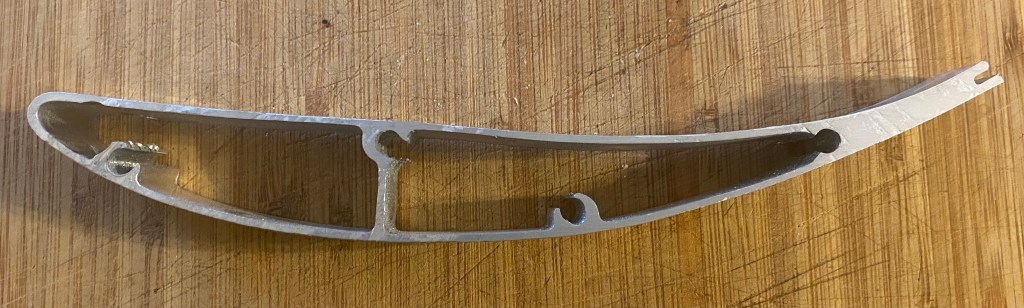

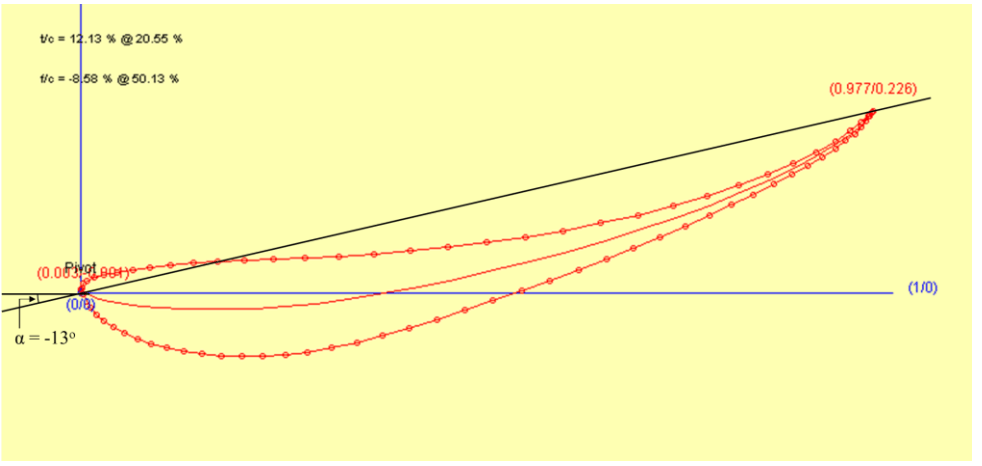
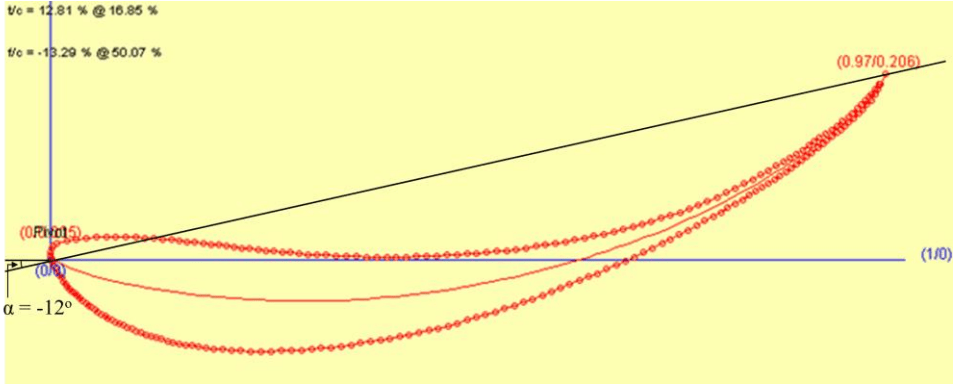



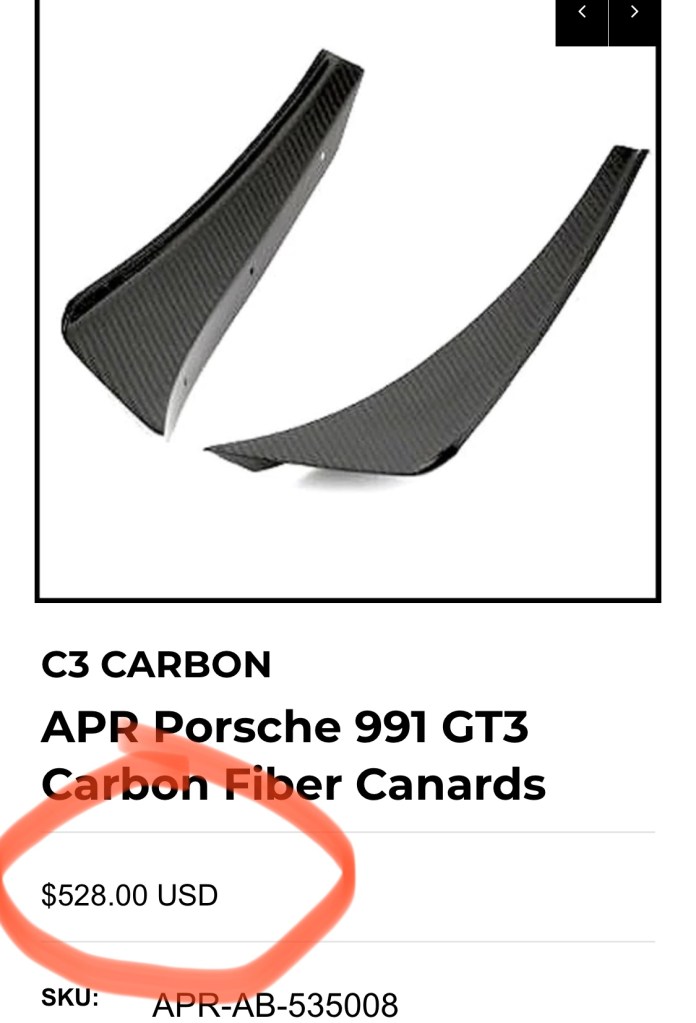
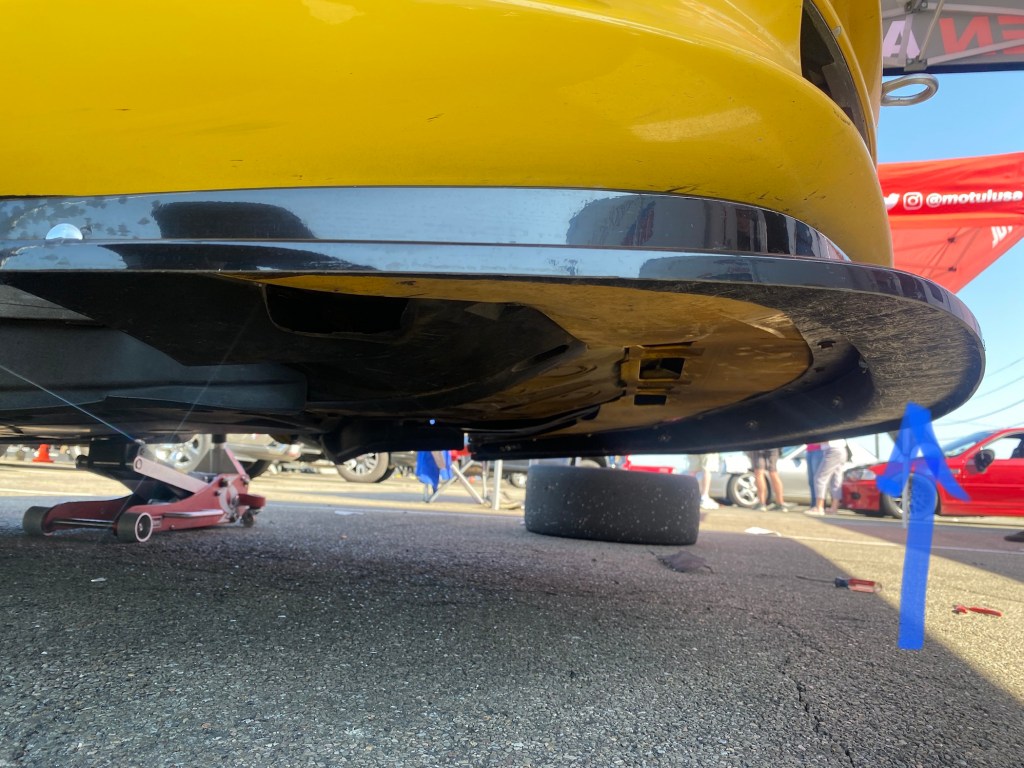
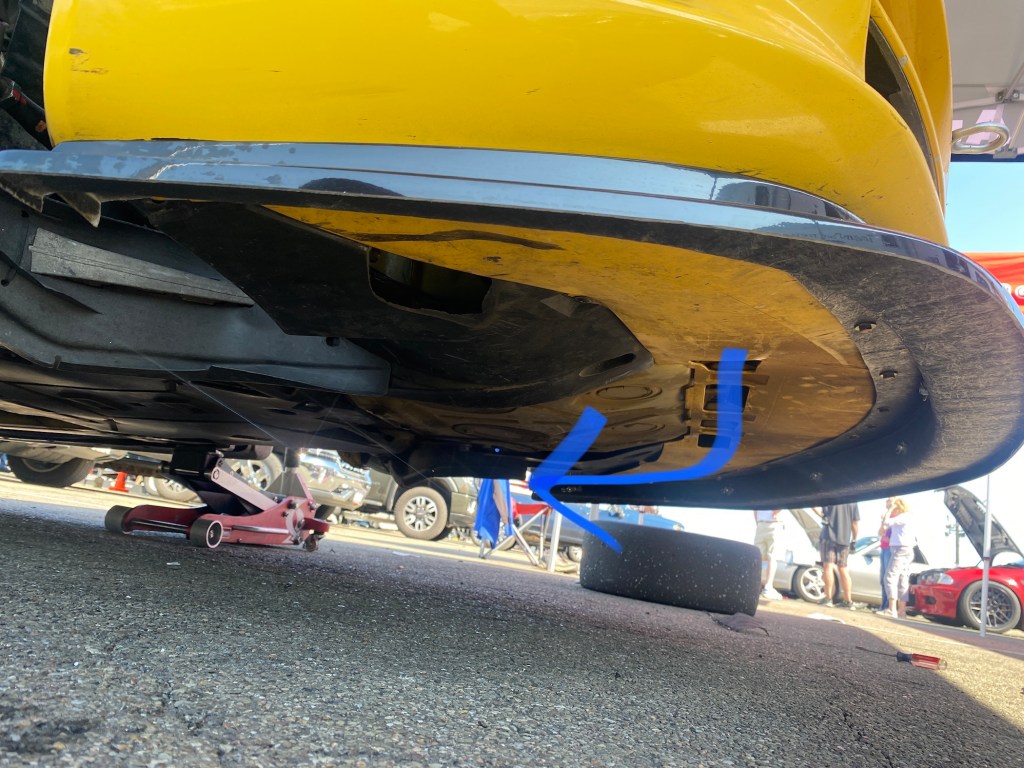
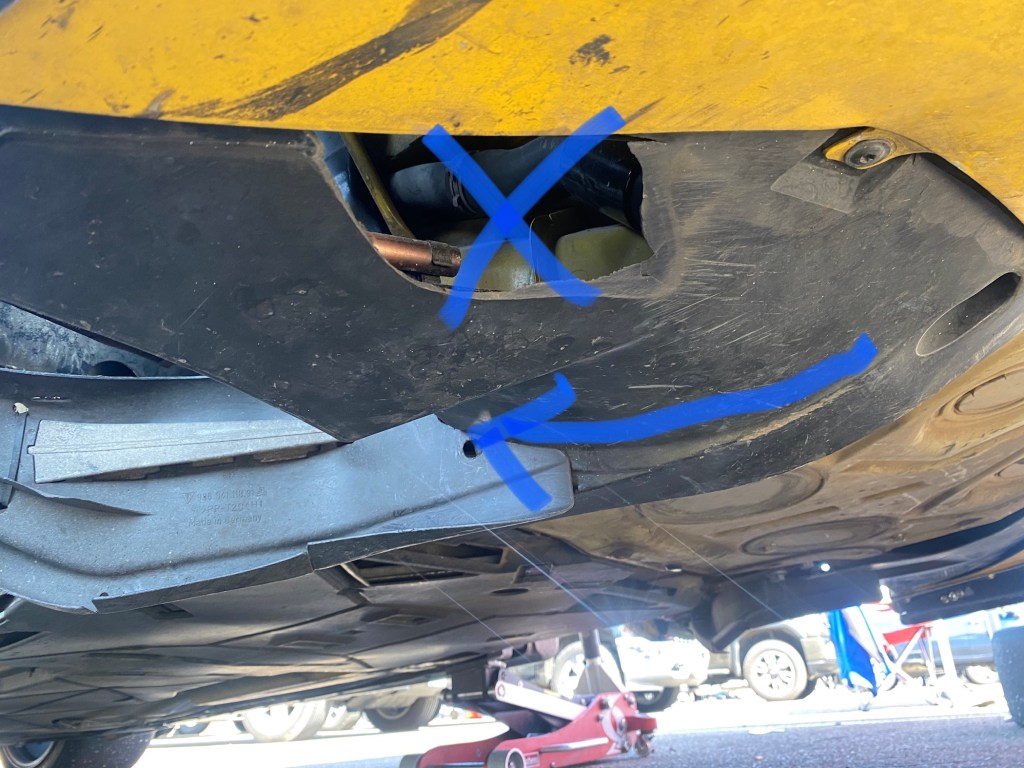
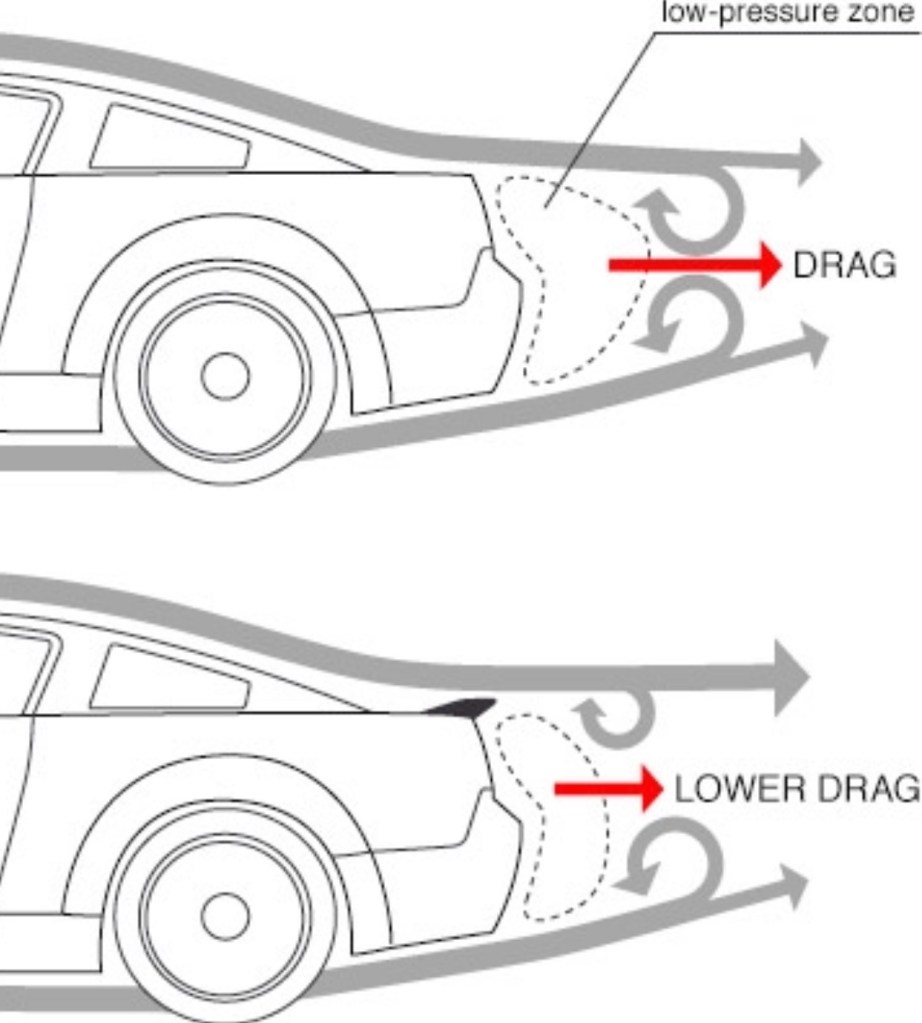


 Occam's Racer