Tire Test: Is the Armstrong Blu Trac Race the Best HPDE Tire?

This tire test starts with a rant; bear with me for a minute while I get this off my chest.

Once upon a time, treadwear (UTQG) meant how long the tire would last. A 300 TW tire lasted longer than a 200 TW, which in turn lasted longer than a 100 TW. Grip was inversely proportionate to wear, and so 100 TW tires gripped more than 200, which gripped more than 300. Makes sense, right? Wrong. That ship has sailed, and it ain’t coming back.

These days treadwear values are total bullshit, especially in the popular 200 TW category. Back when treadwear meant something, honest 200 TW tires, like the Falken RT615k, Nitto NT05, Yokohama AD08R, and other similar tires lasted 20+ hours on track, had good heat tolerance, and respectable speed. Crap can racing series like 24 Hours of Lemons and Chumpcar standardized on the 200 TW tire, and you could chose any of them with relative fairness.

But the landscape completely changed when autocross-specific tires came out, such as the RE71R and Rival 1.5S. Like endurance racing, most autocross classes also require 200 TW tires, but with only half a dozen 45-second runs per day, durability didn’t matter. So the autocross “Super 200” tires were developed and became a completely different animal than any 200 TW tire that came before.

Because autocross is a competition, every autocrosser wants the fastest 200 TW tire. And since treadwear values are set by the manufacturers, they can take a domestic 140 treadwear tire, write 200 on the sidewall, and sell it in the USA as such. And thus began the idiotic 200 TW tire wars where tires got faster, less durable, and the treadwear number remained the same.

The result of that is you can buy a 200 TW Falken 615K+ that last two to three times longer than the 200 TW Falken 660. Bridgestone, Nankang, and Yokohama also offer an endurance 200 TW tire that lasts three times longer than their 200 TW autocross tire. And yet they all have the same treadwear rating. So much for treadwear meaning anything about wear.

So does 200 TW mean there are now two classes of tires? No. Because there are also tweener tires like the Kumho V730 and Nexxen Sport R, which are part way between an enduro and autocross 200. And then you have Accelera, Kenda, and Valino, who offer bargain 200 TW tires that are slower, but cheaper, than the enduro 200s.

Which brings me to a brand new 200 treadwear tire, the Armstrong Blu Trac Race. It’s certainly a bargain 200 TW, but I was curious to see whether it was also an autocross or enduro 200 TW. Or something else.

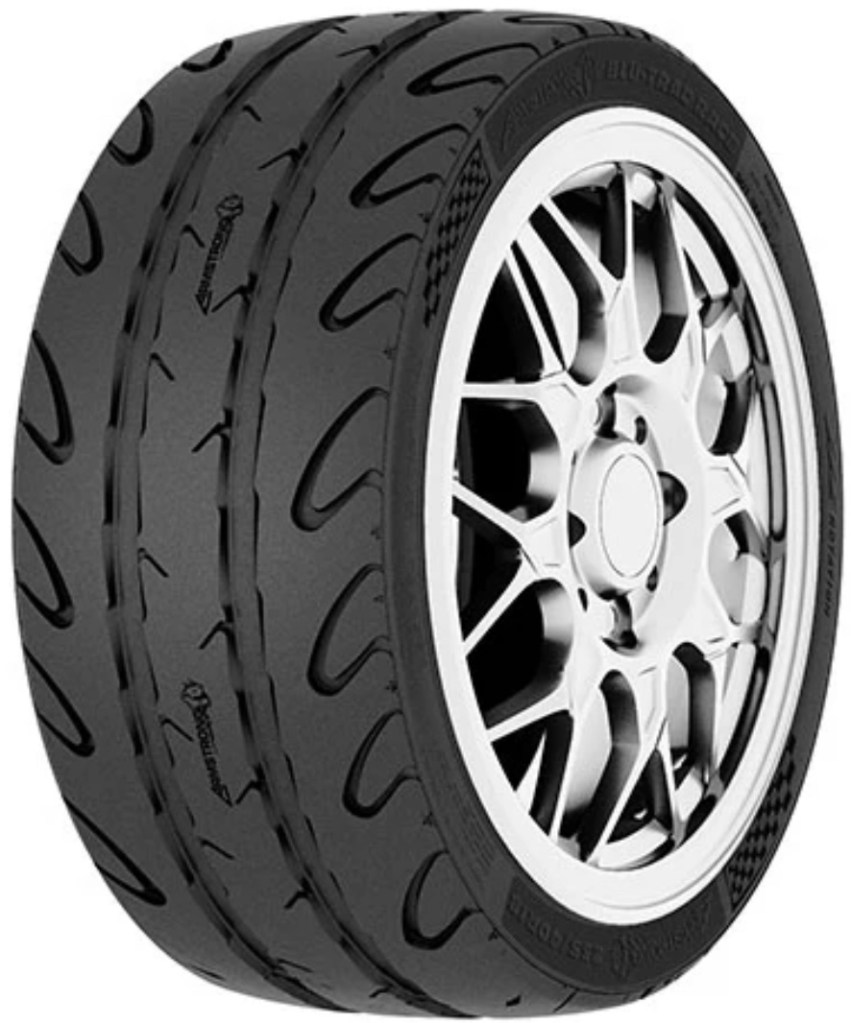
Armstrong Blu Trac Race

You may not have heard of Armstrong tires; I hadn’t. They are available through Tire Streets, who deal in lesser know brands, mostly from Indonesia, I believe. If you are in the drift community, you know Accelera tires, which are the official tire of the LZ World Tour. If you’re outside the drift community, you may not know Accelera or Armstrong or Tire Streets.

I ordered the 235/40r18 size, which were on sale for $135 each, shipping included. This is about half of what most 200 TW tires cost, and so you can see we are clearly in the bargain 200 TW segment.

The first thing I noticed about the Blu Trac is that the tread pattern looks a bit like the venerable Nitto NT05. There are two very wide center grooves, and a symmetrical tread pattern, so you can flip the tire on the rim and get a little more life out of them.

Armstrong Blu Trac Race

When new, they give off a low whoop-whoop sound like a helicopter. I found a resonant frequency at about 35 mph that was uncomfortably loud. But once the tires wore down some, the sound level went down to where I stopped noticing them entirely.

But the street is no place to test a track tire. To properly evaluate them, I’d need to take them to a racetrack, record lap times and G forces, and compare them to a known quantity. Before doing that, I heat cycled them with a few laps at Pineview, and let them sit for 24 hours.

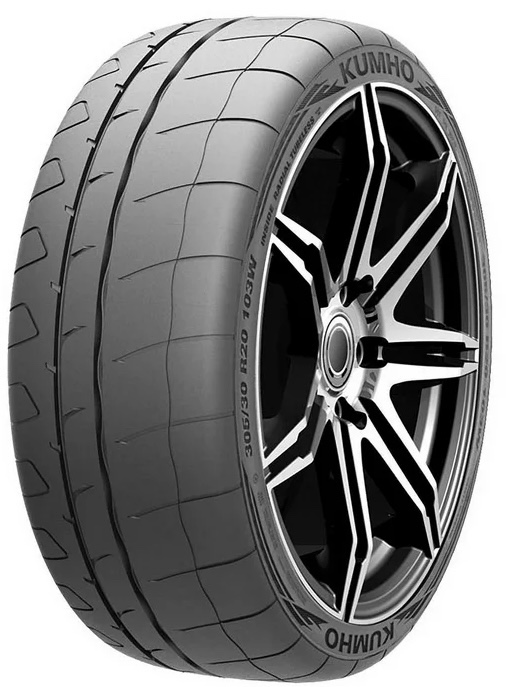
Kumho V730

To see if the Blu Trac were any good, I compared them to Kumho V730s. I’ve been using the V730 recently, and I feel they set a new standard for track tires. I used to feel that way about RS4s, but a ridiculous sale price on the Kumhos got me to try them, and the gain in grip is an acceptable tradeoff for increased wear.

The V730 tread pattern isn’t symmetrical, and is similar to another ancient Nitto track tire, the NT01. Now there was never anything wrong with the NT01, and I think Nitto could have written UTQG 200 on the sidewall and nobody would have blinked.

V730s are well regarded in the track community, and inhabit the tweener space between autocross tires and enduro tires. The smaller tread grooves disappear quickly, leaving two off-center groves that could be mistaken for a Maxxis RC1. Like the RC1, these won’t work well in the rain. But I have other tires for that.

Pirelli PZero PZ4

To make this more interesting, I’ll also throw in a set of Pirelli PZ4 tires, which I bought specifically as a wet tire. The Veloster N originally came with PZ4s, and most comparison tests put them on par with the Michelin PilotSport 4S and Continental ExtremeContact Sport. The PZ4 is rated at 280 TW, and is not a dedicated track tire. It’s a good street tire, OK on a dry track, and great in the wet.

Track testing

For tire testing I go to Pineview Run, mostly because I’m a member and can go whenever I want. It’s empty on weekdays, so I can run as many laps as I want. They run a much shorter track during the week, and so I can get a lot of laps and normalize the data.

I use a pyrometer to properly set tire pressures, and bleed them down to get an even gradient, slightly hotter on the inside. I use an AiM Solo DL for lap times and data gathering, and then convert the lateral Gs into a CSV file. This way I can average the various peaks and valley, to find a more stable lateral G value.

I did the testing over two days, doing back to back runs an hour apart. Pineview runs their track sessions on the hour, and so I couldn’t get sessions any closer than that. However, weather conditions didn’t change much, and so I don’t think that was much of a factor.

All of the tires were mounted on 18×8.5” wheels. The Kumho tires were mounted on Koenig Countergram +43, and the Pirelli and Armstrong tires were mounted on Motegi MR140 +45. The wheels are all within half a pound of each other, and I feel the offsets are close enough that the differences will be down to the tires themselves.

But note that I also threw in a mismatched set of tires, to see how the V730 front and PZ4 rear would work. I reckoned that less rear grip would allow me to rotate the car easier, and perhaps set the fastest time. But it didn’t.

TireLap
Armstrong Blu Trac Race46.596
Pirelli PZero PZ445.401
V730 front, PZ4 rear45.030
Kumho V73044.616

The fastest lap was the Kumho V730 all around, going about four tenths faster than the cocktail with the PZ4 on the rear. The handling with mismatched tires was a little too loose for my tastes, and I even spun the car once with the Pirellis on the rear.

With the PZ4s front and back, I went .8 seconds slower than with V730. People love to hate the PZ4, but it’s not a terrible tire. Compared to the V730, the PZ4 is noticeably less sharp everywhere, but especially on turn in.

Which brings us to the Armstrong Blu Trac Race, which where 1.2 seconds slower than the Pirelli PZ4, and a full 2 seconds slower than the V730. On a longer race track with a more typical lap time of 90 seconds, Blue Trac Race would have you 4 seconds off the pace of the V730.

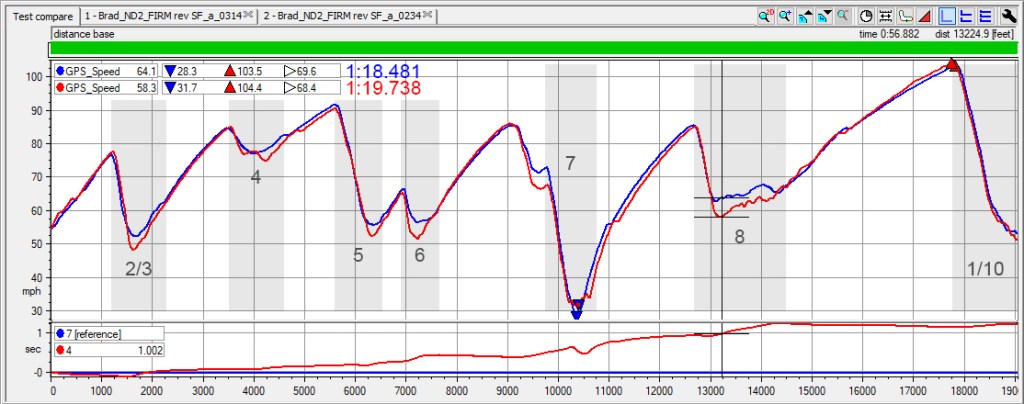
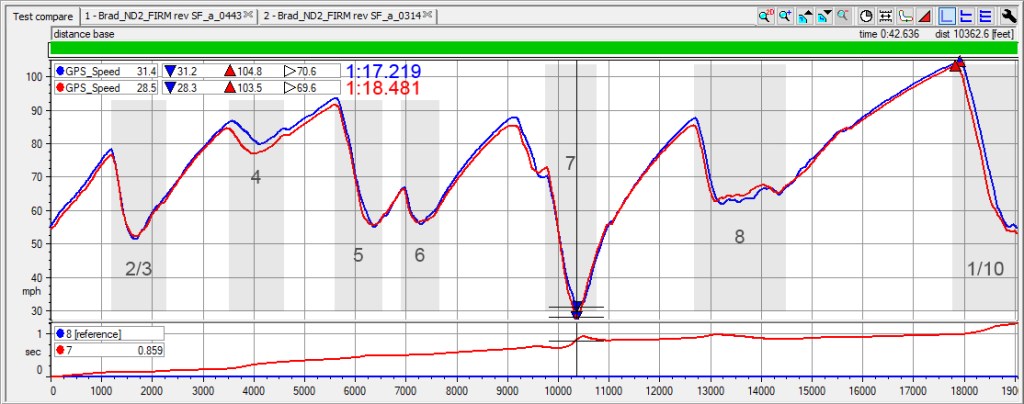
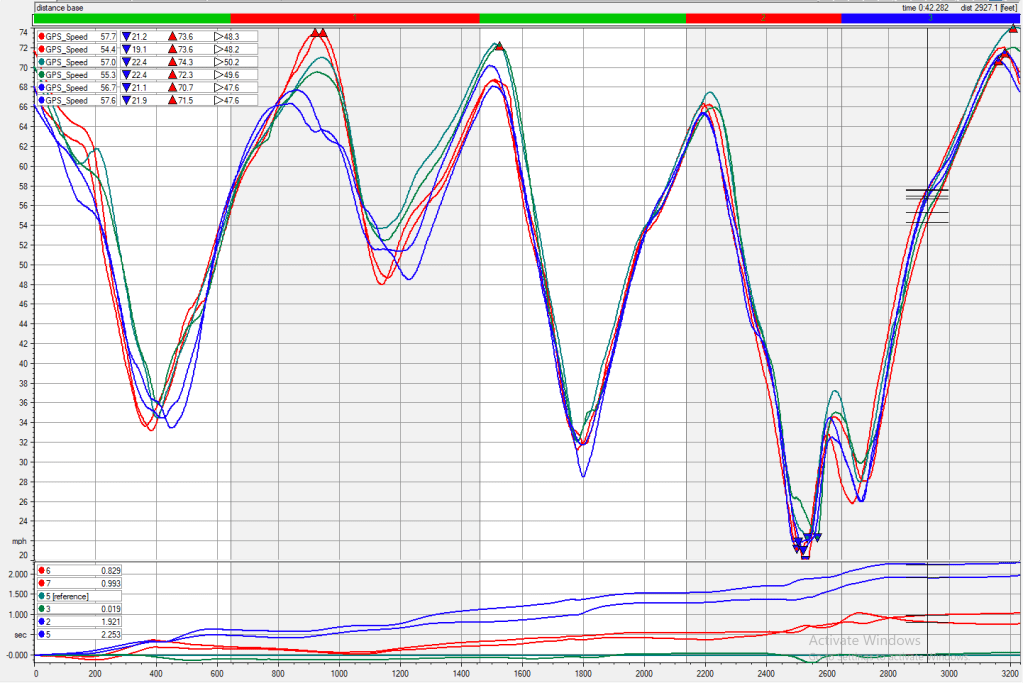
If you look at the following speed trace, you can see where the Blu Trac (blue) loses out to the PZ4 (red) and V730 (green). Blu Tracs have a corner speed that’s similar to the PZ4, but I’m consistently later to throttle on these tires, which results in a lower top speed. The Kumhos have more grip and allow me to maintain a higher minimum corner speed, which results in the fastest lap times.

Speed trace with Armstrong (blue), Pirelli (red), and Kumho (green).

But let’s talk about how the tire feels and wears. I really like the way the Blu Trac Race tires break away early, and are predictable when sliding. I often use all-season tires for hooning, and the lateral Gs of the Blu Tracs are similar. The difference is, Blue Tracs have fewer grooves and wider tread blocks, and these combine to make a really friendly tire that begs to be driven sideways.

Pineview has a rough surface with a lot of right turns, and so the left tires get a lot of abuse. My Veloster is front-wheel drive, and the combined braking, accelerating, and turning with all the weight on the nose absolutely murders the front left. As such, I ruined my Pirelli PZ4s in just seven 15-minute sessions. I had bought them for rain use, but the forecast was wrong two Wednesdays in a row, and I ended up eating the tires before I got to use them in the rain.

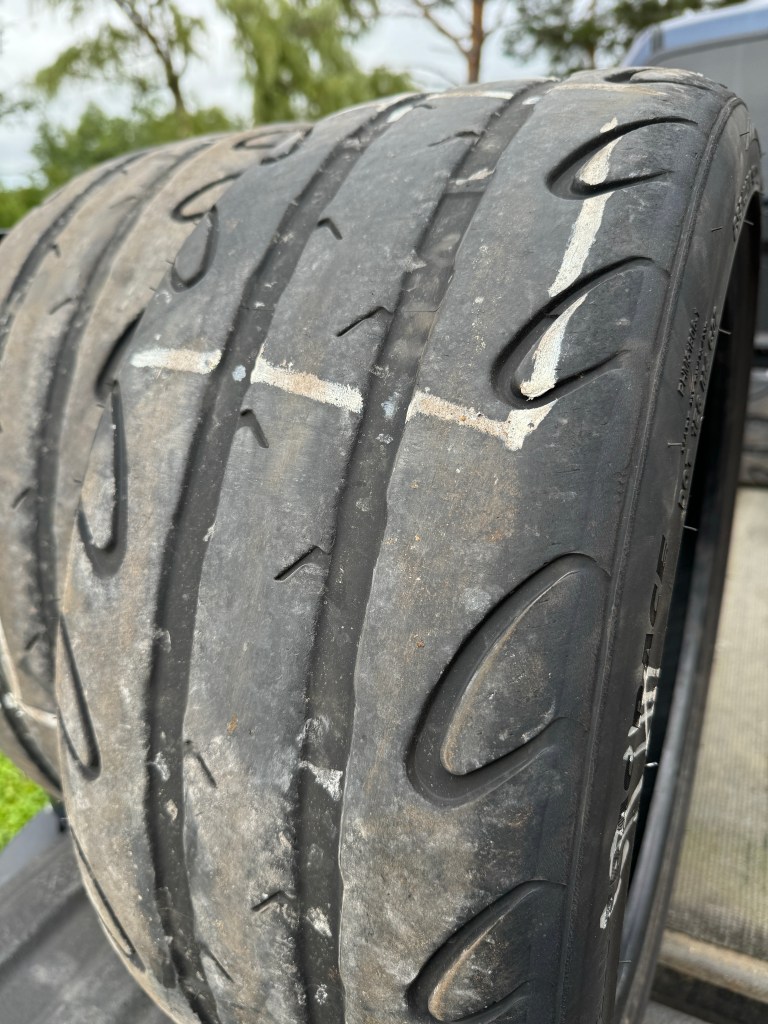
Front left tire on Blu Trac Race shows even wear and no blisters, with plenty of life left. Front left Pirelli PZ4 is in the trash.

Conversely, I ran eight sessions on the Blue Trac Race tires, and they are wearing superbly. They certainly have the durability to last an endurance race, but you’d be well off the pace of everyone on RS4s. However, there’s a better use for Blu Trac’s than racing.

The best HPDE tire?

I started this article by wondering if the Blu Trac Race was an endurance 200 or a Super 200. But what I found out was, it’s neither. It’s a HPDE 200. Yeah, that’s right, I’m starting a new category of 200 TW tires, and I’m putting the Blu Trac in there at the top.

HPDE stands for High Performance Driving Education, and if you want a tire that is exceptional for learning how to drive, this is your tire. The lower grip, predictable breakaway, and durability combine to make a tire that is perfect for the E in HPDE.

Armstrong Blu Trac Race tires are not going to win any timed competitions. Full stop. But they will help you learn how to drive your car at the limit, because the limit is lower, easy to find, and easy to recover when you invariably go over.

My Veloster N is a well balanced car that doesn’t know it’s FWD. In fact it pushes less than many RWD cars. I can pitch it into a corner and get a four wheel drift, easy-peasy. Ergo, driving it on tires that have less grip is actually more fun. No tire has put such a big smile on my face as the Armstrong Blu Trac Race.

At the end of the session, many people came up to me to tell me how fast my car looked (because it certainly wasn’t fast on the stopwatch). And I think this was down to the car sliding everywhere, and just how loud the tires are. See and hear for yourself.

This is what fun sounds like.

In the following video, I do some laps in front of and behind a Mitsubishi Evo X. He’s got a 400 hp tune and Kumho V730 tires; I’m 130 hp down, driving a stock Veloster N, with Blue Trac Race tires. I point him by part way through the session, and I’m able to keep a similar pace. So a decent driver can wheel the shit out of these tires and run with faster cars on better tires. And have more fun in the process.

Veloster N Blu Trac vs Evo X V730

Note this is on the shortest track layout at Pineview, which is about 6 seconds faster than the lap times in the previous table. To learn more about the track, see Pineview Run Layouts.

If you appreciate articles like this, and websites with no ads, no pop-ups, or other annoying shit, consider buying me a coffee. Thanks!

Veloster N Lowering Springs, Splitter, and Diffuser Undertray

Earlier this year I installed ARK lowering springs, which lower the car 1.25” front and 1.15” rear. I chose ARK springs because they are only slightly stiffer than OE springs (134% stiffer front and 125% rear), and that should allow me preserve the Veloster’s decent road manners. Most lowering springs have a higher spring rate than ARK’s 263 F and 336 R, and would beat the shit out of me on potholed New York roads.

I chose lowering springs over coilovers mostly for the price ($250 on FB marketplace), but also because I like messing around with the OE shock settings. I set my N Custom mode for medium stiff suspension when on track, but can quickly soften the suspension on the touch screen, for rain or street.

Lowering springs alone can reduce roll stiffness and increase bump steer, so they aren’t always a performance benefit. So I also installed the Whiteline front roll center bump steer correction kit. As near as I can tell, the combination of lowering springs and Whiteline kit have improved the handling, and I don’t feel a hint of bump steer or any negative handling traits.

I tested the lowering springs in the A2 wind tunnel, and it resulted in less drag and less downforce than when the car was on OE springs. If you’ve read my wind tunnel report, you’d know the Veloster makes a little bit of downforce, straight from the factory. With the lowering springs, this turned into a small amount of lift, mostly on the rear. That was surprising, as I expected that lowering the car would increase front downforce, but the front also lifted a little.

Lowering the car also reduced drag, which was probably a result of less frontal area and less air going under the car. It’s not a huge change (.014), but the result of both drag and lift shows a very, very slight aero advantage over the base car.

One caveat is that I didn’t use the same wheels and tires on my second trip to the wind tunnel. I made a mistake and had my track wheels and tires (18×8.5 +43 with 235/40R18 tires) rather than the OE wheels I used on my previous trip to the wind tunnel (19×8 +55 with 235/35R19 wheels). This put the tires 18mm (3/4”) wider on each side, and could account for some of the difference in lift, but not drag reduction.

New splitter mounts

I also improved the splitter mounts both in front and in the rear. I placed the support rods further apart on the bumper, which reduces the angle of the rods. The rods are turnbuckles from the Lowe’s racing department, allow easy height adjustment, and with 3/8” bolts, are plenty strong.

I also made a new aluminum rear undertray and added a full width piano hinge to it. Thus, the entire splitter can be adjusted via the splitter rods, which changes the height and angle of attack on the splitter.

Splitter has wider support rods and a hinged undertray.

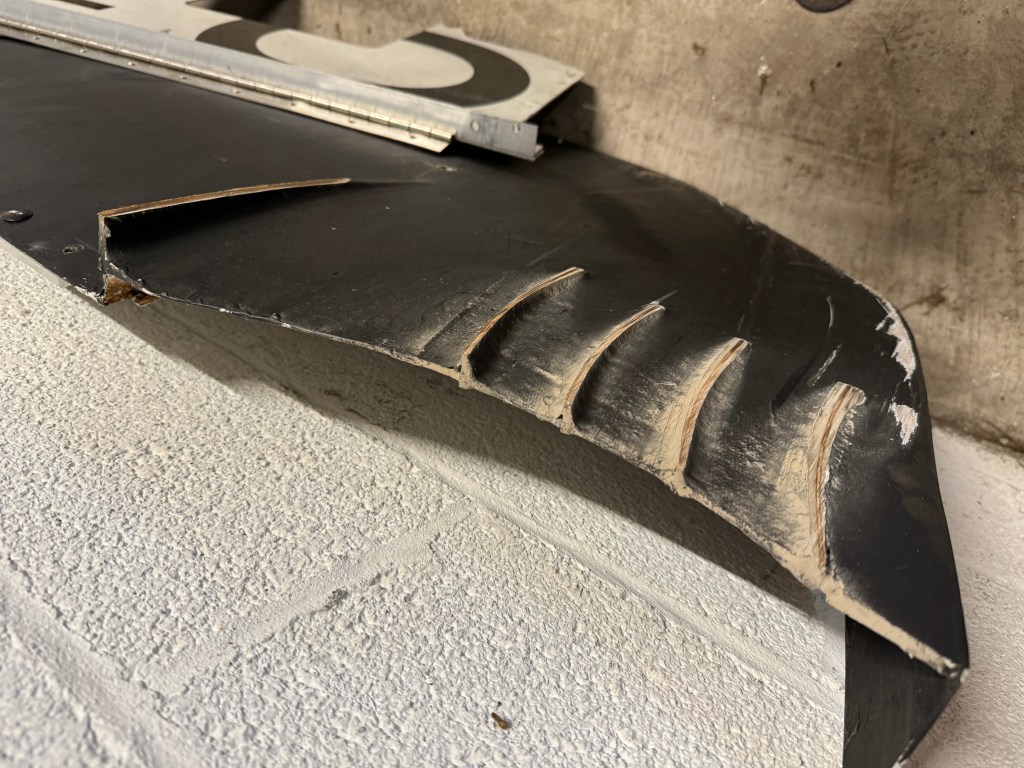
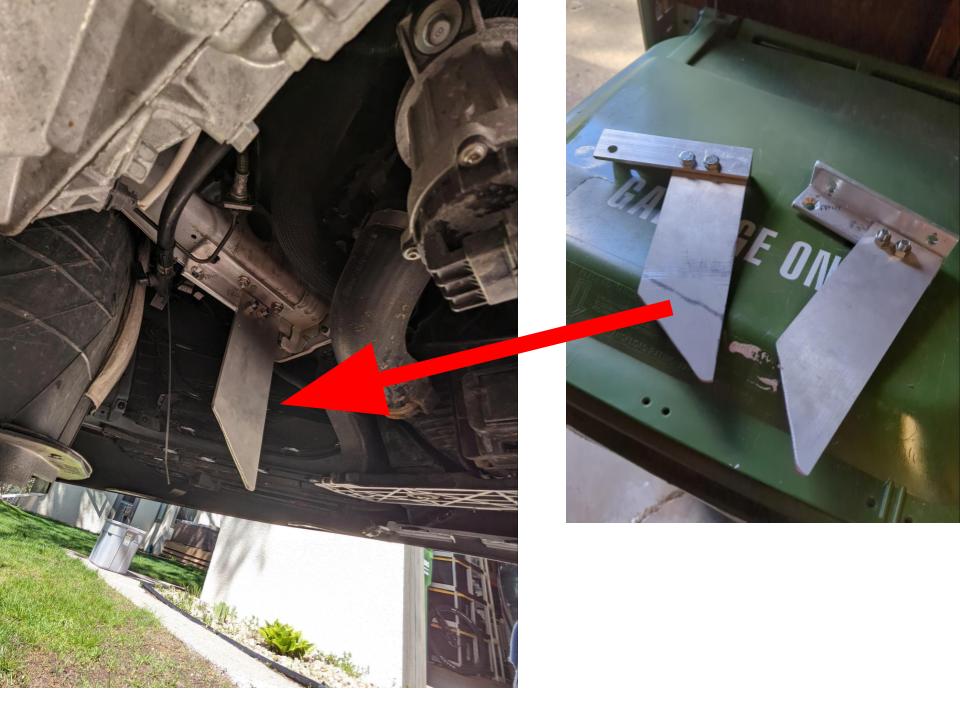
But the lowering springs are too soft or too low, because the splitter touches down on bumps and compression turns. In fact the vortex strakes I put so much work into have now been ground down to insignificance.

Vortex strakes clearanced out on the asphalt grinder.

I figured I have three choices going forward:

  • Revert to OE springs – The lowering springs aren’t much of a performance benefit, and if I had to do it all over again, I wouldn’t.
  • Coilovers – Digressive coilovers with heavier springs would swallow hard bumps on the street and curbs on track, while allowing stiffer springs. I’d also be able to corner balance the car, and change ride height. And I could still change suspension compliance, just not from the touch screen.
  • Remove the splitter – It’s been grounding out on steep driveways and on track, so I could just remove it. But I want more front downforce, damnit! Can I have my cake and eat it, too? What if I made a front undertray that fits exactly the same as the OE undertray, but has a built in diffuser? Hm….

Diffuser undertray

Digressive coilovers are the obvious choice going forward, but for the sake of experimentation and another DIY project, I decided to make an undertray with a diffuser. This won’t make as much downforce as a splitter, but it’s also completely tucked up and won’t hit anything, and invisible from the outside.

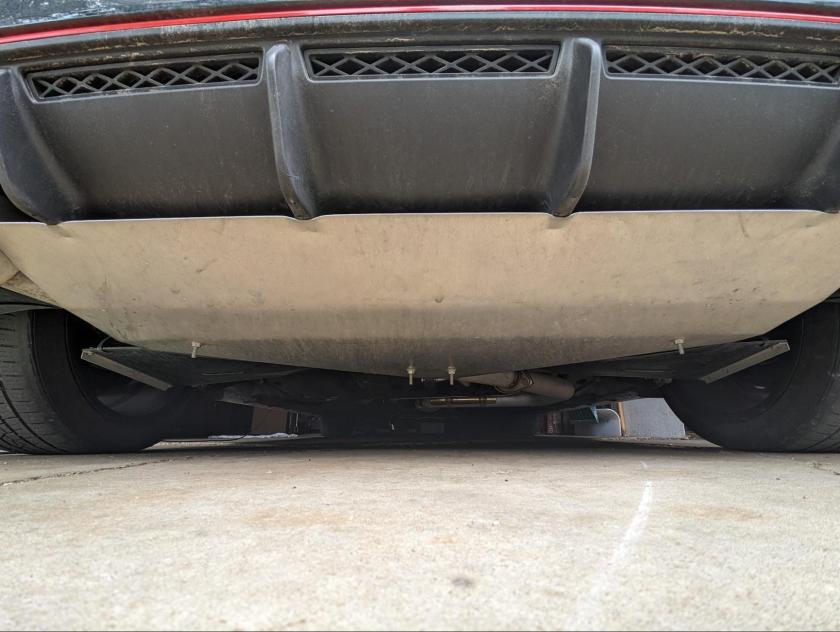
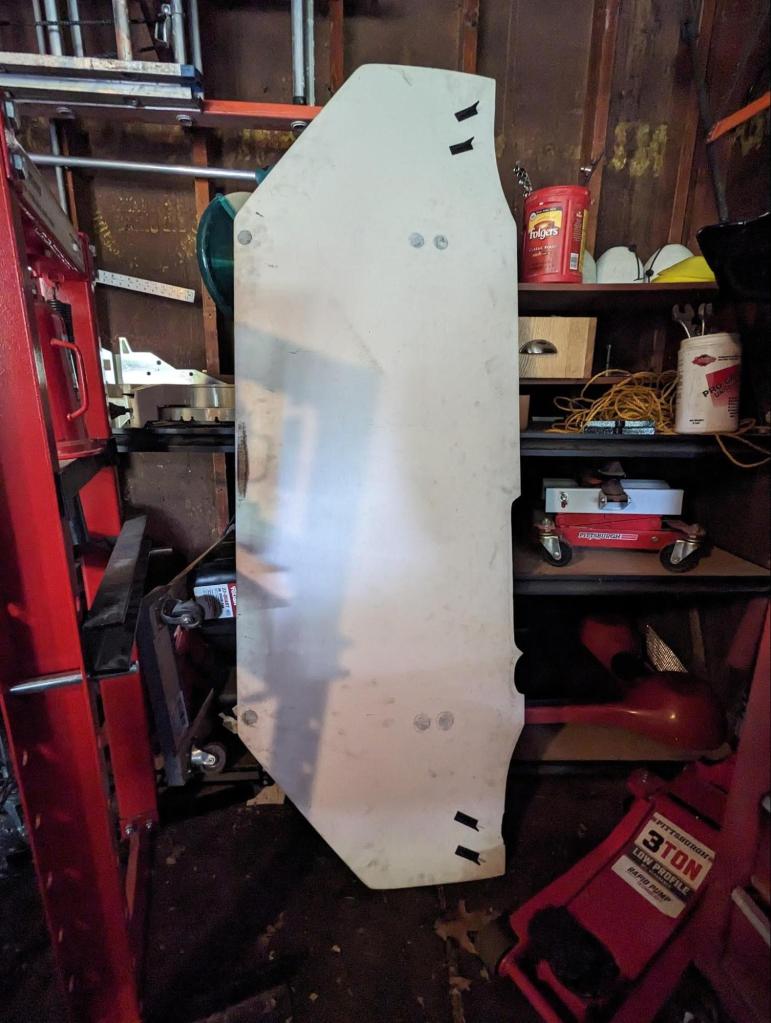
I started by tracing the OE undertray onto scrap aluminum. A single piece of aluminum would have been best, but I didn’t have anything 63” wide, so I pieced together three street signs. I get street signs from my local metal recycler for $1 per pound, and so this represents about $10 in materials.

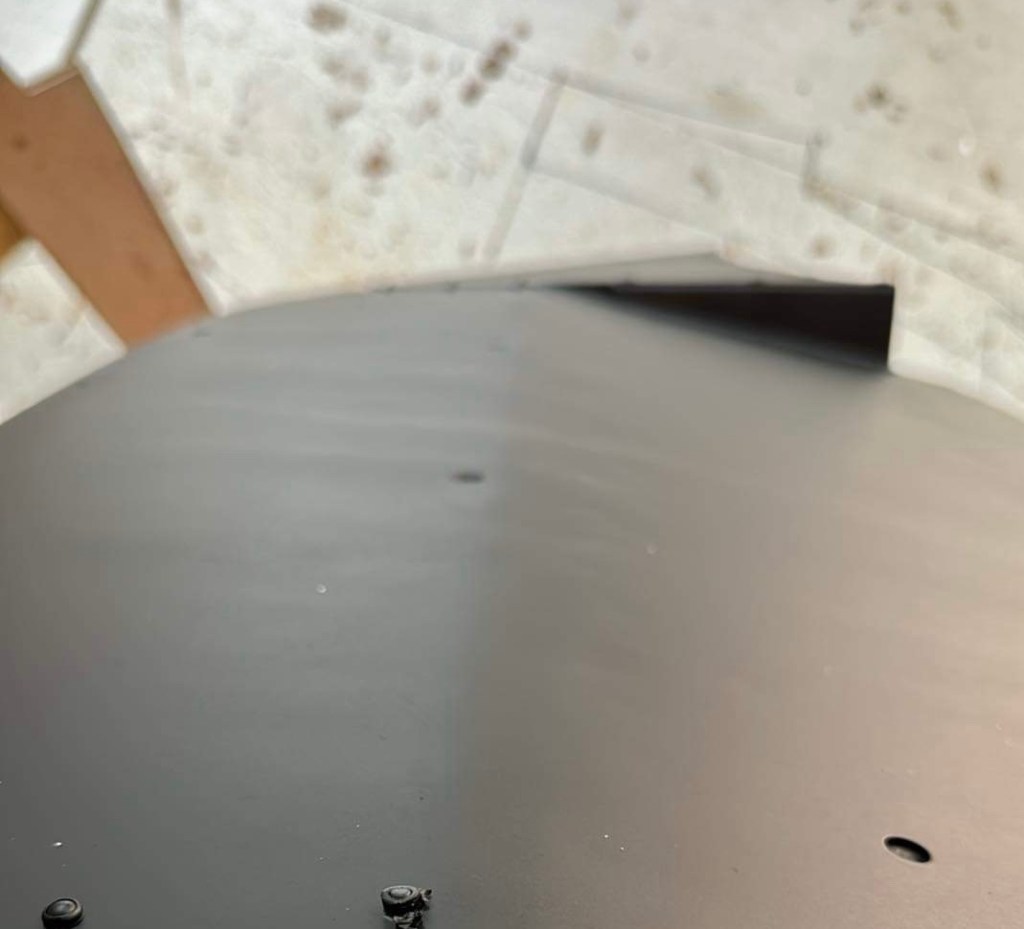
I then cut out the general shape and drilled the mounting holes. To create the curve of the diffuser, I clamped the aluminum down to the table and alternately leaned on it and tapped with a hammer to create a curve. It looks like a single bend in the picture, but it’s actually three bends, with a gradual radius.

Diffuser kick is gradual.

There are little aluminum ramps, sort of a Z-plate, that connect the flat portion in front of the wheels to the curved section in the middle. You can see those little triangles in the previous (blurry) image. These are fastened with rivets.

Aluminum signs riveted together.

I guessed at the shape and length of the diffuser, and guessed wrong. It took a few tries to get the shape of the trailing edge, because the oil pan and intake plumbing are in the way. While doing that trimming, I also decided to add a hole for oil filter access. I later taped over this, and so accessing the oil filter is as simple as removing the tape.

Final shape of undertray, compared to OE.

The undertray attaches at the OE mounting points, but I replaced the plastic pop fasteners with 6mm speed clips. I used long countersunk Allens for the four bolts that attach to the radiator bracket. It’s fuggin solid.

How will it work? It’s hard to say, but I’ll make a guess. A flat splitter was 132 lbs of downforce at 100 mph, while the curved splitter was 163 lbs. So the diffuser portion alone might be 30 lbs of downforce, and when coupled with the differential in front pressure… let’s call it 60 lbs of downforce.

Splitter curvature (and/or vortex strakes) also contributed to a significant reduction in drag (.019) that resulted in a gain of about 3 hp vs the flat splitter. So the diffuser undertray may have some drag reduction, as well.

As DIY projects go, this was a satisfying one. It cost me $10 in materials and was finished by lunchtime. It weighs only 2.5 lbs more than the OE plastic, and is just as unobtrusive. The diffuser likely confers a performance benefit in both downforce and drag, and would probably pass scrutiny for a street (unmodified) class. I’ll take that as a win.

There are some racing rules that specify a flat splitter, but say nothing about the undertray (SCCA STU, for example). A clever person could add a flat splitter in front of this type of undertray, and get the full benefit of a fully curved splitter, while also adhering to the written rule. Likewise, there are some racing rules where a splitter costs some performance points, but you can add an airdam and (unspecified) undertray for less. Undertray diffusers FTW!

Veloster N Aero Builds and Lap Times

As a follow up to the previous post, I wanted to see how much aero was worth at various race tracks. To do this, I’ll build a Veloster N at three stages of aero development, and see how they compare in OptimumLap. Let’s call these aero packages OE, Sport and Track.

OE aero is simply the car as delivered. If you read my wind tunnel report, you’ll know the coefficient of drag is .421 and the coefficient of lift is -.027. The drag is higher than you’d expect, and the fact that the car makes a little downforce straight from the factory is remarkable.

Sport aero consists of parts you’d drive on the street, so I’ll add lowering springs, but not a splitter, because that would take damage on driveways. I’ll add top and bottom canards to get more front downforce, and I’ll balance that out with a wicker/kicker on the spoiler. Wind visors worked really well on my VN, so let’s add those, too. Given these modifications, we have a car with around .50 drag and -.50 downforce, not bad.

The more extreme aero kit I’ll call Track aero, and this is my curved splitter and a wing, plus hood vents. I’ll keep the canards as well, and this brings the drag up to an even .60 and downforce to 1.00.

Note: The Veloster N hatchback isn’t very efficient when used with a wing. As a result, most wings I tested are worse than a 4:1 L/D ratio, which is pretty awful. Sedans and coupes would return much higher L/D ratios, and I’ve seen 8:1 or even 12:1 L/D out of a wing. So the aero builds in this article represent a worst-case scenario, and one can surely do better using a different car. But since I own a Veloster N… it’s my party, I’ll cry if I want to.

I’ve tested all of these parts in a wind tunnel, and so the drag and downforce numbers are accurate to within a couple percent, even though it looks like I’m just choosing round numbers. To compare lap times on each aero build, I’ll throw them all into Optimum Lap and see the time deltas for different tracks. In the following table, the numbers represent the time advantage per lap versus the OE aero.

TrackSport aeroTrack aero
Watkins Glen1.51.9
Palmer1.32.3
Thunderbolt1.31.9
Club Motorsports1.22
Road America1.21.25
Waterford.91.7
NYST.91.5
Gingerman.91.45
Mid Ohio.91.4
Summit Main.81.25
Thompson.71.9
Lime Rock.71.1
VIR.7.3
Pineview long.61.2
Canaan.61
Pineview short.5.9
Lap time deltas vs OE aero

From this you data you can see a couple outliers, and the most obvious is VIR. Sport aero was a .7 second advantage over OE bodywork, but Track aero was only .3 seconds faster. Meaning, you’d go faster with the Sport aero than Track aero! This is the only track where this is true, and so drag is obviously a dominant factor at VIR.

VIR: green is OE, red is Sport, blue is Track.

Drag also plays significant role at tracks like Watkins Glen and Road America, and coming up with an aero package for these tracks is more challenging, because you really need to strike a balance between drag and downforce. Knowing exactly how much downforce and drag each part makes is essential, because then you can just put the numbers into OptimumLap and find out which aero will make you fastest.

On the other end of the spectrum are tracks where cars spend most of the time cornering, which makes it quite easy to design a car’s aero: add as much downforce as you can, and ignore drag completely. For example, at Palmer, the big aero build goes a full second faster than the medium aero build, which in turn goes 1.3 seconds faster than OE aero. That’s 2.3 seconds in your pocket from aero alone, that’s awesome.

Remlap (Palmer backwards) with the same color schemes.

That same strategy can be used for any race track where there are shorter or fewer straights, and more corners. And so Canaan, and Club Motorsports, Pineview’s various layouts, and Waterford are also tracks where you’d go after as much downforce as possible, and completely ignore drag as a matter of any consequence.

In the middle of these extremes are most of the race tracks in the USA, which have both fast and slow sections, but not too much of either. Tracks like Gingerman, Lime Rock, Mid Ohio, NYST, Summit Point, and Thunderbolt come to mind. At these tracks, the lap time delta between Sport and Track aero is around 160%, and for the most part, you can again ignore drag and go after as much downforce as possible.

If you’d like to know how fast your car goes around various race tracks with different aero parts, I’m available for consultations. I can build your car, any options you choose, and simulate the lap times at any race track (I can make any track from 10hz GPS data). I charge a measly $50 per hour, and it takes about that long, so contact me if you are interested in this service.

Veloster N Aero Success Story

This is a guest post from Dan Ayd, chronicling his adventures in performance driving and aerodynamics.

I love tracking my Veloster N. However, the specter of losing control, either by incompetence or mechanical failure, terrifies me. So over the past three years I’ve been gradually improving my car’s aero, and my driving skills. 

I primarily participate in an annual high performance driver education (HPDE) hosted by the Minnesota BMW CCA chapter at Brainerd International Raceway (BIR) using the 13-turn competition course. This club runs an extraordinarily safe and well structured event over the course of three days in the first week or so of June in northern Minnesota. 

The first year, 2021, I had just gotten this car and my goal was a two minute lap measured by my Apex Pro. In 2022 I upgraded tires from the 300 treadwear OEM Pirelli PZero rubber to Nitto NT05. These are old technology, but a tried and true weekend-warrior 200TW tire, back when that rating actually meant something.I also had an alignment done changing front from 1.5° to 2.5° negative camber, and zeroed toe both front and rear toe. These changes brought my my best lap down to 1:58. 

In 2023, I got down to a 1:56.42 with only the addition of a 22mm Whiteline rear anti-sway bar. It’s unlikely this addition was responsible for a 2 second improvement so I will chalk this up to an excellent instructor, Rory Lonergan, who is an outstanding FWD-car driver, for making inroads on my skills. 

In 2023 I also started exploring car aerodynamics, mostly because of Turn 2, a flat, high-speed right-hand sweeper. I tried focusing on braking points, turn in, apex, and track out, but I found myself highly inconsistent with entry, maintenance, and exit speeds. I’m sure this is in large part due to my lack of practice–only coming to this track for two days of lapping a year isn’t enough to really improve, except in qualitative aspects like comfort with speed, noise, flags, traffic, etc. Despite the data showing manageable G forces, I simply didn’t trust the car, so I’d arbitrarily brake and/or lift at a safe speed below 100 mph. 

Turn 2 Bugaboo.

The data showed only 0.7-0.8 lateral Gs and I knew from looking at other corners, the car was capable of much more than that, more like 0.95. I never looked down at the speedometer to know how fast that was, but looking at the lap data I usually arrived at that turn around 116-117mph. There was so much going on still on the track that I didn’t have the mental currency to focus on details. I felt that by adding some aero, I could not only reduce the speed by increasing drag, but also increase lateral grip to the point that the turn would become no-lift. As in, I could floor it from the exit of turn 13 and not decelerate until braking into turn 3 almost a mile later.

I was only familiar with aero in terms of making the car slippery, but not how to use downforce to increase grip. After watching some YouTube videos by Julian Edgar I bought his book and was inspired to make a flat floor beneath the lumpiest part of my car, the rear third. 

The Veloster N comes with a front undertray that’s quite smooth and it joins up to a center section at the passenger footwells that are also quite smooth. Once past the fuel tank the exhaust and suspension are hanging in the wind followed by a stupid cosmetic “diffuser” that is probably only good at acting like a parachute. I felt that Julian’s MPG-chasing aero concepts could help here at little cost and almost zero impact to weight and aesthetics. 

I purchased sheet aluminum and wrapped the entire muffler and extended it over the edge of that parachute. I also fashioned some ABS sheet plastic covers over the control arms, and included a strake to maybe keep air going straight. I picked up a couple miles per gallon in subjective highway fuel economy, but I saw no improvement in Turn 2. 

Everyone who follows Julian Edgar’s advice wants to make a flat floor; they also seem to get the same flat results.

I shared my mods with the forum on www.velostern.com, and one of the members pointed out to me that someone he knew was buying a Veloster N and would be writing about it on his blog while he “aeroed the shit out of it.” Through this networking I met Mario Korf, and when he began writing about his Veloster N, I started following his Occam’s Racer website, reading all of his posts, messaging him directly, and listening to his guest spots on club-racing podcasts. 

What I started learning was that most street cars, especially hatchbacks, create lift rather than downforce. However, the folks at Hyundai poached Albert Bierman from the BMW M division, and with his guidance, they created a car that actually creates downforce, right from the factory. 

The use of the flat undertray and the wing-like OE spoiler resulted in car that didn’t lift at speed, and had minor amounts of downforce. Based on his session at the A2 wind tunnel in North Carolina, Mario opined that there would be huge gains to be had with a big, properly designed splitter and a wing out back and up in clean air. 

Ok, I’m in, but how do I make this stuff? I hadn’t a clue. After purchasing his wind tunnel report, reading his blog entries from the archive, and peppering the poor guy with hundreds of texts I began formulating a design based on his wind tunnel splitter.

I started by getting a 4×8 foot sheet of 5mm Meranti plywood from a local boating store. I set to work measuring, cutting, and gluing three layers together and cutting the laminated structure overnight under the weight of my car in a curved shape to resemble a wing. This was Mario’s theory of making the entire width of the splitter a diffused surface. 

Laminating the splitter and adding thickness to the leading edge, so that it can be properly rounded on the underside.

Once dried solid, I used a belt sander and began sculpting the underside of the leading edge to be rounded to keep air attached and flowing smoothly. I tapered the end to combine with the curve to reach about 13° of upward rake under the car mirroring his least draggy splitter design. It measured 67” wide and 24” long. 

The trailing edge sweeps upwards at about 13°.

I used Professional Awesome normal 6” long quick release brackets connected to custom rear vertical supports I made using clevis-cotter-pin quick releases of my own making along with their carbon splitter rods up front. These were extremely secure and allowed a small amount of angle and height adjustment.

Custom splitter brackets use Pro Awe quick release mounts.

I set it to have an upward tilt of 0.6° at the front and a height of about 4” from the ground. I initially tested the splitter in daily driving, and it seemed to reduce drag by about 10%. According to Mario’s data, it should be good for about 150# of downforce at 100 mph.

The Veloster N is aerodynamically balanced from the factory, and so adding front downforce alone would be a disaster on track; I had to add a wing. Getting a wing high enough or far enough back to get into something resembling clean air on this car isn’t easy. With the sloped glass and weak plastic shroud there’s not much support for 100 pounds of downforce without drilling holes in metal to support gaudy uprights, and I prefer a cleaner, less Ricky Racer aesthetic. 

Mario and I passed ideas back and forth as I iterated in my head. When I was in upstate New York for work he invited me to join him at his home track, Pineview Country Club, for a coaching session in his car.

Dan flogging Mario’s car at Pineview Run. You can read about that in How Experience Level Affects Lap Times.

Upon finishing, he surprised me with a gift of the wood prototype roof piece he made for a wing mount. When I got home I needed to modify it slightly to ensure air would separate cleanly above the rear window so I added a layer of Meranti plywood, sculpting and smoothing the enlarged structure so it would look good enough to make Mario proud. Now I needed to mate metal to wood attaching the wing to the car with solid and reliable uprights.

Hatchback roof extension is bolted in place and holds the wing securely.

After several rounds of mental iteration I settled on plate aluminum uprights like an F40 Ferrari with a Performance Car Innovations (PCI) V2 airfoil 48” in length. At the height I selected, 9” at the rear, 7” up front I expect it will produce around 80 lbs of downforce at 100mph. This was one of the wings featured in Mario’s wind tunnel report although slightly shorter. If I needed more downforce, I could add a 1/2″ Gurney flap and get around 120 lbs. Those figures are based on his wind tunnel testing, and should be pretty accurate.

Because the Veloster roof slopes downward, I needed to verify the proper wing angle. The folks at PCI said the wing would start stalling at around 10°. So I did tuft testing on the wing and discovered that the 3.5° angle of attack resulted in some stalling at the rear edge of the wing. So I slotted the rear holes and flattened the wing to 2.7° from horizontal, and the wing now has full attachment. 

Tuft testing to find the maximum angle before separation.

The Veloster N has about 65% percent of its weight on the front wheels, and the typical formula is to match aerodynamic balance with chassis balance. However, you’ll recall that I added a thicker rear sway bar and significant amounts of front camber, and thus moved the mechanical grip further forward. This is not good for a doofus like me, on a track that has a 100 mph turn! 

By biasing the aero at 55/45, the car transitions more to understeer the faster I go. This makes me feel safe and helps me focus on braking, turn-in, apex, and track out. Since my track car is my daily driver, this is extra important. 

Overall, the car looks pretty badass in my opinion, and the aero parts are sturdy. I can stand on the splitter. I can lay on top of the wing. This homemade crap is strong, even if it seems a bit weird to put plywood on a car!

Looking great on the track and on the street.

And at the track, the shit actually worked. Over the course of 8 sessions, or almost a hundred laps, I felt increased confidence in turn two, and the data bore this out. Lap times plummeted from 2023’s best of 1:56.42 to 1:52.42, a staggering drop of 4 full seconds. Mario predicted about 2.5 from aero alone so let’s say the additional seat time and coaching (it was a driving school after all) was responsible for the other 1.5 seconds. 

Looking closer at the data between 2022 (pre-aero) and 2024, my minimum speeds are still very inconsistent, but there are glimpses of what a new personal best if I could string them together. Slow, difficult turns like 3 and 13 were a mixed bag, and aero has little impact. The biggest benefits of aero seem to occur at turn 2, where I’m going 8 mph faster, and turn 4, where I have an additional 6 mph. In the S-turn (turns 10/11) I picked up sometimes 8 mph. I’d wager there’s another 2-4 seconds, but we’ll see next time out on the track.

T2,and T10/11 are the biggest wins.

This adventure in aerodynamics has been a huge success. My car is faster and safer, and along the way I’ve gained a friend in Mario. I’ve learned new skills in woodworking, and stoked a desire to fabricate with metal as well. Time at the track has added other friends and given me great memories, so anything that extends that is great in my book. Cheers to aero!

Wing Logic vs 9 Lives Racing

The availability of inexpensive extruded aluminum wings has changed motorsports. Ten years ago it was rare to see a wing on a budget endurance racer or HPDE car. Now they are everywhere. A lot of the credit (blame?) goes to Johnny Cichowski of 9 Lives Racing, who sells an inexpensive extruded aluminum wing that sets the standard for the industry.

When you have a winning formula, people copy you. That’s the nature of business. That’s also the nature of racing. And so it’s no surprise that someone else has created a similar product.

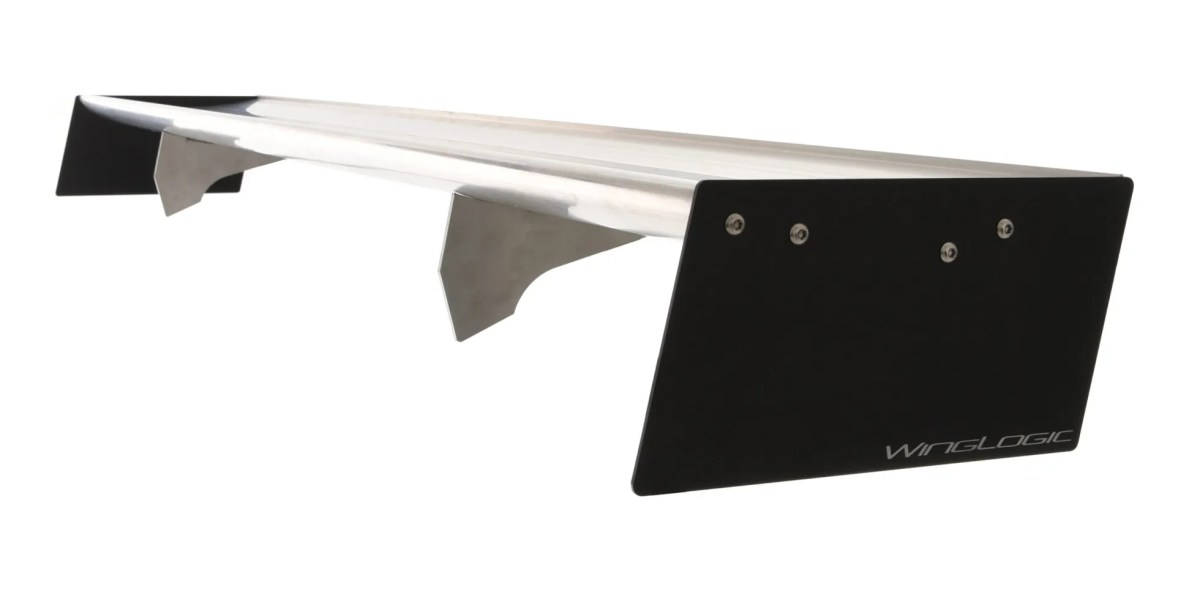
This new extruded aluminum wing comes from Michael Jui of Wing Logic. He got wind that I was going to a wind tunnel, and asked if I would test his product. Of course I said yes, because I want that data, and I think the racing community as a whole would like that as well. So let’s take a look at this new wing in as much detail as I can, and compare it to the 9 Lives Racing Big Wang.

Wing Logic’s chord measures about 9.8”, while the 9LR wing is 9.2” across the top. So, the Big Wang is actually the smaller wing.

The wingspans are slightly different, as Wing Logic’s comes in standard lengths of 60″, 65”, 70″ and 72″. 9 Lives makes their wings to fit certain models, but you can also order a custom length. This is important because most racing rules limit wings to body width, and so if you have a Miata, you need to trim an inch off the 65″ Wing Logic, and re-tap the holes on one side. I didn’t do that for this test, so Wing Logic has a slight advantage, with 1″ more wingspan.

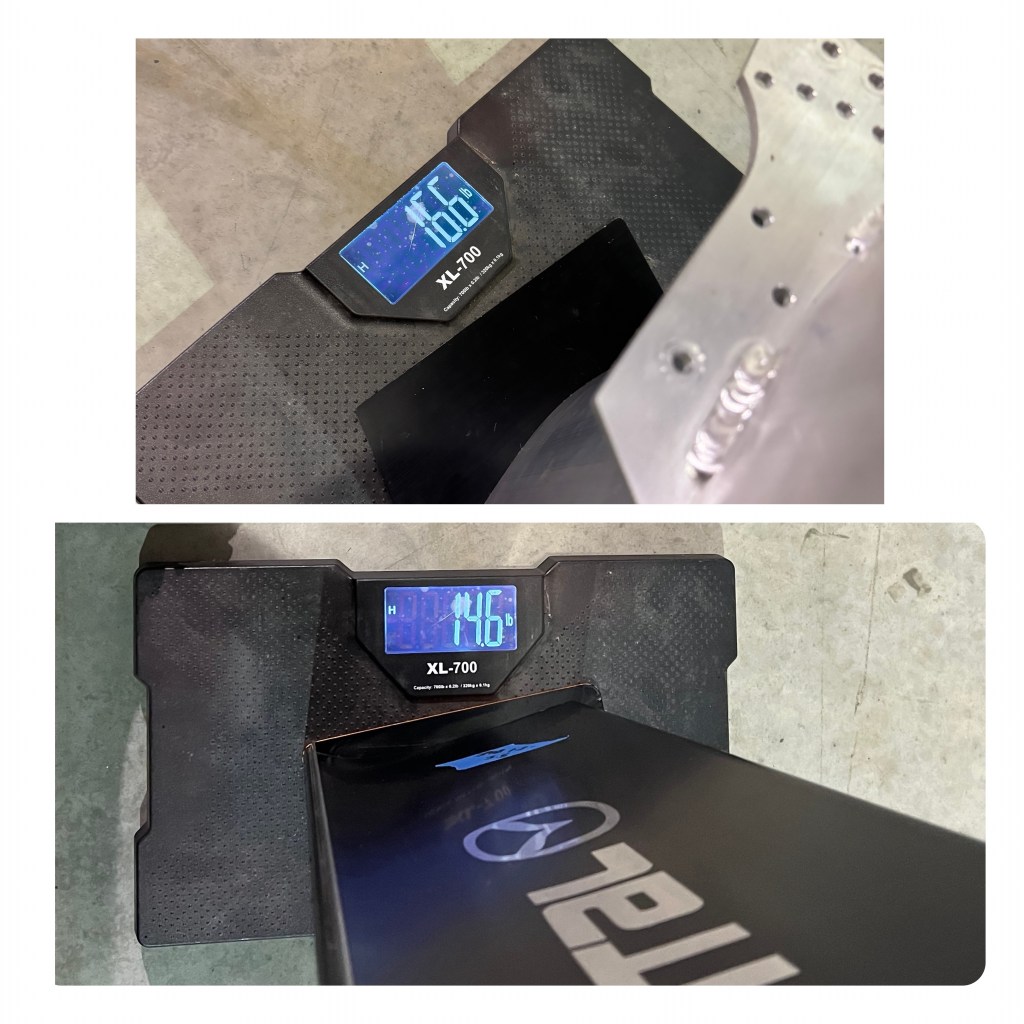
The construction of the wings are pretty similar, but Wing Logic has some extra internal thickness in a couple places, and while 9 Lives uses 5mm hardware for the end plates, Wing Logic uses 6mm. The Wing Logic end plates are 3mm, which is thicker than I’ve seen anywhere. All of this adds up to a wing that is sturdier, but heavier. A 65” Wing Logic fully set up with end plates and welded bottom mounts weighed 16.6 lbs. A 9 Lives 64” wing dressed the same weighed 14.6 lbs.

Wing Logic is 2 lbs heavier.

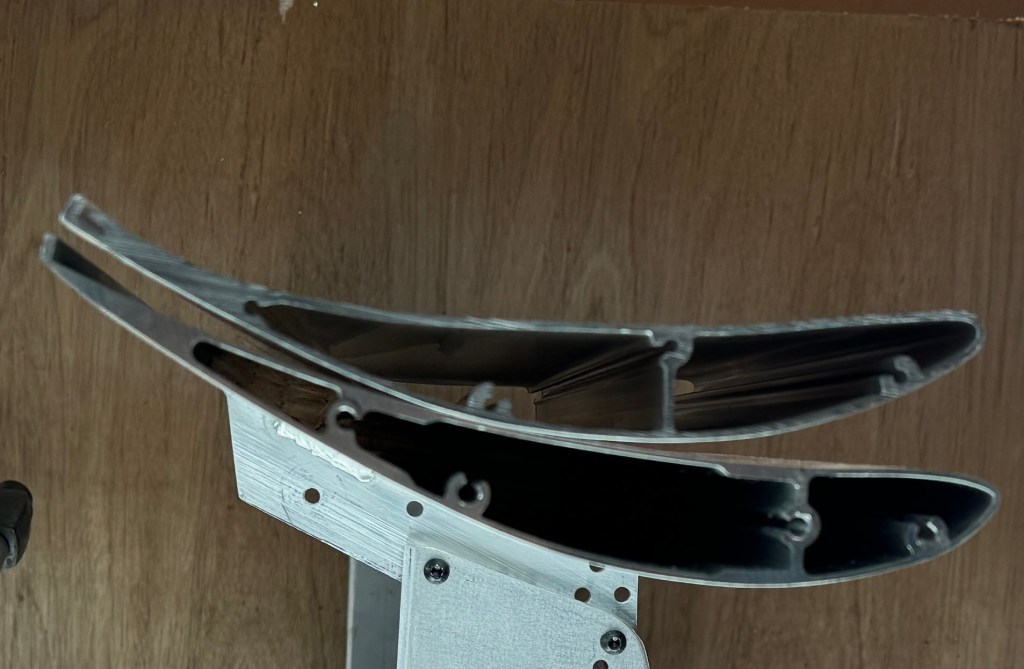
The shape of the wings are similar, but not the same. Anyone who says Wing Logic copied the 9 Lives Racing shape is simply wrong. As near as I can tell, Wing Logic is using a CH10 (Chuch Hollinger CH 10-48-13), which is a low Reynolds high-lift aviation airfoil, while the 9 Lives Racing wing was designed as a motorsports wing from the start.

If you measured Wing Logic in Benzing coordinates it’s a Be 133-105, while 9 Lives measures Be 123-125. That means the position of maximum thickness and maximum camber are the same in both wings, and that’s why they look similar. But Wing Logic’s is thicker and 9 Lives has more camber.

9 Lives top, Wing Logic bottom

If you want to dive deep on that topic, I wrote an article on Car Wing Comparisons. Of all the wings I investigated, the most efficient was the CH10. But that is based on free stream efficiency, which means that the wing is not on a car, but just suspended in the air.

Cars are large and aerodynamically inefficient compared to wings, and when you put a wing on a car, the drag doesn’t go up that much, but the downforce does. So you usually get the best vehicle efficiency by choosing a wing that has the most downforce, not by choosing a wing for its efficiency or low drag.

Enough preamble, how do the wings compare in the wind tunnel?

Wind tunnel testing

I use the A2 wind tunnel, because for people like me, it’s the only game in town. I’ve tried to get into other wind tunnels, and either I’m not allowed, or it’s prohibitively expensive. The Aerodyne wind tunnel next door has a rolling floor, and I’d like to try it, even if it’s 4x the cost. But the rollers are designed for NASCAR, so unless I bring a car with a 109″ ish wheelbase (Miatas are 90″), I’m shit out of luck.

A2 doesn’t have a rolling floor, and so the effect of the tires rolling on the ground can’t be measured. This is significant for underbody testing, but you can measure things on the front of the car and over the body with acceptable accuracy.

There’s a lot of online conjecture by people who have never been to A2, that the small size of the wind tunnel, and the proximity of the walls, contributes highly to a blockage rate (or ratio?) that makes this wind tunnel results inaccurate. However, the walls in the tunnel are designed to reduce the blockage, by being curved rather than flat. And I’m also not after 100% accuracy, I’m looking for deltas – the difference between this or that. Did this wing have more or less drag than the previous wing? Did it produce more or less downforce? These things can be measured with accuracy at A2.

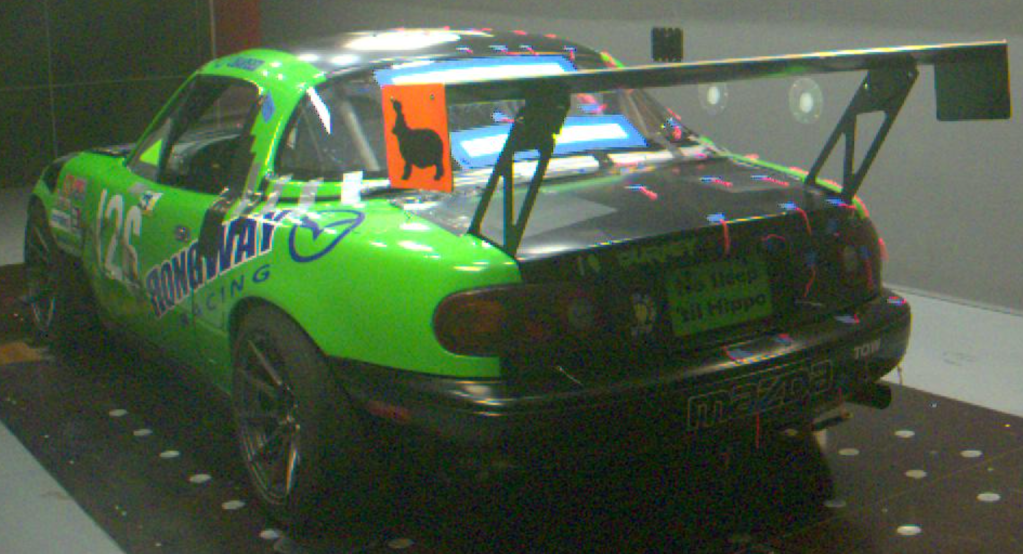
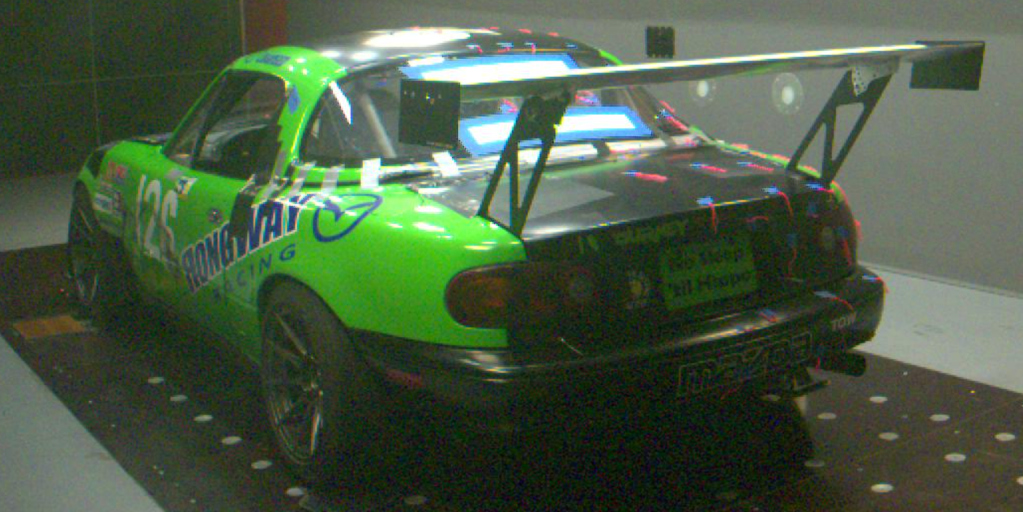
For the wind tunnel testing, I wanted to to use a car that already had CFD done on it, so I borrowed Phil Sproger’s car. His NA Miata has a 9 Lives Racing medium aero kit, and we set the ride height so that it would be as close as possible to the specifications that Morlind Engineering used when they ran CFD for 9 Lives Racing. (AJ Hartman and I did 42 runs on this car, baselining the car vs CFD, and then testing wings, spoilers, fastbacks, and many other ideas for drag and downforce. You’ll be able to read about that in a future report.)

9 Lives Racing Big Wang.

We tested a 65″ Wing Logic back to back with a 64″ Nine Lives. Wing Logic has a built-in 1/4″ Gurney flap, and 9 Lives Racing has a slot for Gurney flaps of various heights, and we used a 1/2” Gurney. But because the slot is slightly recessed, this is more like 3/8”. So while one wing was slightly larger, the other had a slightly taller wicker, and it should be a fair fight.

Wing Logic – notice the smaller end plates.

I also threw in a strange DIY wing I made to see how it compares. It measures 41″x16″, and looks like an old-school F1 wing. The low-aspect ratio would not work in its favor, however the extra chord should make the wing slightly more efficient by having a higher Reynolds number.

Let’s see how they measured up at 100 mph, using the following fields:

  • Front downforce – This is a negative number, which you can think of as lift. When you add rear downforce (or drag), it lifts the front of the car through leverage, like a see-saw.
  • Rear downforce – This is the wing’s job, and varies with wing angle, Gurney flap height, and many other variables.
  • Total downforce – Front lift and rear downforce combined.
  • Drag – The number of pounds of drag the wing adds. This is a pretty meaningless number on its own, but is used to calculate the L/D ratio.
  • HP – An easier way of thinking about drag is how much horsepower it consumes.
  • L/D ratio – This is also known as aerodynamic efficiency, and is usually a good way of determining which part is better on the car. Note that the numbers in this table are not the bullshit free-stream efficiency you see in CFD, but the actual returned efficiency as run on the car.
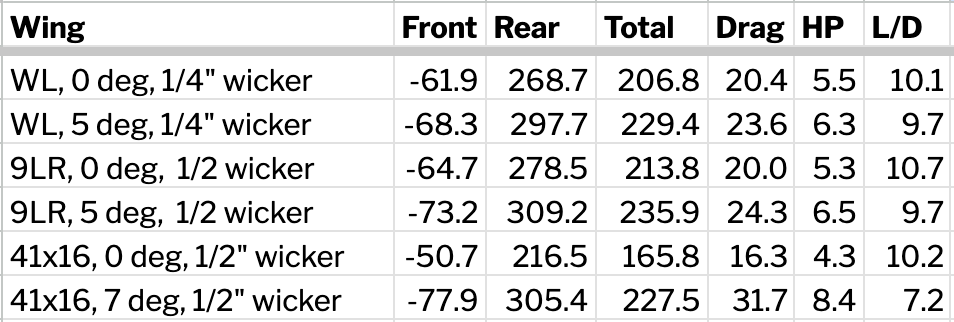
Three wings compared at zero and 5 degrees.

As you can see from the data, at zero degrees angle of attack, Wing Logic, 9 Lives Racing, and my DIY wing are all better than a 10:1 L/D ratio. At this setting, the Big Wang makes the most downforce, and is thus the most efficient by about 5%.

When I set the wings to 5 degrees, Wing Logic and 9 Lives are identical in terms of aero efficiency. The Big Wang makes slightly more downforce, but the bigger wing makes less drag, and they are effectively the same at this setting. This is also about the maximum angle you can set, because air is coming down the roof at 5-7 degrees, and so if you use more angle than this, the center of the wing stalls, which adds drag and reduces downforce.

As a side note, my chunky DIY wing was similar to the other wings at zero degrees, by virtue of less drag. I should have tested it at the same 5 degrees as the others, because it was stalling at 7 degrees. It’s definitely the worst wing here, but not by a lot. On the plus side, it weighed on average 6 lbs less than the aluminum wings, and it cost me $30 in materials!

To get back to the actual contenders here, the two aluminum wings performed the same at 5 degrees AoA, but that isn’t the whole story, because the Big Wang is dimensionally the smallest. If you are racing in a class that limits total wing area (GLTC 500 square inch wings, for example), then the 9 Lives wing will give you about an 8% advantage over Wing Logic. It’s not a huge difference, but in a rule set that limits wing area , I’d take the Big Wang.

The full results of the wind tunnel testing are in my Miata Wind Tunnel Report, where I go into not only wings, but different tops, front end options (canards, hood and fender vents, splitter adornments, etc. You can purchase the report here by clicking the button, and you’ll get a link where you can download it.

If you don’t want to invest in the wind tunnel report, but you want to support this kind of investigative content, Buy Me a Coffee. It takes 15 coffees ($5 each) to pay for one run in the wind tunnel. That doesn’t count the many hours of preparation, towing 11 hours each way, gas, hotel, and other expenses I accrue on the way. Your support makes it possible for me to do community-driven wind tunnel testing. Thanks!

CFD vs wind tunnel

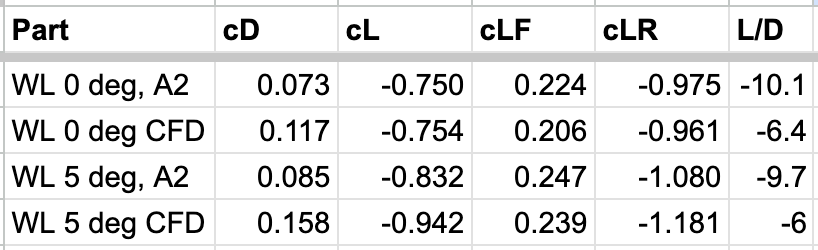
Both 9 Lives Racing and Wing Logic publish CFD results of their wings, and I thought it would be illuminating to see how accurate those are compared to the A2 wind tunnel. Wing Logic use Kyle Forster to do their CFD, and he used a 70” wing on a Mustang rather than a 65” wing on a Miata, so it’s not a direct comparison. Kyle used the same CFD settings as he did for AJ’s wings, which have generally landed within about 3% on loads in the same tunnel with matching cars/positions etc, so A2 correlation should be OK for this data.

Note that the reference area for the Miata is 1.67 meters squared (18 square feet), while in the CFD, it’s set at 1 meter squared. Ergo, I need to multiply the CFD numbers by 1.67 so that they match the wind tunnel data. When I do that, you can see, the wind tunnel returns similar downforce as the CFD, but drag is higher in the simulation.

Wing Logic wind tunnel (65″ Miata) vs CFD (70″ Mustang)

Is this a big problem? Not really. After testing the same wing on a Veloster N, an 8th Gen Civic coupe, a Miata, and a Supra, I can tell you that the shape of the car has a greater impact on a wing’s performance than any CFD error. On a hatchback, I’ve seen a 3.5:1 L/D and on a coupe up to 24.5:1. In the end, the main difference between CFD and wind tunnel results isn’t computer vs real world, it’s the shape of the car. A Miata ain’t a Mustang, and that’s likely where most of the differences lie between the Wing Logic CFD and wind tunnel data.

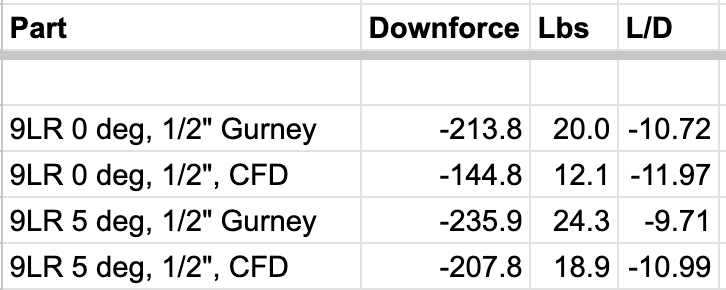
9 Lives Racing also publishes CFD using a 64″ wing on a Miata, and that’s exactly what we brought to the tunnel. So we can get an apples to apples comparison on this wing for shiz. But 9 Lives doesn’t publish coefficients, they only give us drag and downforce. Still, it’s enough to work from.

9 Lives Racing wind tunnel vs CFD at 100 mph.

Comparing the wind tunnel results to CFD, the computer predicted both less drag and less downforce than we got in the wind tunnel. The fact that the CFD was off by 33% in downforce points to some kind of problem with that model.

I base that on another nugget Kyle dropped on me which is that as a general rule of thumb, if CFD is off by <20% it could be correlation, <30% it’s setup differences, >30% something has gone wrong with the output numbers at some point or the CFD is extremely broken. So I’m not sure what’s going on with the 9 Lives / Morlind Engineering CFD, but it’s not matching real-world values very closely. When we tested the whole car (not just the wing), the drag was also off by a lot (as in .4 vs .6).

70″ Wing Logic, end plates, 3/4″ Gurney

I was also able to test a 70″ Wing Logic on my Hyundai Veloster N, which allowed me to compare the effect of wingspan on a hatchback. Last year I tested a 55″ Big Wang on my Veloster, and since Wing Logic and 9 Lives are pretty similar, I can get find out how much I was giving up with a shorter wingspan.

I also wanted to try 12″ square end plates to see if the smaller end plates were giving up some performance. And since Wing Logic has a built-in Gurney flap, I also wanted to see what would happen if I butted up a 3/4″ Gurney flap against that. (If you’re wondering what a 1/2″ Gurney would do, you can just average the numbers).

70″ Wing Logic on Hyundai Veloster N.

Comparing the 70″ Wing Logic to 55″ 9 Lives is absolutely not fair, so think of this only as a comparison of wingspan. The longer wing made 10 lbs less downforce (what in the actual fuck?), but had a lot less drag. The end result is a much better L/D ratio of 7.4:1 for the longer wing compared to about 3:1 for the shorter wing.

Now this is flatly absurd, because according to Kyle, an increase of 100mm span is worth about 7% load on the same car, so an increase in 15″ span (375 mm) should be an increase of 26% difference in load, not a decrease of almost 7%. I’m not sure what’s going on here, as the wing was in a similar position, and on the same car.

Changing the smaller end plates for 12″ square end plates added 7.2 lbs of downforce, but also used an additional 1.1 hp in drag. The change in parts returns a L/D ratio of 1.3:1, which means the smaller end plates would be faster anywhere but an autocross course.

Adding a 3/4″ Gurney flap added 48.1 lbs of downforce for 21.4 lbs of drag, which works out to a 2.25 L/D ratio. If you need more rear downforce, adding the larger wicker would be worthwhile on just about any track that isn’t a high speed oval.

Conclusions

Comparing the two wings, my main gripe is that Wing Logic’s wing is 2 pounds heavier than a 9 Lives wing of the same length. That’s not a lot of weight, but the location of the weight, high up and at the polar end of the car, isn’t helpful. As previously stated, in a racing class that limits the wing size to a certain amount of total area, 9 Lives has a slight advantage.

Those negatives aside, Wing Logic has a fine product that is well constructed and performs similarly to the Big Wang. At $349-399 with free shipping, Wing Logic’s wing is a downright bargain.

Pineview Run Layouts

Pineview Run recently put out a new Track Safety Course in which they detail new rules for 2024, and show the official layouts. Many of the new layouts are a result of fast bypasses that short cut some of the more technical turns.

In very round figures, this is how the bypasses compare to the original course.

  • Bypass 1: Going directly down the hill after Turn 2 is about 7 seconds faster than going through The Crick (turns 3-5).
  • Bypass 2: Going around the outside of the uphill esses shaves off about 3 seconds per lap.
  • Bypass 3: Short cutting the S-trap is worth about 6 seconds.

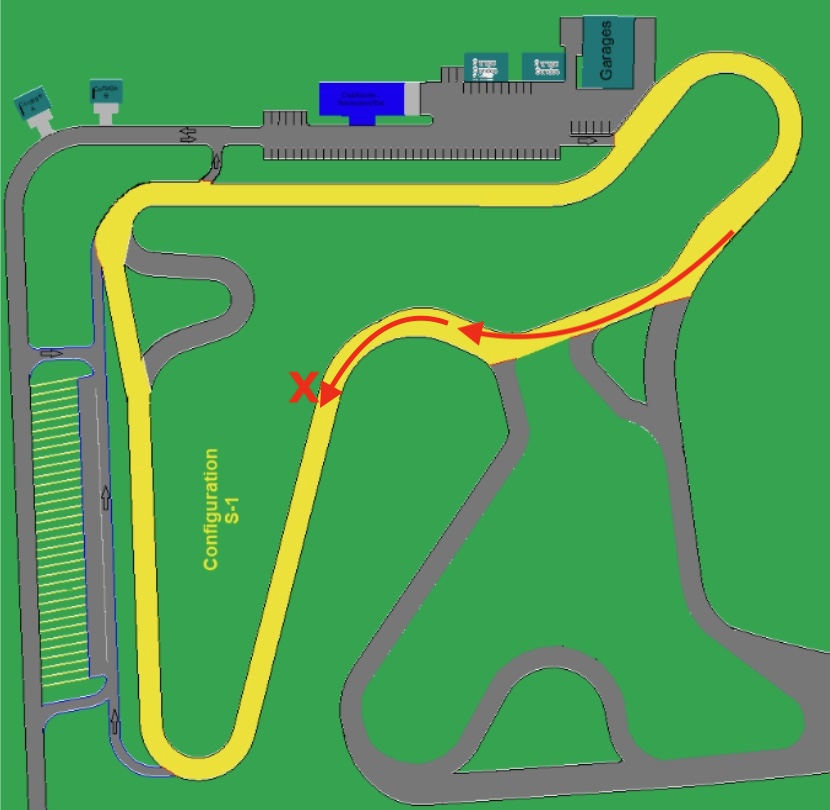
S1 = Shortest (Indy)

S1 is the shortest layout, and quite fast. This course was used for one of the races in the 2023 Pineview Challenge Cup. The biggest challenges are 1) drawing a straight line through the kink/bypass at T4, and 2) staying on the track at the exit of the knuckle.

Try not to fall off at the red X.

I call this one “Indy” because it’s like the shortest version of the Brands Hatch track, which they call Brands Hatch Indy. This is as small and simple as you can make Pineview, and would be good for winter driving clinics, where you don’t want to plow the whole track.

This track is about 40 seconds faster than the original course, and measures about 6/10ths of a mile on the driven line.

S2 = Short with S-trap (Kart)

Similar to S1, but including the S-trap. This has been the default layout for Wednesday and Thursday in 2024. It’s about 5/8 of a mile, and has a lap time around 34 seconds faster than the original layout.

Short and technical, good for karts.

S3 = Southern Loop

Either of the previous short layouts allows the S3 course to be run at the same time. The haripin is very tight, and braking for that, while maintaining speed for the steep uphill, will be an interesting challenge.

Fastest and slowest corners in this layout.

This layout was also used (with cones) for an autocross event in 2023, but I think the other short courses would be better for that. Also, I bet this layout could be run in the opposite direction, which might be more fun.

M1 = Triple Bypass (Gillette)

If you take the original track layout and add all three bypasses, you get a short and flowing circuit that’s heart-attack fast. Pineview calls it M1, but I call it “Gillette” in honor of Pineview Challenge Cup champion Jeremey Gillette, who beat everyone in 2022, and a triple bypass surgery in 2023.

Gillette is a fast and flowing course

If the first bypass is new to you, keep your wheels straight when going over the crest down the hill; the car gets very light here, and any amount of steering angle can bite you when the car settles down onto its suspension again. The bypasses combine to make this about 16 seconds faster than the original track.

M2 = Double Bypass

This track layout isn’t mentioned in the Pineview safety course, but they do run it occasionally. Note that the other layouts are called M1, M3, and M4, so perhaps they meant to include an M2 layout all along.

This course bypasses T4 and the S-trap, but keeps the uphill esses. Compared to the original layout, it’s a lot faster, but also removes the two most technical corners. This is a fun layout, just the same.

Fun.

M3 = Happy Hour

I seem to recall this layout being used for Happy Hour, it uses only the first bypass. The S-trap is important for new drivers, as it slows cars down before entering the front straight. With only one bypass, this layout is about 7 seconds faster than the original.

Oh yes it’s Ladies Night, and the feelings, right, oh what a night (oh what a night).

A few years ago Pineview started hosting Ladies’ Night, which was for women only, and open to the public. The times they are a changing, and in 2024 it’s called Happy Hour, to be more inclusive of everyone, regardless of their gender or pronoun identification. On the flip side, the event is now for members only, and over double the price, making it far less inclusive. I don’t know what’s going on with that, but at least there’s still a ladies-only run group.

M4 = Original

This is the original track layout with no bypasses. It’s the most technical and busy course, and it might be my favorite. On the racing line, it’s almost exactly 1 mile long, with 15 turns and a lot of elevation crammed into that length.

OG layout.

I used to dislike the S-trap, especially on my motorcycle, but now after bypassing the S-trap, I like it both ways. On a motorcycle it’s a painfully slow corner (20 mph), but it was an easy place to catch people. Likewise for cars, if you get the S-trap right, you make up time on 99% of people. Most of that is people throwing away speed on the initial corner entry, but a lot of people also pinch the exit.

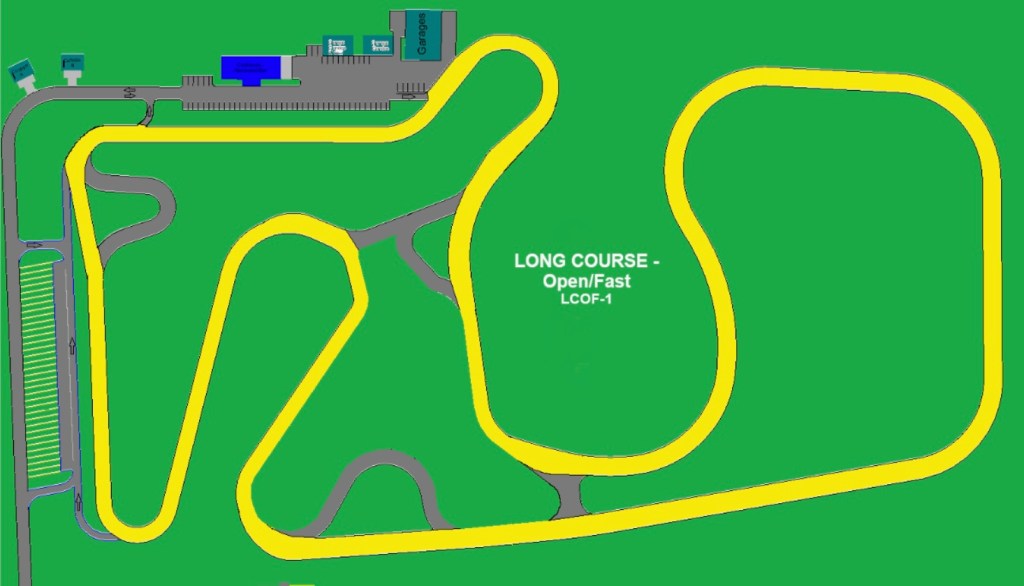
LCOF1 = Long Course

Pineview calls it LONG COURSE Open/Fast 1 (LCOF-1), but I would simply call it L1 or long course. This is the original track plus the extension, with all the bypasses. It’s fast, flowing, and fun, and hopefully what the big-car people wanted all along. (I was fine with the original track, but I’m a weirdo.)

Long course with all the bypasses is fast and fun.

The new extension has more elevation than the old, and the new section of track is at least 10 feet wider. Fast cars will go over 100 mph on the back straight. The track measures just over 1.4 miles on the driven line.

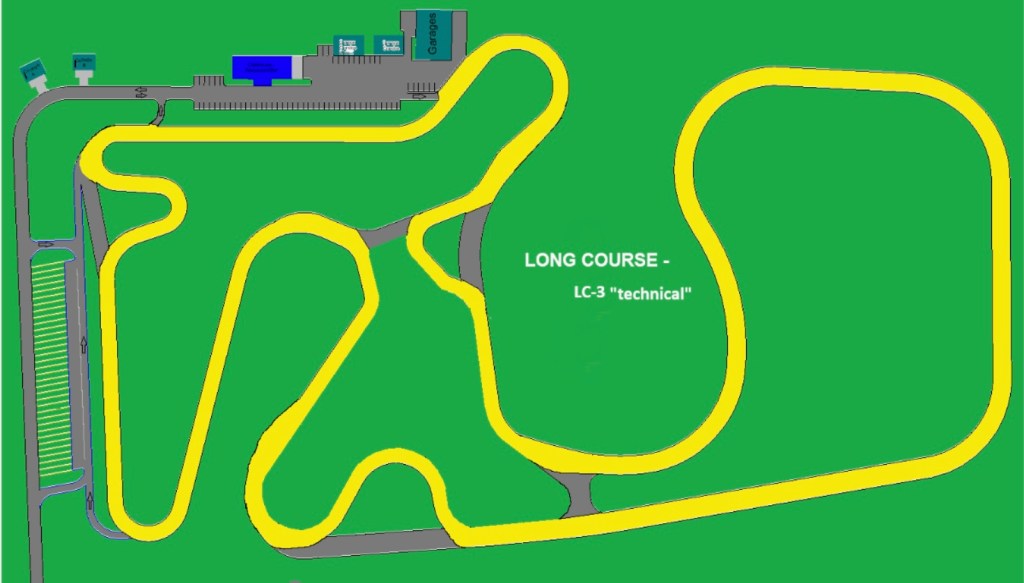
LC3 = The Equalizer

This is the longest layout using all of the original circuit, plus the extension. I want to call it Marathon because of the length (1.5 miles), but I think of it as The Equalizer. On the original course, lighter and less powerful cars seemed to have an advantage with all the tight corners. However, the long course with the bypasses and extension gives the advantage back to heavier and more powerful cars. So when you combine all the technical corners from the original track with the fast and flowing nature of the extension, this should put all cars on equal footing. Hence, the Equalizer.

The longest and most technical layout should equalize cars and make it all about driver skill.

I’m really looking forward to this layout. I think the trickiest part will be transitioning from the extension’s back straight to the original course’s uphill esses. With so much speed going into a short 90-degree corner, it’ll be easy to blow the entry to T8. But if you do blow it, there’s a lot of runoff going up the hill if you miss your braking marker.

Missing layouts?

That’s 9 track layouts, but if you do the math, there are a 16 track configurations possible. So what’s missing from the “official” track list?

  • OG no S-Trap – Several members have complained for years about the S-trap being too slow. An easy solution is to use the original course, but bypass the S-trap. But that configuration doesn’t exist in the official documentation.
  • Long course + crick – Turn 4 is the most technical corner at Pineview, and I’d like to see it added to the long course. The crick, as I call it, also slows cars going down the hill, and makes it much less likely for there to be a “coming together” on the back straight.
  • Long course + esses – The uphill esses are painfully slow in a FWD car, and I can see why some people might want to avoid them. But braking from high speed on the back straight and then having to turn into T8 and go up the esses would be very challenging. People will get to do this in the LC3 layout (Equalizer), so it’s not a high priority to add this option separately.
  • Long course + S-trap – This is missing from the list, but not one I’d be interested in.
  • Double Combinations – And then there are three long course combinations that use two bypasses instead of one or all three. Of those, the only one that’s compelling are adding both the crick and the esses. But this is so close to L3, so why bother.

Drive it!

That wraps up the possible layouts at Pineview, at least going in a clockwise direction. However, as of this writing, only the original layout options are open. There’s still some work being done on the extension, and we expect to drive on the long courses starting in June.

I’ve driven on the repaved extension, and it’s good. I had previously complained about bumps on the new asphalt, and the dip going up the back straight, but all of these have been addressed. There are a couple patches where the asphalt isn’t perfect, and a couple undulations on the extension that could be smoothed out more. Once the circuit gets a final coat of asphalt, I feel this track will rival any track on the east coast.

If you want to try out the track, Pineview is open Wednesday to Sunday. You can get a guest pass here. Or check the calendar for events when S2K Takeover, Mass Tuning, SCDA, and Xtreme Xperience have rented the track. Those groups bring their own insurance, and it might be easier to get on track with them (no track safety class, no Raceiver radio requirement, etc). If you are a regular follower of my blog, definitely contact me before you come to Pineview, there’s a good chance I can meet you there.

Note that one of the new rules for 2024 is a sound ordinance by the town of Otisco. The law states a limit of 70 db at the property line, which is 250′ in this case. That means your vehicle must measure 88 db at 30′ or 92 db at 20′, with your engine at 3500 rpm. If you think the residents of Otisco have it out for Pineview, they absolutely do (and PV now joins other tracks with this problem, like Laguna Seca, Lime Rock, Waterford, etc).

Pineview’s neighbor to the south is Wonderland Forest, an outdoor concert venue for hippy bands, and they also have the residents up in arms over their music festivals. Wonderland is going to court with the town of Otisco over the sound issue, so thanks to them for doing the heavy lifting. Let’s see how this one plays out, until then, please muffle your exhausts.

DIY Rocker Vents

In a previous article I covered Miata fender vents in some detail, including commercially available louvers and DIY solutions. I cited Race Louvers wind tunnel data, which found that after a certain size, more vents don’t equal more downforce. What I didn’t mention was the reason for those diminishing returns.

All of this venting is overkill unless you can reach further inside the wheel well.

Take a look at a Miata unibody with the fenders removed, and you can see the problem. At the top of the fender, vents can reach just about the width of the tire, but the air has to travel all the way up there in order to be extracted. A more direct route is behind the tire, but the chassis is in the way! Moreover, air needs to take a 90-degree turn to make its way out of the wheel well. On a Miata, there’s a sharp lip here where two seams come together, which makes it even harder for air to turn the corner.

Naked Miata shows the crux of the problem.

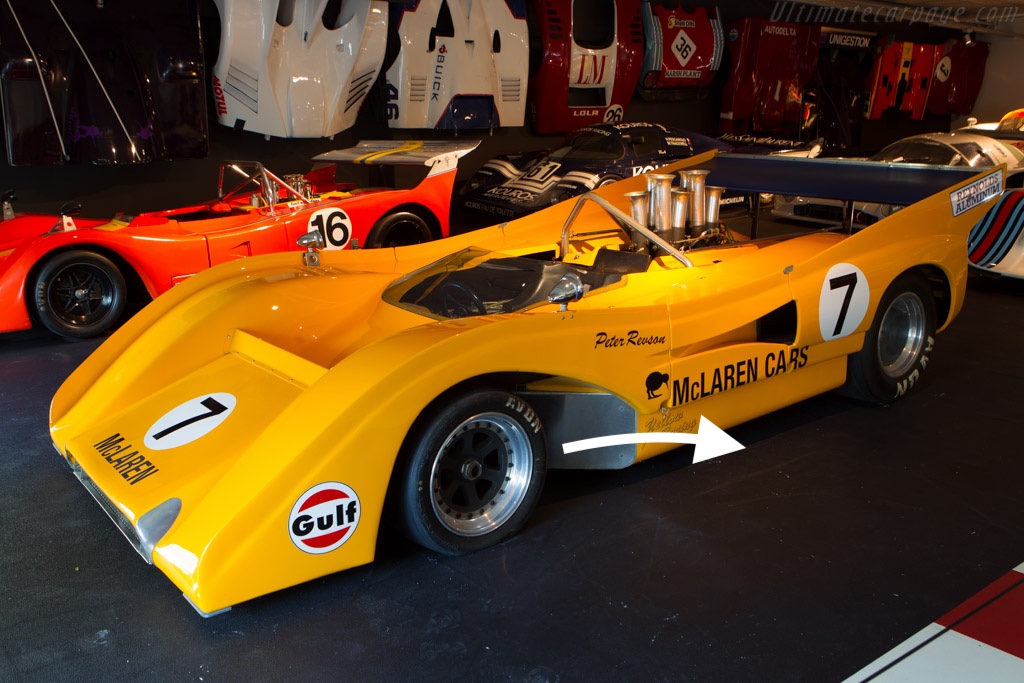
In order to extract more air, the vents need to reach further inside the wheel well. Ideally the vent should be located low and behind the tire, because that’s the most direct exit route from the trailing edge of the splitter. And while doing that, you’d also design a much smoother exit. The end result would be quite different than the haphazard dumping and venting of air into the wheel well, and more of a purposeful and free-flowing duct from splitter diffuser to behind the wheel. Now these aren’t new ideas; you can see all of that on a McLaren M8 from half a century ago.

McLaren M8 had big vents and smooth exits back in 1971.

A more subtle solution can be seen on the underside of current NASCAR stock cars. Notice the air channels behind the tire that exit at the front of the rocker panel. This allows the cars to look stock-ish, but they perform much better and make a lot of downforce. In fact too much downforce, because NASCAR had to reduce the effectiveness by adding splitter stuffers.

NASCAR underbody aero was so effective they required splitter stuffers (the black horizontal bars in the splitter diffusers) to reduce front downforce.

I don’t know if these vents have a proper name, but I’m going to call them rocker vents based on their location in the rocker panels. They are a very Occam’s Razor solution to extracting air from under the splitter; of the myriad ways you might solve the problem, rocker vents are the simplest. Well, at least from the perspective of air, it’s the most direct route.

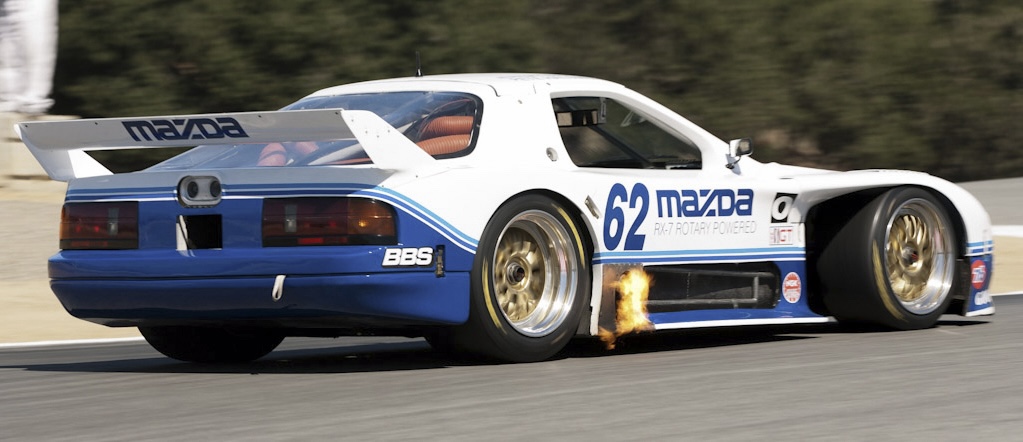
I wanted to implement something like the NASCAR rocker vents on Falconet, but hadn’t seen anyone else modify their Miata in such a manner. AJ Hartman did something like this on his Mustang, and said it was very efficient, with a L/D of 14:1.

So I knew it could be done, I just didn’t know how to do this on a Miata. I did a lot of exploratory cutting on the driver’s side, and the pictures show how I did a much cleaner job on the passenger side.

I want to thank Aussie reader/supporter Jim Grant for assistance with this project. He recognized I had no idea what I was doing and explained how cars are put together, and how to get my head out of my ass. Thanks Jim!

Step 1: Measure

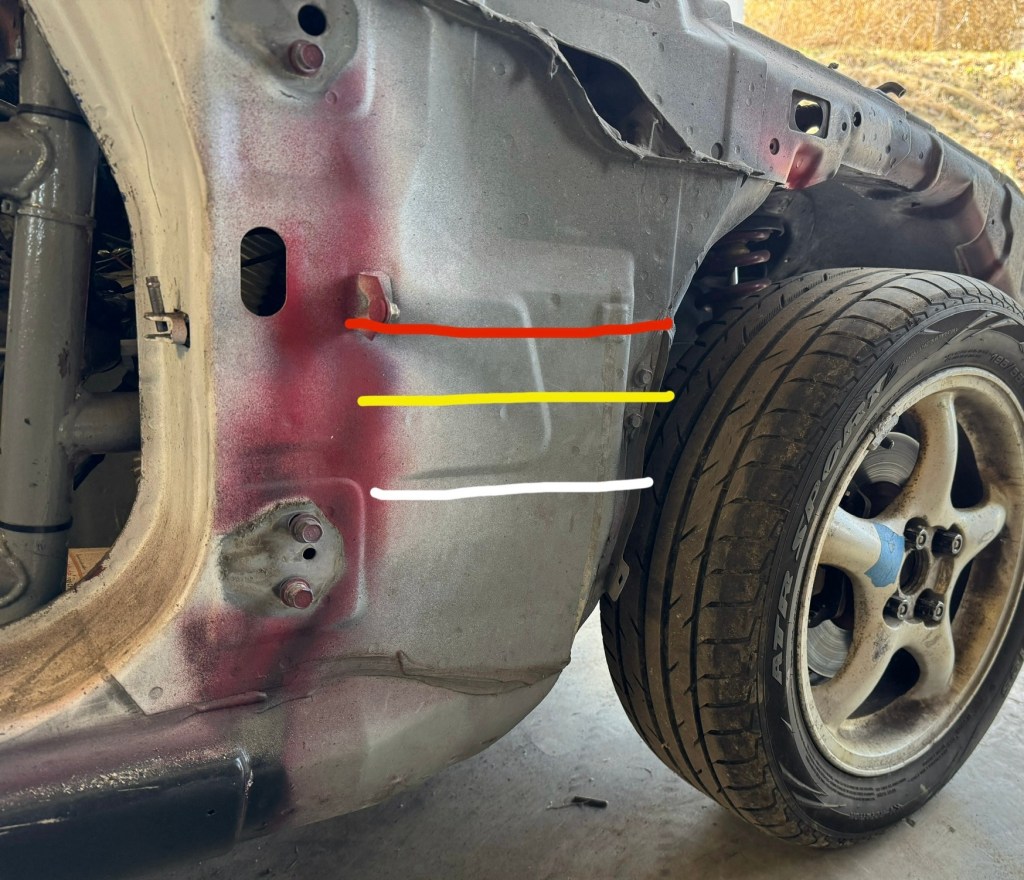
My first decision was how large (height and depth) to make the vent. There are a few considerations for height, see the following image with colored lines.

Three logical places to cut.
  • The white line is the most conservative cut, because it goes just below the curved wheel tub inside the wheel well. Cutting at this height leaves two threaded holes intact, in case you want to add bolt-on fender braces.
  • The yellow line is about where the mid-body style line is on a NA Miata. Aesthetically, this is probably the best place to cut a NA Miata, but on a NB it wouldn’t matter. This cut goes between the two bolt holes, and so you could still use the upper hole to mount something.
  • The red line is to the top of the wheel tub. You could go higher than the red line, but most of the air you’re trying to extract is below the splitter, so I’m not sure if a higher cut helps that much. Might look cool tho.
Bring that rocker vent all the way to the top and it might look like a RX-7 GTO. Fucking badass.

In retrospect, if I did this again, I’d cut on the yellow line. Mostly because I think it would look better to have the duct exit on the style line. I don’t know that there’s a lot more air to extract at that height, and it could be that a vent even half this high is just fine (the NASCAR vents are quite low). In any case, I used the white line.

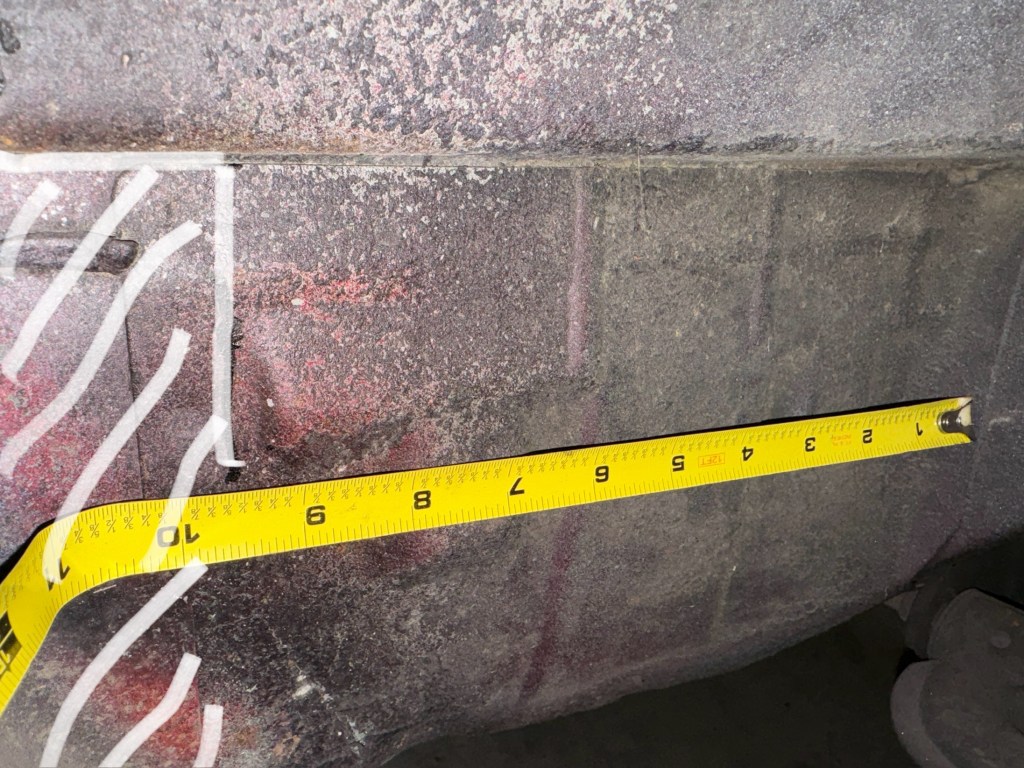
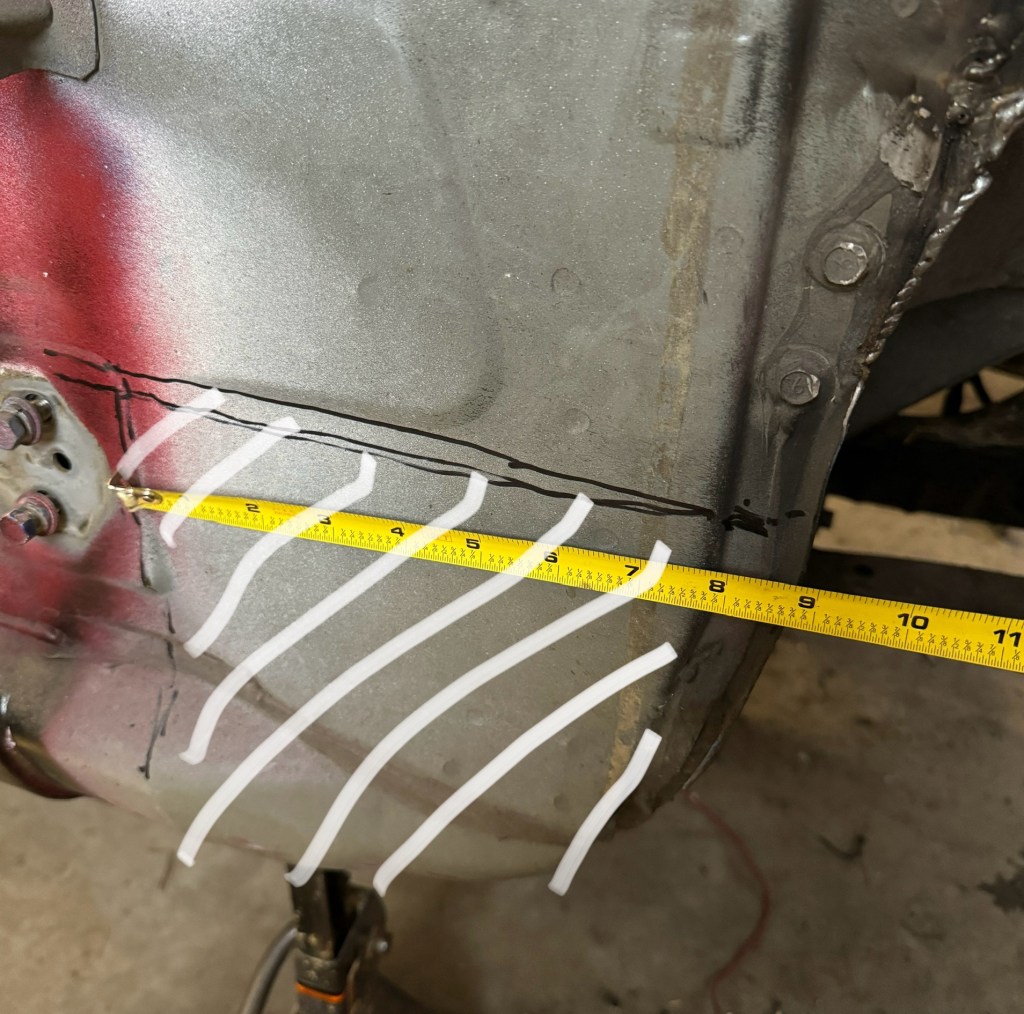
The next decision is how deep to make the cut. I measured and marked a line 9.5” from the inside of the wheel tub. This is where the inner sheet metal is located within the footwell, and so the cockpit remains unmolested.

I removed the white crosshatch area, it starts about 9.5” from the inner wheel well.

The rocker vent would be more effective if I had cut further inside behind the wheels, but then I’d need to weld sheet metal inside the cabin. Going further than that, there’s other unibody structure and cage tubing that would be difficult to work around. If I’d kept going deeper, I’d hit the clutch dead pedal, which could be sacrificed I suppose, but I do use it.

All said, I chose to make the rocker vent only about 3” (75mm) deep. This isn’t a lot of extra volume, but it does allow air to exit at less of an angle.

I used a sharpie to draw a line back to the hinge at my desired height. I’m not going to use the lower hinge (my doors are only half height), but there’s a vertical chassis member here and I wanted to keep that intact. So at this point, I have defined the area I want to remove.

Take a minute to pause and question if you’re really going to do this.

Step 2: Surgery

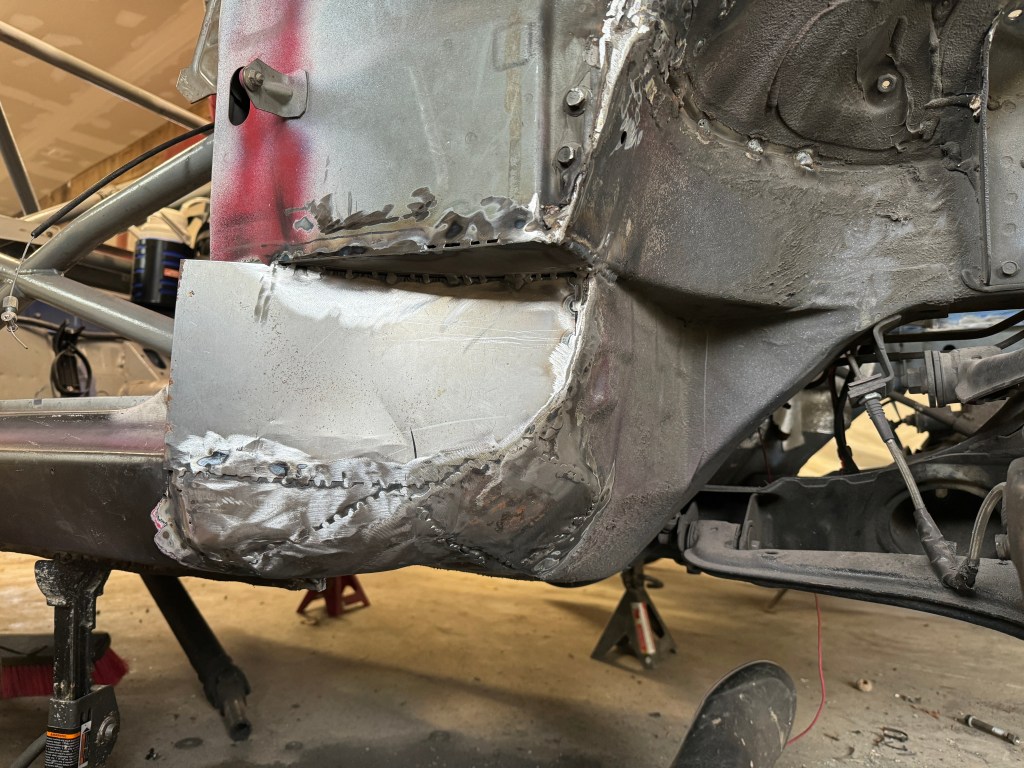
I used a grinder with a cutoff wheel to cut along the lines. There’s a horizontal shelf inside that has to be removed. It’s spot welded in various places (you can see the dots) and I tried drilling those out and in some cases getting in between with a cold chisel and breaking the welds. This little shelf is a pain in the ass.

Cut an opening so that you can remove the shelf.

I continued to cut out all of the sheet metal and spot welds until I had a rectangular-ish hole like this.

The point of no return. Or, what the fuck have I done?

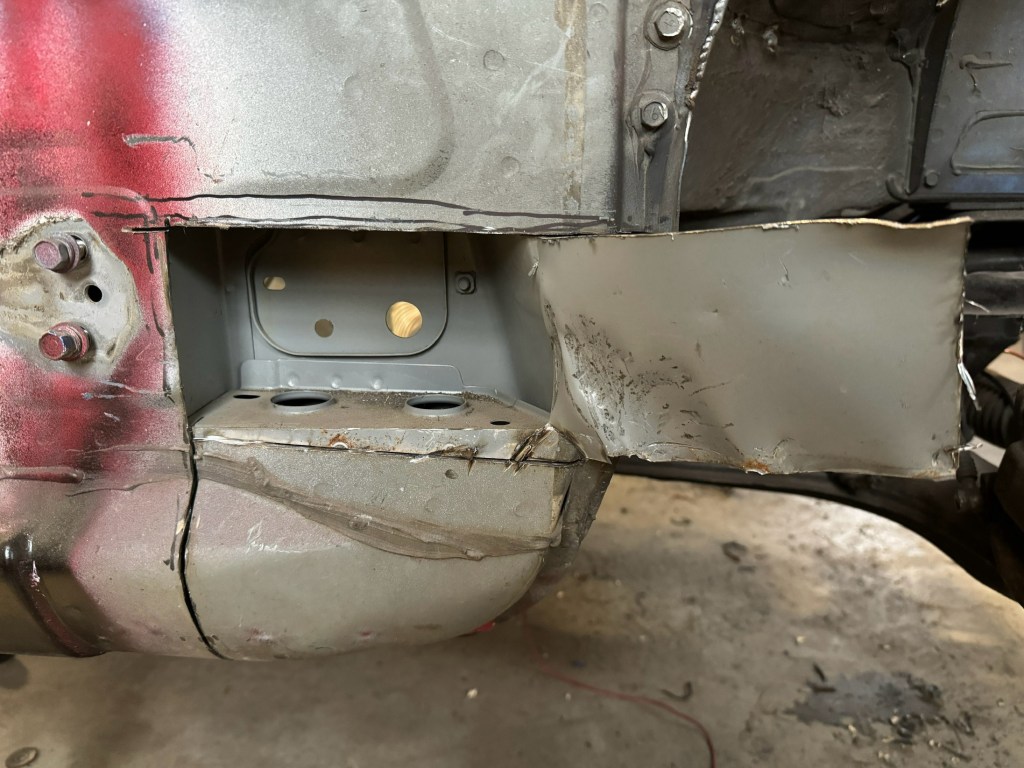
The interior footwell and exterior wheel tub are two pieces of sheet metal with an air gap between them. I used a cutting wheel to make a slit in this area, and then used a reciprocating saw to cut out the sheet metal. I ended up with a cavity or “smile” between the interior footwell and the fender well.

Cut out all the sheet metal between the footwell and the wheel tub.

To get a smoother exit for air, I used a cut off wheel to cut several straight lines through the bottom sheet metal. I then bent the sheet metal upwards to close that gap.

Slits make it easy to bend the bottom upwards.

I used a hammer to tap these into a more graceful arc.

I should have cleaned off all that gunk with a wire wheel before starting. This needs to be bare metal for welding.

I then cut the front of the rocker panel off at an angle, so that air can make less than a 90-degree exit. Notice the rocker panel is made of a few layers of sheet metal, and plays a significant role in chassis structure and stiffness.

Front of rocker panel cut at an angle.

Next I’ll weld in some sheet metal to cover all this ugliness, and provide a smooth path for air to flow.

Step 3: Welding

Welding Mazda sheet metal kinda sucks. I was once a certified structural welder, but you’d never know looking at the shit job I did on this. I got the best results by spot welding pieces together, and then joining some of those to create stitches. Note that continuous welds are unnecessary, as you can fill the gaps with seam sealer.

First step was to bend in a piece of sheet metal to make a smooth curve, and then cut it to size.

Nice curve.

Next I welded in a horizontal flat that makes the ceiling part of the vent. Otherwise there would be an open cavity that might collect gunk inside. I welded that to the curve I had cut.

The ceiling of the vent.

Next I welded the tabs I cut in the footwell area, that I had bent upwards with a hammer. I ran a cutoff wheel into the overlapping pieces of metal and pulled the little triangles out, then smashed it all flat again. This way the seems were pretty tight and easy to weld inside and out.

Bend tabs up, close the gaps, and weld.

Now the fun part, bending sheet metal into curves and tacking it into place. I used aviation shears to cut sheet metal into various shapes, and then tack welded it all together. This process is more art than science, and satisfying work.

Small pieces of sheet metal can be bent and spot welded to make easy curves.

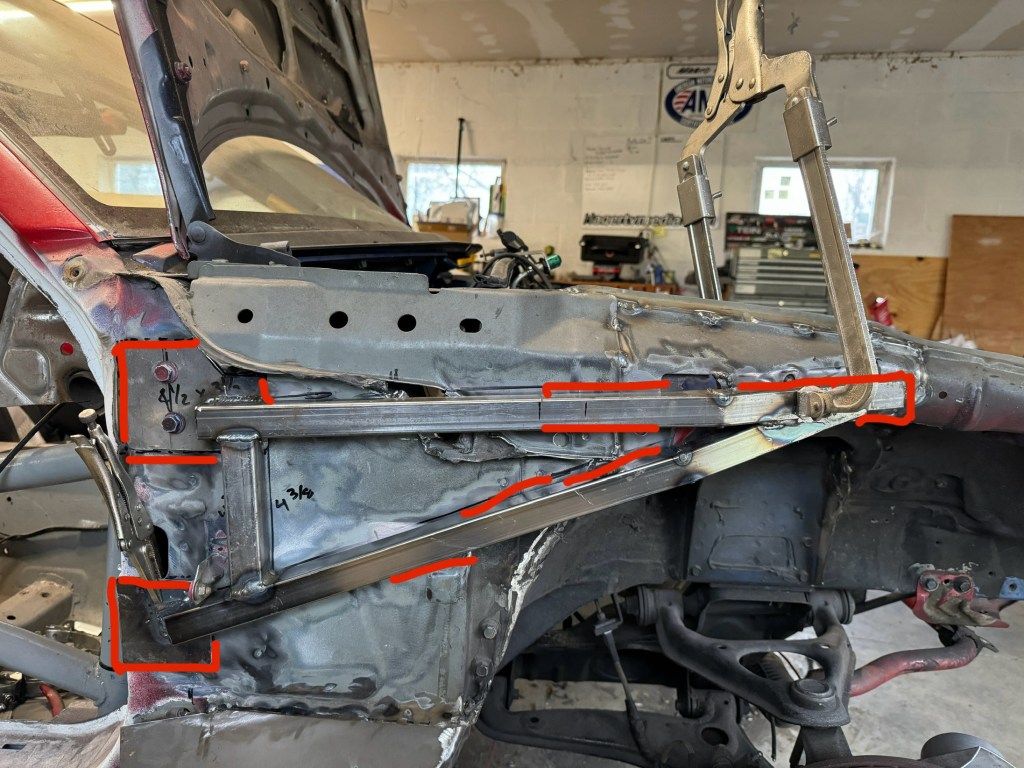
The next step was to add external bracing to the shotgun panel (the frame member that connects the door hinge area to the shock tower). There are several commercially available fender braces, but I chose to DIY my own and weld it on rather than use bolts.

DIY fender brace and welding spots.

I used 1” square tubing and 1/8” steel spreader plates to make a triangular brace. Weight weenie that I am, I was pleased they only weighed 3 lbs apiece. I then welded the braces in several spots, choosing places where the sheet metal overlapped and was doubled in thickness. I also seam welded the entire front of the chassis for good measure.

Front view shows the 3” (75mm) of extra depth cut inside the wheel well, and rounding underneath and at the exit.

I ordered a new set of fenders, which I’ll cut artfully to expose the rocker vents. In the meantime, I took my existing fenders, which have a large fender cut, and mounted them up to see what this all looks like.

When looking at the rocker vent from the rear, you can see that air will exit much lower and smoother behind the wheel. No more 90- degree bend or having the air exit between the chassis and the quarter panel.

Big vent with a smooth exit will help the splitter make more downforce, and should cool the brakes as well.

Step 4: Finish

The final steps are to fill the gaps between the spot welds with seam sealer (automotive caulk). I have also heard that you can fill the rocker panel and front cavities with expanding foam, which supposedly adds more rigidity. I don’t know that expanding foam from a can (Great Stuff) is appropriate for this, but it would certainly be easy to do.

I’m not going to cover the rocker vents with quarter panels; the area will be entirely exposed. So it needs Bondo, primer, and paint to match the bodywork. I haven’t done all that yet, but it’s just regular bodywork, and I’m the last person you want to watch do that.

When that’s done, I’ll also add some vanes under the car. I’ll take my inspiration from NASCAR again, and guide the air out the new rocker vents with a pair of strakes.

Wind tunnel test?

I’ll add strakes like these red ones.

To find out how much downforce and drag the rocker vents make, I’ll fabricate rigid covers that approximate the shape of the original bodywork. I’ll then remove the covers and A/B test the vents back to back in the wind tunnel.

The A2 wind tunnel has a static floor, and so it’s not as accurate as one with a vacuum to remove the boundary layer, or a rolling floor. So while the numbers won’t be 100% accurate, there will be a useful delta value, and a way to compare the rocker vents to other vents.

Caveats aside, I’ll update this article with those results sometime after 6/20.

Now it’s your turn

If I’ve inspired you to make rocker vents, consider the following:

First, do you really need rocker vents? A splitter alone makes enough downforce to offset a low-angle single-element wing. Add splitter diffusers and vent the fenders, and you may get another 50% more downforce. Add spats, side plates and canards, and you could double the original splitter’s downforce. At this point you’ll almost certainly need maximum wing angle and a Gurney flap, and even then the front aero load distribution may be too high (oversteer in fast corners).

But if you’ve already done all the tricks and still need more front downforce, then the rocker vent is perhaps the next step. But you’ll probably need to add some combination of spoiler, second wing element, and rear diffuser.

On the other hand, maybe you’re not after maximum front downforce and are simply after better efficiency, or maximizing the effectiveness of the undertray. Or perhaps you’re dodging the points taken for using a splitter, but you want similar downforce. That’s a pretty clever use of rocker vents, and I would definitely get on board with any of that.

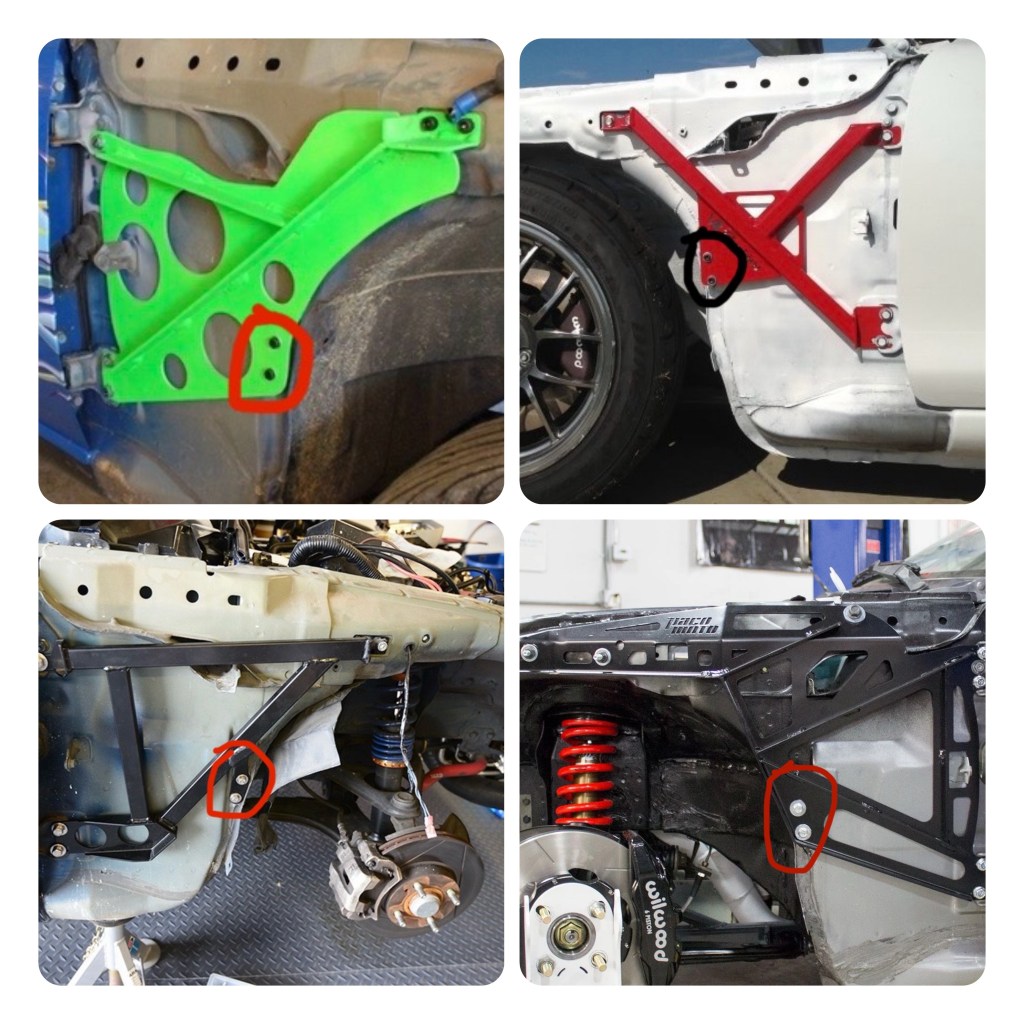
Next question, do you have a full cage? You’re removing important structure from the unibody and a full cage is arguably a requirement for rocker vents. Without a cage, you’ll need fender braces or other supports that help support the shock tower (no, not a strut tower brace).

As a practical matter, most commercially available Miata fender braces use the two threaded bolt holes in the wheel tub for mounting, and the location of those bolts limits the size of the rocker vent. If you recall the previous image with the horizontal lines, you’ll want to cut on the white line, or lower.

If you make rocker vents, you’ll need a full cage and/or fender braces. Some bolt-in solutions shown.

Final question, if you’re racing, do your rules allow modifying the unibody structure? For any Spec racing series, that answer is certainly no. For other series, it will depend on how they evaluate such modifications.

I’m building Falconet to the NASA ST/TT 3 rules, and changes to the unibody require the “non-production chassis” mod, which is a .4 points penalty to the lbs/hp calculation. If I was building to the NASA ST/TT 4-6 rules, then this modification would be illegal, as the rules state you can’t alter the unibody.

My car also fits into SCCA Time Trials Unlimited 2 class, and this would be legal. But not in any of the Max classes (in fact Falconet isn’t legal in Max for other reasons as well).

I didn’t look up the SCCA road racing rules because it’s a 1000 page rule book. Nor did I look at the 400 page autocross rules, because this is an aero mod, and unlikely to help much at 40 mph. But there’s probably some flavor of unlimited class my car would fit into if I wanted to roadrace with the SCCA or dodge cones in a parking lot. (I don’t.)

Most of the Grid Life Trackbattle classes state that you can’t make modifications to the chassis, and that includes GLTC. But you should be able to get away with rocker vents in Street Mod, Track Mod and the Unlimited classes.

Most endurance racing rules would allow rocker vents, and with their high efficiency, it would be a good idea for AER, 24 Hours of Lemons, Lucky Dog, Northeast GT and WRL. Champcar would assign material points (2 points per square foot of metal), and that might be 4 points total. But a clever team could reuse sheet metal taken from various weight loss trimmings and/or use the lower quarter panels and do this mod for free.

If you aren’t racing or tracking your car, one could argue that rocker vents are a lot of work for Racing Inspired Cosmetic Enhancement (RICE). But if that’s the way you roll, you’ll one up everyone else’s fender vents at the local cars and coffee.

All told, this project cost me maybe $40 bucks in materials (8 feet of 1” steel tubing, welding wire and gas), so if you have more time than money, I say why the fuck not? So now it’s your turn. Let’s see some rocker vents!

Miata Fender Vents

A splitter makes the majority of its downforce through suction. If you’re fuzzy about what that means, read Top 10 Reasons Your Splitter Sucks. In that article, I beat to death the fact that it’s the underside of the splitter that does most of the work. To make a splitter work better, you need to expand the air under and behind the splitter. The most common way to do this is with splitter diffusers (aka splitter tunnels or splitter ramps).

Splitter diffusers dump air into the wheel wells, which is a convenient area with a lot of volume. But it’s also an area of chaos, with spinning tires that squirt a jet of air perpendicularly across the splitter diffusers, and suspension parts moving rapidly up and down. Getting air to move efficiently through this mess isn’t easy, and so pressure can build in the wheel wells, which reduces the effectiveness of the splitter.

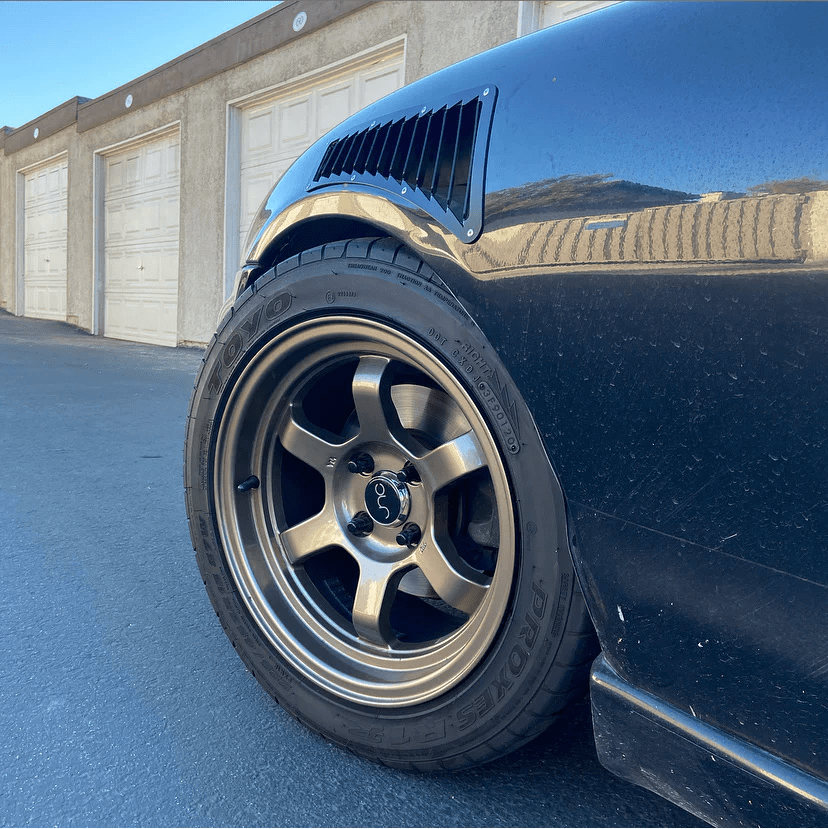
So anything you can do to get air out of the wheel wells will help the splitter make more downforce. As a byproduct, you’ll often get better brake cooling as well. The most common way to extract air from the wheel wells is by installing louvers on the top or sides of the fenders.

Three typical locations of fender vents. Image from Race Louvers.

You can also cut a slit and push the fender inwards. Or some people pull the rear of the fender away from the body, and extract air from behind the fender.

However you do it, fender vents have been proven to be highly efficient and add downforce with very little drag. Race Louvers test data shows that a top vent alone is worth about 14-17 lbs of downforce at 100 mph, and only a pound or so of drag. Adding another vent behind the fender results in more gains.

But what’s interesting is that adding a third vent doesn’t seem to add any more downforce. Despite the fact that Race Louvers is a business that wants your money, they advise you not to buy a third vent. So there’s definitely a point of diminishing gains with fender vents, and I’ll address one solution to that in the future.

In this article, I’m going to review some of the popular Miata fender vents available, and some DIY solutions for the frugal. Most of these are universal in nature, and can be used on other cars as well.

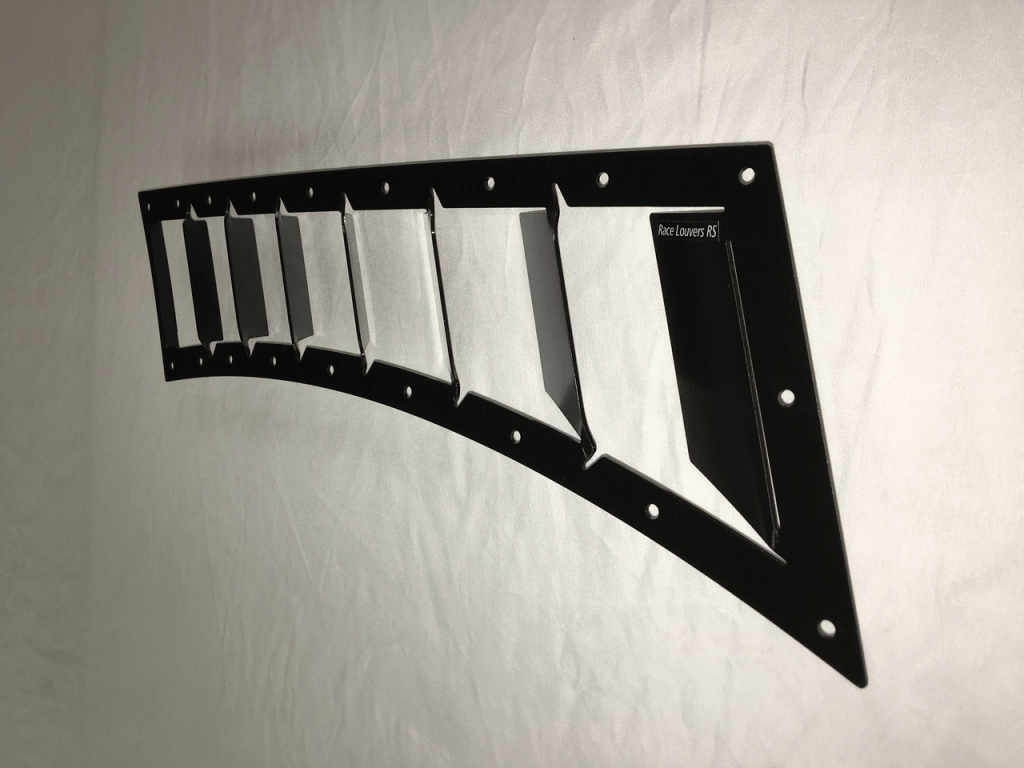
Race Louvers

I’m going to start with Race Louvers fender vents, because Al from Race Louvers has done a lot of wind tunnel testing and publishes PDFs on his site. Much of this article is based on the testing and data in his articles and videos with AJ Hartman.

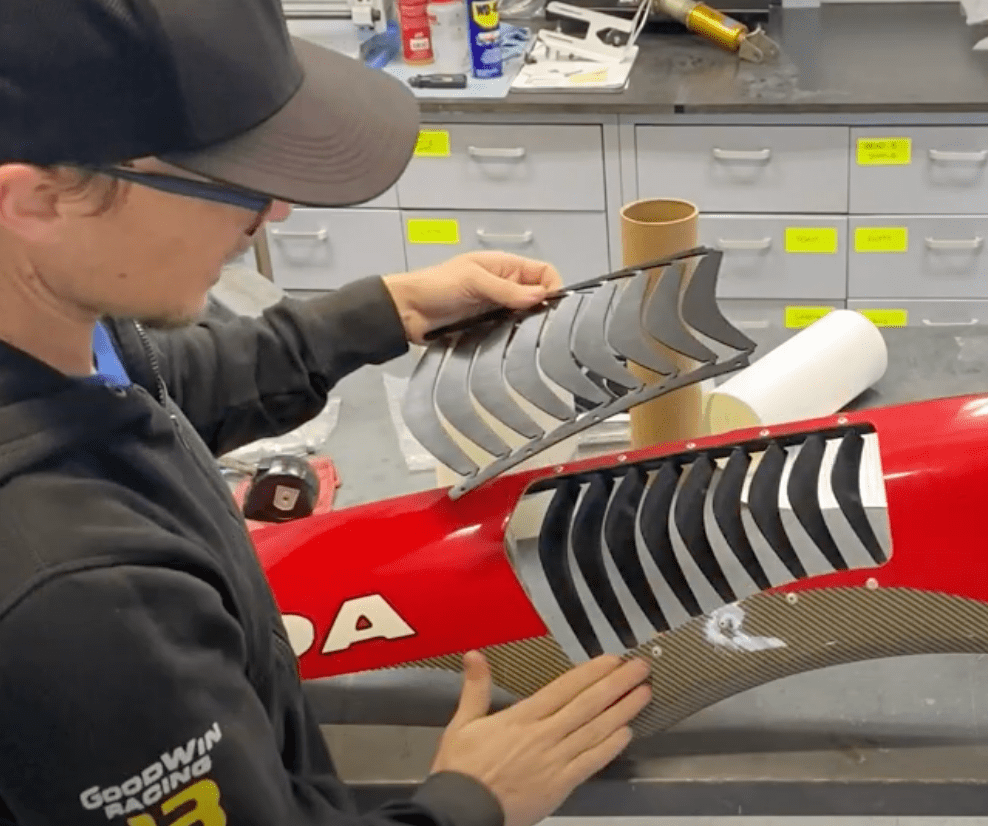
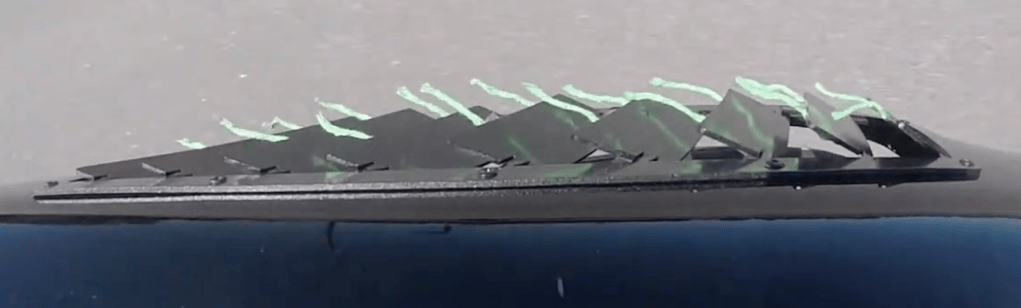
Al’s extensive wind tunnel testing shows that louver blades should extend both above and below the bodywork. This applies not only to fender vents, but hood vents as well. Louvers that were only on top of the bodywork, or were only recessed below the bodywork, didn’t work as well as louvers that extended both above and below the skin. Moreover, it appears that the depth below is more significant than the height above. This discovery seems lost on virtually every other manufacturer.

The biggest difference between Race Louvers and most other vents is that the louvers extend well below the surface. The data shows that this is important.

At $289 for the curved version you see above, or $279 for the straight version (less visually interesting), these do not come cheap. But then again, other louvered vents aren’t going to perform as well as these, so you get what you pay for.

On a NB Miata, these tested at 17 lbs of front downforce and virtually no drag. If that doesn’t seem like a lot of downforce, note that any gains you make in front downforce are typically matched with 100-150% more rear downforce. So you could think of this as a means of adding 42 lbs of total downforce.

Now this is just from a single pair of vents on top of the fenders, and more venting can be done behind the fenders. Race Louvers doesn’t have a rear vent for Miatas, but Left Lane Designs does.

Left Lane Designs

Left Lane Designs makes rear fender vents for NA and NB Miatas. NAs use two vents, one on either side of the style line, while NB Miatas have just a single big vent. These are priced at $279 and $289 respectively.

Upper rear and lower rear vents, with the rear of the fender spaced out as well. The door gets in the way of a smooth exit, so I wonder how much that helps.

Adding the Left Lane Designs vents to the Race Louvers fender vents could get you as much as 50 lbs of front downforce. At least that’s what Race Louvers got on another test using similar vents, and I think that data can be safely applied to Miatas and other cars. Again, add 100-150% because now you can add more rear downforce.

Singular

For $249 you can get Singular fender louvers, which are the same vents that are on Ryan Passey’s HyperMiata. These laser-cut aluminum vents are visually interesting, in that they have some curvature to the vent shape, rather than the more rectangular venting on the Race Louver vents. This curvature follows the countour of the Miata fenders, and while I haven’t found any data on them, it’s a great look. (I’ll be testing these in a wind tunnel soon.)

HyperMiata fender vents.

One interesting feature of these vents is that for an additional $40 you can get a partial cover so that these vents are legal for Grid Life Touring Cup. GLTC limits the size of fender vents to 45 square inches for some reason, and it seems as arbitrary and quizzical as SCCA Time Trials limiting splitter diffusers to 84 square inches, or NASA ST4-6 limiting hood vents to 3/8″ in height. Whatever people, whatever.

R Theory

For slightly less dosh than the Race Louver or Singular fender vents, you can get a similar looking vent from R Theory. However, the similarities are only skin deep. Literally.

If you watch their wool tuft testing video, you can see that the louvers do not extend into the fender. Recall from the Race Louvers data that it’s probably more important to extend below the surface than above. The Singular vents are similar in this fashion, but at least those install below the surface, while the R Theory appear to install on top of the fenders (which not only looks less professional, but probably increases drag as well).

The R Theory vents in action.

While the $192 price is significantly lower than Race Louvers or Singular, I couldn’t justify the loss in performance of using these. If you want fender vents because they look cool, go for it. If you’re primarily looking for performance, I’d look elsewhere.

Spiked Performance

Spiked Performance sells an inexpensive aluminum fender louver for $169. Like the R Theory vents, they install on top of the fender skin. Spiked vents measure about 33 square inches, and appear to be the smallest here. Based on that, I would expect them to be the least effective (but still worthwhile).

Spiked makes simple fender vents with an attractive shape that follows the wheel arch.

Napp Motorsports made a great installation video, and it looks quite easy with the supplied cutting template and a few rivets.

DCN Performance

I’ve never heard of DCN Performance, but they have NB Miata fender vents that are inexpensive and appear to be properly engineered. You can buy all three vents directly from DCN and Top Miata.

I didn’t see a US supplier, but I did find the lower pair of vents available on Etsy and eBay. At $150 for the lower pair, these are worth looking into.

DCN louvers extend beneath the skin and allow for a fender cut.

Amazon plastic shit

Finally there are tons of universal plastic shit vents you can buy on Amazon or eBay. I’m not going to review any of them because I would rather put a stick in my eye than put these on my car. If you’re too cheap to buy decent vents, don’t buy plastic crap, make them yourself.

DIY options

If you think it’s ridiculous to spend nearly $600 on fender vents, or support crappy products made in China, I’m with you on both counts. This whole site is about DIY creativity, and I neither shill for nor take kickbacks from anyone. Let’s DIY us some fender vents!

Fenders holes

If you’re a cheap bastard or just an avid DIYer, then you can make your own fender louvers by just cutting into the sheet metal and bending louvers into it. Follow a pattern like Race Louvers and make them go both above and below the fender skin.

Another option is to say fuck the louvers, and cut a big gaping hole in the fender. In the course I took with JKF Aero, the CFD showed that a big louver-less hole made more front downforce than a fender vent with louvers. So if you’re after the maximum front downforce, and can accept a slight drag increase and loss in rear downforce, get that cutting wheel out grind you a big ass hole in your fenders.

Note that you should put a 3/8” Gurney flap on the leading edge. For hood louvers, you’d want up to 1” high flap, but apparently fender vents should use a smaller leading edge flap.

Fender cuts

Another easy modification is cutting a slit into the fender and pushing the bottom inward. On a NA Miata, a lot of people make a subtle cut on the belt line. But some people make a more aggressive cut higher up, and vent the entire rear of the tire.

Two variations on a theme.

I tested fender cuts versus Singular fender vents in the wind tunnel. That data, plus hood vents, wings, fastback, canards, and many other aero options are in my 54-page Miata Wind Tunnel report, which you can purchase for $35. Buying this report helps support this web page, aero investigations, and future wind tunnel testing. Thanks!

3D printed

If you have a 3D printer, Beavis Motorsports has a free STL file you can use to print a “time attack style” fender vent. These sit up quite tall, and you’d think they would be really draggy, but Race Louvers tested a 1 7/8″ tall time attack vent (not this exact vent, but something similar) and it made 14 lbs of downforce and 1 lb of drag, which was the second best of the vents they tested.

Time-attack style 3D printed fender vent.

I don’t love the look of these, but that’s purely a subjective thing. If you do, then something like this is a good option.

Installation advice

After reading all of the PDFs on the Race Louvers site, and watching too many of his videos, I’ve distilled the following advice, which applies generally to all fender vents.

  • Don’t place top-mounted fender vents too far rearward. The vents should end 6″ before the windshield to avoid high pressure air from the windshield interfering with the vent.
  • Airflow over a hood or fender is generally straight back, and louvers should be installed perpendicular to this flow. Don’t angle the louver blades more than about 15 degrees or it will reduce their functionality. (The louvers should be more vertical than swept back.)
  • Many people have removed their fender liners completely, which is often a mistake. But if you still have fender liners, you’ll get the most downforce by cutting a hole in the fender liner near the louver. If improved cooling is your primary goal, remove the front of the fender liner.

GT7 Aerodynamics

I’ve been playing Gran Turismo since the first version on the PSone, and I still grab my controller a couple times a week and get in 26.2 miles to earn my “daily disappointment” (a roulette prize wheel that always seems to land on the most worthless prize).

GT7 touts itself as a racing simulator, but its aero modeling sucks. I understand why they did this, to protect the game’s leveling system, called Performance Points (PP). In the real world, downforce benefits you in fast corners, the faster the corner, the more benefit. In order to balance that in the game using their PP system, every car would have a different PP value at every track. That’s too complicated, so Gran Turismo simply made aero less effective.

How much less effective? I’m glad you asked! To find out, I built four cars with exactly the same weight, power output, suspension, ground clearance, etc., but very different aero.

Vanilla GR86 with no aero.

I had to buy ECUs, power limiters, and ballast to make them all equal weight and weight distribution, and then I put them all on Sport Medium tires.

Group 4 has a splitter and wing.

I chose the Subaru BRZ and Toyota GR86 because there are a few different versions of the car, but one could do this experiment with a Mustang, C7 Corvette, or other car that has both street and racing versions.

Group 3 aero incudes much venting and a rear diffuser.

I used Watkins Glen for the race track, because it has fast corners where aero is effective. At least in the real world. In the Gran Turismo world, aero is virtually meaningless:

BuildFront / Rear DFGrip @ 75 mphLap
No aero 524pp0 / 0 1.18g2:06.845
Street aero 545pp200/3001.22g2:07.006
Group 4 532pp200/3501.21g2:07.076
Group 3 549pp500/8001.29g2:06.730
Car builds, downforce, grip, and lap times

As you can see, the car with the most downforce (1300 lbs), set the fastest lap, but only by a tenth of a second! In second place was the car with no aero at all, and it came in at 524 points versus 549 points for the Group 3 car. In the real world, you’d see a few seconds between a car with no aero and a car with a simple splitter and wing.

In conclusion, aero is meaningless in Gran Turismo, and that makes me sad. But are the aerodynamic values in GT7 totally worthless? No. I discovered that the downforce values listed for each car are fairly accurate, which means we have a large catalog of data that is otherwise very difficult to find!

Downforce values in GT7

In GT7 all cars with aero are given front and rear downforce listed in pounds. For example, a Toyota GT-One has 600 lbs of front downforce and 900 lbs of rear downforce. But in order for those values to have any meaning, we’d need to know what speeds those figures are based on. After some investigation, it appears to be at about 130 mph (210 kph).

I’ve come to this conclusion by comparing the real-world downforce values for several cars to the downforce values in the game. To get the real-world values, I went to Muslanne’s corner and noted the downforce values for every car (at 150 mph) and threw them in a spreadsheet. I then compared that to the same car in Gran Turismo, factored in the speed, and came out with 130 mph as being very close.

Another car that helped me figure out this value was the Porsche 911 GT3 RS, which reportedly makes 895 lbs of downforce at 124 mph. By factoring in a speed change to 130 mph, I got 984 lbs of downforce, which is close enough to GT7’s figure of 1000 lbs.

So here’s a smattering of cars in GT7 and their approximate coefficient of lift (cL), which is inverted here to mean downforce. If you’re not familiar with coefficients, check out my article on Thinking in Aerodynamic Coefficients to see examples of various cars and how much downforce and drag they make. Note that you can take any car in GT7 and divide the total front and rear downforce by 900 and get a close approximation to the (inverted) coefficient of lift.

CarFrontRearTotal DFcL% FDrive
Formula1500200035004.2042.9%MR
GT-R LM1400140028003.4350.0%FF
RB X20191000160026003.2038.5%MR
Valkyrie1000150025003.0540.0%MR
Gr 2, GT500750115019002.3339.5%FR
GT-One60090015001.8440.0%MR
BRZ GT300 50080013001.3738.5%FR
Group 345070011501.2139.1%FR
911 GT3 RS35065010001.0635.0%RR
Amuse S2K3505509000.9538.9%FR
Group 42003505500.6036.4%FR
RX7 GTO (real)5250.57FR
Street car aero2003005000.5940.0%All
RE-RX71503505000.5930.0%FR
RCR Civic2002504500.5344.4%FF
Miata touring703504200.5016.7%FR
LP 750-4 SV ‘151502504000.4237.5%MR
C7 ZR-11502504000.4237.5%FR
Gr 3 road car1002003000.3233.3%All
930 Turbo1001502500.2740.0%RR
Cayman GT4801602400.2633.3%MR
911 GT3 (996) ‘01301201500.1620.0%RR
C8 50801300.1438.5%MR
M2C 2040600.0733.3%FR
911 RS SC (993) ‘95060600.070.0%RR
NSX Type R2525500.0550.0%MR
WRX ‘99040400.040.0%FR
GR Corolla020200.020.0%FR
E30 M3, 190 Evo0000.000.0%FR
GT7 cars and downforce

I’ve also added the front aero load distribution (% F) and the drivetrain layout to the table. Many people say you should match aero distribution to weight distribution, but I don’t subscribe to that theory, and neither does Gran Turismo (or the real-world values in Muslanne’s database). You can see that aero distribution is typically around 40% front (meaning more rear aero), regardless of drivetrain layout. Even the front wheel drive Nismo GT-R LM car has a 50/50 aero distribution, despite having 65% of the weight on the front tires.

You’ll also notice that some cars that probably do have some downforce, such as the E30 M3 and 190E DTM cars are listed as having no downforce in GT7. And the Miata Touring car can somehow make 350 lbs of downforce, despite being a convertible. (In my real world testing, a convertible top made 40% of the downforce as a hardtop.) There’s also no concept of lift in the game, and as you might know, most street cars make lift, and cars with zero lift are rare. Anyway, it’s a game afterall, and I’m sure there are many other oversights and some mistakes (and that goes for this article as well).

Readers’ Rides: Dylan’s Northstar VVT ITB Stonker

If you’d like your car featured in Readers’ Rides, see the information on this page and then let’s get the ball rolling!

The first Readers’ Rides feature is Dylan Pudiak’s 1991 Miata. I’ve watched his car transform from average, to exceptional, back to average, and then to its current status as the northstar build for all normally aspirated BP engines. What began as an engine failure turned into a journey of epic proportions. It didn’t happen over night.

Dylan’s car build is documented in 24 episodes on the Napp Motorsports channel.

A Hero’s Journey

If you don’t know what the Hero’s Journey is, it’s a template for storytelling where a person goes on an adventure, is victorious, and comes home transformed, with knowledge to bestow upon others. Think of stories like Star Wars or The Hobbit. Dylan’s journey follows this template closely, so I thought I’d tell his story like this:

A hero ventures forth from the world of common day into a region of supernatural wonder: fabulous forces are there encountered and a decisive victory is won: the hero comes back from this mysterious adventure with the power to bestow boons on his fellow man.

The Call to Adventure

Our story begins with a Call to Adventure. For Dylan and many other driving enthusiasts, that call was autocross. But on his way home from dodging cones, our hero encountered Supernatural aid in the form of bad luck. Or as many early Miata owners know it, SNC Life.

The World is Yours! Right up until you shear the crank bolt.

When the Miata was released in 1989, the engine had a short-nosed crank (SNC) that could eventually wobble or shear the crank keyway. Half way through 1991, Mazda released long-nose crank engines to fix this problem. Fortunately for us, Dylan had the earlier 1991 Miata, and while driving home from his call to adventure, the crank bolt ejected itself.

The common solution to this problem is to find a later 1.6 engine with a long-nose crank and replace the whole mill. But that would be the end of the story, and a pretty boring one at that. Instead, Dylan recognized that the Threshold Guardians to a faster autocross time were the lack of power from just 1597cc and an open diff with a fragile ring gear. Luckily, these things can be easily remedied with parts from later 1.8 Miatas.

The threshold: from known to unknown

A significant part of the Hero’s Journey is the journey into the unknown, and for Dylan, this begins with swapping in a 1.8 (BP05, 1994-1997). Most people would have chosen a later model VVT engine, but a standard 1.8 was the easy button, because he could keep the 1.6 AFM and ECU, and do an exhintake cam swap as well.

The exhintake cam swap is where you take an exhaust cam, grind off one end, install it on the intake side, and re-time it. The exhaust cam doesn’t have any more lift than the intake cam, but it has more duration. When properly tuned, this can add up to 8 hp, which puts the engine close to what a VVT makes.

For simplicity, Dylan kept the ECU from the 1.6, as well as the air-fuel meter (AFM). The AFM is a flapper type valve that doesn’t flow enough for anything more than a stock motor. People with modified 1.6s often use a RX7 AFM, which instantly gives more power on the top end.

1.8 engine… but what’s that thing in the corner?

I don’t believe I’ve seen anyone swap in a 1.8 engine and keep the 16 AFM; most people splice the wiring to run a 1.8 ECU and much less restrictive MAF sensor, or better yet, go to a standalone ECU. The path less chosen probably cost Dylan a few ponies, and with this combination the car put out 102 hp and 100 ft-lbs on a Land and Sea dyno. These dynos read lower than Dynojets and after correcting by 112%, that’s something like 114 hp at the wheels. This is respectable, but if he’d done all of that with a Megasquirt, he’d be looking at something in the mid 120s.

Dylan lapping his 1.6/1.8 mutt at Toronto Motorsports Park

To put the power to the ground more evenly, Dylan had to address the other Threshold Guardian, the open diff and 6″ ring gear that can break on stock power. He found a 7″ ring gear and Torsen LSD locally from Stefan Napp, which brings us to the other important character in this story.

Han Solo, Gandalf, and Goldilocks

In Dylan’s Hero’s Journey, Stefan Napp plays several important roles, and is simultaneously Helper and Mentor. He’s like Gandalf, Obi-Wan Kenobi, Samwise Gamgee and Han Solo all wrapped into one. Later, he’s also Darth Vader and a drug-pedaling pimp, but that’s getting ahead of the story.

With Stefan’s guidance, Dylan swapped his 1.6/1.8 mongrel, to a junkyard VVT, and then threw the Napp-recipe at it:

  • VVT sourced from a junkyard
  • Head work, ported and shaved 0.040″
  • Custom bumper routed intake, Skunk2 intake manifold
  • Raceland header, custom 2.5” exhaust
  • Megasquirt 3
  • 150 whp, 127 ft/lbs on 93 octane, as measured on a Land and Sea dyno

All of those modifications resulted in 150 whp on Rick Gifford’s “heartbreaker” Land and Sea dyno. On a Dynojet, that’s probably in the neighborhood of 165 whp. It’s worth pausing a moment to mention Rick, because he’s a Gandalf-level engine tuner with a dyno at his house. He serves as another Mentor character in pretty much all the Dylan and Stefan stories. (Rick also tuned by 1.6 Miata).

So let’s call it around 165 (Dynojet) horsepowers at the wheels. Sounds perfect doesn’t it?

The Napp recipe for Goldilocks.

In fact it was perfect. I drove Dylan’s car at Pineview Run, and it was the Goldilocks of Miata motors: not too much power, not too little, just right. The power felt ideal for the chassis, retaining all of the characteristics of a momentum car, yet providing instant tractable power, and enough oomph to occasionally surprise.

I still don’t know that there’s a more satisfying combination of engine and chassis, it was magical. Stefan’s K24 Miata was there the same day, and I honesty liked Dylan’s more. That’s really saying something.

On a personal note, driving Dylan’s car at Pineview was also the moment I realized I was a complete dumbass. At the time I was being an iconoclast by trying to tune a 1.6 engine, and I thought cams and bolt ons could help my B6-ZE run with BPs. Three corners into driving Dylan’s car I understood exactly what a huge mistake I’d made.

From Goldilocks to Jenna Jameson

Speed is a drug. Napp is a dealer. Dylan saw the huge gains Stefan made, and was naturally tempted to take a bigger hit. Too much is never enough.

So the next stage in Dylan’s journey was to take Goldilocks and hook her on smack, then turn her out onto the street as a common hooker. OK, maybe that’s a little harsh, it’s just a turbo we’re talking about; but it sucks and blows just the same.

Modifications at this stage included the following:

  • Garret gt2560r turbo
  • Flyin miata exhaust manifold
  • Ported turbo exhaust housing
  • Flyin miata oil cooler
  • ATI Fluid damper
  • R8 Ignition Coil Kit
  • 252 whp, 221ft/lbs @14psi (same dyno)

I don’t pay too much attention to turbo Miatas, but it seems like ones putting out mid 200s at the wheels are a dime a fucking dozen. After all the work they’d done to get Goldilocks to dance like a ballerina on swan lake, it seems terribly underwhelming to wind up with a common skank twirling on a brass pole.

Hot. Also a lot of heat.

I didn’t get a chance to drive Dylans turbo at Pineview, but it wouldn’t surprise me if it was slower on that track. But I did get to drive Dylan’s car on the street on the way back from Watkins Glen, and I will say the acceleration was exhilarating. So fucking what.

Part 1 of a 10-part build mistake series.

Transformation and atonement

The next stage in the Hero’s Journey is the revelation that brings our protagonist out of the abyss, transforms him, and sets him on the path to atonement.

What set that off was typical turbo problems: heat. With rose-tinted beer goggles, Dylan looked back on the simplicity, reliability, and ease of driving that Goldilocks NA. And thus the revelation to go back to normally aspirated power. And then go completely overboard, boring the engine to the maximum displacement. And then add cams, shim-under bucket lifters, and ITBs. It has, well, everything:

  • 85.5mm Supertech pistons 11:1 (2L displacement)
  • Manley H Beam rods with ARP main and rod bolts
  • ACL Race main and rod bearings
  • Boundary oil pump
  • +1mm intake and exhaust valves
  • Supertech dual valve springs with titanium retainers
  • Tomei 252 10.8mm Intake Cam, Tomei 256 10.0mm Exhaust Cam
  • Shim under bucket lifters
  • Maruha adjustable exhaust cam gear
  • 0.040” head shave, 0.030” cometic head gasket, final compression 12.25:1
  • Full head porting
  • 3.6kg flywheel
  • Fluidamper 
  • Jenvey ITB’s and SPS plenum
  • Custom halfrad setup
  • Break-in tune without plenum: 184 whp @ 7400 rpm, 132 ft/lbs @ 6300 rpm
  • Estimated 200 whp @ 8000 rpm on E85
Glory.

The end result still needs final tuning, but it’s likely 200 whp on a Land and Sea (heartbreaker) dyno, and well over 200 on a Dynojet. This is about as far as you can go with a Mazda BP engine, and I want to personally thank Dylan and Stefan for reaching the limit.

Suspension, wheels, brakes

You don’t do all of that work and roll around on OE anything. Dylan did it right yet again:

  • Ohlins road and track coilovers, corner balanced
  • Custom extended top hats
  • Racing Beat front and rear swaybars
  • Paco strong arm fender braces
  • 4.1 Torsen diff
  • V8 roadster hubs
  • Full polybushing kit
  • Frame rails
  • 1.8 brakes
  • Hawk HP+ panda
  • 15×9 Konig Countergrams
  • RS4s 225/45
Chasing the dragon.

Aero

I’m an aero guy, so let’s take a look at how the air moves over and around the car. Starting at the front, Dylan has a SPS air dam, AG Limited front lip and custom undertray. The top is a standard Miata hardtop, but has a spoiler extension on the roofline. For rear aero, Dylan has two trunks, one with an Ikon Style duckbill spoiler, and another with a APR GTC200 wing.

’90s perfection

Judged against modern aero like a 9 Lives Racing medium aero kit, Dylan’s aero isn’t quite up to snuff, and probably has a little more drag and little less downforce. But I honestly wouldn’t change a thing! This is 1990s perfection. Visually, this is the pinnacle of Radwood-era aero, and “fixing” this would be as sacrilegious as fixing Jennifer Connelly’s overbite. For a dual duty car that sees more street than track, changing the aero would be pointless.

You’d grin like that, too.

It’s amazing to look back at this Hero’s Journey and appreciate the Gift of the Goddess. Thank you Dylan Pudiak and thank you Stefan Napp, for showing us the way.