Ken Hill recently posted an article on substack of how the no-brakes drill eroded his confidence and made him 10 seconds slower per lap. I read this with great interest, because I personally feel the no-brakes drill is the foundation of performance driving.
I feel so strongly about that, that I can get into this fixed mindset: “Everyone will benefit from doing the no-brakes drill!” But after reading Ken’s article, I 100% agree with his assessment of why and how it didn’t work out for him. This seems contradictory, so let me explain.
22 years ago I was a globe trotting motorcycle journalist for a boutique quarterly magazine called Moto-Euro. It was a heavy and expensive coffee-table magazine, and our snobbery meant we only covered British and European bikes. But Keith Code’s California Superbike School wanted us to write an article about them, and I wanted to take the school. So the publisher went colorblind for an issue and said OK to a lime green Kawasaki ZX-636, rather than our usual blood red Ducatis.
I was a rider of average skills, with a motorcycle racing license from the Penguin Racing School at Loudon, NH. My racetrack experience was limited to NHMS on my Hawk GT and tracking a brace of Ducatis in Almeria (Spain). So this would be only my 5th track day, and my first time at Sears Point (which is Sonoma Raceway now, but is forever Sears Point to me).
Sears Point is a rollercoaster of blind corners and walls, and not what I’d call an easy track to learn. Nor would I call it one of the safer tracks in the USA. And if that setting wasn’t challenging enough, it was raining.
But it gets worse; in the classroom, Keith informed us that the first two sessions of the day, we would not be shifting or using the brakes. Wait, what?
I’m supposed to ride a high-performance bike I’ve never ridden, on a highly technical track I’ve never seen, in the goddamn rain, without using the brakes?!?!
But we all did it. And survived it. And then we did it again. And I can tell you, it was astonishing. Self preservation is a strong instinct. But as any racer can tell you, catching the rider in front of you is a stronger instinct!
So I gradually increased my speed, changed my lines, took a few risks, let off the gas later, found even more time on corner entry, and kept going faster and faster. All the while staying in 4th gear and never touching the brakes. In the rain.
Of course we eventually got around to shifting and braking, but those first two sessions were the foundation of the entire program.
Over the next two days, most of the coaches, including Keith Code himself, shared track time with us. As often as not, they’d elect to do the 4th-gear no brakes drill for the entire session – the whole train of them going nose to tail, scything through backmarkers.
Since that school, I’ve done the no-brakes drill on over 30 tracks, both on bikes and in cars. These days I use 3rd gear instead of 4th gear, because I’m in cars more than on bikes, but the drill is the same.
Trailbraking on a motorcycle
Back in 2004, the Keith Code order of operations was brake in a straight line while downshifting, release the brakes completely, then tip the bike into the corner, next crack open the throttle to stabilize the bike mid corner, and finally roll on throttle to corner exit. You read that correctly, no trailbraking.
Later (much later) I would learn motorcycle trailbraking from Bill Sink at EvolveGT, and that brought a whole new level to my riding. Same bike, same track, I dropped 1.5 seconds on corner entry alone! As effective as trailbraking is in a car, on a motorcycle, it’s a world of difference.
What happens when you trailbrake a motorcycle is slightly different than on a car. In both vehicles weight transfers to the front end, which results in a wider contact patch from the increased load, plus more heat, more mushing into the tarmac, and thus more grip.
But on a motorcycle, it’s proportionately more weight transfer. You never see a car go into the braking zone with the rear tires hovering just off the ground, but this is business as usual on a motorcycle. And so corner entry depends almost entirely on the front tire, and you control that, and feel that, with the brake lever.
Another thing that happens when you trailbrake a motorcycle is that the steering sharpens due to changes in geometry. The forks compress, which shortens the wheelbase slightly, but this also changes the steering angle, because the ass-end of the bike is in the air, and the forks are shorter.
When you take all of these factors together, it means a motorcycle on the brakes at corner entry has a very different feel than one that is coasting. Feel is super important, especially on a bike. Less so at the novice level, but certainly at Ken’s level, so let me delve into that for a sec.
Driving the front vs the rear
There are two types of riders and drivers: those who require front-end feel, and those who drive the rear end. Riders and drivers who drive the rear tire(s) are looser and more fun to watch. Their general attitude is “I’ll throw it into the corner and figure it out.” These are riders like Marc Marquez and drivers like Michael Schumacher or Max Verstappen. Their skill is legendary, and they seem like aliens because no other humans can do what they do, lap after lap.
Then you have the riders and drivers who depend on front-end feel. They can be incredibly fast and consistent when they are 100% comfortable with the front end. But it takes them time to get there, and if the planets aren’t aligned, the aliens are light years in front. In this category I’m thinking of riders like Colin Edwards and drivers like Jenson Button or Alain Prost.
I’m a front-end rider and driver myself. I suspect Ken Hill is as well. But even if he favors the rear, he’s obviously comfortable standing the bike on the front tire with the brakes, trailing off the brakes gradually while turning in, and then settling into the corner, and doing that all as one smooth uninterrupted action. He’s been able to take that complicated series of steps and push it into the subconscious, executing the dance with thoughtless precision. And so not doing that with the extra grip and feel generated by trailbraking seems weird and unsafe.
Coasting into the corner isn’t just a strange feeling, it’s new. Ken has to engage his conscious mind to do it. The subconscious mind can process information 500,000 times faster than the conscious mind. Think about the scale of that for a second. Actually, don’t think about that; if you have to think, you’re processing power goes down by magnitudes.
And this is why an intermediate rider doing this drill is faster. Intermediate riders have too much on their minds, and nothing has been pushed to the subconscious yet. They are thinking their way into the corner: Brake, blip-shift, trail brakes, tip in, body position, weight balance, roll throttle, etc. The fewer things they can think about, the better they get at executing everything else.
As they say, smooth is fast, and that’s the other reason the no brakes drill is faster than it should be. There is no braking that’s smoother than air braking. There is no downshifting technique that’s smoother than the not-shifting technique. There’s no acceleration that’s smoother than being in too tall of a gear. The end result is that 4th gear no brakes on a motorcycle results in a smoother and faster corner for the intermediate rider.
But not for riders that are very advanced, because not-braking takes more mindshare than braking. You can see this in Ken’s vMins. His mid-corner speeds are lower everywhere compared to when he’s braking, and that shouldn’t be the case; mid corner has no braking or accelerating in it. He’s thinking his way into the corner, and losing speed because of it.
Now this was the first time Ken did this drill. If he’d done this 1000 times, as I’m sure Keith Code has, then Ken’s vMins would be the same or higher than when using the brakes. He may not believe it, but the law of physics says so.
I’ve already described the reasons that trailbraking is more effective on a bike than on a car, and how feel is perhaps the most important variable when you have a contact patch that’s smaller than a credit card. But there’s yet another difference between cars and bikes, which is how a motorcycle steers.
Motorcycle tires aren’t flat across the tread surface like a car tire. Turning on a bike is accomplished by leaning the tire onto the curved profile of the tire carcass. Ergo, a tire with a more triangular profile falls into a turn quickly, while a tire with a more rounded profile, takes more effort to turn. But there isn’t a lot of scrubbing of the tire surface, and therefore, turning doesn’t slow a bike much.
Conversely, on a car, the front tires turn by scrubbing and this reduces speed a lot. It also gives the driver a lot of feedback through the steering wheel, making it heavier to turn. Motorcycle riders can also feel trailbraking as a a waggle through the bars, but they don’t get the dramatic slowing down that you get when steering in a car, and this is a significant difference between cars and bikes.
Let me show you what I mean.
Pineview Run, no-brakes drill
In the following speed trace, both drivers are in the same car (Miata) on the same tires (Hankook RS4). The red line is an intermediate driver, braking and shifting, and trying his hardest to impress his instructor. The blue line is the instructor (me), doing the 3rd gear no brakes drill (3GNB). I also put up the latG trace so you can see we have the same amount of peak grip, but we use it differently.
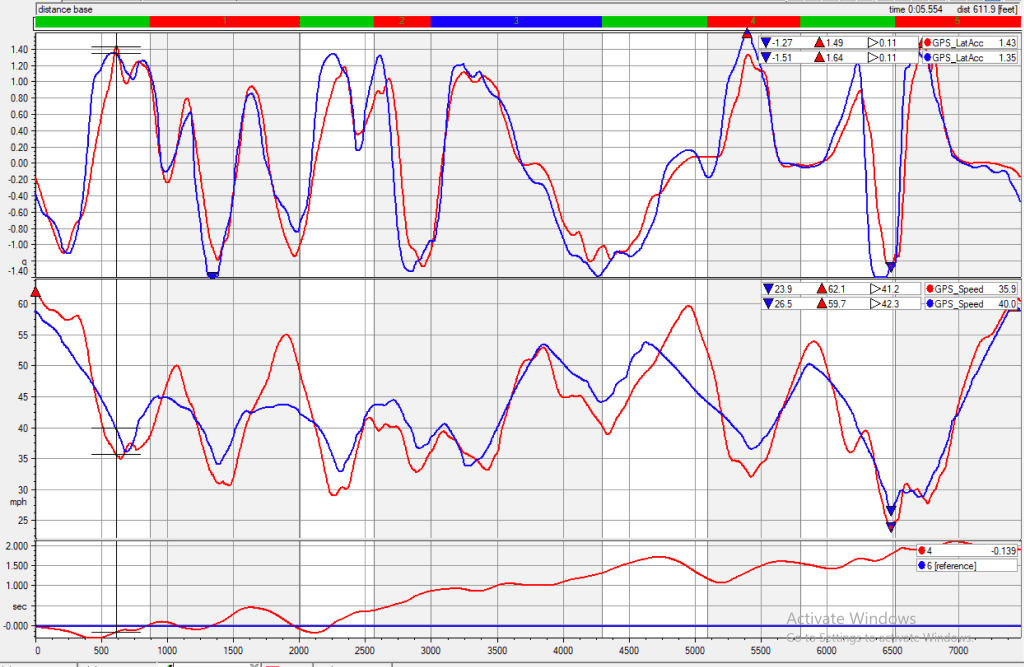
You can see from the steepness of the upward slopes that the red driver is using 2nd gear a few times, while I’m in 3rd gear the whole time. Likewise, his deceleration slopes are very steep, and mine are gradual, because I’m air-braking. But if you look at the very end of the deceleration zone, it looks like I’m braking or in some cases, even trailbraking. I swear I’m not.
What you’re seeing is nothing more than me increasing steering angle towards the apex, but it results in a lot of deceleration, and grip, and feel, right where it matters most. If you look at the data, you can see the intermediate driver at this point of corner entry often has less deceleration than I do, even though he’s on the brakes. Crazy, right?
In the end, my ability to be smooth and carry entry speed into the mid-corner is more important than any amount of braking and shifting, and so I go two seconds faster than my student. Let that sink in.
But don’t take this to mean the no-brakes drill is the fast way around the track. Beating up on intermediate drivers is easy, so let’s see how I compare, as Bad Brains would say it, I against I.
In the following speed trace, the blue lines are the same 3GNB lap I did against the student. Contrast that with the green line, which is me braking and shifting. I’ve added longG to the middle of the graph so we can see just how much more braking and accelerating I’m doing, it’s a ton.
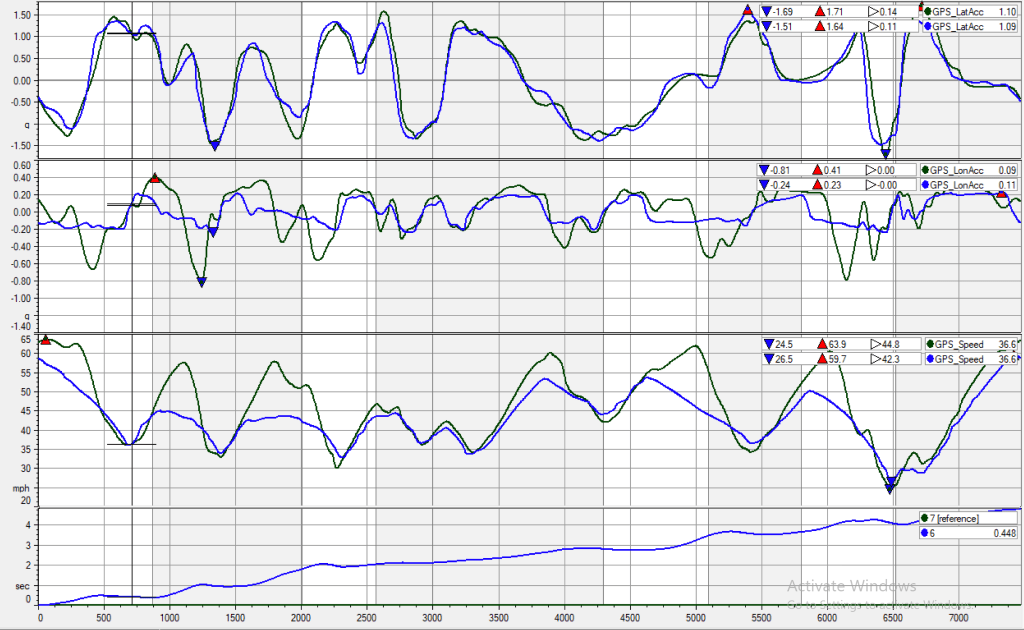
In the speed trace, you’ll notice that I’m getting down to the same vMins in most corners, but sometimes it’s difficult to improve on a no-brakes vMin. The reasons for that are A) smooth is fast, and B) sometimes it’s important to sacrifice maximum cornering grip to rotate the car early in the corner, so that you can get to full throttle earlier.
The result is that I’m 5 seconds faster. In reality, the no brakes drill is quite slow. This is a short track only 1 mile long, but it has a lot of corners, and on most tracks the difference is usually around 6 seconds or so. I obviously don’t teach the no-brakes drill because it’s the fastest way around the track, I teach it because it’s the foundation of performance driving.
A skid pad No-brakes is the foundation of performance driving
Is the no-brakes drill the foundation of performance driving? Or is a skid pad?
It’s hard to argue the incredible value of a skid pad. This is the best way to learn how to drive the limit of lateral grip. Skip Barber taught this for many years at Lime Rock Park, and if you watch this old video (skip ahead to 15 minutes), you’ll see that the skid pad was how they taught both limit driving and car control.
The skid pad makes it easy; hold the wheel so that you’re turning at a constant angle, go faster and faster, and you’ll find the limit of lateral grip. And then you’ll push harder and go over it. And then recover. And then go over. And recover. Again and again and again. A skid pad is the best way to find the limit, input that sensory information into your brain and butt for later retrieval, and train muscle memory for recovery.
Once you can regularly find and stay at the limit, you can experiment with limit steering. Most people start with the gateway drug, lift-throttle oversteer (LTO).
LTO is exactly what it sounds like; when you’re cornering at the limit, lift your foot off the throttle for a second, and the weight transfers forward, giving the front tires more grip. This in turn makes the rear end have less grip, so the car oversteers. You’d want to practice this many times on a skid pad, rotating the car just by interrupting the throttle.
After LTO you might practice holding oversteer into a drift because A) that’s super fun, and B) it’s a tool in your toolbox. After drifting, maybe you practice fully pivoting the car so that it spins. Because spin recovery is another important skill.
But you’d also want to practice inducing understeer by adding too much throttle too soon. That’s another important skill, for dealing with a loose car, driving in mixed conditions, or pushing understeer to the exit in an increasing radius turn.
After doing all of these experiments, you come to the realization that when the car is at the limit, you can steer with your feet and control speed with your hands! And now you’ve gone from a person who drives a fast car to someone who drives a car fast. Thank you skid pad.
But a skid pad isn’t always the answer.
- Most of us don’t have access to a skid pad. I daresay it’s cheaper and easier to find track time than it is a skid pad.
- Only one person can use it at a time. If you’re teaching a class of students, you have to rotate everyone through. Each student might need 15 minutes, half an hour, or half a day to get comfortable finding the limit and experimenting with what they can do there.
So if you don’t have a skid pad, what can you do? Simply drive a track without braking or shifting! This is essentially the same thing you’d do on a skid pad, but do this on a track. The no brakes drill is how you can find and experiment with the cornering limit, with the added benefit that many people can share the track at the same time (provided they are all doing the same drill).
In the end, the reason the no-brakes drill is the foundation of performance driving is because we don’t all have skid pads.
I’ve worked with one HPDE group that does the no-brakes drill, but it’s only for two laps at the start session. Their heart is in the right place, but they got it wrong, wrong, wrong.
Wrong: the whole pint of the drill is to be at the limit, and you can’t do that on cold tires. Braking and accelerating is what heats up tires, and so you need a couple laps going full blat before you can do the drill.
Wrong: two laps isn’t enough time to find your visual references of where to get off the gas. And you need those just to survive this! At Ross Bentley’s Speed Secrets Academy, we set up two cones for EoA (brave and braver) so students can instantly get up to speed. Otherwise they would spend the whole session identifying and remembering references, rather than driving and experimenting at the limit.
Wrong: they do no brakes at Watkins Glen, which is not an appropriate track for this drill. The straights are too long and the walls are too close. The best tracks for this drill are low speed, long corners, and lots of runoff. You know, like a skid pad.
I’d also say this drill isn’t for absolute novices. Right seat instruction is still important for making sure the driver has the right seating position, ergos, and can get around the track comfortably.
And as we saw with Ken, expert level riders (and perhaps drivers) may not get anything out of this drill. But that leaves the majority of people in the middle, who will truly benefit from setting a solid foundation for their performance driving.
So why is the limit higher?
I want to delve into one more thing that I’ve kind of touched on here, but haven’t explained yet. It’s the answer to the question, “why is the cornering limit higher in the no-brakes drill?”
The reason is, because this drill allows you to easily set the ideal entry speed for the highest possible mid-corner speed (vMin). Smooth is fast, and not upsetting the vehicle with any changes in speed means the tires can do all of their work in the lateral direction.
Does that make sense? Perhaps a better way to explain this is what happens when your entry speed is too low.
When you come into a corner too slow, your subconscious mind will make you add throttle. It’s a natural and almost unavoidable consequence of arriving at the corner too slowly. When you change speed in the corner, you create an artificially lower limit. This is because tires can accelerate, brake, or corner, and now you’ve asked the tire to sacrifice some cornering for acceleration, and so the limit is now lower.
The result of adding gas with an artificially lower limit is usually understeer. The weight has shifted off the front tires, and so the car pushes to the outside of the turn. I’d hazard a guess that 90% of people that complain about their car understeering are arriving at the corner too slowly.
The other thing that happens when you enter under the limit is oversteer. The tires were already being used for cornering, so they don’t have as much grip for acceleration, and it’s not that difficult to add too much throttle and lose rear traction.
In the end, both understeer and oversteer are the result of an artificially induced lower cornering limit, which is because the driver didn’t set the ideal entry speed. Which is why not braking, using a taller gear, longer and lighter braking, and other similar strategies that focus on maintaining momentum result in faster lap times. Lap times comes from lateral grip. But that’s a story for another time.
Getting back to Ken Hill
If there’s one thing I’m taking away from Ken’s experience with the no-brakes drill, is that it made him uncomfortable. I love that.
If you can execute something with 100% ability and confidence, then you’re not learning anything. You have to stretch your abilities and get uncomfortable in order to learn; that’s where the growth is.
I also think Ken is beating himself up too much. Given the differences between trailbraking on a bike versus a car, plus the fact that you can’t slow a bike much by steering, and the fact that Ken had to use his conscious brain for corner entry, I’m pretty impressed with his 10 second delta when not using the brakes.
Ken instructs mostly on bikes, but also in cars. In a car, I bet this drill would have gone better, and that 10 seconds would be more like 6 seconds. Perhaps his lack of comfort might even be reframed as a good thing. So here’s an open invitation to Ken:
Ken, come to Pineview Run as my guest, drive my Veloster N (it’s not that different from your son’s Elantra N), and do the no-brakes drill for a few sessions. Compare your data with and without brakes (we can be Race Studio 2 buddies), and see what happens to your vMins. We can both write about the conclusions on our respective blogs, and give the readers more information on the no brakes drill.
I’ll try not to have a fixed mindset about the result, but it won’t surprise me if you find that the no-brakes drill is the foundation of performance driving!















 Occam's Racer