It’s been a little while since I announced that I would be teaming up with Spec13 to Busa-swap my 1994 Miata. I can pretty much assure you that looking back on this years from now, that this was both a necessity and a mistake.
A necessity because the motor allows me to do things I couldn’t have done with any other engine. And this has nothing to do with the power output, ram-air system, 11k redline, or sequential shifting, and everything to do with weight and packaging, and how I can exploit that.
A mistake because I was just about to get out of Miatas entirely, and concentrate on other things in my life. But the availability of this motor swap is creating so many opportunities for radical change that there will be no going back to a standard Miata! This is a one-way trip to the dark side of aerodynamic madness. So, what’s happening?
The engine and transmission are out, and the PPF has been removed. The Spec13 kit doesn’t use the PPF, and so the diff is supported by a rear bracket (I got mine from K-Power, but Spec13 will also offer a version of this).
I bought a V8 Roadsters subframe, which isn’t necessary, but should create more space to mount the engine. Not that the Busa engine needs a lot of room, it’s tiny. What excites me about the tubular subframe is what I can do with all the extra space.

The area in front of the engine block will be used for a radiator and extractor hood. That won’t take up much room, and I should be able to run the headers in front of the engine, put a hole in the firewall, and make a side exit exhaust.
This is a lot of work, and it’s extra work considering that Alyssa scanned the engine bay and is designing the header pipes right now. The engine sits longitudinally, and the pipes exit like a standard Miata under the car. Well… that’s what the swap kit comes with, but like I said, I want to make a side exit exhaust, and so my headers will likely wrap around the front of the engine.
The reason for that is threefold:
- Side exit exhausts are cool looking. I like the idea of a motorcycle muffler set into the door and visible on the passenger side of the car.
- A side exit makes it easier to make a flat bottom, because I won’t have to worry about heat management. I may still need to cool the diff with a NACA duct, but that’s a minor thing compared to cooling an exhaust.
- With one less item in the transmission tunnel, I can dump air into the empty chamber and make a front diffuser. Huh?
Because the Hayabusa transmission is within the engine case, this leaves the trans tunnel mostly empty. Typically you have a PPF, driveshaft, and exhaust sharing the trans tunnel, but with two out of three of these removed, there’s a lot of air space in the tunnel.

My plan is to diffuse air from the center of the splitter into the transmission cavity and make downforce in front of it. This is an area that a standard car can’t exploit, and because the diffuser is so far forward, it should create front downforce.
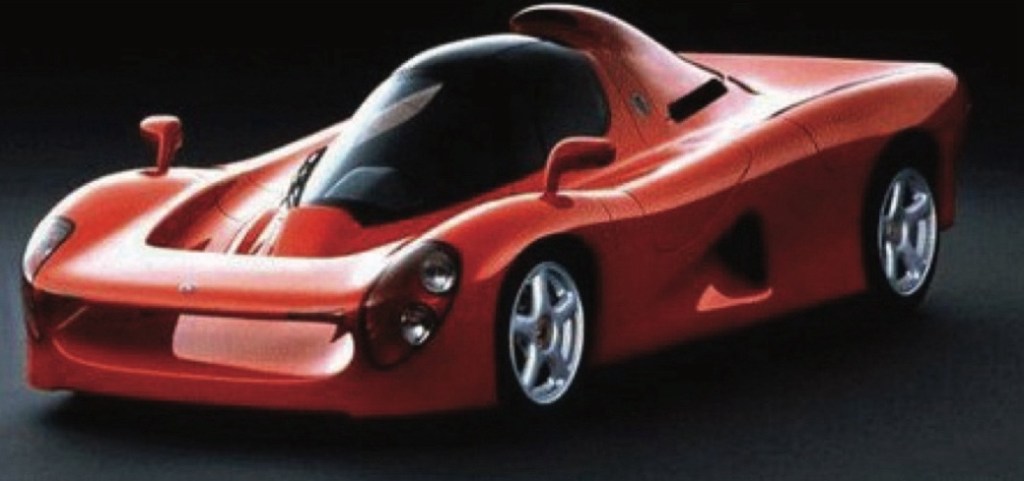
The Toyota GP-One used a front diffuser, but sends air to the sides, rather than into a central tunnel.

The Miata chassis doesn’t allow me to do the same thing, which is why I’m sending some air down the center tunnel. But I’ll also be sending some air to the sides via what I’m calling rocker vents.
Rocker vents
There are many options for fender vents, from expensive laser cut aluminum, to budget eBay plastic, to the cheapest solution – simply cutting a hole in the OE fenders.
Vents on the top of the fender are important, but so are vents behind the front wheel. The budget solution is to make a horizontal cut and then push the fender into the wheel well. Or some people will pull the bottom of the fender away from the body and vent air between the chassis and quarter panel. And finally some people will cut into the quarter panel and install Left Lane Designs fender vents.
All of these are good solutions to venting the front wheels and making the splitter work better. I like the following picture, which is a great example of NA Miata fender venting.

That’s good venting, but it’s not enough for Falconet’s front diffuser, so I’m cutting into the chassis to get even more extraction. My front wheel extractor vents will start about 3” further inside and exit into the bottom half of the doors. Say what?

I’ve been looking at DTM cars and Japanese GT500 cars (similar chassis), and they all have extreme front vents that exit in the rocker panel. Unfortunately I can’t do that without seriously compromising the unibody. My car has a full cage, but there are no tubes that connect the cage to the shock towers (yet), and so unless I weld those in, I’ll have to limit the amount of venting I can do.

I’d like to start the vent as near to the center of the car as possible, but I can’t get too aggressive with it, because if I cut into the footwell, I lose space for the dead pedal. I can live without that, but if I go further, I’ll lose space for the clutch pedal as well. So unless I mount the clutch lever on the steering wheel or shifter, there’s a limit to how centrally located the extractor vent can go. (The motorcycle transmission allows clutches upshifts, so this isn’t an insane idea.)

So for the time being, I’m going to stop the fender vent at the footwell, keeping all of the sheet metal in the cockpit intact. In the image above, that inner wall with the holes in it is the vertical wall that makes the side of the footwell.
I had originally thought I’d cut out the bottom door hinge completely and continue the extractor vent into the rocker panels. But I don’t want to turn my car into a noodle. There’s a vertical support at the hinges which ties into the rocker panel, and so I’m leaving all of that intact. This makes the exit of the duct much shorter and a harder angle than I’d like, but I’m just not feeling brave enough to cut a hinge into the middle of the car and then re-brace it.
This is already a lot of work, and you might be wondering, what’s all of this venting going to be worth in terms of downforce? I honestly don’t know. It’s not just fender venting we’re talking about, it’s a front diffuser.
I will A/B test the rocker vents in a wind tunnel on 6/20, but without spinning tires, I don’t know how accurate it will be. But I can at least compare the rocker vents with other fender vents I’m testing, and see how they compare. I took a bunch of pictures and will do a how-to post in the future.
I can tell you that the idea of the whole aero package occupies my thoughts from the moment I wake up. I’ve drawn and re-drawn several ideas, and I’m not ruling out a front wing molded into the bodywork.
 Occam's Racer
Thank you for helping me feel like I’m not the only insane person on earth with respect to modifications to my Miata.
Insanity loves company.
LikeLike
I’m glad for the company!
LikeLike
Sweet project.
LikeLike