
In my first article on the MSHD, I mentioned the author of the MSHD thesis, Sriram Saranathy Pakkam, also tested the wing as a dual element. The results looked fantastic, with a CL of over 4.0, That’s over 170% more downforce than when used as a single element. But what’s more remarkable, was that as wing angle increased, it never seemed to stall. Stalling is the point where downforce decreases with more angle, and drag goes way up.
You might wonder why stall is important for a wing that’s not used on an airplane; it’s not like the car is going to fall out of the sky! But because cars have cambered rooflines, the middle of the wing experiences a steeper angle than the outsides of the wing. Air coming down the center of the roofline might be anywhere from 5-10 degrees, while the air at the sides of the car is at zero degrees.
This means if you set up a typical 2D wing at zero degrees AoA, the middle of the wing might be at 5 degrees (for a hatchback) or 10 degrees (for a sedan). The maximum angle of attack is often around 10 degrees for most wings, and so the middle wing could be at maximum downforce, while the ends of the wing are underperforming at zero degrees.
This is a suboptimal condition, but some people do worse and set the angle so that the outsides of the wing are at 10 degrees. But now the middle of the wing is at 15-20 degrees and certainly stalling.
In the end, what most people do is hedge their bets and set the wing to 2 or 3 degrees AoA. At this setting, none of the wing is at peak downforce, but neither is it stalling badly.
This is why the best performing single wings have a 3D shape that follows the camber in the roofline. The ends of the wing twist downward (or the middle is pushed upwards if you prefer), and so the entire wing experiences the same angle of attack across the surface.
But if you looked at the MSHD data, it appears that it can be run at pretty extreme angles without stalling, even up to 20 degree or so. This means you can set the ideal angle of attack at the ends of the wing (which perform best because they are in free stream), and ignore the extra roofline-induced angle in the center of the wing. If we believe the data, maybe a 3D wing isn’t even necessary when using a MSHD airfoil? It’s something I’ll have to build and test in the future.
As good as the MSHD is as a single element with respect to stall, the dual element seems even more forgiving. The author never found a point at which the wing stalled, the downforce just sort of flattened out at extreme angles of attack.

It sounds too good to be true, and so I’ll have to run a full sweep in the wind tunnel and find out for myself. But that may take a few months before I can assemble everything and schedule the tunnel time. So in the meantime, I’m going to build a hack-job dual element and see how it performs on track.
Upper element
The specifications of the dual wing used in Pakkam’s paper are as follows:
- Upper element was a scaled down MSHD airfoil. Other airfoils were tested as the flap, but none performed as well.
- Upper element measured 35% of chord, so this is about 3.5” chord for a WingLogic 250mm.
- Total chord measured 120% of the bottom wing. On the WingLogic MSHD, this should be about 12” overall from leading edge to trailing edge.
- Pakkam used a fixed 36-degree angle between the upper and lower wings, and then adjusted the wing as a whole to test different angles of attack. This is different than I’m used to: usually the bottom wing remains fixed at close to zero degrees, and the flap is adjusted from 25-35 degrees or so.
I’ll eventually 3D print a MSHD with a 3.5” chord, but for the time being, I’m going to use the upper wing I built for the previous version WingLogic. This will at least give me something to track test this year.
The upper wing I’m using is a cheap aluminum extrusion you can buy for $35 on eBay, Amazon, etc. I bought two of them and joined them together with a M8 stud. I also put a bracket in the middle of the wing to keep the middle from sagging. I then had a buddy weld all the way around it. It’s stiff and light and has a 4.7” chord. You can read about the construction of that wing here.
The airfoil looks a bit like a Wortman FX72, a high-lift aviation wing (coincidentally chosen as one of the comparison wings in Pakkam’s thesis). But the FX72 is the exact opposite of the MSHD with respect to stall. If you set it over 12 degrees, the downforce falls off a cliff, and the wing drops out of the sky.
Because the airfoil isn’t the ideal MSHD shape, I chose to back off the angle of attack (relative to the bottom wing) to 30-degrees, instead of 36 degrees. At this angle, I don’t think the upper wing will stall, and it’s an easy angle to set, with a simple 1:2 rise over run.
I overlapped the top wing over the bottom by about 1”, and set the gap between the wings at just over 1/4”. I settled on these figures by measuring the overlap and gap distances used in Pakkam’s renderings, as they were not given specifically in the paper.
I made endplates out of recycled street signs, natch. On a single wing, I make the top of the endplate parallel to the chord of the wing, which makes it easy to set the angle of attack (put a digital level across the top of the endplate). For this dual wing, I made the bottom of the endplate parallel with the main wing’s chord, for the same reason. The rest of the endplate has sort of a trapezoid shape; there’s no data behind it, other than it looks good to my eye.

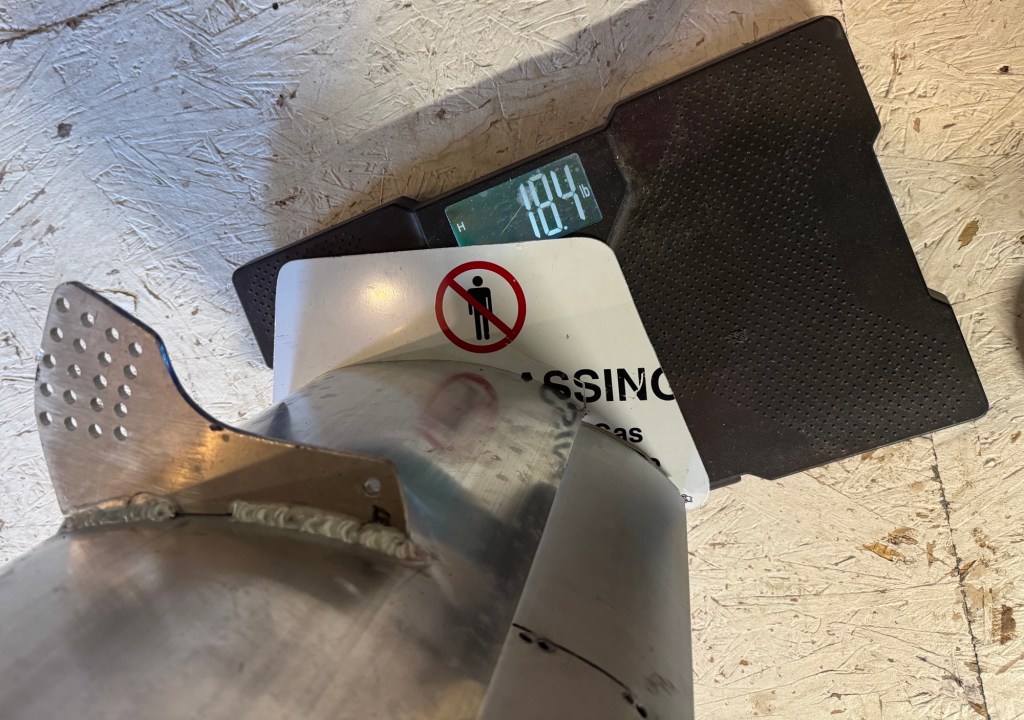
Completely assembled with bottom mounts, endplates, and center bracket, the 65” wing weighs 18.4 lbs.
Testing… soon
I’ll bring the dual wing to the A2 wind tunnel for testing when I have a chance, but until then, all I can do is track testing. Luckily I’m racing the Lucky Dog event at PittRace on October 25-26, and will hot swap the wing in the pits. This would normally be a terrible strategy for an endurance race, but the team I’m driving with (Rongway Racing) doesn’t particularly care about where they finish, and are just in it for the fun. They support doing aero experiments during my stint, and so I shall.
The car is the same Miata I brought to the wind tunnel, and has a 9 Lives Racing dual element on it right now. Swapping the wings during my session should be a good A/B test for subjective feel, and of course I’ll be collecting data. I plan to test the wing as a single element as well, which should be doubly interesting.
 Occam's Racer