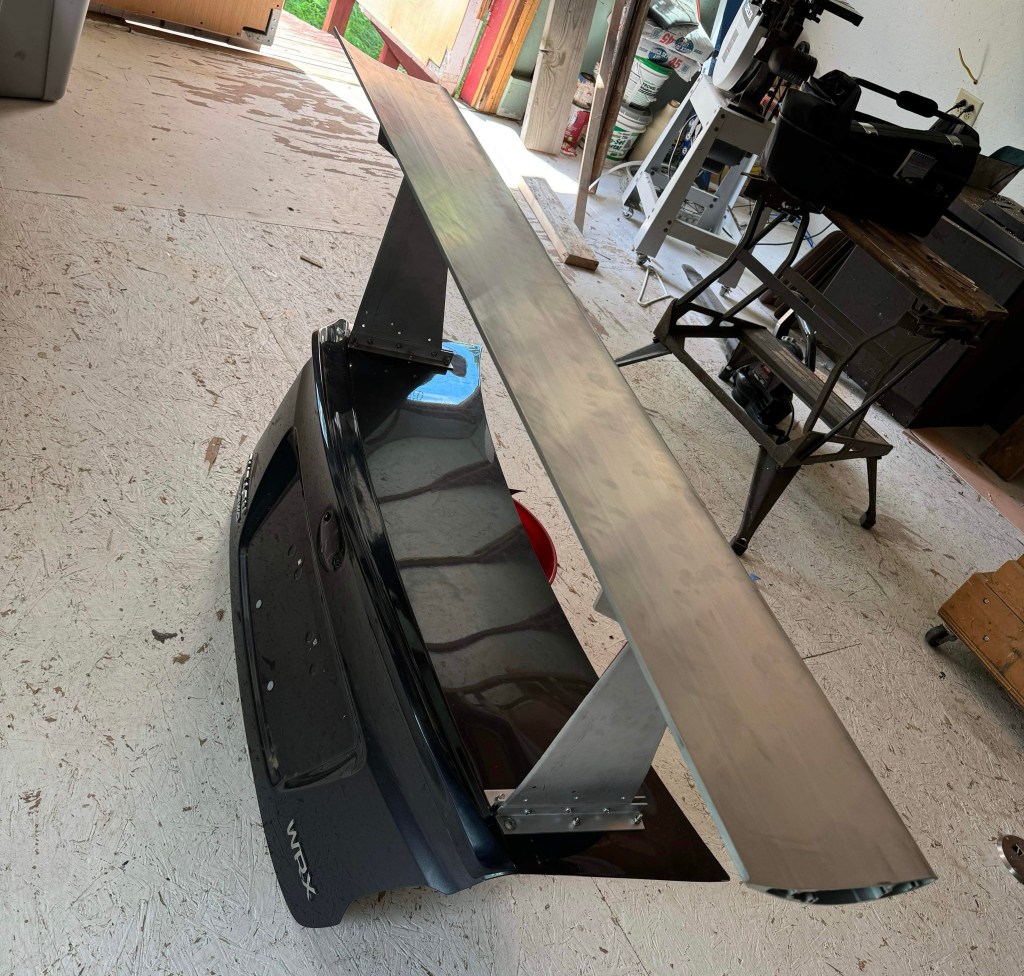
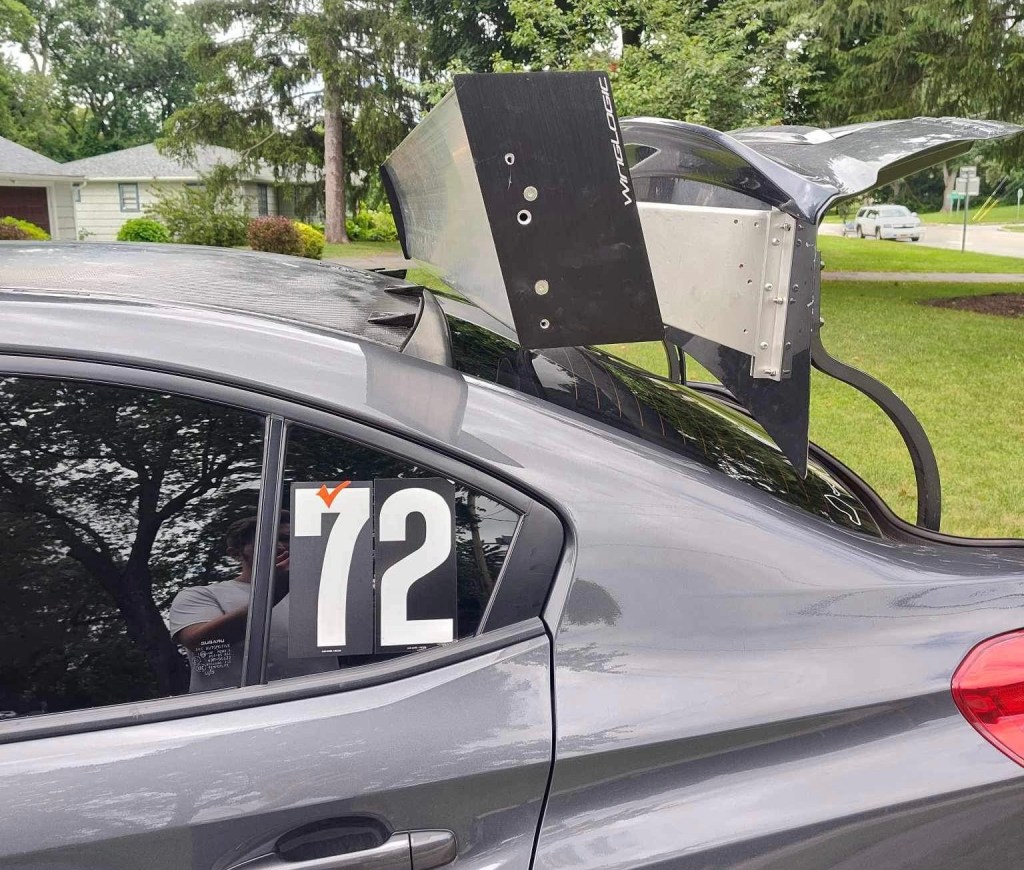
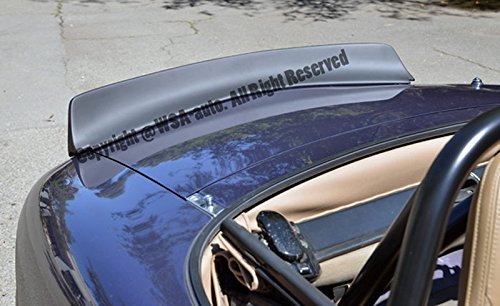
Wing Logic Dual Element

In the previous article, I mounted a Wing Logic wing to Steve Leo’s WRX. He’s been pretty happy with it, but I’ve been wondering about adding more rear downforce. An excess of rear downforce can make a car boring to drive, but it also improves braking, high-speed stability, and requires fewer corrections when you lose control. So while more rear downforce might ruin the aerodynamic balance, if the driver goes 2 seconds faster, let’s call that a better car.

If you want more downforce from a Wing Logic wing, you can increase the size of the Gurney flap by duct-taping down a piece of angle aluminum butted up against the built-in 1/4” Gurney flap. And with the larger wicker, you can add a little more wing angle. But you’ll soon hit a point of diminishing returns, and shortly after that, the wing will stall out. I haven’t run a full sweep on this wing, but I’ll guesstimate that a Gurney flap 1″ tall (very draggy) and an angle of attack around 11-12 degrees is the limit.

If you still need more downforce, the easiest way to do that is add a second element above the main wing, set somewhere between 25-35 degrees angle of attack (in relation to the main wing). Unlike the single wing, the double wing won’t stall because of the slot between the wings; Air shoots through the gap at great speed and this keeps air attached to the underside of the upper wing. Thus you can run more angle on the upper wing, which effectively increases both the chord and camber of the entire wing, without flow separation.

If you have a 9 Lives Racing wing, they can sell you a dual element wing for around $440 (with shipping). The kit includes the upper wing, plus adjustment brackets that go inside the standard end plate, plus little brackets that go in the Gurney flap slot. It’s a clever arrangement that’s easy to install and remove. I tested the double wing in a wind tunnel, and came away really impressed with how well it worked.

If you have a Wing Logic wing and you want a dual element, you’re shit out of luck. There isn’t a similar kit available, and I have yet to see anyone cobble something together. I wonder if the reason for that is because some people believe (incorrectly) that you can’t put a dual-element wing on top of a wing that has a Gurney flap? There was a recent discussion of this on the Professional Awesome Facebook group, and it seemed like most of the people said you should cut off the Gurney flap, or a dual wing won’t work with a Gurney flap on the lower wing, or that Gurney flaps only work on the top wing. That’s horseshit.

You can absolutely put a Gurney flap on the lower wing. Two research papers (James C Moss , and later F.M. Catalano and G. L. Brand) concluded that adding a Gurney flap to the main (bottom) element of a dual-element wing added downforce and improved L/D ratio. By fiddling with the Gurney flap height, overlap, and gap, they increased lift by 12% and increased L/D ratio by 40%.

But before you go adding a Gurney flap to your double wing, you should know that the authors only got those results after tons of experimentation. The height of the Gurney flap, the distance (gap) between the wings, and the overlap between the wings all need to be set correctly to get the most out of it. Knowing all of this, if you’re going to put an upper element on a Wing Logic wing (or any wing with a Gurney flap), you’ll need to be able to adjust the upper wing’s X-Y-Z coordinates for angle, gap, and overlap.

If this is all too much work for you, go and buy a 9 Lives Racing Big Wang and add The Deuce double element kit. It’s already set up with the right overlap and gap, and is simple to adjust for angle. The performance is excellent, and you will not be disappointed. Tell Johnny I said hi.

But if you’re a DIY-or-die kind of person (ahem, guilty), or you have more time than money, then maybe putting together your own dual wing how you want to spend a day. If that’s the case, read on and I’ll walk you through how I made a dual element for a Wing Logic.

Assembling the upper wing

I make wings rather than buy them, mostly so that I can experiment with different shaped airfoils and construction methods. My S1223 is a torsion box, and my MSHD is a foam core with fiberglass. But neither of those construction methods works great for a wing with a much smaller chord and less thickness. So rather than build one from scratch, I bought a couple cheap extruded aluminum wings on Amazon for $35 each. You can sometimes find them cheaper, and my friend Bill Fischer of Garage Heroes in Training once bought one of these wings and got a box of 10 for the same price.
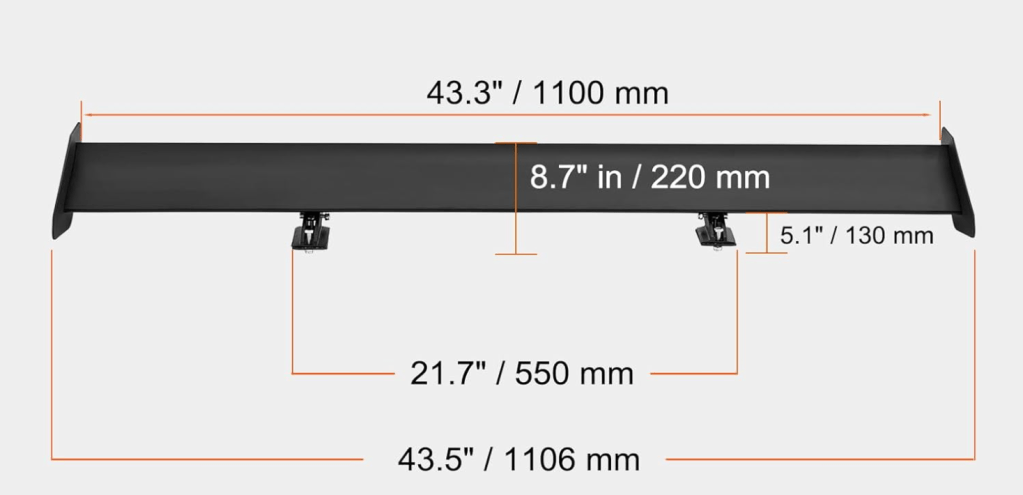
Cheap extruded wing from Amazon, eBay, etc.

I’m not exactly sure what the airfoil is, but it looks a bit like a Wortmann FX 72-MS-150A. With a cL of 1.8, this is decent, but not what I’d call an ultra-high lift wing. According to my Car Wing Comparisons article, the airfoil outperforms the NASCAR used for in their Car of Tomorrow for a hot second.
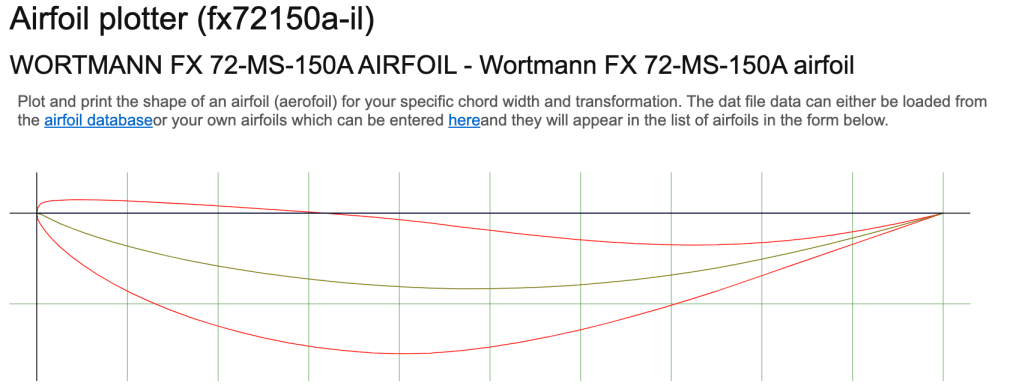
Airfoil Tools is a great place to research wings.

These cheap extruded aluminum wings are strong and light. They have two internal semi-circular spars that run the length of the wing, and provide a lot of stiffness. These supports are also tapped with M8 threads and do double duty fastening the end plates. While I might wish for a different shaped airfoil, the entire design is lightweight, sturdy, and inexpensive.

The wing has a 4.7” chord, which is larger than the upper element 9 Lives Racing uses. A rule of thumb is that the upper element should be about 30-40% the chord of the total wing (combined chord of main and second element), and this second element comes in at 32% of the combined 14.7”, and that’s right in the ballpark.

Wing profile and center support.

The longest of these cheapo wings I’ve found is 135cm (53.3”), and so if you want a bigger wing than that, you’re going to have to figure out a way to join them together. Welding is the obvious solution, but I didn’t want to rely on skin strength alone, I wanted to add an internal support as well.
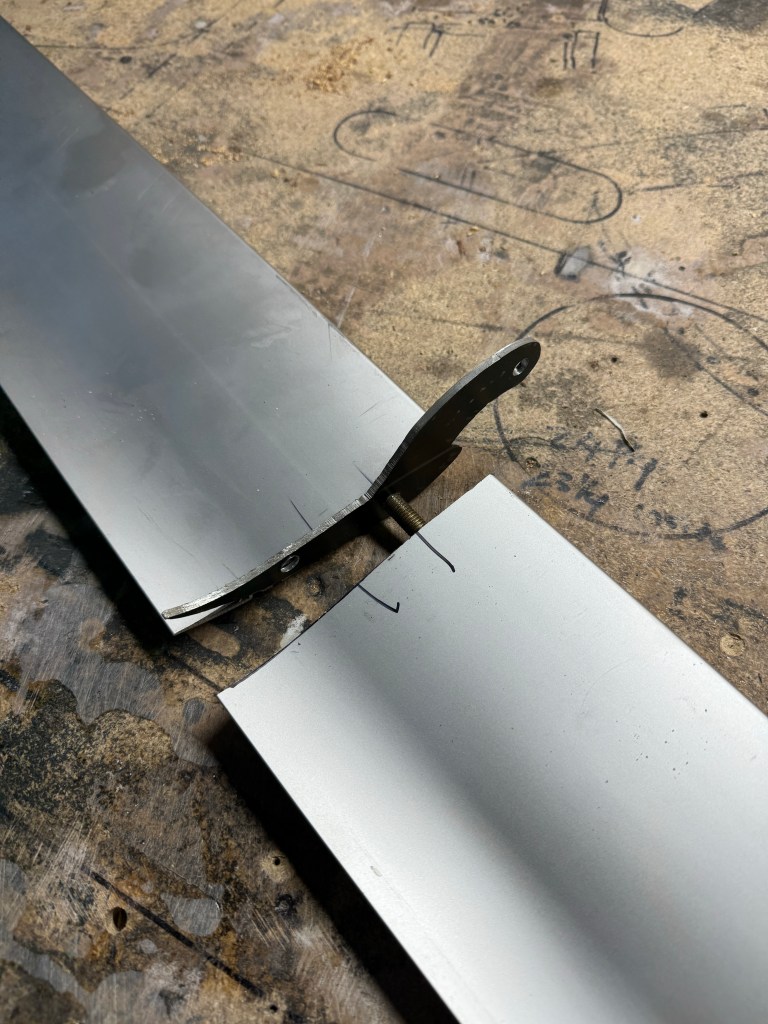
M8 stud is threaded into both sides.

I cut threads into one of the wing holes and installed a M8 stud, bottoming it out on the threads. Then I tapped the same hole on the other wing. I sandwiched a little bracket between them, which will be used to hold up the center of the wing, and then twisted them upon each other, essentially threading the two wings together.

Both halves threaded together.

I took the wing to a local fabrication shop and they charged me their hourly minimum of $80 to weld it up. So that’s $150 for the upper wing, all in. I’m sure the welding could be done cheaper, especially if I was doing several wings at the same time.

Welded all the way around, and pivoting on the center support.

Double wing end plates

To mount the upper wing to the lower, I’d need to make new larger end plates that hold the ends of the upper wing. The top wing also needs to be able to adjust for angle, gap, and overlap, and because it fits inside the end plate, it’s kind of an end plate within an end plate situation. I made the inner plates from 9mm plywood because I needed to countersink the 8mm hardware into the ends. If I used 12 gauge aluminum, the bolt heads would stick up proud and keep the wing from changing angle.

Maximum angle for a second element is typically around 40 degrees, measured from the bottom element. But at this angle, the upper wing risks flow separation. A safer bet is to set the upper wing to 35 degrees, which should provide nearly the same downforce as the maximum angle of attack. I traced all this out on the end plate (a No Parking street sign, per my usual $1-per-pound source at the metal recycler).

I always lay out the chord line parallel to the upper edge of the end plate, this makes it easy to set the angle of the wing. I’m also mocking up the position of the upper wing.

I first made the maximum downforce 35-degree setting, and to this I added a low-drag setting of 25 degrees. I don’t see needing any more adjustment than that, because I can always rake the entire wing to adjust between the high- and low-downforce settings. If I want less downforce, I’ll just remove the upper wing and run it as a single. From there I can tune wing angle and Gurney flap height as I would any other single element wing.
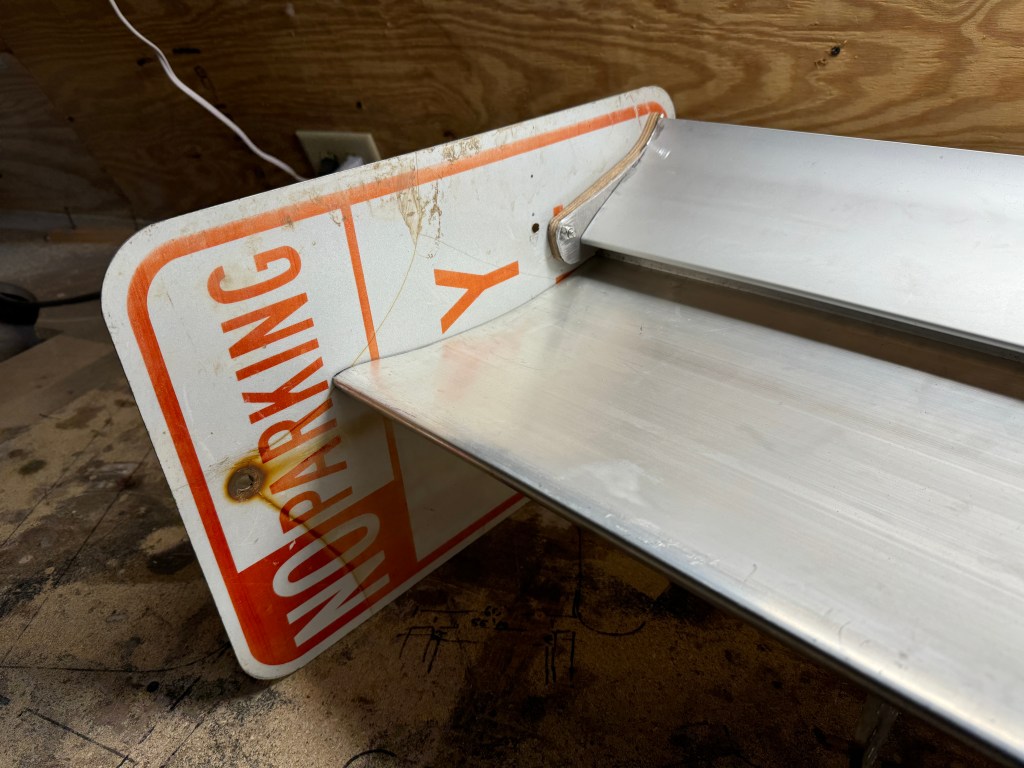
Upper wing pivots inside of end plate. You can see the forward hole, which increases overlap and gap. The gaps are larger than you’d have normally, because of the Gurney flap.

The completed double wing weighs 22.8 lbs total, and so the upper wing added only 6.2 lbs, including all of the things required to mount it. That’s pretty light, and it feels quite sturdy. Eventually I’ll lighten the main wing by milling out slots and wrapping it with carbon fiber. But more on that DIY project when I’ve liberated the wing from Steve.
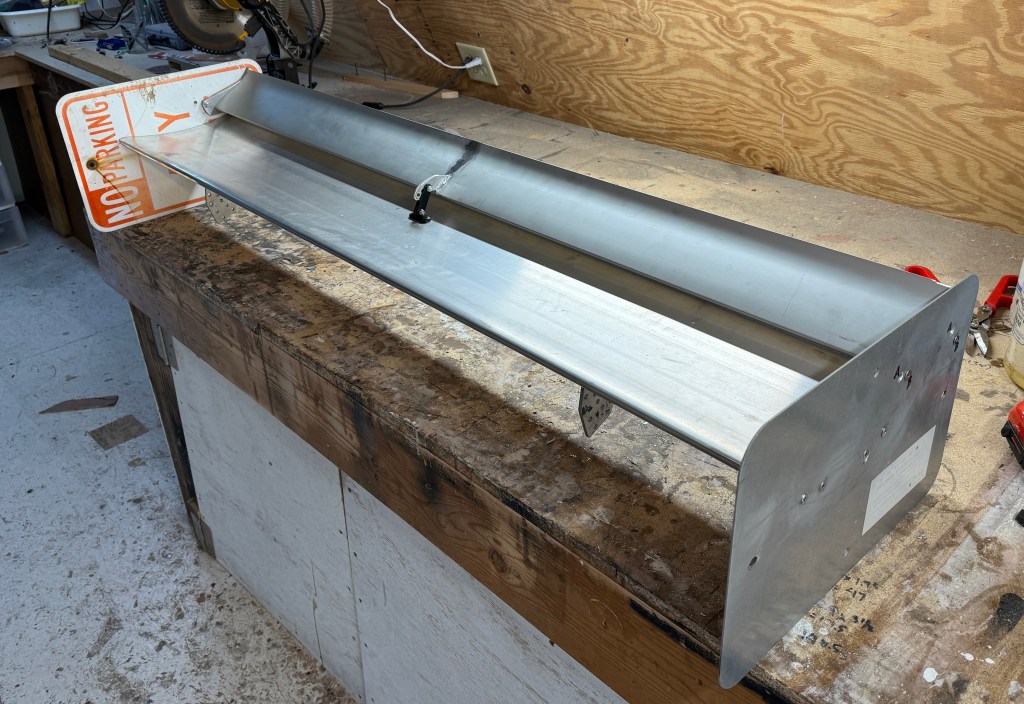
Completed wing.

Data?

This section is supposed to be filled with A/B testing data, including vital details about the ideal gap height for a dual-element wing that has a 1/4” Gurney flap on the bottom wing…. but instead it’s filled with a pissy rant.

Steve and I had a full test day planned, which involved him setting a few laps and then coming into the hot pits, where I could quickly change the main and upper wing angle, gap height, and swap between single vs dual wing. But despite an entire day at Watkins Glen, we got shit all of nothing. The problem is the same as the first time I did aero testing… Watkins Glen.

The weather is always variable, and the first session was wet and made data irrelevant. In the second session, a McLaren (620R?) dumped it’s coolant and oil on the first lap. This sent four cars into the T11 wall, and the cleanup crew onto the track for a lengthy stint. In the third session, again on the first flying lap, a Corvette stacked itself in Turn 2, requiring a full session of cleanup. And in the fourth and final run of the day, a BMW M2CS decided to get some new baby-blue racing stripes in T10. In the end, I don’t think the Advanced/Instructors run group got more than 15 minutes of track time the whole day.

Now this is the same run group I would have been in if I chose to drive that day. The two people I was with (Steve and Gregg) were the first two cars through the oil. Steve was going slowly because the McLaren directly in front was misting oil on his windshield. Gregg went through at speed and saved it like a hero. But he has a ton of experience at WGI and has proven many times over that he can save a spin.

Gregg saves it and avoids the wall. The next four cars don’t.

Well, if I was out there, I would have certainly been passing both of them in the session, which would have made me the first car through the oil. Dodged a bullet right there, I did! (I’m kidding about passing them; I drive like a grandma on this track.)

And this is why I seldom drive Watkins Glen, even for free. There are so many other tracks that have runoff, sand traps, and slower speeds, and are much safer as a result. Where I find enjoyment is pushing the car to the limit, and I’m not going to do that here, it just doesn’t make sense, financial or otherwise. My understanding is that some track day insurance companies will no longer cover cars at Watkins Glen, and I can’t blame them for that.

But I also understand that many of you like the combination of high speed and steel walls; you feel it gives you focus or commitment or whatever. Good for you. But the reason i have no data or wing gap information is because someone else also felt that way, and lost their focus or commitment or whatever.

Mounting a Wing Logic wing on a Subaru WRX STi

Wing Logic makes a satisfactory wing at a great price. It doesn’t come set up for any particular car, and so you will need to do some DIY fabrication. You’ll have to figure out things like how to mount the wing securely in the correct location, and then you’ll need to drill the bottom mounts for a range of useful angles, and then weld the bottom mounts to the wing.

It takes some patience and know-how to figure it all out, and if I’m being honest, 90% of people will cock it up and do a sub-optimal job, losing some of the wing’s performance in the process. If you buy a ready-made kit from 9 Lives Racing, AJ Hartman Aero, and other reputable companies, you’ll get an easier install and better performance straight out of the box.

But if you know what you’re doing, a DIY wing like Wing Logic or 9 Lives Racing’s new Express kits, can save you some money. Or if you have a car that doesn’t have a ready-made kit available, then a DIY solution is the only game in town.

I tested a Wing Logic wing in the wind tunnel vs the industry standard 9 Lives Racing Big Wang (Wing Logic versus 9 Lives Racing), and found the performance was similar. Wing Logic’s wing has less camber, and so it makes less downforce for a given area, but it’s a physically larger wing (9.2” vs 10”), and so the performance ends up being quite close. 9 Lives has the edge in weight and performance, and so if you’re racing in a series that limits the total wing area (GLTC, SCCA TT Nats, etc), or if you care about two pounds (high up, at the polar end of the car), then 9 Lives is a better choice. For the track rat or hard-park poseur, it’s a wash. I have plans to radically lighten the wing by milling it out into a skeleton, and then wrapping with carbon fiber, but that experiment will have to wait until the end of the track season, because I no longer have it.

Steve Leo is making a foam composite dual element, and while that process takes place (for fucking forever) I loaned him my 65” Wing Logic for his Subaru WRX STi. He didn’t have any wing mounts for it, but he had a spare trunk, and I said bring it over and I’ll figure something out.

Because I had already tested this wing on a Miata, the wing has brackets welded 41” apart. Ergo, I’d need to put the same spacing on the Subaru trunk. As luck would have it, that put the wing mounts right on top of the hinges, which is a sturdy area with some extra thickness and support in the metal frame. Also as luck would have it, the hardware would now be in the way, and I’d have to work out how to allow the trunk to close.

But first things first, to place the wings on the surface of the trunk, such that the wing is braced against side to side movement. I went to the Lowe’s racing department and bought a couple feet of 1” angle aluminum. I cut this into four pieces to make brackets, and sandwiched the Miata wing stands between them.

But I couldn’t put bolts through the top of the trunk and nuts on the bottom, as the nuts would be in the trunk gutter – this would cause interference and keep the trunk from closing. So I installed the hardware upside down, with countersunk 6mm bolts going through the underside and nylock nuts on top. It’s maybe a little less attractive, but this was the only way I got it to work.

Countersunk bolts of differing lengths install from the bottom.

It took a bit of head scratching, but I figured out how to install all 12 bolts from underneath. It took bolts of different lengths, which I’ve noted in the previous images in case you want to give it a go. It all came out surprisingly sturdy, and probably more rigid than you’d see on most cars. You can grab the wing and shake the car side to side, and the wing mounts don’t move.

Angle aluminum brackets on the trunk hold the wing stands in place. It’s very rigid.

The only thing I wasn’t terribly happy with is that the wing is too far forward. The rule of thumb is to overlap the trunk by 1/4 of the chord. So on this 10” wing, 2.5” should overlap the trunk, and 7.5” should be over the bumper.

How important is that? Well, I tested a Civic coupe in the wind tunnel, and moving the wing from on top of the trunk to the ideal rearward position resulted in less drag and more downforce. Usually you get one at the expense of the other, but this was a win-win. I would have liked to do that for Steve, but I didn’t have any more aluminum stock to make another set of wing stands, and he needed this done ASAP.

We got super lucky with the setback distance, any closer and the wing would hit the roof when the trunk was fully opened. I’ll take that as a win and optimize the wing stands at some later date.

By a stroke of luck, the trunk can open fully and the wing doesn’t hit anything.

Data?

Steve reports that the wing is working really well, but through some bad luck, we have had the devil of a time getting comparative A/B data. He’s used the wing at Watkins Glen, Lime Rock, NYST, and Pineview Run, and while we have data from those events, it’s not the kind of back-to-back data that tells a compelling story.

By the seat of the pants, the Wing Logic setup works better than the VSC rally wing he had on there previously. But the Wing Logic single wing doesn’t work quite as well as the Wing Logic dual element he tried this week. Wait, what?! Dual-fucking-element Wing Logic? You can read about that in the next post.

From Corvette C5 Wind Tunnel Test to GLTC Win

Luke McGrew qualified on pole for the first Grid Life Touring Cup (GLTC) race at COTA this year, and then proceeded to win all the races. This isn’t super surprising, because he’s always a front runner. But Grid Life nerfed the flat-tuned cars even more this year. So how the fuck is Luke doing it in a C5 Corvette?

For starters, he’s a hell of a driver. He’s also really smart about the way he sets up his car. For example, he uses a small spoiler rather than a wing. But wait a goddamn minute, everyone knows wings work better than spoilers, right? Well, it depends on the car, and it depends on the rules.

GLTC is a pounds-per-horsepower series that allows some aero for free (small wings and spoilers, undertrays without splitters, hood and fender vents, etc), but penalizes or bans other aero parts. As such, a careful reading of the rules is important, and optimizing to those rules can confer a small advantage.

Luke knows what he’s doing, and part of that is doing the research. In that, he found an old wind tunnel test on a C5 Corvette. After reading that, he asked me to “check his math” so to speak, by running simulations in OptimumLap. After purchasing the wind tunnel report (to get the cL and cD data), I built several versions of his car, ran simulations, and verified his gut feelings were spot on.

No splitter and a spoiler instead of a wing.

There’s more backstory to this story, so let me elaborate.

The wind tunnel report

Back in 2002 a group of SCCA racers took a C5 Corvette to a wind tunnel and published a report on the results. It’s not a very long report, but the story is compelling, and the data speaks for itself. The report is available here for $37. I’m going to review some of what’s in that report, but without any specifics, because the author said not to reprint any of it without permission, and so I won’t.

The group did 26 runs in 10 hours, which is oddly the same number of runs I did at the A2 wind tunnel. They used a much larger wind tunnel at the Canadian National Research Center, in Ottawa, Canada, whuch measures 9 meters square by 24 meters long. This is quite a bit larger than A2 wind tunnel (which is 14 feet wide and 58 feet long), and so the Canadian results should be more accurate.

But how accurate is a wind tunnel compared to the real world? I don’t know. When I posted my wind tunnel data online, some internet pundit, without a shred of empathy or humility, puffed up said I made a major mistake in my report, because the wind tunnel optimizes to a constant Qrh, not V-100mph, so that my data was useless without the Qrh average for each run. I have no idea what that means, but I don’t see anything like a Qrh average column for this wind tunnel report either. And so I guess all this data from Canada is similarly worthless?

Well, I’m not a professional aerodynamicist, I’m a fuggin hack, but I’d have to think the differences from each test run are still important, even if the actual numbers aren’t 100% accurate. So let’s shove all the caveats and internet buffaloes aside and move ahead with what they tested, and the comparative data.

  • Drag – In the test they tried various things to reduce drag, from taping up the front grill to rounding the B pillar, to putting a hole in the license plate. Some things worked surprisingly well, some had no effect at all.
  • Rear wing vs spoilers – A couple different wings were tested, and since the baseline car used a spoiler, they included the data for that as well. But isolating the spoiler data is rather difficult.
  • Wings, end plates, and Gurney flaps – They tested three different end plates on the standard wing, and their results were somewhat similar to mine, which is that end plates are the least important part of the entire aero package.
  • Splitters – They tested a splitter with a flat undertray and one with diffusers. They call this a Laguna undertray for whatever reason, and I will say the design looks quite good.
  • Yaw – I didn’t test yaw, but they did, using both + and – 3 degrees for most of the runs, but they also tested higher yaw angles initially before settling on just 3 degrees for the rest of the tests.
  • Tire life – While tire life isn’t something you test in a wind tunnel, the report concludes with results from the race season, which showed tire life was considerably longer using downforce. This is something I wrote about before, that downforce increases tire life, and their experience was the same.

OptimumLap simulations

With all of this wind tunnel data in hand, I went into OptimumLap and built Luke’s exact car. I started with the basic specifications for a C5 Corvette, but used a 252 horsepower flat-tuned dyno chart instead. Detuning is what allows a Corvette to compete in GLTC, and a result of that is a very flat torque curve. This is recognized as an advantage, and flat-tuned engines are penalized for that. Cars are also penalized for aero.

To see which aero version was fastest, I created nine versions of his car, each with different aero parts. I used the coefficients of lift and drag from the report, and swapped out every version of splitter, wing, spoiler, etc. This may sound easy, but the the table that shows the coefficients has low resolution, which made isolating the individual aero components a little tricky. Anyway, I persevered and had my nine different cars, giving them different weights to match the rules.

Grid Life Touring Cup is a pounds per horsepower series, and penalizes cars for using aero, by making them heavier or less powerful. For example, if you use a spoiler or wing that’s larger than 250 square inches, there is a penalty depending on how large you go. Likewise, a splitter carries a penalty over an airdam, and there are penalties for various combinations of wings with splitters.

Because it’s easier to adjust a car’s weight than its engine tune, I simply changed the weight of each aero build to match the GLTC rules. Thus, the car would weigh between 3213 lbs (free aero) to 3371 lbs (splitter and big wing). Note that these weights may be off by a season, as GLTC again nerfed the flat tunes. And also, don’t take too much into the lap time itself, OptimumLap can’t really predict lap times without a lot of fudging, so this is just comparative data you’re seeing.

I then ran all nine cars around various the race tracks GLTC goes to, to see which would win. The winner wasn’t the same at every race track, but a few builds bubbled up to the top, and some sank to the bottom. The following image shows a speed trace and lap times of five of those builds at COTA. I’m not going to reveal which one was the fastest (that’s between me and Luke), but I will tell you which one was the slowest.

Speed trace of five C5 aero builds for GLTC.

See that black line that has the highest top speed? That’s the OEM aero version, essential a base trim model (BTM) off the showroom floor. It might have a 5-10 mph advantage on the back straight, but it posted a 154.44 lap time, which was the slowest at COTA, and also the slowest at every other track. In the end, cornering speed matters more than top speed.

To get back to what I was saying earlier, Luke uses a spoiler and not a wing. GLTC allows you to use a small wing (less than 250 square inches) for free, and so wouldn’t this be better? Not always, and it’s actually quite close. I go through this investigation in my own wind tunnel report (a $25 bargain), showing that there are times when the wing is faster, but sometimes the spoiler wins.

Miata Spoilers

If you’re serious about downforce, use a wing; it can generate more downforce, and is more efficient than a spoiler. It begs the question, why would anyone want a spoiler?

  • Spoilers are usually cheaper than wings.
  • Some racing rules don’t allow wings, but allow spoilers.
  • A small spoiler can reduce both drag and lift.
  • Wings are often gaudy on a street car, but spoilers almost always make a car look cool. Not only my opinion, but NASCAR fans as well.

I tested a Blackbird spoiler in the wind tunnel, and it performed much better than I expected, and in some ways, better than a wing. You can read about that in my Miata Wind Tunnel Report. I finally had an opportunity to test my large-chord, small wingspan S1223 wing in a wind tunnel, as both a single wing and as a dual wing. The results were not what I expected. I go over all of the details in my Miata Wind Tunnel Report, which is available for $35.

I didn’t just test spoilers, I also tested several wings, splitter diffusers, spill boards, tire spats, canards, hood and fender vents, NACA ducts, brake ducts, and even a fastback, which has a built-in spoiler. You can read about all that in the report, but let’s get back to the topic on hand, which is Miata spoilers.

How a spoiler works

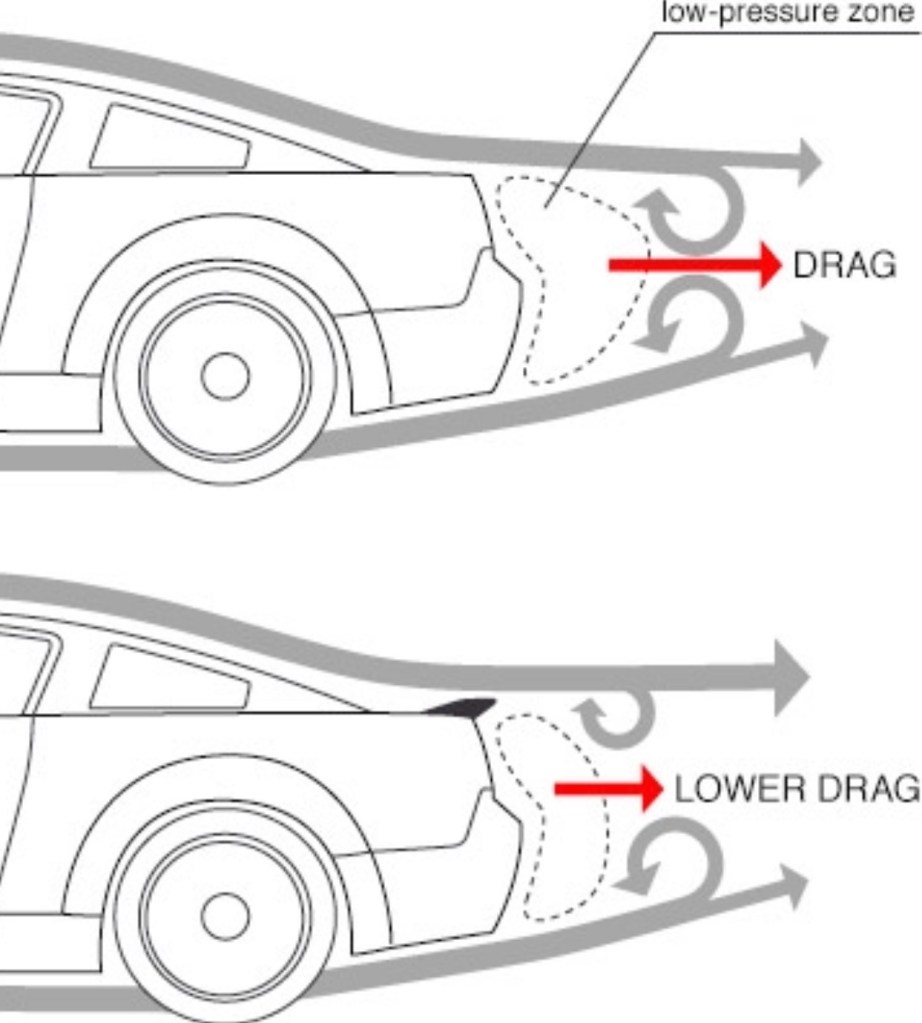
Cars are basically shaped like airfoils, and as air moves over them, it creates lift. The faster the car goes, the more lift and instability is generated. A spoiler, as the name implies, “spoils” the airflow coming over the top of the car, fooling the air into behaving as if the car has a different profile. This cancels some lift, and often reduces drag as well.

A spoiler also concentrates high pressure air on the rear deck lid. Pressure is akin to weight, and so this adds downforce to the rear of the car.

A spoiler also moves the center of pressure rearwards, and like a streamer on a kite, this promotes stability.

Spoiler height

How high should a spoiler be? Let’s take a look at what the pundits say. In Race Car Aerodynamics, Katz shows two different graphs for spoilers. The first is based on spoiler height alone, at a fixed angle of 20 degrees from vertical, or what I’d call 70 degrees.

I’ve put some pencil marks on the graph and drawn some conclusions.

  • A low spoiler about 1″ tall reduces drag the most. It also adds a bit of downforce. From a drag and downforce perspective, it’s a win-win!
  • A 3″ spoiler doesn’t add drag (compared to no spoiler), but doubles the downforce of the low spoiler. In other words, you get something for nothing!
  • A taller spoiler adds downforce and drag, but downforce increases more rapidly than drag. The gift that keeps on giving!

So no matter what height spoiler you chose, it has a benefit. Based on theory alone, we should all have low spoilers on our street cars, and taller spoilers on our race cars (rules permitting).

Note that the previous image shows a loss of front downforce at all spoiler heights, but in my testing, spoilers have increased front downforce by a very small amount.

Spoiler angle

Katz includes another graph on spoiler angle, this time using a fixed-height spoiler. Confusingly, this time the angle is measured from horizontal, not vertical, and the 70-degree angle from the previous graph isn’t included.

Some observations of this data:

  • Drag increases fairly linearly with angle (meaning height).
  • Lift-drag ratio seems best at a very shallow angle, but this may simply be the low overall height of the spoiler. Also note that L/D ratio is at best 3:1, whereas in my testing I’ve seen 11.5:1 L/D ratio using a 5” spoiler on a Miata.
  • Increasing spoiler angle to 60-degrees or more increases downforce, but at a diminishing return.

Spoiler height and angle combined

Next I’ll look at my other favorite reference, Competition Car Aerodynamics. McBeath cites CFD work done on NASCAR spoilers, in which they changed both the spoiler height and angle. Now we’re getting somewhere.

I’ll use the above results to compare spoilers of different lengths and angles that result in a similar total height above the deck. Which in turn allows me to figure out the most efficient spoiler angle.

  • 160mm spoiler, 20 degree angle, 54.7mm total height
  • 80mm spoiler, 40 degree angle, 51.4mm total height
  • 60mm spoiler, 60 degree angle, 52mm total height

It’s a bit difficult to see in this graph, but a 60mm spoiler set at 60-degrees is slightly better than a 160mm spoiler set at 20 degrees, even though the longer spoiler is a little bit taller. In other words, a higher angle works better. But it’s only by a small amount.

Based on Katz and McBeath, here is my simplified conclusion: The total height of the spoiler is the most important factor, and the more vertical, the better.

NASCAR spoilers

NASCAR used rear wings for a short period of time and then switched back to spoilers. Not because they could get better performance from a spoiler, but because the series is always looking for ways to make racing both closer and safer, and the wing did neither. In addition, the fans didn’t like the look of a wing. To be fair, the CoT wing was hideous, see for yourself.

Yuck.

So we can’t look to NASCAR for the most effective spoiler design, because we know their priorities lie in close racing rather than outright speed. But it’s worth noting a few things about NASCAR spoilers.

  • NASCAR probably knows more about spoiler design than any other race series, and they still don’t settle on one design. In fact, the regulations change almost yearly. Looking only at the height, in 2016 it was 3.5″, in 2017 2.375″, and in 2019 8″.
  • Some years the spoilers were adjustable for angle, some years they were fixed, and there have been different heights, widths, and shapes throughout the years.
  • NASCAR uses the spoiler to balance not only the overall aero package, but as a way to balance the performance between different cars, and at different tracks.
  • When NASCAR reverted from rear wings to spoilers, they set the spoiler angle at 70 degrees. In 2019 the fixed angle remains 70 degrees. Interesting.

Here’s an excellent article on A comparative look at NASCAR’s new spoiler, old spoiler, and wing.

Nscs-newspoiler2010hi_medium
Click image to enlarge.

NASCAR spoiler shapes

The 2019 spoiler is flat across the top, but different shapes have come and gone.

Image result for nascar spoiler shape
Curvy, almost bat-wing style.
Image result for nascar spoiler shape
Convex top edge.

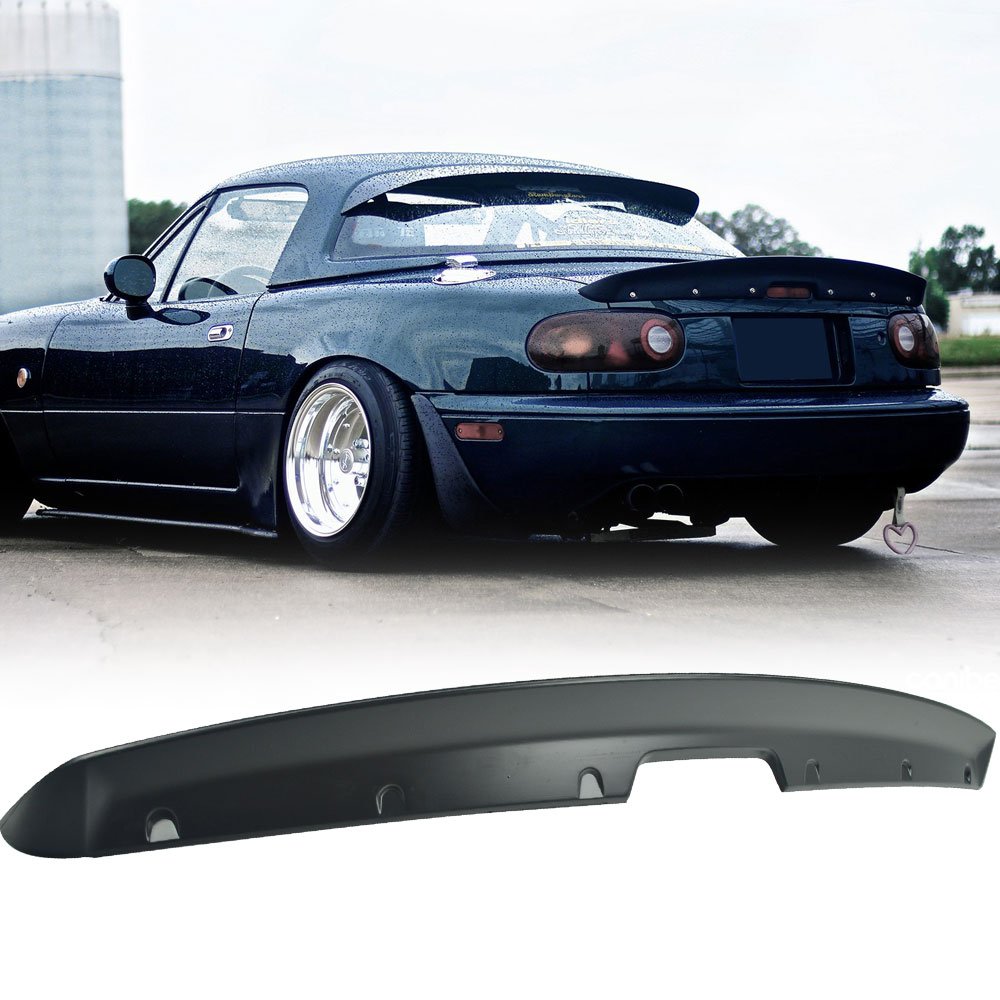
The size and shape of Miata spoilers

So now that we’ve looked at spoiler theories and real-world examples from NASCAR, let’s get down to what matters: Miata spoilers.

  • Miatas have a roofline that is peaked in the middle, and you might imagine that the ideal spoiler shape has a matching convex arc to it. Although like all things aerodynamic, this could be totally false, and maybe the sides should be taller.
  • The rear edge of the trunk is curved and so a curved spoiler would look more natural, and could be an easier DIY project as well. Also, a curved spoiler would be more rigid than flat. However, some race series say that the spoiler must be flat, with no curvature. Booo!
  • There’s no reason to “spoil” the air coming along the sides of the car, and so a spoiler much wider than the rear canopy seems like a waste. Although the exposed spoiler ends are probably adding downforce. Albeit not very efficiently, and at probably a different angle than is ideal for spoiling the roofline shape.

Miata products

This IKON spoiler is an attractive design, with a convex top edge and curved profile. It would be neat to see something like this with a flat extension that’s adjustable for height.

The Rocket Bunny spoiler is flatter across the top, taller, and with a steeper angle. I’d guess it’s slightly more effective than the Icon, but it has a tacked-on look that doesn’t really appeal to me.

And then there’s this JSP spoiler that looks like a wing, but isn’t (air isn’t going to flow under it, hence not a wing). The shape follows the curvature of the sides and roof, and this may be an efficient design. But meh to the looks.

Of course all of these spoilers have a fixed height and angle, so there’s no way to adjust the aerodynamic balance. On the other hand, the Blackbird Fabworx spoiler is large and adjustable for angle. I’m also not a huge fan of the way this one looks, but the beauty lies in the function.

Spoiler done right.

DIY spoiler, testing height

I made my own spoiler, it’s about 3.5″ tall and has some curvature to it that follows the trunk shape. It’s made of plywood and fiberglass, and there are 6mm T-nuts so I can add an extension.

With the low spoiler (without any extension), I ran very consistent 1:22s at Pineview Run. And by consistent, I mean 1:22.03, 1:22.05, 1:22.07, and in my second run, 1:21.99, 1:21.99 and 1:21.93. This was a hot day, and if I compare the times to previous ones, the track was definitely slower than normal.

With a 3.5″ extension (total 7″ height), my lap times were less consistent, most of them around 1:21.5, but my fast lap was a 1:21.03, almost a full second faster. But that one was an outlier, and if I average the five fastest laps, the taller spoiler was about .55 seconds faster than the lower spoiler.

The following table is an average of four back-t0-back runs, two with the spoiler extension, and two without. I’ve averaged the top six fastest laps.

ConfigurationAvg LapSimulatedHPLbsCgCdCl
Low Spoiler1:22.01:21.1111224001.00g.44-0.25
Tall Spoiler1:21.451:20.6311224001.00g.45+0.20

I added .01 to the Cd as a guess, but drag isn’t that consequential anyway. I came about the Cl figure by changing that value in OptimumLap until I got the .55 delta in lap time. It seems absurd to think a spoiler can make a .45 swing in Cl, but that’s what the simulation says. Interestingly, this is also the value cited for a 8″ tall spoiler in MacBeath’s Competition Car Downforce.

In Race Car Aerodynamics, Katz cites several examples of spoilers, but none that go as high as 7″. In his examples, the relationship between height and coefficient of lift is nearly linear, and from 0″ to 4″ there’s a change of about .4 in Cl. So if I extrapolate those values from a 3.5″ spoiler to 7″, I’d only expect to see a change of .4 Cl, which is again pretty close to the test result.

Whatever the case, a 7″ tall spoiler works on a Miata. Now I have to make a taller one and test that.