
My all-time favorite tire is the Hankook Ventus R-S4. They grip well, break away predictably, howl audibly, and stay consistent for hours on end. The symmetrical tread pattern allows you to flip the tire on the rim, and so if you have a camber-challenged car, you don’t have to throw out the tire after wearing out the outside shoulder. On a performance per dollar basis, there is no tire that can equal its combination of grip, durability, and value.
I have heard people complain that they are slow, or suck in the rain, but those people must be comparing them to a Super 200, like a RE71RS or A052. In the Enduro 200 segment, the RS4 is equal to or faster than any other tire.
Several years ago my brother and I tested four 200 TW tires at Thunderhill West in his Yaris. The RE71R was the fastest, but only barely faster than the RS4, and I was most consistent on the kooks. You can read about the subjective testing in Part 1 and data analysis in Part 2. The big takeaway wasn’t just the lap times, but how the tires felt, and the RS4 was my favorite.
If you don’t trust my driving skills, Tire Rack also tested the RS4 versus various other tires. The RS4 was a second faster than the slowest tire in the test, the RT615K+, but lagged 1.5 seconds behind the fastest, the RE71RS. But compared to other Enduro 200s, the RS4’s lap times were right in the middle of the range, equal to the Continental ExtremeContact Force, Michelin Cup2 Connect, and Yokohama AD09.

Of course Andy Hollis has also tested the RS4 for Grassrooots Motorsports, and you can read those comparison tests here and here. But another tire test you may not have seen is one of the best tire evaluations I’ve seen anywhere, and it’s from Rugged Badger Racing. What Roy has done in this video is look at tire tests performed by Grassroots Motorsports and others, and normalize the data using tread width and tire width. After much exhaustive research, and a fabulous spreadsheet (which he links to in the comments), he’s determined the speed of each tire, and the cost to run them.
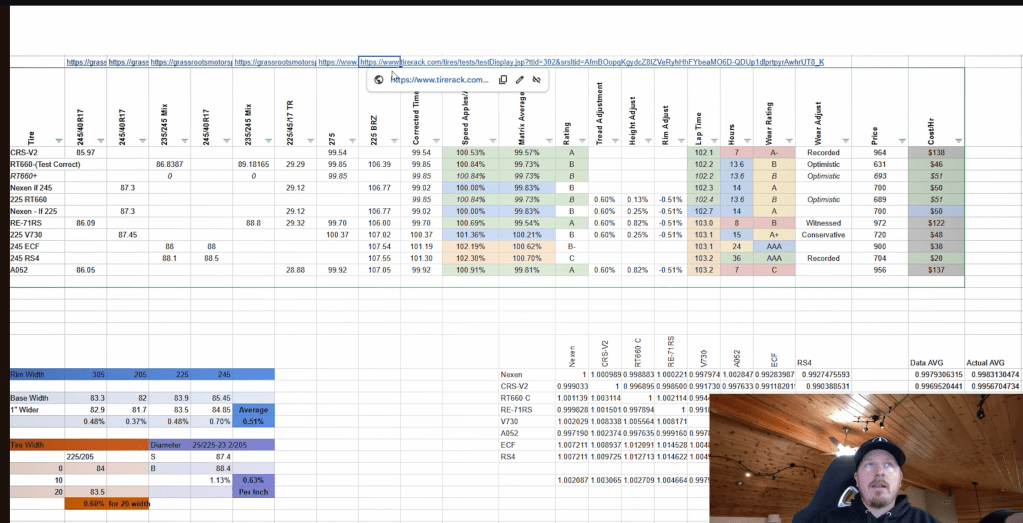
As impressive as Roy’s spreadsheet is, there’s a lot of extra data in it, and so I made a copy, hid several columns, and offer you the following distilled version that applies to Miatas only:
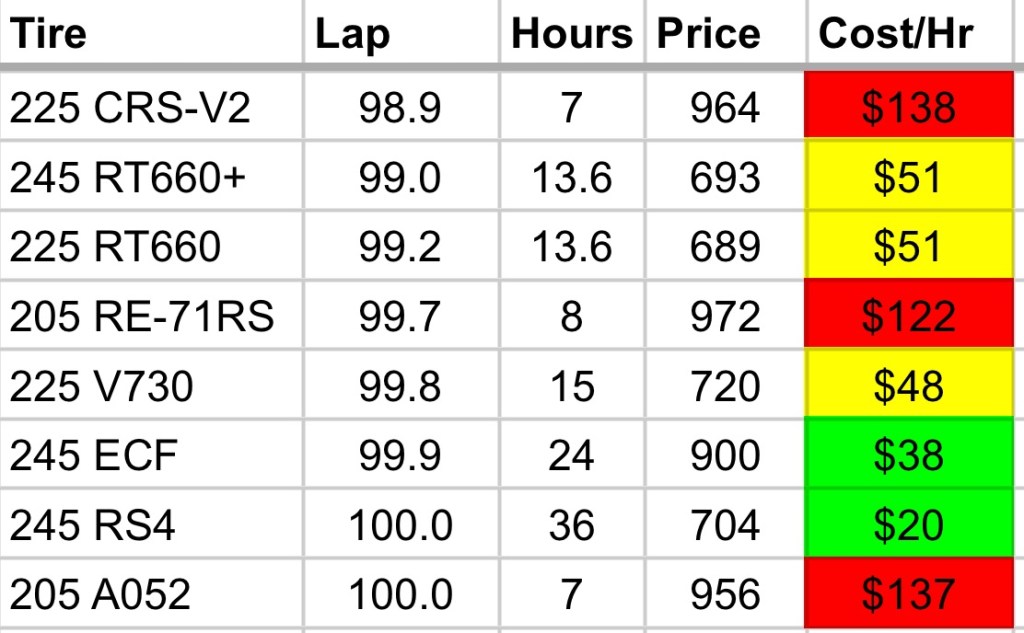
Note that I deleted the Nexen Sport R tire, as they seem impossible to get. I also made the lap time basis an even 100 seconds, so the faster tires can be seen as a percentage faster than the RS4. Otherwise all of the data and analysis is his, and I want to say a big thanks to Roy for nerding so hard on this.
Now if you’re looking at this data and wondering why the A052 is the same speed as a RS4, it’s because the A052 only comes in a 205 width. You really need to watch all of Roy’s video to get the explanations, but as you can see, the 245 RS4 is still the best Miata tire for endurance racing, being only a second or so behind the fastest in class, while costing much less. The Continental ExtremeContact Force is 0.1% faster, but it’s about double the running costs.
Another reason Miata people love the RS4 is because it comes in all the Miata sizes.
- 195/50-15 – Don’t think of this tire as a 195, it’s actually wider than most 205 tires. This is the perfect size for for 6.5-7.5″ wide wheels.
- 225/45-15 – This tire on a 9” wheel is one of the best combinations for track driving. The sidewall stretch makes for a very precise turn-in, and a playful and predictable feel.
- 245/40R15 – The widest 15″ size gives more grip and longer wear, but you should run this on a 9.5″ wide wheel for the best results. If you have a boosted or swapped Miata, these are your dancing shoes.
But not for the Veloster…
As much as I love the RS4, I’ve never had them on my Veloster N. The reason for that is twofold: 19” tires are stupid expensive, and the Veloster can’t easily fit a 245/40R18.
To the first point, I can get a 235-width RS4 in a 19” diameter at a heady $326 apiece. But I wouldn’t put track tires on my OE wheels, nor would I buy aftermarket 19” wheels. This is because, like most track enthusiasts, I swapped the heavy OE 19×8 +55 wheels for aftermarket 18×8.5 +45 wheels. This drops about 10 lbs per wheel, plus the tires are typically 20% cheaper.
Hankook makes a 245/40R18, but it runs wide, and it won’t fit a Veloster N easily. One of the major problems with the VN is the inability to use wide wheels and tires. A Civic Type R comes with 10″ wheels and 265 tires, while the Veloster struggles to fit a 8.5″ wheel and 245s.
This combination just barely clears the fenders with some of the narrower 245 tires, but you might need to roll and pull on the metal to avoid cutting the rubber. If you have coilovers you can get more negative camber, but with just camber bolts and stock suspension, you’re typically stuck with a 235 tire. And this sucks because many of the 200 TW enduro tires don’t come in a 235 width. Continental ExtremeContact Force, Maxxis VR1 or VR2, and my favorite, the Hankook RS4, come only in a 245/40R18.
Coming soon, 235/40R18
I just looked at Tire Rack and saw that they have the RS4 in 235/40-18. Now this was a surprise, because I have absolutely checked Tire Rack’s website many times for this phantom size, and it has never existed before. Thinking this was an error, I went to the Hankook website, and sure enough, the manufacturer doesn’t list this size at all! (Update, now it does, but not on the Shop page.)
I called Tire Rack to investigate, and they assured me that they had this size tire in stock, but there was only one tire. They were as perplexed as I was about why they had just one tire of a new size, but perhaps they were sent an early sample to measure it up?

Looking at the specs of the tire, right away I think I see a mistake. The tread depth is listed as 7/32″, while every other RS4 is listed at 8.9/32″. I think I know what’s going on here, which is that 7mm is equal to 8.9/32″, and so someone entered the tread depth information incorrectly. However, this being a new size, perhaps they changed something? When you create a new tire mold, I imagine there’s an opportunity to sneak in some updated technology, and reducing tread depth would certainly make the tires faster off the shelf.
Speaking of specs, the tread width measures 8.6″. The rule of thumb is to match wheel width with the tire’s tread width (not section width). Many people believe you should fit the widest tires you can, but it turns out that’s not true. Tire Rack did a very good investigation into wheel and tire widths, and found that properly sizing the tires to the wheel width makes the fastest combination, and narrower tires were often faster in the dry, and always faster in the wet. (As a side note, when Tire Rack put out this report and accompanying video, my brother and I vowed to buy all of our tires from Tire Rack in the future. This is the kind of reporting that buys our allegiance.)
So that you can choose the appropriate tire for your wheel width, I made the following table listing various track tires by tread width:

Notice the average tread width of a 235-18 track tire is about 8.3”. Continental and Michelin tires run a bit narrower, while the Super 200 cheater tires (A052, RT660, etc) run wider. But RS4s are also on the wider side, and at 8.6”, the 235 RS4 should be ideal for my 8.5″ Konig Countergrams. Given Tire Rack’s testing, I’d bet even money that the 235 is faster than 245 on 8.5″ wheels.
Up until a day ago I didn’t know which tires I was going to use this year. I almost resigned myself to buying off-brand all-season tires in an effort to find the best of the worst. As fun as it sounds to gather that data, it’ll be great to be back on the kooks again.
Despite only having a single tire in stock, Tire Rack assured me that they would be regularly stocking this size in the future, and that the first shipment is due on April 1st. Trusting this isn’t an April Fools joke, I gave them my credit card number so I can be at the front of the line when they unload the first shipment.
Thank you Hankook for making the RS4 in Miata sizes, and now a Veloster size. Thank you Tire Rack and Roy for exhaustive testing and reporting. Let’s get this track season started already!
Update: Buy your wheels and tires from Tire Rack
Since posting this article I’ve added wheels to my order, and this is significant news for one thing that I just learned: you can order any wheel you want from Tire Rack.
If you use Tire Rack’s website and search for wheels, you must enter your car info. They won’t sell wheels without knowing what car they are for, and they won’t sell you anything with an aggressive fitment.
The only 8.5” wide wheel they’ll sell me for my Veloster N is an Enkei with +50 offset. It’s a fine wheel but at 20 lbs, it’s 2-3 lbs heavier than a Konig wheel of the same size. And while I like the 9-spoke pattern on the TS9, I’d prefer a 10-spoke.
What galls me is that I know for certain that a +43 offset fits just fine, and I also know Konig has a bunch of wheels in the +43-45 range. I also know Tire Rack sells them, but there’s no way to actually order them for my car using their website. However, there’s a simple workaround.
It feels so 1999, but call 888-456-1732 and press 1 for Sales. I talked to Luke, who absolutely knows his shit, and he set me up with bronze Konig Dekagrams in 18×8.5 +43. The price was the same you’d see anywhere else, but also cheaper because Tire Rack will fit the TPMS sensors, plus mount and balance the tires for free. If required, they also send centering rings, lug nuts, and a drive tool for free.
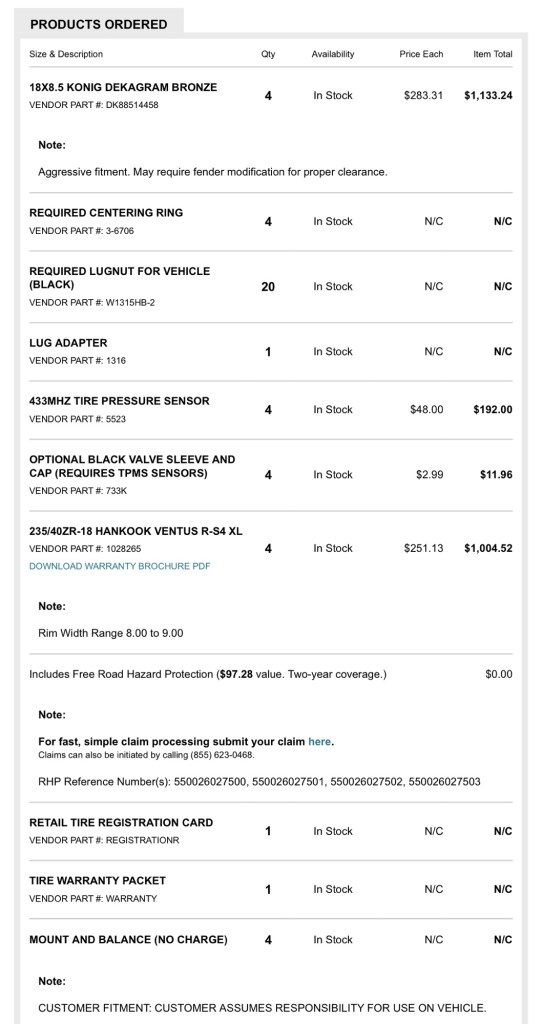
I was already pleased as punch, but then the very next day I got an email to say my order has been shipped! Well either they were sitting on more than a single tire, or that April 1st shipment arrived early. Either way, track season has begun.
 Occam's Racer