There is a new time trial series in Florida called FARA Super Lap Series, and one of my regular readers asked if I could help him optimize a car for that. I took a look at the rule book, and I must say, the philosophy and ground rules are excellent. But the classing system is probably one of the worst I’ve ever seen.
Now before I go sniping at them, I also want to acknowledge the hard work that goes into creating a racing series. This includes securing track dates, building a website, wrangling sponsors, writing a rule book, etc. It appears that FARA has done an outstanding job with 95% of it. It’s only the classing rules that are out of step with an otherwise excellent effort. Bravo.
So let me apologize ahead of time for any feelings I hurt, that is not my intent. That said, let’s talk about the classing system and how I’d build a car to the limit of the rules.
Classing
The classing structure is based on points:
- SL5 – Up to 7 points. Unless you’re racing in Grid Life Sundae Cup, I’d stay out of this class, it’s just too limiting.
- SL4 – Up to 14 points. Shitty Miatas.
- SL3 – Up to 21 points. Could be fun.
- SL2 – Up to 28 points. My Veloster would go here.
- SL1 – Up to 34 points. Could be fun.
- SLU – 35+ points. If you’re building for the unlimited class, you don’t need to keep track of points. Fun build, but not relevant to this article.
To find out what class you go into, you add up the points for the car’s power to weight ratio, tire choice, tire width, aero, suspension, brakes, drivetrain, and gearing. I’ll look at these in turn.
Power to weight ratio
To figure out your power to weight ratio, the rule book gives you the following formula:

If I use this formula to calculate the power to weight ratio for a Miata, I get 31 lbs/hp. Oops, the 2 is on the wrong side of the parentheses. Certainly the intent was to add peak hp and peak torque together, and then divide by two, not add half of the torque to the horsepower. Anyway, good for them to include torque in the calculation, I get what they meant, even if the formula is wrong.
Once you have the (correct) power-to-weight ratio for your car, you can see how many points that is using the following table:
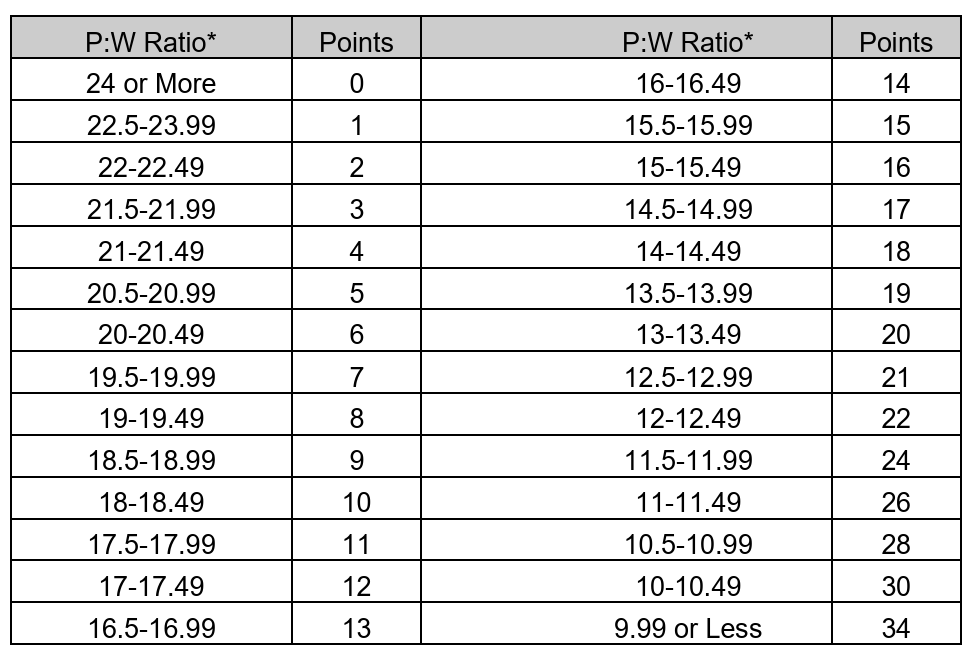
Right away I see a huge mistake, which is that the point system goes in the opposite direction than it does in reality. In the real world, adding power has diminishing returns: the more you add, the less you gain. But you can see in the formula there’s a straight rate of 1 point per interval until 12 lbs/hp, and then you take two points per interval. This is so backwards I have a hard time wrapping my head around it.
What that math results in, is that if you take a stock Corvette or similar car with a power-to-weight better than 10, it’s going to be in the Unlimited class, even if it’s on all-season tires. I’ll run some simulations later, but I can see right away that this wrong.
Anyway, I have the first principle for any FARA build, which is to build to a 12:1 power-to-weight ratio, or worse. (Unless building for the Unlimited class, which I will hereafter ignore.)
Tire points
The fact that the power-to-weight points goes in the opposite direction of reality prepared me for how FARA treats tire points: Fantasy land. FARA bases tire points on treadwear (UTQG) value!
- 300 TW or more, 0 points
- 200-280 TW, 3 points
- 100-180 TW, 6 points
- Less than 100 TW, 9 points
If you follow recent trends in tire performance you know that tire grip has nothing to do with the treadwear value! Any race series that bases performance on treadwear values needs to look at the work Andy Hollis has been doing for Grassroots Motorsports. He’s tested lots of tires and then gives them letter grades (from D to AAA) in different categories. Most importantly, he ranks the tire on time trial pace, and this requires evaluating every single tire, not looking at what the manufacturer writes on the sidewall.

So let me break down these FARA tire categories, and which tires I’d opt for:
- Any tire with 300 TW or more is zero points, and so while some performance cars come on a 540TW tire (I’m looking at you Corvette C8), you’re basically talking Michelin Pilot Sport 4S vs Continental ExtremeContact 02. Andy Hollis rates the ECS02 as B- grade and the PS4S as a C grade, but everyone else puts them as equals. Lots of high-end sports cars come with the PS4S as original equipment, and so I applaud FARA for having a 300TW category.
- In fantasy land, 200 TW tires all have the same performance. In reality, some 200 TW tires (Valino GP08R, Accelera 651, Armstrong Blu Track Race, Kenda KR20A, etc.) are slower than a 300 TW tire, while many of the super 200s (A052, CRS, RE71RS, etc.) are faster than 100 TW tires. And you also have the Hoosier Track Attack Pro and Vitour P1 Tempesta, which somehow get a 200 TW rating, and are faster than 60-80 TW tires.
- 100 TW tires are a loser’s choice in FARA. With the exception of the Goodyear Eagle Supercar 3R, there isn’t a single 100 TW tire that is faster than a mid-tier 200 TW. Just use the best 200 and stay away from this category.
- Any sub-100 TW tire is 9 points, but there’s a chasm of performance between a Toyo RR and a Hoosier A7.
So if you understand that treadwear has nothing to do with grip, and that there are outliers within every segment, then there are only three tires to choose from: Conti ECS02 (300 TW, 0 pts), Hoosier Track Attack Pro (200 TW, 3 points), and Hoosier A7 (under 100 TW, 9 points). Note that the Hoosier TAP is new and there aren’t a lot of sizes available yet, so if you can’t find them in your size, get the Vitour P1 Tempesta. (Which is a A+ tire rather than a AA tire, so how much are we splitting hairs here, Andy?).
At this point it’s appropriate to mention coilovers. If you’re using a 300 TW tire you can get away with stock suspension, but any performance tire pretty much requires coilovers for the negative camber alone. FARA penalizes 1 point for 1-way adjustable coilovers and 2 points for 2+ damping adjustments. Good lord that’s a cheap price to pay for making your car lower, better sprung, corner balanced, and with camber. Ergo, going forward in this article, I’ll add one point to the 200 TW and A7 tires for coilovers, as it’s a no-brainer.
Tire width
Tire width is another area FARA kinda misses the boat, as they assign points using a straight scale (sigh). It goes like this:
- 225 and less – 0 points
- 245 – 1 point
- 265 – 2 points
- 285 – 3 points
- 305 – 4 points
- 315 and over – 5 points
The first problem here is that heavier cars use wider tires, but don’t get a huge advantage out of the extra width. If you’re going to evaluate tire width, you need to take into account the weight of the car. The real imbalance is when you have a lighter car that is using a wider tire for its weight.
Most cars weigh about 13-14 times the tire width. Ish. So a car with 245 tires is going to weigh in the neighborhood of 3200-3400 lbs. And that’s a fine width for an OEM tire, but track cars typically have much wider rubber. For example, my 2000-pound Miata also uses 245 tires, and it get’s proportionately more grip out of the same width.
If the FARA people had looked around, they’d have noticed that every other racing series that uses tire width as a variable either sets a limit on max width, or sets tire width based on the weight of the car. So FARA could have said SL5 max width 205, SL4 max width 225, and so on, and it would make more sense. Or set the tire width based on weight.
But here’s something that’s also true: wider tires don’t make you go any faster! Unless you have a wider wheel to support the extra width, wider tires are often slower. A 245 tire on a 7″ rim is not as fast as a 225 tire on a 9″ rim. Tire Rack did the testing for this, and it’s not even close. So if you want to accurately assign tire width as a factor, you also need to take into account the wheel width, and honestly, it would be more accurate to track the wheel width alone and ignore tire width altogether. Or use NASAs time trial rules and force all competitors to measure their mounted tires with a caliper.
The other reason tire width is a problem is because tire manufacturers lie about tire width the same way they do with treadwear. They can write whatever they want on the sidewall, and so most of the Super 200s run a full size wider. If you measure a 225 A052 or RE71RS, you’ll find it’s about as wide as most 235s. And the most egregious offender is Hoosier; their 225 A7 is wider than many 245 tires!
So, given how FARA treats tire width, what would I do? I’d run the widest wheels that would fit my car, and then select a tire with a tread width (not section width) that matches my wheel choice. On my Miata, that could be a 225 on a 9” wheel or a 245 tire on a 9.5-10” wheel. On a heavier car, I might lean into a 265 tire on a 10.5-11” wheel, but I’d have to see how the points shake out. Tire compound is way more important than tire width anyway, so that’s going to be the thing to simulate.
Aero
Most aero items appear to be free, and so if your car has hood and fender vents, canards, a diffuser, or other unlisted aero items, you’re only bound by the “can’t be overly large” clause. The only thing FARA penalizes are splitters and rear aero. And honesty, I agree with that.
- 2″ splitter – 1 point
- 4″ splitter – 2 points
- >4″ splitter – 3 points
- 150 square inch spoiler or wing – 0 points
- 249 square inch spoiler or wing – 1 point
- 499 square inch spoiler or wing – 2 points
- 699 square inch spoiler or wing – 3 points
- 700+ square inch spoiler or wing – 4 points
I’ll have to run simulations to determine which aero items to choose, but the 2″ splitter and 249 square-inch spoiler (not wing) would be a good low-DF combination for 2 points. A 4″ splitter and 699-ish wing is a proven combination on tracks around the world, but for only 2 more points I might rather use a larger splitter and a dual wing. Running simulations will be important here.
Misc points
I already went over coilovers, and so the remaining things FARA assigns points for are the following:
- Aftermarket brakes (1 point) – You only need to set one fast lap in time trials, so I wouldn’t opt for aftermarket brakes.
- DCT-type transmissions (1 point) – I guess this is an advantage, but I would personally never. OptimumLap does instantaneous shifts, so I have no good way to simulate this, so I’ll ignore this for now.
- Changing the gearing (3 points) – I have run thousands of simulations in OptimumLap, and I can tell you with certainty that gearing is the least important factor. I’m not sure why FARA charges 3 points for this, and no build I’d spec would change the gearing. And how were they going to police this anyway?
Guidelines
After reading the rulebook, I’ve got the following parameters:
- 12 lbs/hp or worse.
- 200 TW or A7 on the widest wheel possible; tire width TBD.
- No aero vs small splitter with 249 square-inch spoiler vs unlimited splitter and max wing.
OptimumLap Simulations
To calculate lap times, I’ll build the various cars and test them at Sebring. I don’t have Homestead in my list of tracks, but if someone gives me 10hz GPS data I could run some simulations on that as well.
The first thing I’ll do is load up a test vehicle to represent an average car. It weighs 3000 lbs and has an even power spread with 150 hp and torque. Don’t worry about that 20:1 lbs/hp ratio, because I’ll be using the Power Factor modifier to make adjustments up and down the scale. I’ll also specify some round numbers for frontal area, drag, etc. But take note that the coefficient of downforce is -0.15, which is a negative number and represents lift.
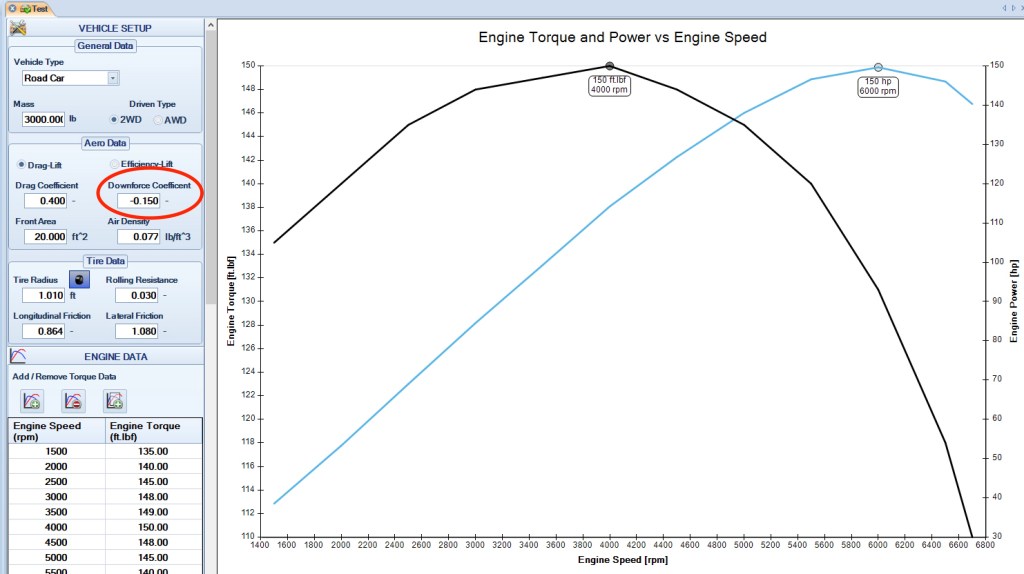
| OptimumLap uses a coefficient of downforce, not lift, and so if you are used to using negative numbers to represent downforce, invert them. Most passenger cars have around .15 positive lift, and so you’d enter -.15 in OptimumLap. |
Note that the lap times are not supposed to be 100% accurate, but the deltas are. In order to get accurate lap times, I need to factor in things like surface grip, camber, and other variables, which are time consuming. I’m really only interested in, is this faster than that, which I can get from OptimumLap without doing the corrections.
Next I’ll do a Batch Run simulation and sweep the Power Factor in 20 increments. This will allow me to see how the various lbs/hp ratios and lap times play out. I’ll run the batch simulations three times: once for the 300 TW, once for 200 TW, and once for Hoosier A7. It went like this:
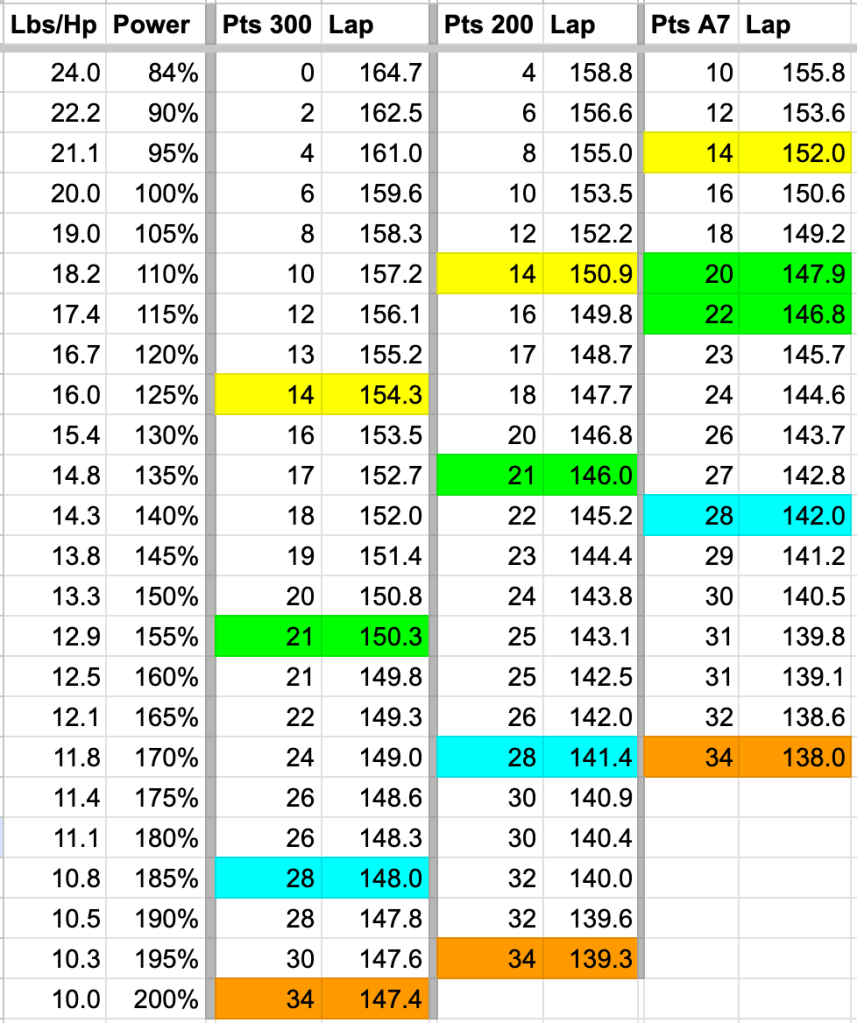
- SL4 (yellow) – Given 14 points to work with, the fastest lap is with 200 TW tires. It’s 3.4 seconds faster than the 300 TW, and 1.1 seconds faster than the Hoosiers.
- SL3 (green) – With 21 points to spend, the results are pretty much the same, and I’d want the 200 TW tire.
- SL2 (cyan) – Same deal with 28 points, but the Ho-hos are catching up.
- SL1 (orange) – With more points for power, I’d be smoking purple crack. The Hoosiers go 1.3 seconds faster than 200 TW.
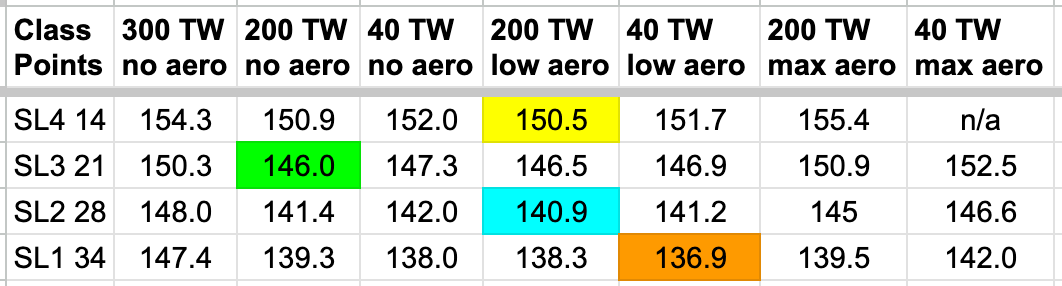
I haven’t factored in aero yet, but the trend is pretty obvious for SL4 and SL3: use 200 TW tires unless you have 34 points to work with. Next I’ll build a couple aero cars, but I don’t need to sweep all the values, just simulate builds that correspond to 14, 21, 28, and 34 points. Like so:

Which results in the following summary of classes and lap times.
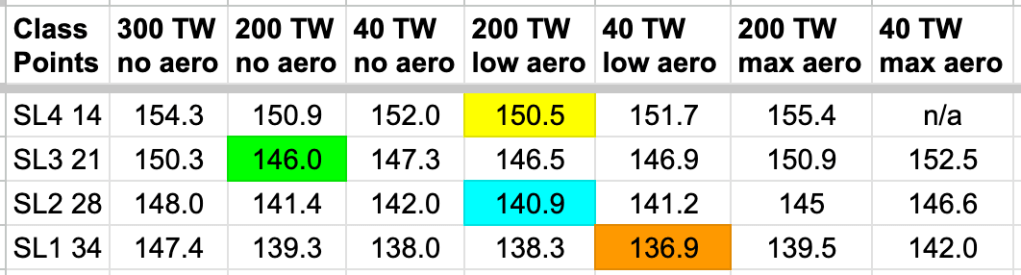
Given all of these simulations, here are the builds:
- SL4 – 19 lbs/hp with a 2″ splitter, 6″ spoiler, and a 225-width 200 TW tire on a 9″ wheel. This is probably a NA/NB Miata with a few bolt ons.
- SL3 – 15.5 lbs/hp with no aero, 225-width 200 TW tire on a 9″ wheel. There are a lot cars around this power-to-weight ratio, from ND1 Miatas to Mini Coopers to BMW E46s, etc.
- SL2 – 12 lbs/hp with a 2″ splitter and a 6″ spoiler. At this power level, you’re probably looking at a 245-width 200 TW tire on a 10″ wheel, and that would cost another point for tire width, so the car would be at 12.6 lbs/hp. No big deal. My Veloster N would go into this class, as would many faster cars.
- SL1 – Same car as above, but now on Hoosier A7s.
- SLU – A Corvette C8 (stock, as delivered) would go into the Unlimited class based on power-to-weight ratio and tire width. It would do about the same lap time as the SL3 car. This shows you just how imbalanced GT the FARA system is, and how building a car to the limit of the rules is a huge advantage.
Before I go, I guess you might be wondering why I specced a spoiler and 2″ splitter. Well, a single wing (499 sq-in MSHD) and a 4″ splitter would cost an additional 2 points. And while this would confer more aero benefit, I feel the results would be quite similar. I guess if you really want me to know the values, buy me a coffee and I’ll run those, or get OptimumLap (it’s free) and do them yourself.
Conclusion
The primary purpose of an amateur time trial series like FARA is to get like-minded enthusiasts together and have some fun. If the existing rules do that, then I’d call it a success. But if rules result in bad feelings and unfairness, then that’s not a success. However it shakes out, I really like FARA’s philosophy and general intent, and wish them and their competitors good luck.
If I was going to fix the rules, I’d do this:
- Reverse the weighting of points in the power-to-weight rubric so that it matches the real world of diminishing returns.
- Create a tire point system based on GRM letter grades. The best way to do that would be to runs hundreds of simulations; an easier way would be a straight scale: D = 0, C = 2, B = 4, A = 6, AA = 8, AAA = 10.
- Penalize points for tire width where vehicle weight is < 11 times tire width (wide tires) and give back points where vehicle weight is > 13 times tire width (skinny tires). Or, just ignore tire and wheel width altogether.
- Double the points for coilovers (2 points for 1-way, 4 points for 2+ way).
- Throw out the points modifiers for aftermarket brakes and gearing changes.
 Occam's Racer