How Many Tires Do I Need?

When I was racing Miatas, I had 32 wheels and tires. And probably another 8 tires unmounted. That was a lot of fucking tires.

Now that I’ve embarked on a new journey with a Veloster, it got me to thinking, how many wheels and tires do I need? One of the things that prompted this question was a steak knife.

Steak knife hole is no match for the tire sealant kit that comes with the VN.

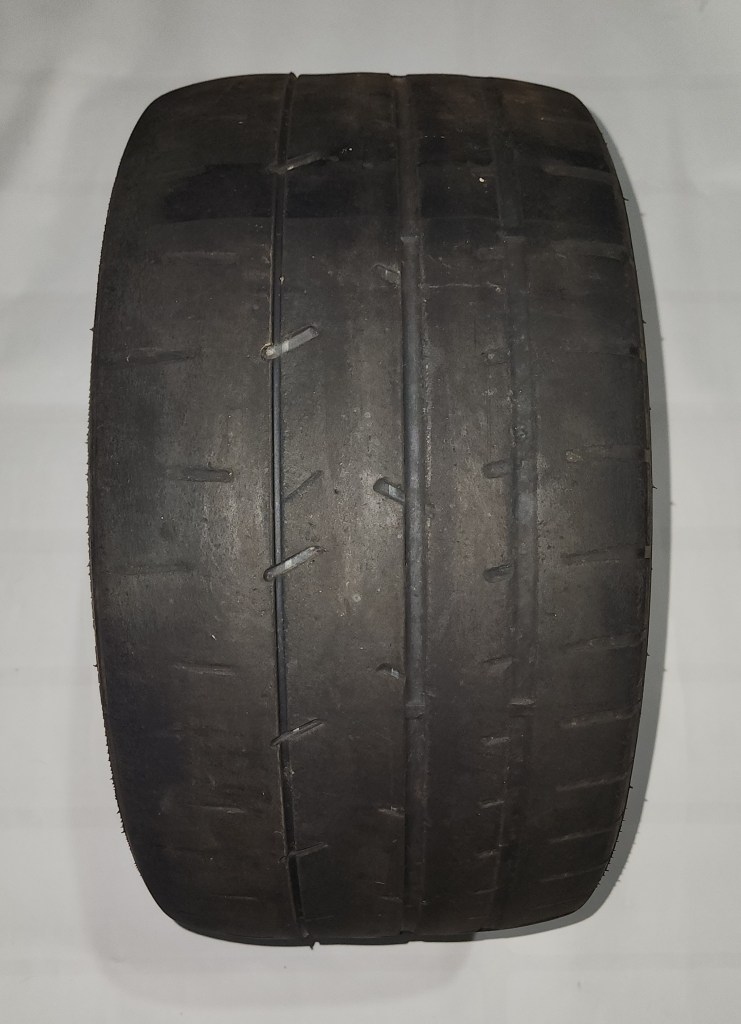
The tires had 16k miles on them, and if you look closely at the pic, you can see some cracking in the first groove on the right. So it was time to replace these anyway.

As it happened, the first tire I needed turned out to be a spare. The tire inflator and bottle of sealant that comes with the Veloster didn’t do shit for the knife wound, and I wasn’t going to be stranded on the road with three passengers again.

There’s a cavity in the trunk designed for a space-saver spare, but because of the big brakes on the VN, a normal spare won’t do. I’ve heard that a 18”compact spare from a Hyundai Genesis will work, but I didn’t find any locally or on Row 52. So I ordered one from Modern Spare, which is an alloy spare tire that has a nice modern look.
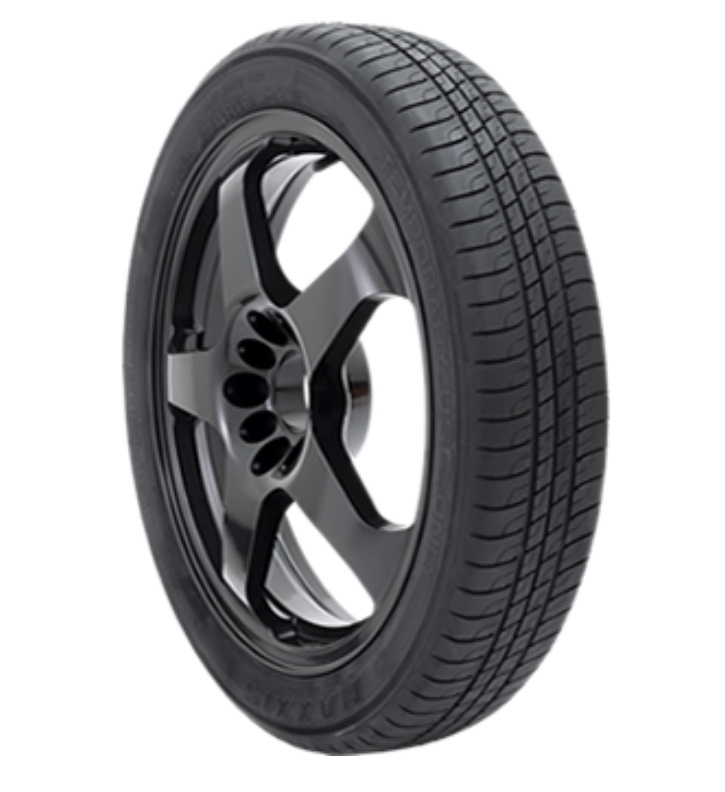
Modern Spare makes a good looking alloy space-saver, but it’s expensive.

With that necessity out of the way, I can get to the burning question of how many more tires I need.

If I had unlimited space and funds, I’d probably have six sets of tires. 1) slicks, 2) rains, 3) super 200, 4) enduro 200, 5) One-lap tire 6) snows. But I don’t have that kind of space or money, and so three sets of tires will have to do.

Enduro 200

This is my favorite class of tire, with good performance and great longevity. Enduro 200s aren’t super finicky about camber or pressure, and any street car can use these with great effect.

I’ve raced or tracked on 615K, 651, Z2, NT05, Sur4G, R1R, RT660, A052, VR1, and more. For a long time the Falken 615/615K/615K+ was my favorite tire, but the faster and longer lasting Hankook RS4 is the best of the enduro 200s. It’s not a Super 200, nor is it great in the rain, but it has great feedback and lasts forever. In fact, they usually age out before I wear them out.

And yet I bought Kumho V730s instead. Part of this was because the RS4s were $100 more per tire, but the other part is that I trust Andy Hollis. In the world of motorsports tire testing, he is The Man. Andy says the V730 has a good blend of durability and grip, and is slightly faster than RS4s, which is exactly what I’m looking for.

I don’t know why they are so cheap in 235/40-18, compared to other sizes, but Amazon was recently selling them for $127 with free shipping. They are back up to full price now, but still cheaper than RT615K+.

One Lap tire

By this I don’t mean a one-lap wonder tire, like a RE71 RS or A052, but a One Lap of America tire. If you aren’t familiar with this race, it’s 4K miles of street driving with drag racing, skid pad, autocross, and track driving mixed in. Competitors are allowed one spare tire, but otherwise must use the same set of tires the entire time. Over 80% of the field uses the Michelin PilotSport 4S.

The PS4S is the top of the heap in the UHP category, which includes other great 300-340 TW summer tires like the Continental ExtremeContact Sport. Another tire in this category is the Veloster’s OEM tire, the Pirelli PZ4.

Compared to the PS4S, the PZ4 is a little quieter and has less rolling resistance, but is a touch slower on a race track. Some online reviews say the PZ4 is a better rain tire, but it’s hard to believe based on the PS4S being typically the best in that category.

Anyway, I’d driven the PZ4s at Pineview and did a 1:18 in a stock Veloster, and so I can verify it’s a decent tire with easy handling traits. It’s a couple seconds behind a 200 TW, but if it’s as good on a wet track that people say they are, I’ll be happy. I coach at Watkins Glen regularly and it always seems to rain at least part of the day there. Every. Fucking. Time.

Between the PS4S, ECS and PZ4, it was a difficult decision. But again my wallet made the choice, because I found the Pirellis for $150, half the price of the Michelins.

All-season

All-season tires suck at everything. Some people call them no-seasons. Apt.

But I need a set of cheap tires to put on my OEM wheels, so I don’t wear out my summer tires on the road. And while I don’t intend to drive the Veloster in the snow, I need a tire that works OK when it’s cold out.

When it comes to all-seasons, I go for the cheapest ones. I don’t drive fast on the street, and crap tires are more fun to hoon around Pineview on. I found 235/35-19 Crosswind tires for $65. I’ve never heard of Crosswind, but they have a lot of great online reviews and I got all four tires for the price of one premium 200 TW.

I don’t know if the 235 Crosswind is narrow for its size or if the 235 PZ4 runs wider than normal, but you can see there’s a big difference in the width of the tire.

How the tires stack up: 235/35-19 on 8” is the narrowest. Of the two 235/40-18 tires, the PZ4 are wider than the V730. Stacks have exactly 1 1/4” between each: 36 7/8”, 38 1/8”, 39 3/8”.

Wheels

The OEM wheels are 19×8 +55 and weigh 29 lbs. They look OK to my eye, but I don’t love them for the weight, or for the price of 19” tires. I have no use for them, other than shitty all-season tires.

The Veloster can’t fit wide aftermarket wheels, so most people choose a 18×8.5 wheel with a +45 offset. I believe a 18×9 +42 would fit with mild camber and fender rolling, but there are very few lightweight wheels in this size (Enkei PF01, Konig Rennform, Braid FF). I’m not a cone dodger, but I believe the D-Street folks are using 18×8 +50, which also seems like a good size for a dedicated snow tire.

Side note: The Veloster’s closest competition is the Civic Type R, which rides on 265 tires on 9.5” wheels. Most comparison tests have these two cars lapping very closely, but if you could put the Civic’s wheels and tires on the Veloster, I’m pretty sure the VN would be on top every time.

For my track tires, I bought 18×8.5 +43 Konig Countergrams from Fitment Industries. I always wanted these 9-spoke wheels on my Miata, and I like them a lot on my VN. At 18.7 lbs each, they remove 40 lbs of rotating mass.
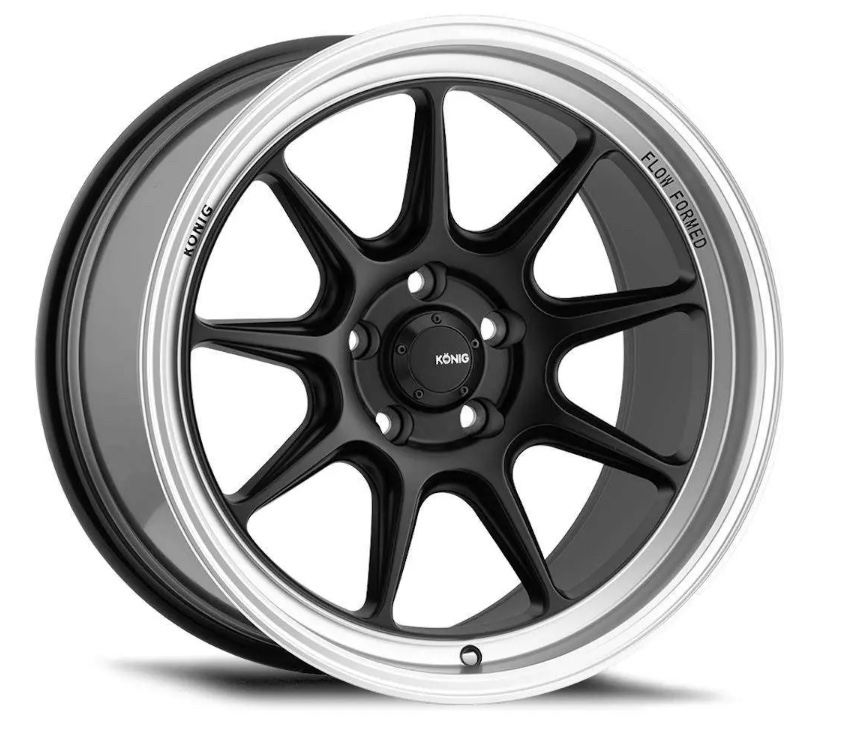
Countergram is a good looking, lightweight wheel.

My One Lap PZ4 tires are on 18×8.5 +45 Motegi MR140 wheels I got from Phil’s Tire. They weigh under 19 lbs, and were a bargain at $165 shipped.

Spartan 10-spoke design at a great price.

This is now the second time I’ve mentioned One Lap of America. A seed has been planted.
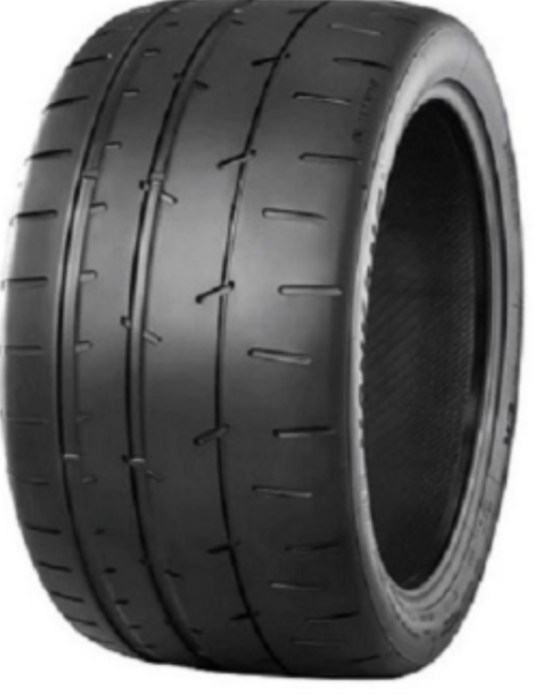
Tire Test: Vitour Tempesta P1 vs Nankang CR-S V1

Shortcut: go to https://vitourp1.com/ to order these tires.

I heard through the grapevine that there was a new 200 TW tire, and after doing some internet sleuthing, I met Sammy Valafar, who was instrumental in bringing the Vitour P1 tires stateside and doing the testing.

If you’re a Miata person, you might have heard of Sammy. He used to race Spec Miatas and was NASA national champion at one point. Recently he’s turned his attention towards the Optima Battery Ultimate Street Car time trials series, and autocross. The following video has some details on the test:

I asked Sammy for more information on the test, and he generously supplied me with a detailed report, spreadsheet and various conclusions. I wanted to look at the raw data myself, and so he sent me the Aim Solo data as well. What follows is a third-person look at all that data.

Testing details

  • Venue: The test was performed on December 17th, 2022 in Lot 6 at Autoclub Speedway, in Fontana, California. The tires were tested back-to-back with very little time between runs. I feel pretty confident that track conditions were not a factor here.
  • Vehicle: 2002 Mazda Miata making approximately 150 HP at the wheels. Xida Gen 2 single-adjustable coilovers and pillowball suspension bushings.
  • Drivers: Sammy Valafar and Tommy Maresca.
  • Wheels: Both sets of tires were on Konig Countergram wheels, 15×9 +35.

Tires

Nankang CRS 225/45R15 V1: Sammy and Tommy have both won races and championships on this tire, so they know it very well. The tire and wheel package weighed 34 lbs 13 oz.

Nankang CRS

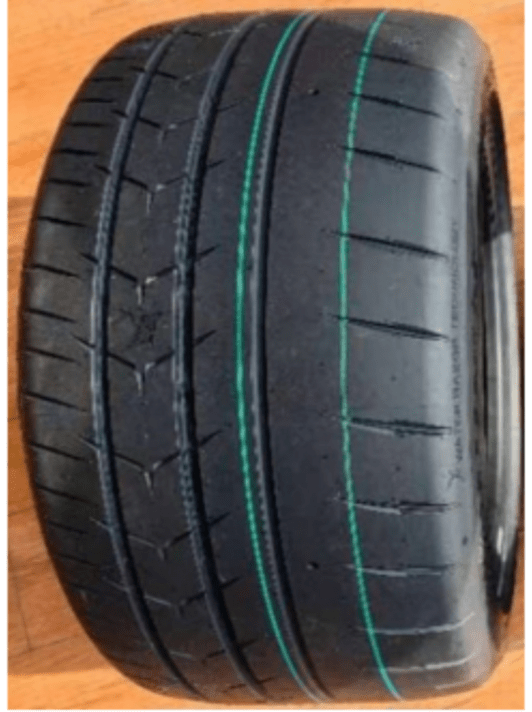
Vitour Tempesta P1 225/40R15: Note the shorter sidewall. Theoretically this could help with acceleration (shorter final drive) and should have less sidewall flex when cornering. At 32 lbs, 9 oz mounted up, it’s two pounds four ounces lighter than the CR-S. Wow.

Vitour P1

Testing data

Race Studio is great for visualizing data, but when you want to compare actual numbers, I like to use a spreadsheet. I download all the data as CSV files so I can normalize the spikes and dips in the Aim data. The spreadsheet also allows me to do math functions, which I used for the following fields.

  • Peak lateral Gs – I see a lot of people citing peak lateral Gs as if it’s meaningful data, but it really isn’t. If you look at GPS data, it’s full of peaks and valleys; you might see a peak value of 1.72g followed immediately by 1.19g dip. This is clearly not what’s happening in the real world. Peak lateral Gs is only useful if there’s a smoothing function in the device or in post processing. My method of smoothing peak lateral Gs is to take the highest reported Gs that occur within a half second interval, and average them.
  • Average lateral Gs – This is a better way of looking at the lateral loads on a tire. I look at where a corner begins and ends, and then average all the values in between. Because different people drive the same corner differently, I don’t use a point on track to determine where a corner begins or ends, I use when lateral Gs exceed .6 G. (I change this value depending on the track and corner, but this a good value for this autocross track.)
  • Gsum – Because tires are often mixing braking or acceleration in the corner, I’ve also included a value for Gsum, which takes the absolute value of both lateral and longitudinal Gs and adds them together. This only returns a high value if the driver is blending inputs, though.
  • Min corner speed – This value isn’t a great indicator of tire performance, because it has a lot to do with driving style. Personally, I carry more corner speed, whereas my brother has more of a point and shoot style. We might be the same speed on any given day, but my min speeds would be higher on the same tire, and so it’s not the most important aspect, but I included it because I see the same thing here with Sammy’s and Tommy’s driving styles.
  • Average corner speed – In the same manner that I find average lateral Gs (CSV > spreadsheet), I find the average corner speed. This turned out to be pretty important.
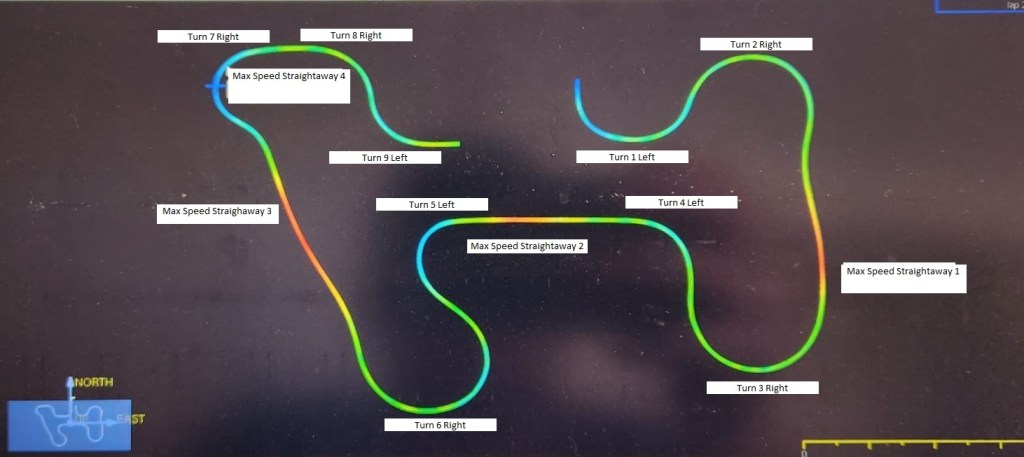
  • Straight speed – There are four straights on the course, and top speed is recorded for each.

Track and sectors

The test course has 9 turns and 4 straights for a total of 3100′ long, with a lap time under a minute. If you look at the default track map in Race Studio, it uses a 14-sector track map, which I don’t find very useful. If you divide a track into that many sectors, you can get a driving line that’s simply impossible to replicate in real life.

Autocross course

I like to look at sector times, so that I can throw out driver mistakes and calculate the theoretical best lap. So I created a custom map that divides the track into just four sectors. This is a more realistic view of what the tire and driver are capable of in an optimal lap, and a good way of organizing the report by sector.

  • Sector 1 begins with a standing start, so the first left hander isn’t at full speed or full lateral Gs, and there’s more long-G acceleration in it. The left transitions immediately into a 180-degree right, followed by a short straight.
  • Sector 2 is a 180-right followed by a 90-left, with a longer straight.
  • Sector 3 is an over-90 left followed by an over-180 right, ending in the longest straight.
  • Sector 4 starts with a kink left into two 90-rights right and a short 90-left at the end.

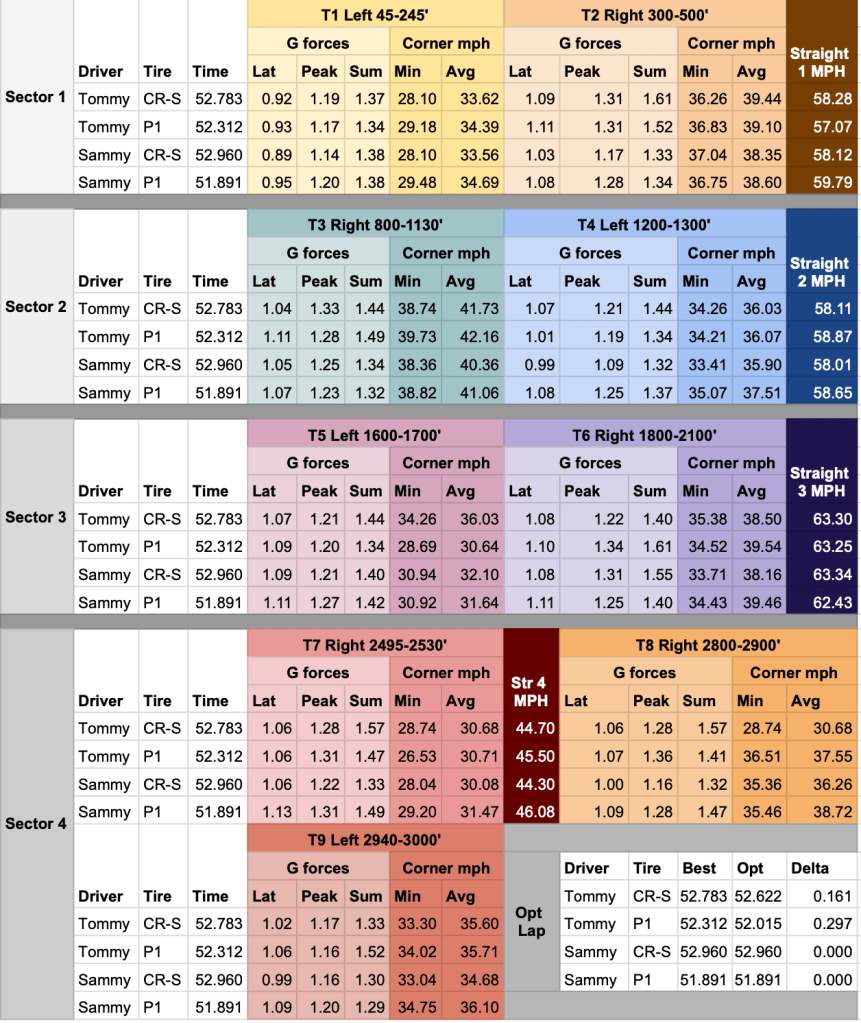
I color-coded the summary data to make it easier to read, but it’s still a mess of information that may give you a headache.

Test results CR-S vs P1.

Conclusions

What we are looking at here is simply data, and what the data says is the Vitour P1 is faster than the Nankang CR-S. I’ve only shown the best laps from each driver, but each driver did four laps on each tire, and so I was able to normalize the data somewhat, and also get theoretical best laps (the Opt Lap part at the end).

What the data doesn’t capture are the nuances. Drivers may prefer one tire over another based on feel, sound, breakaway characteristics, or other variables that aren’t easily captured in GPS data. And drivers may put down more consistent times on one tire, and choose that over an outright faster time.

But however you slice it, I think the most telling factor in this tire test is that both Sammy and Tommy have lots of experience on the Nankang CRS, and have won races and championships on it. And yet they both went faster on the Vitour P1 the very first time they tried it, and they did so consistently.

Back in January 2024 when I last updated this article, there was a big hubbub about whether or not the P1 would be legal for SCCA competition. Apparently the tire was banned for not having enough sizes. I don’t race with the SCCA, so it doesn’t much matter to me. As a Miata guy, I’m glad to see Vitour offering big-boy 285 and 305 widths in 15″ wheel sizes, and it would be nice to see some other manufacturers do the same.

Update for 2025 – The tires are legal for SCCA racing, go get you some at VitourP1.com.

Tire Testing Accelera 651 Sport

If I was going to pick one tire to use for everything, I’d use the Hankook RS4. It’s not the fastest, but it’s fast enough, decent in the rain, has great feedback, lasts forever, and is available in three 15” Miata sizes. The 195 is really a 205 width, and a good choice for Miatas on stock power and skinny wheels. The 225 is an ideal choice for most upgraded Miatas on 8-9″ wheels. The 245 is good for tight courses and for more powerful cars on 9-10″ wheels. This is my favorite tire and I see no reason to do HPDEs or endurance race on anything else.

And yet… I keep buying different tires! Some of this is wanderlust, to just see what else is out there. Some of this is bargain hunting: I got Yokohama S.Drives on closeout and was out the door for $200 mounted and balanced; I bought 225 Maxxis RC1s on closeout for $108 each, with free shipping; I’ve bought Douglas all-season tires for $36 for sliding around and training. And then I’ll stumble across cheap take-off slicks that are priced so well that I don’t have a choice.

Tire testing is a hobby, but also something of a responsibility. I wrote the rules for the Pineview Challenge Cup, and I rank every tire individually. Some of that ranking comes from online tire reviews, but a lot comes from my personal testing. The primary way I evaluate tires is to look at the lateral Gs in Turn 2 at Pineview Run, a long right hander.

Turn 2 for tire testing

I export the data to a CSV file, and then average the lateral Gs through 200 feet of that corner. This removes the peaks and valleys from the 10hz GPS data, and also idiosyncrasies of driving style and line, and gives me a solid number I can use to compare to other tires.

Tires that I have personally tested and have the lateral G data for are the following: Achilles ATR Sport 2, BFG Rival 1.5 S, Bridgestone RE71R, Champiro SX2, Continental ECS, Douglas all-season, Dunlop DZ102, Falken 615K+ and RT660, Hankook RS4 and Z214, Hoosier A7, R7, and SM7, Maxxis RC1 and VR1, Nexen N’Fera Sur4G, Nitto NT01, Pirelli PZero PZ4, Toyo RR, and Yokohama S.Drive. I’m sure I’m forgetting some, but you get the idea. I often put one of my Aim Solos in other people’s cars, and the list of tires that I have data for, but didn’t personally drive, is about twice that many.

I don’t know of anyone else who has such an extensive database of tire grip, but then I wouldn’t expect to! It takes a lot of time, money, and effort to gather and collate this data, so this is the kind of thing one keeps to themselves. Or at least it’s not something that’s shared with other people without some means of compensation.

Tire Test: Accelera 651 Sport

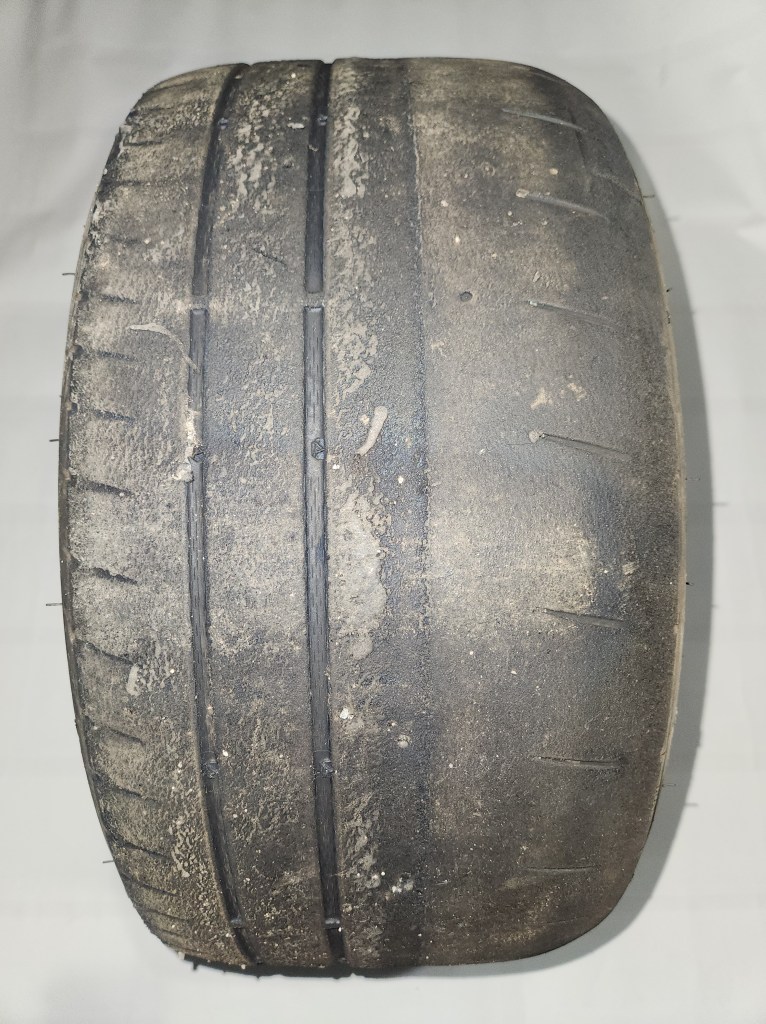
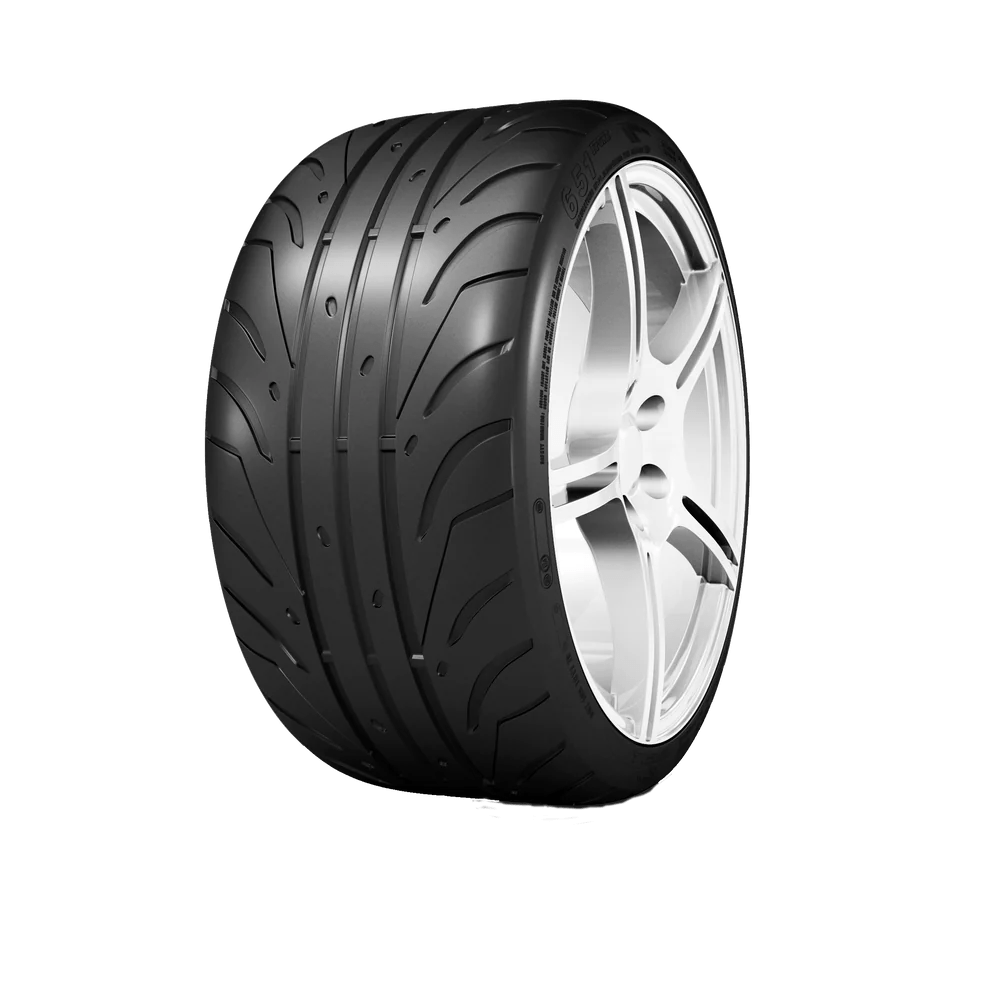
I recently tested the Accelera 651 Sport, and I’m not shy about sharing this data, because it’s not a competition tire. Most of the people using this tire are drifting, and even though the treadwear carries a 200 UTQG rating, this is a mid-300 TW tire, grip wise. The tread pattern also has three center grooves, which is something you see on 300 TW tires and not 200.

I’ve raced on the 651 Sport previously, but in a Honda minivan, in a 24 Hours of Lemons race. That car is brutal on front tires, and we destroyed them quickly; I didn’t feel it was a fair test of this tire. You can read that report over here, but the gist of it is that the 651s were fast in a straight line, but lacked cornering grip compared to the N Fera Sur4G.

The reason I hadn’t previously tested the 651s on a Miata is because Accelera only made them in a 195 width. Given that these tires run narrow to begin with, I wasn’t interested. But starting this summer Accelera started offering the two most popular Miata sizes: 205/50-15 and 225/45-15. I ordered a set of 225s as soon as I’d heard about them.

I had the tires mounted at Shade Tree Auto, my favorite car mechanics in Ithaca. Jack, the owner, races in Champcar, and his team regularly kicks my team’s ass, and so I know that he knows what he’s doing. Jack did my alignment at the same time, and when he was finished called me to report something very strange going on. The car pulled to the right on acceleration. He knew it wasn’t the alignment, and suspect diff bushings, a worn out Torsen, or something else in the drivetrain.

I picked up the car, drove it home, and noticed the same thing. On the gas, and on the brakes, the car would veer to the right. At 80 mph and on the gas, the car felt unsafe.

I really didn’t want to take my rear end apart, but I had to see what was going on. When I pulled the tires off, I set them up against the wall instead of stacking them on top of each other, as usual. I don’t know why I even looked, but I noticed they were different heights. Two of the tires were about 1/4” taller than two others, weird. I installed two of the tires with the tread facing backwards, so that I could get the same size diameters on the front and rear, and viola, the on-throttle steering returned to neutral!

I got two tires flipped on the rim so that my tread pattern is all going the same way now, and now as long as I run the larger ones on the rear (or front), the car tracks perfectly. I contacted the tire importer Tire Streets to tell them about this, and they rectified the situation with a new set of tires. They didn’t have the 225s in stock, so I got 205s instead, but in the 100 TW compound instead of 200. A+ for customer service, even if it did take several pictures and measurements before they believed me. The replacement tires are in a heated basement waiting for next year and another tire test.

I had no idea that 1/4” in diameter would have this kind of effect. I posted about this on the HPDRE group on Facebook and found that other people have had similar problems with different brands of tires, even well known name brands! FWIW, three of the tires all had the same date codes, one was different, but two of them measured undersized.

If I can pass along this one piece of knowledge – measure the diameter of your tires – and keep someone else from disassembling their car looking for answers, then my work is done here.

When mounted on 15×8 wheels, a stack of four 225 Acceleras measured exactly the same height as a stack of 225 Maxxis RC1s. The 651s I drove on the minivan were narrower by comparison, and so perhaps new Accelera sizing is more in line with other tires now?

My initial plan was to use these tires in a Lemons race, but that plan when to shit, quite literally. My first chance to test the tires was at the final Pineview Challenge Cup race. I hadn’t driven in 14 weeks because of Lyme disease, and was still not feeling 100%, but I figured that getting back on track might kickstart my system.

My first few laps with the tires were tentative, and I initially thought the 651s might be similar to all-seasons. But I think it was just cobwebs, since I got better and better as the day went on. The time trial race is just three laps per session, one warm up, and then two hot laps.

In my first run I barely broke a 1:20. My second run I did a low 19, and started feeling more myself. In the final run I did a 1:18.6, and that felt like a pretty good lap. I initially set the tires to 28 psi cold, but after checking the pyrometer, added 4 psi all around to bring the center of the tire up, and that helped lap times as well.

The tires felt really good, with great audible feedback and predictable breakaway. They are a little vague on turn in, but are responsive to mid-corner steering and throttle inputs. I was a little disappointed in the lap times, being 1 second off the time I set using Continental ExtremeContact Sport (ECS). But like I said, I’ve been out practice for a bit, and I’m comparing to a different day, with different conditions.

So let’s look at the data. The following image is lateral Gs comparing four laps on Conti ECS (red) vs four laps on Accelera 651 Sport (blue).

Lateral Gs – 651 (blue) vs ECS (red)
  • A – This is Turn 2, where I do most of my lateral G data gathering. If I went by peak lateral Gs, then the 651s would win, and this is why I average the Gs over 200′ of distance
  • B – This is a right/left going down the hill, and it’s not a peak G corner, but it’s a good measure of driver confidence. On average, the ECS are giving me a bit more confidence.
  • C – This is T11, also called the Knuckle, a long left hander. You can see red and blue overlap quite a bit here, and lateral Gs are just about the same.
  • D – This is the Blind Hairpin, a cambered 180 with a downhill braking zone that requires a lot of turn-in confidence. In this section, the Conti ECS has more grip.
  • F – This is the S-trap, a super tight right-left switchback that loads the tires a lot. Again, a very slight advantage to the ECS.

Now this wasn’t a back-to-back comparison; track conditions were different both days. The wheels were different as well. The 205/50-15 Contis were mounted on 15×6.5 wheels, while the 225/40-15 Acceleras were mounted on 15x8s. If the Conti was available in a 225, and it was on a 8″ wheel, I think the Conti would be a clear winner, but as it is, there’s not much to choose between them.

While I haven’t tested the Accelera 651 Sport for longevity, they are so similar to the Conti ECS I bet they are the same in that way as well. Like the ECS and many other 300 TW tires, the 651s have three center grooves, and I would guess they make a good rain tire.

All in all, I think the Accelera 651 Sport is a solid alternative to the Continental ECS, Firestone Firehawk Indy 500, Michelin Pilot SuperSport, PS4S, and other 300-340 TW tires. The 651s are a step above the older 300 TW summer tires like Yokohama S.Drives, which Miata people generally liked.

Accelera should really be rating these as 300TW. Compared to other 200TW tires, the 651 Sports are at least a second per mile slower than even a mid-range 200TW, like the RS4. Against a A052, it’s not even close. If Accelera stamped the 651 Sport as a 300TW, and the Sport Xtra as a 200TW, nobody would bat an eye, and people might actually start racing competitively on them. At the same time, they should change the tread pattern on the Xtras, there should be only two center grooves for a larger contact patch and less tread squirm.

Until those updates are made (never?), I guess it all comes down to this: for those situations when I don’t care about lap times, and just want a playful and responsive tire with great feedback, I would be happy to drive these tires all the time. I’ll even go on board to say they are my second favorite tire right now.

Accelera tires are imported by Tire Streets, and have a unique 30-day money-back guarantee. They are priced well, and are a bargain in the larger sizes. I plan to use up this set as a dual-duty tire, and then mount the Accelera 651 Sport Xtra tires I got in exchange. These carry a 100 UTQG rating, but based on the 200 TW 651 Sport being more like a 300 TW, I’m betting the Sport Xtra 100 TW is more like an actual 200 TW. But I’ll only know that after I flog them through Turn 2.