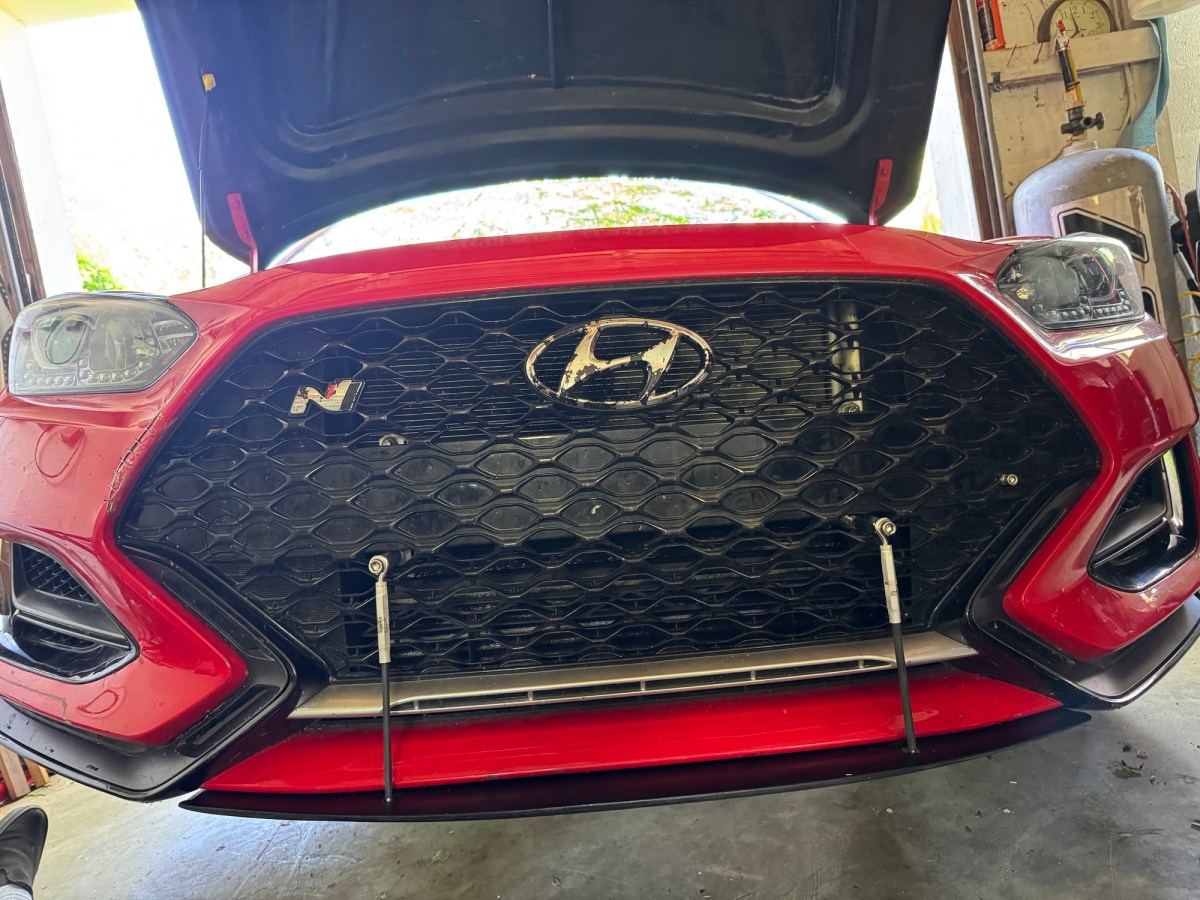
In this post I show you a small splitter I made for my Veloster N. It’s about the size of your typical aftermarket front lip, but it’s much better performing, because it leverages all of the wind tunnel work I’ve done.
If you’ve read my wind tunnel reports, you know that 9 Lives Racing splitter diffusers on a Miata made only made about 8 lbs of downforce at 100 mph. This is pretty underwhelming, but they also don’t have a lot of area. Meanwhile, curving the entire trailing edge of the splitter upwards (essentially making a splitter diffuser across the full width of the car) made 150% more downforce (added 60+ lbs) on my Veloster. And so those are the numbers behind why I have a 36” wide central diffuser in my undertray, and not skinny little ramps in the wheel wells.

I chose to make the splitter quite small, it measures just 36” wide, so that it fits between the two big black chunks of plastic on either side. The splitter is also very short, only 2” lip maximum, and the sides taper back to follow the lines of the body. Area-wise, this is definitely the world’s smallest splitter.

You might wonder why I chose such a small splitter lip. My recent experiments with rear aero have shown that my car goes faster and faster with more rear downforce. So if I were to use a big splitter, I might need a 70” wing to balance that out. Maybe a double wing.
I don’t want to do that because this is a dual duty car, primarily for coaching and DEs. I don’t use the car for any kind of competitions, and so it’s more important that I don’t ground out the lip on driveways, or hit logs at my mom’s house! I also want the car to look cool, and I don’t like huge wings on a street car, but that’s just an aesthetic thing.

The splitter fits in between the undertray and the middle fascia. There’s quite a gap here, and so I tripled the thickness of the leading edge to 3/4”.
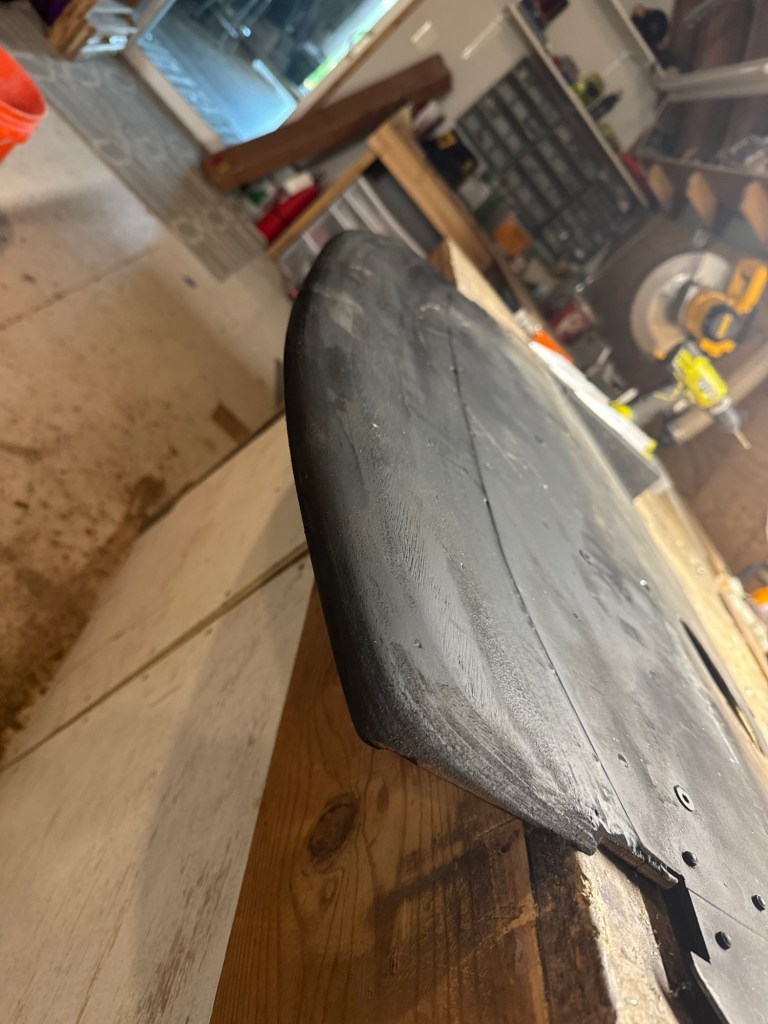
It’s easy to add extra thickness to a splitter and round it over, and with that you get better flow attachment. I don’t know why I don’t see more people doing this. Also worth noting, the big roundover made the splitter about a pound lighter!

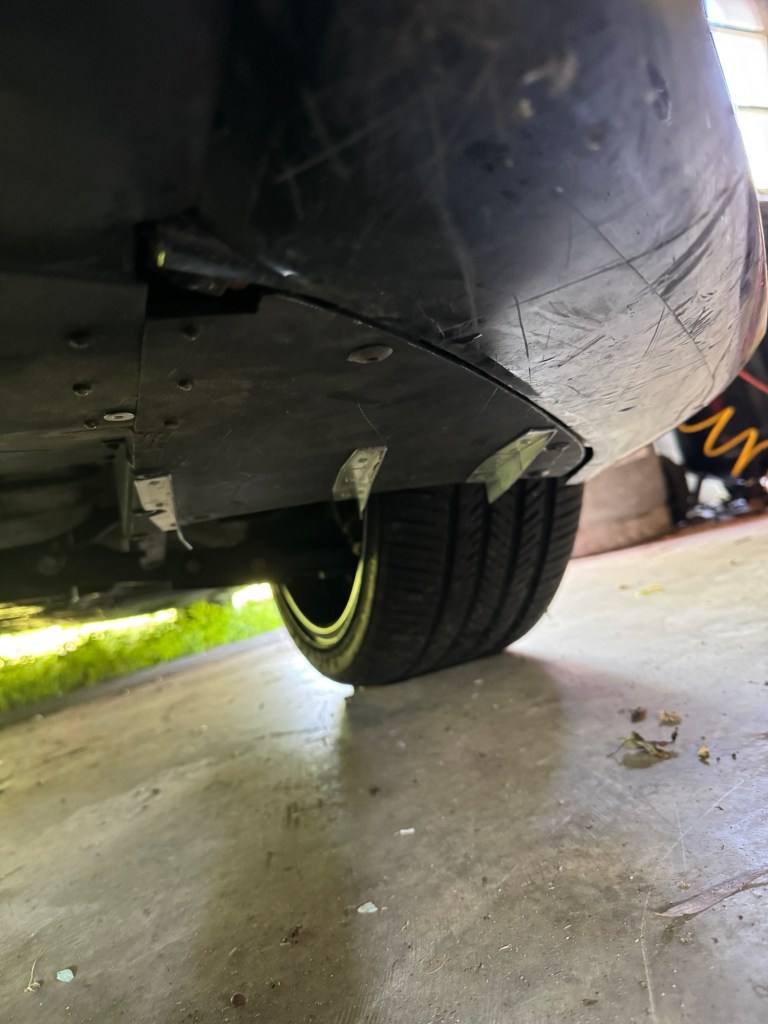
I also decided to add some vortex strakes to send air sideways. Typically these go directly in front of the tire, which reduces tire squirt. But because my undertray is narrower than a full-width splitter, only the outermost strake lines up with a tire. The other two strakes should direct more air to the brakes.
To mount the splitter and undertray I use speed clips through various parts of the fascia, long bolts to the radiator bottom (where the OE undertray mounts to), and splitter rods in front. The splitter rods mount to the bumper beam using U-bolts and other hardware from the Lowe’s racing department. All of the metal parts to mount the splitter are less than $50.
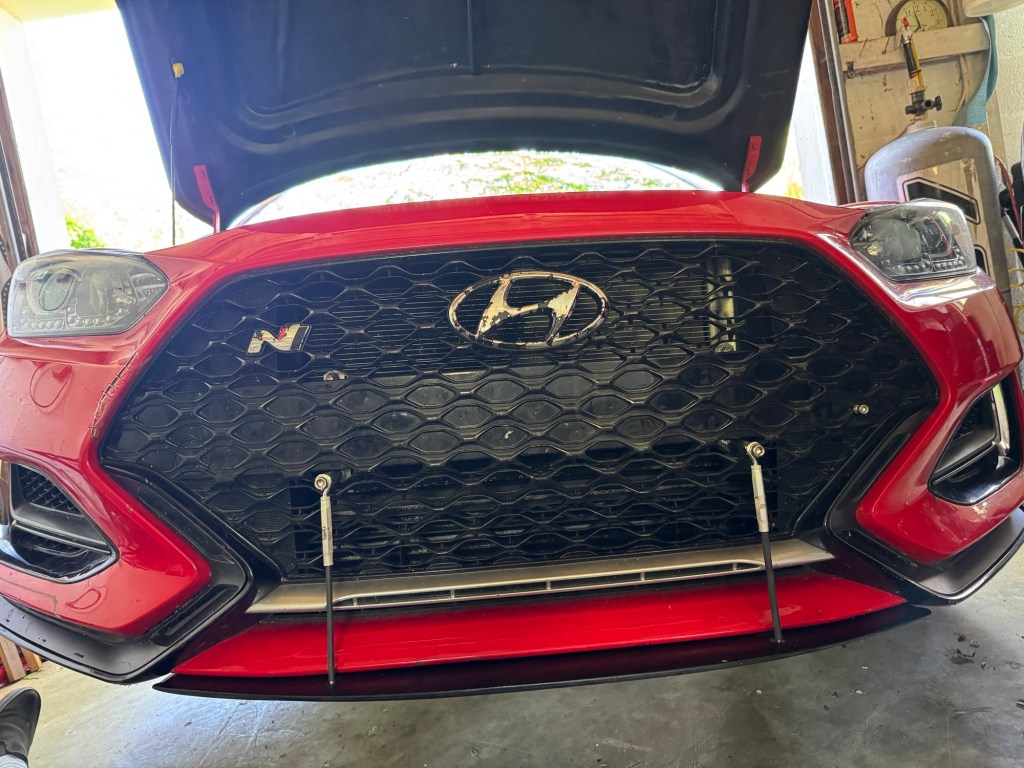
The splitter is meant to be set for maximum ground clearance, so that it’s flush with the underbody. But the turnbuckles allow me to add some rake, and I could angle it down a few degrees if I want to. But like I said, this is mostly a street car and ground clearance is important, so I’ll keep it flush most of the time.
All said and done it weighs 11 lbs, and is built way stronger than necessary. But it makes the whole front end more rigid, and ties everything together nicely. The front fascia used to flex quite a bit if I pushed in on it with my foot, and now it’s much more solid.

Which brings me to the final step, which has nothing to do with fixing my mishap, but something I’ve been meaning to do for a while: add canards. I’ve tested canards in the wind tunnel on a couple occasions, and while I liked the results, the front fascia felt a little too flexible for my tastes (the bottom canard would flex downward at speed) and so I never used them on track.
I have two sets of canards, some commercial products from Verus and DIY ones I made. In the wind tunnel, the CFD-designed Verus canards made only 15 lbs of front downforce at 100 mph, compared to the 85 lbs my canards made. However, my canards were pretty draggy and the Verus ones had zero effect on drag or rear downforce. So I figured I’ll mount the Verus ones permanently, and make mine removable, and use them only when I’m at the track.
Note that the reason my canards made more downforce (and drag) is simply the location. In all of the wind tunnel data I’ve accrued, the bottom canard does the work, and the upper canard helps reduce the drag in the entire system. It’s important to get the bottom canard as low down as possible; mine go on the ridge of red plastic, at the bottom of the bumper fascia. (See more in my blog post on canards for more details.)

How much downforce will these changes make? I’ve optimized the splitter in several ways, but it’s too high for there to be much ground effect, and the splitter lip itself is rather short. Let’s call it 50-60 lbs of downforce at 100 mph, plus maybe 110-120 lbs for the canards and hood vent. Both of those items help with splitter extraction, so they go hand-in-hand.
Around 170 lbs of downforce at 100 mph is about the same as my 12-degree full-curve splitter made alone (without canard or hood vent), which I felt was pretty decent. However, the bottom canards are doing half the work, and they are draggy sumbitches. At a slow track like Pineview, I’ll surely use the lower canards, but I’ll have to A/B test them at Watkins Glen before knowing if they are beneficial at a fast track.
This was a good stopping place for the day, and I think I earned myself a cold one (Best Day Brewing N/A West Coast IPA.)
 Occam's Racer