A lot of people say that putting a spoiler or wing on a FWD car is stupid. Downforce shifts the weight balance rearward, and that takes away grip from the front, where you need it for acceleration and turning. There is some logic to this thinking.
Tire grip is roughly equivalent to the amount of weight on the tires, and when you add downforce on one end of the car, it changes the balance of grip. For example, let’s take a RWD car that weighs 3000 lbs and has a 50/50 weight balance. If I add 125 lbs of rear downforce at 80 mph, now there’s 1500 lbs on the front tires and 1625 lbs on the rear. At speed, that’s 108% more grip on the rear, and the balance of traction is now 48/52, biased towards the rear.
The result of that shift in traction should result in better longitudinal Gs, meaning better acceleration and braking. However, lateral Gs may suffer slightly, and the car would be more prone to understeering in the middle of the corner.
Now let’s take a FWD car that also weighs 3000 lbs and has a 66.7/33.3 weight balance. That means it has 2000 lbs on the front axle, and 1000 lbs on the rear. Adding the same 125 lbs of rear downforce makes 1125 lbs on the rear, which results in about 112% rear grip at speed. So you can see that adding rear downforce on a FWD car changes the balance of grip quite a lot.
Just like RWD, longitudinal grip should increase when braking in a FWD car, by utilizing the rear tires more effectively. However, the opposite is true when accelerating, and I’d expect to see lower long-G at speed as the weight shifts away from the drive wheels. It’s likely that the same scenario plays out in a corner, with too much weight shifted rearwards; since most FWD cars push already, adding understeer likely makes the situation worse.
Theoretically and mathematically, adding rear downforce on a FWD car, without offsetting that with about twice as much front downforce, sounds like a recipe for going slower. Right?
Fuck math
Let’s throw all of those calculations out the window and see what actually happens when you put rear downforce on a FWD car. For this practical application I’m using my Hyundai Veloster N, and driving it at a fairly low-speed race track, Pineview Run.
I tested four rear aero options:
- N wing – The N model came with a large chunk of plastic that is someone’s stylized idea of what a wing should look like. It doesn’t really have an airfoil shape, but let’s call it a wing since air goes underneath it, as well as over the top. In the wind tunnel it made 27.3 lbs of rear downforce and 3.5 lbs of front downforce at 100 mph.
- Ducktail – I tested a DIY ducktail spoiler in the wind tunnel, and it made over 140 lbs of downforce, but also a ton of drag. I felt it was too tall, and cut it lower. I don’t have wind tunnel data for the shorter version, but I’ll throw out a guess and say it makes 100 lbs of rear downforce and a couple pounds on the front.
- Single-element wing – This is a DIY 54″x11″ S1223 wing with a small Gurney flap. I’ve tested it in the A2 wind tunnel and it made 113 lbs of rear downforce, but unlike the spoilers, it lost a little front downforce through leverage. The wing is located further rearwards and doesn’t aggregate high pressure on the roof, so the rear downforce gains are offset by front downforce losses; this is normal for all wings.
- Dual-element wing – The above wing, but with a 4.7″ chord wing set at 30 degrees above the main wing. I didn’t test this in the wind tunnel, and I don’t have a good guess on downforce or drag, but it’s more of both.
N wing vs Ducktail
Take a look at the following speed trace, which shows the OEM wing vs the DIY ducktail spoiler. I started the session using the ducktail and after setting a decent lap, I quickly pitted, removed the ducktail, and replaced it with the N wing. This took about a minute, and I got right back out again and set a few more laps. The lap with the ducktail is blue, and the red lines are the N wing.
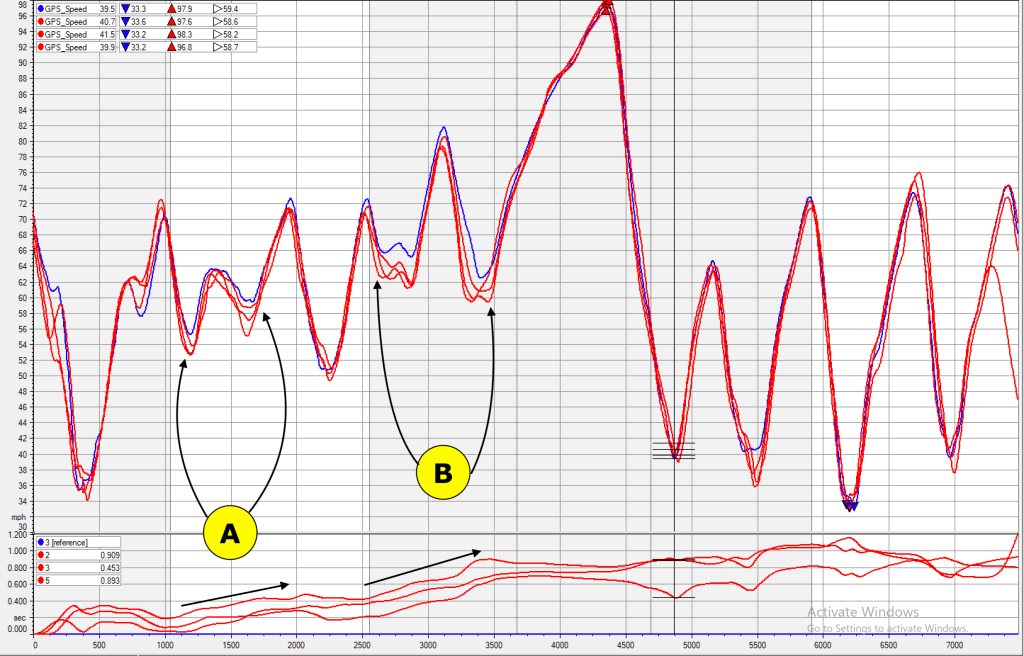
A – The first significant difference is a pair of left hand turns. You can see the blue line has a higher minimum speed in both of them, and results in a slightly faster top speed on the next straight.
B – These are two fast right handers, and again you can see there’s a significant difference in the minimum corner speed. On the following straight, the top speed ends up being the same, but on a longer straight, it’s likely the ducktail would slow down from drag. At this point in the lap, the ducktail has about a .7 second advantage, but over the rest of the lap where the corners are slower, there’s no difference.
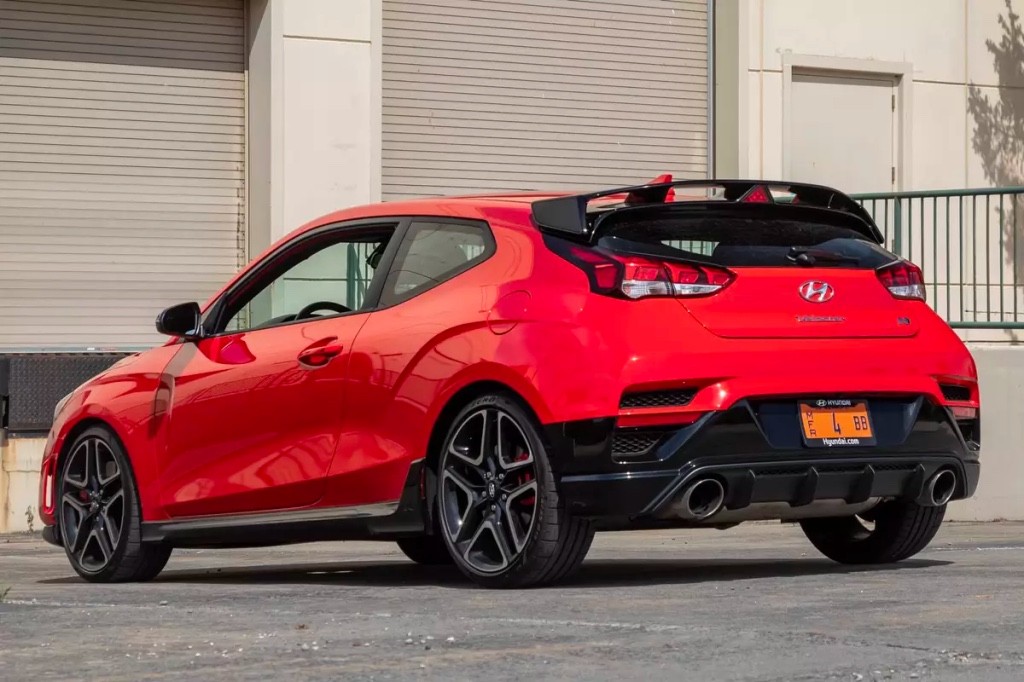
Subjectively, I could tell the difference between the two rear aero devices. With the N wing, the car suddenly felt more lively, and the rear end moved around. This translated to more fun, but a slower lap time.

Ducktail vs single wing
Next I tried the ducktail vs the single wing, and they set nearly the same lap times. In the following speed trace, the ducktail is red, and the single wing is blue.

A – The long left-hand sweeper is pretty much the only place where the wing has an advantage over the ducktail, keeping a higher speed throughout.
B – The spoiler makes it easier to back up the corner, and I’m at full throttle earlier than when I use the wing.
C – Again, I back up the corner slightly better with the spoiler. It might be that the additional drag is helping me slow the car and get it turned earlier, but that’s just conjecture.

Subjectively, I couldn’t tell the difference between ducktail and wing. The wing was ultimately about .1 seconds faster, but I didn’t set enough laps to make that statistically accurate, and I’d call it a wash.
Ducktail vs double wing
Again I used the ducktail spoiler as the baseline aero, comparing the double wing to it. Since the single wing and ducktail were quite similar in performance, you could also say this is a single wing vs double wing test.
For this one I’m showing three laps from each, and I’ve also included lateral Gs, because there’s some additional interesting data points here. The ducktail is again red, and the double wing is in blue.

A – This is the long left where aero makes a difference, and you can see the blue lines in the upper graph are lower, indicating more lateral Gs. In the speed trace, you can see the difference is a couple mph.
B – What’s interesting here is that the lateral Gs at this spot are the same, but the vMin is higher for the blue line. Perhaps this means I have increased confidence in this corner, despite the same Gs?
C – The higher vMin in the previous corner allows me to consistently get to a higher speed.
D – The back straight is the only section where the ducktail is faster, and it’s entirely due to having less drag. You can clearly see the advantage in top speed.
E – Here the dual-element wing allows me to brake a little later, and that also results in a little time gained.
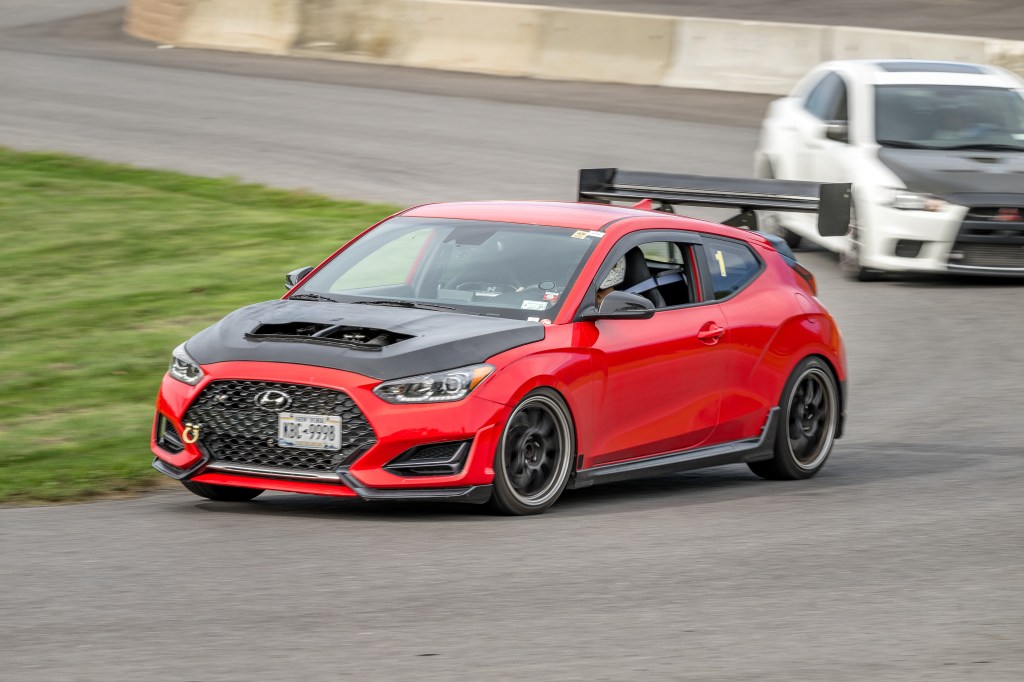
Subjectively, I can’t say I felt a huge difference between the spoiler and double wing, except that the double wing makes a small whistling sound at times. And on the back straight, I swore I could feel the drag from the double wing, but that could also be my imagination.
Conclusion
It’s pretty obvious from the lap times that adding rear aero makes this driver faster in this car. The Veloster has more rotation built in than the average FWD car (though maybe not as much as an Elantra N), and so it can benefit from additional rear grip at speed. It may also be that my particular driving style benefits from more rear grip. I didn’t do this experiment with another driver, so I don’t know if driving style is an important variable.
Caveats aside, the data shows that the double wing was about .6 seconds faster than the single wing or the ducktail spoiler. And both of those were about .7 seconds faster than the OEM wing. All said, I went 1.3 seconds faster using rear downforce alone, with no splitter or canards (although I do have hood vents, and I suppose that should count for something).
What’s surprising is that rear downforce made a quantifiable difference on a low speed track where aero only matters in a few corners. On a longer track with sustained high speed corners (Club Motorsports, Nelson Ledges, Palmer, etc.), I could see this being a three second advantage.
Another surprising thing I learned in this test is that I can make a minor change to the rear aero, and you can see it clearly in the 10hz GPS data. I know the track well and I’m a decent driver, but I make mistakes and I don’t have pro-level car control or consistency. So it doesn’t compute that there should be such an obvious signal in the data.
But I think what I’m seeing here is that I probably drive the car to the same level of instability. When the car is more settled, it allows me to release the brakes sooner and/or open the throttle earlier. And that flattens out mistakes I make from corner to corner.
So while I may not be able to drive the same line or make the same inputs exactly the same lap after lap, I end up driving consistently by maintaining a certain level of instability that I’m comfortable with. And that’s why you’re seeing strong signals in the data for what are relatively minor aero changes at low speed.
I would imagine that many other competent (but not professional) drivers do the same thing, driving to a certain level of comfortable instability. And because of that, I think using a 10hz GPS device to get long-G, lat-G, and a speed trace is acceptable data gathering for aerodynamic experiments.
I guess the final question is, why does adding rear aero alone reduce lap times? Mathematically, I’ve ruined the aerodynamic balance of the car by adding a lot of rear downforce and none in front. Engineers should be storming my house with pitchforks and torches, rooting out the madman who Frankensteined their masterpiece…. but for fuck’s sake, the car is actually faster. Either I need to do a bunch of math to calculate why that’s happening, or build an even bigger wing and fuggin send it. Yep.
 Occam's Racer