This tire test starts with a rant; bear with me for a minute while I get this off my chest.
Once upon a time, treadwear (UTQG) meant how long the tire would last. A 300 TW tire lasted longer than a 200 TW, which in turn lasted longer than a 100 TW. Grip was inversely proportionate to wear, and so 100 TW tires gripped more than 200, which gripped more than 300. Makes sense, right? Wrong. That ship has sailed, and it ain’t coming back.
These days treadwear values are total bullshit, especially in the popular 200 TW category. Back when treadwear meant something, honest 200 TW tires, like the Falken RT615k, Nitto NT05, Yokohama AD08R, and other similar tires lasted 20+ hours on track, had good heat tolerance, and respectable speed. Crap can racing series like 24 Hours of Lemons and Chumpcar standardized on the 200 TW tire, and you could chose any of them with relative fairness.
But the landscape completely changed when autocross-specific tires came out, such as the RE71R and Rival 1.5S. Like endurance racing, most autocross classes also require 200 TW tires, but with only half a dozen 45-second runs per day, durability didn’t matter. So the autocross “Super 200” tires were developed and became a completely different animal than any 200 TW tire that came before.
Because autocross is a competition, every autocrosser wants the fastest 200 TW tire. And since treadwear values are set by the manufacturers, they can take a domestic 140 treadwear tire, write 200 on the sidewall, and sell it in the USA as such. And thus began the idiotic 200 TW tire wars where tires got faster, less durable, and the treadwear number remained the same.
The result of that is you can buy a 200 TW Falken 615K+ that last two to three times longer than the 200 TW Falken 660. Bridgestone, Nankang, and Yokohama also offer an endurance 200 TW tire that lasts three times longer than their 200 TW autocross tire. And yet they all have the same treadwear rating. So much for treadwear meaning anything about wear.
So does 200 TW mean there are now two classes of tires? No. Because there are also tweener tires like the Kumho V730 and Nexxen Sport R, which are part way between an enduro and autocross 200. And then you have Accelera, Kenda, and Valino, who offer bargain 200 TW tires that are slower, but cheaper, than the enduro 200s.
Which brings me to a brand new 200 treadwear tire, the Armstrong Blu Trac Race. It’s certainly a bargain 200 TW, but I was curious to see whether it was also an autocross or enduro 200 TW. Or something else.
Armstrong Blu Trac Race
You may not have heard of Armstrong tires; I hadn’t. They are available through Tire Streets, who deal in lesser know brands, mostly from Indonesia, I believe. If you are in the drift community, you know Accelera tires, which are the official tire of the LZ World Tour. If you’re outside the drift community, you may not know Accelera or Armstrong or Tire Streets.
I ordered the 235/40r18 size, which were on sale for $135 each, shipping included. This is about half of what most 200 TW tires cost, and so you can see we are clearly in the bargain 200 TW segment.
The first thing I noticed about the Blu Trac is that the tread pattern looks a bit like the venerable Nitto NT05. There are two very wide center grooves, and a symmetrical tread pattern, so you can flip the tire on the rim and get a little more life out of them.
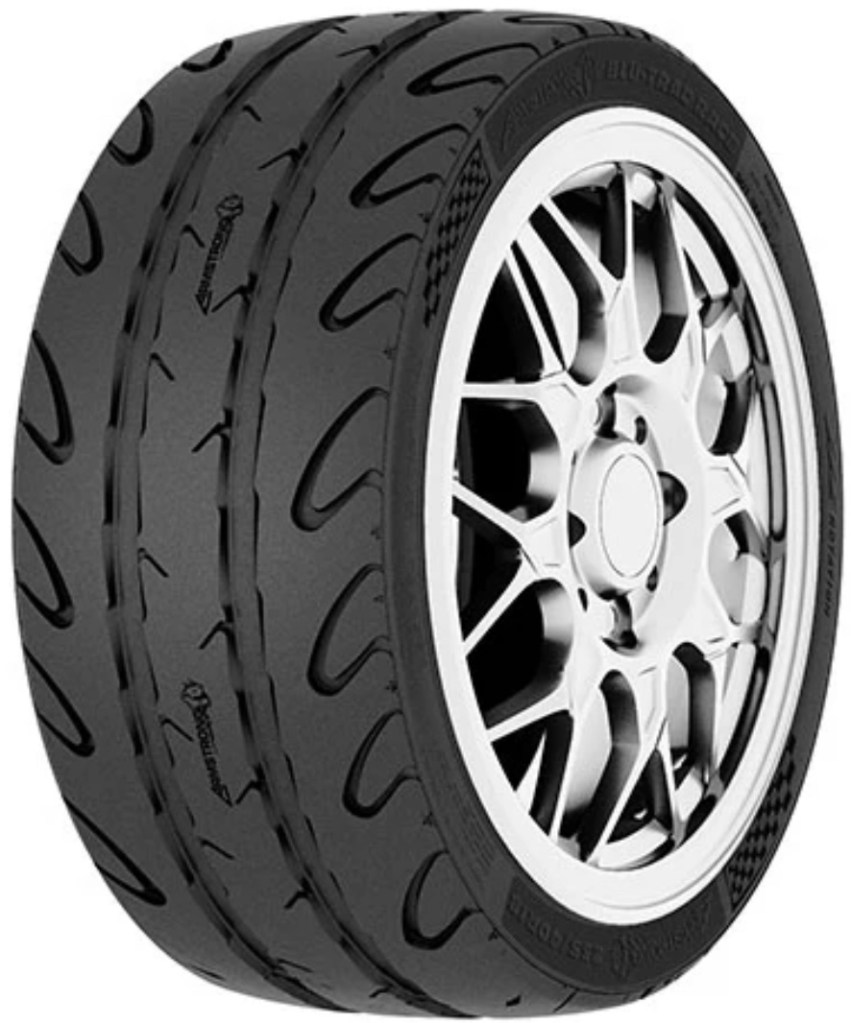
When new, they give off a low whoop-whoop sound like a helicopter. I found a resonant frequency at about 35 mph that was uncomfortably loud. But once the tires wore down some, the sound level went down to where I stopped noticing them entirely.
But the street is no place to test a track tire. To properly evaluate them, I’d need to take them to a racetrack, record lap times and G forces, and compare them to a known quantity. Before doing that, I heat cycled them with a few laps at Pineview, and let them sit for 24 hours.
Kumho V730
To see if the Blu Trac were any good, I compared them to Kumho V730s. I’ve been using the V730 recently, and I feel they set a new standard for track tires. I used to feel that way about RS4s, but a ridiculous sale price on the Kumhos got me to try them, and the gain in grip is an acceptable tradeoff for increased wear.
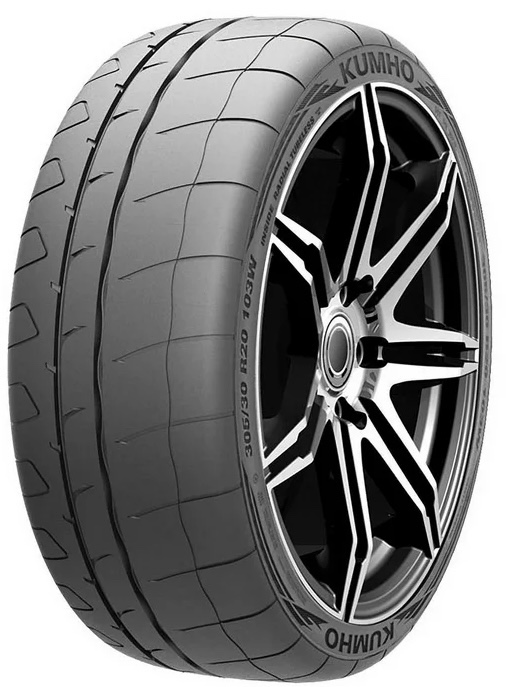
The V730 tread pattern isn’t symmetrical, and is similar to another ancient Nitto track tire, the NT01. Now there was never anything wrong with the NT01, and I think Nitto could have written UTQG 200 on the sidewall and nobody would have blinked.
V730s are well regarded in the track community, and inhabit the tweener space between autocross tires and enduro tires. The smaller tread grooves disappear quickly, leaving two off-center groves that could be mistaken for a Maxxis RC1. Like the RC1, these won’t work well in the rain. But I have other tires for that.
Pirelli PZero PZ4
To make this more interesting, I’ll also throw in a set of Pirelli PZ4 tires, which I bought specifically as a wet tire. The Veloster N originally came with PZ4s, and most comparison tests put them on par with the Michelin PilotSport 4S and Continental ExtremeContact Sport. The PZ4 is rated at 280 TW, and is not a dedicated track tire. It’s a good street tire, OK on a dry track, and great in the wet.

Track testing
For tire testing I go to Pineview Run, mostly because I’m a member and can go whenever I want. It’s empty on weekdays, so I can run as many laps as I want. They run a much shorter track during the week, and so I can get a lot of laps and normalize the data.
I use a pyrometer to properly set tire pressures, and bleed them down to get an even gradient, slightly hotter on the inside. I use an AiM Solo DL for lap times and data gathering, and then convert the lateral Gs into a CSV file. This way I can average the various peaks and valley, to find a more stable lateral G value.
I did the testing over two days, doing back to back runs an hour apart. Pineview runs their track sessions on the hour, and so I couldn’t get sessions any closer than that. However, weather conditions didn’t change much, and so I don’t think that was much of a factor.
All of the tires were mounted on 18×8.5” wheels. The Kumho tires were mounted on Koenig Countergram +43, and the Pirelli and Armstrong tires were mounted on Motegi MR140 +45. The wheels are all within half a pound of each other, and I feel the offsets are close enough that the differences will be down to the tires themselves.
But note that I also threw in a mismatched set of tires, to see how the V730 front and PZ4 rear would work. I reckoned that less rear grip would allow me to rotate the car easier, and perhaps set the fastest time. But it didn’t.
| Tire | Lap |
| Armstrong Blu Trac Race | 46.596 |
| Pirelli PZero PZ4 | 45.401 |
| V730 front, PZ4 rear | 45.030 |
| Kumho V730 | 44.616 |
The fastest lap was the Kumho V730 all around, going about four tenths faster than the cocktail with the PZ4 on the rear. The handling with mismatched tires was a little too loose for my tastes, and I even spun the car once with the Pirellis on the rear.
With the PZ4s front and back, I went .8 seconds slower than with V730. People love to hate the PZ4, but it’s not a terrible tire. Compared to the V730, the PZ4 is noticeably less sharp everywhere, but especially on turn in.
Which brings us to the Armstrong Blu Trac Race, which where 1.2 seconds slower than the Pirelli PZ4, and a full 2 seconds slower than the V730. On a longer race track with a more typical lap time of 90 seconds, Blue Trac Race would have you 4 seconds off the pace of the V730.
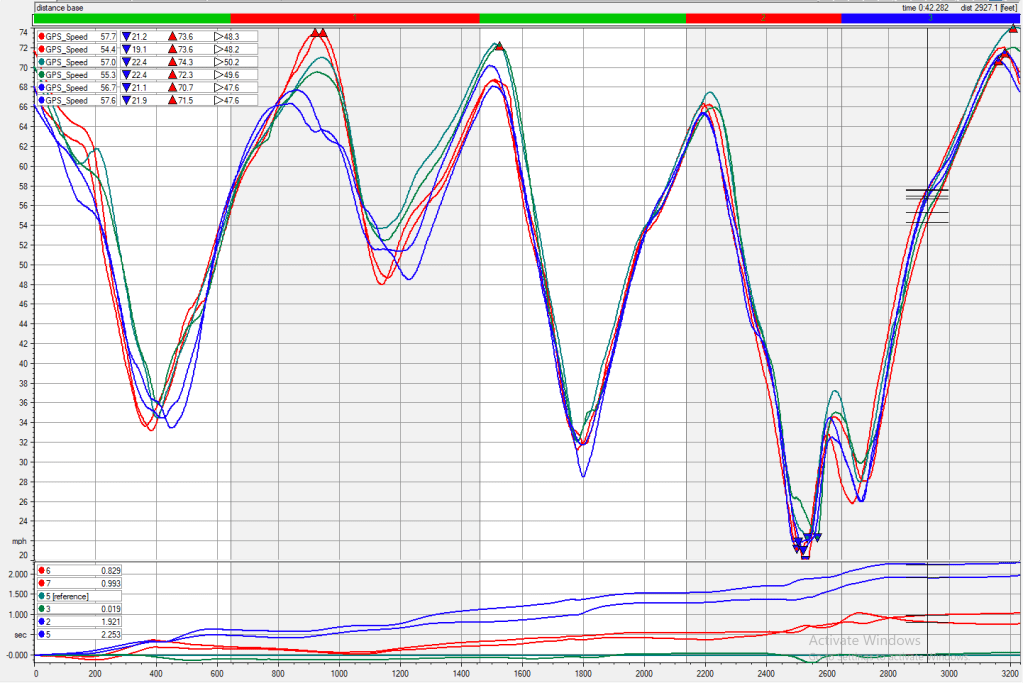
If you look at the following speed trace, you can see where the Blu Trac (blue) loses out to the PZ4 (red) and V730 (green). Blu Tracs have a corner speed that’s similar to the PZ4, but I’m consistently later to throttle on these tires, which results in a lower top speed. The Kumhos have more grip and allow me to maintain a higher minimum corner speed, which results in the fastest lap times.
But let’s talk about how the tire feels and wears. I really like the way the Blu Trac Race tires break away early, and are predictable when sliding. I often use all-season tires for hooning, and the lateral Gs of the Blu Tracs are similar. The difference is, Blue Tracs have fewer grooves and wider tread blocks, and these combine to make a really friendly tire that begs to be driven sideways.
Pineview has a rough surface with a lot of right turns, and so the left tires get a lot of abuse. My Veloster is front-wheel drive, and the combined braking, accelerating, and turning with all the weight on the nose absolutely murders the front left. As such, I ruined my Pirelli PZ4s in just seven 15-minute sessions. I had bought them for rain use, but the forecast was wrong two Wednesdays in a row, and I ended up eating the tires before I got to use them in the rain.
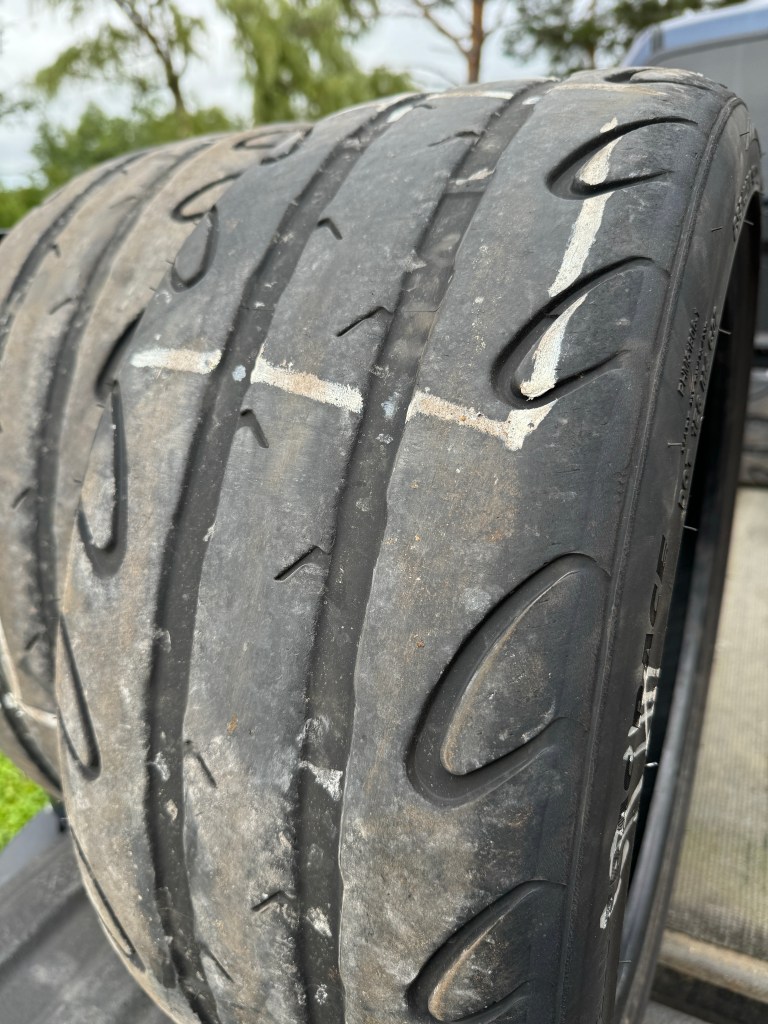
Conversely, I ran eight sessions on the Blue Trac Race tires, and they are wearing superbly. They certainly have the durability to last an endurance race, but you’d be well off the pace of everyone on RS4s. However, there’s a better use for Blu Trac’s than racing.
The best HPDE tire?
I started this article by wondering if the Blu Trac Race was an endurance 200 or a Super 200. But what I found out was, it’s neither. It’s a HPDE 200. Yeah, that’s right, I’m starting a new category of 200 TW tires, and I’m putting the Blu Trac in there at the top.
HPDE stands for High Performance Driving Education, and if you want a tire that is exceptional for learning how to drive, this is your tire. The lower grip, predictable breakaway, and durability combine to make a tire that is perfect for the E in HPDE.
Armstrong Blu Trac Race tires are not going to win any timed competitions. Full stop. But they will help you learn how to drive your car at the limit, because the limit is lower, easy to find, and easy to recover when you invariably go over.
My Veloster N is a well balanced car that doesn’t know it’s FWD. In fact it pushes less than many RWD cars. I can pitch it into a corner and get a four wheel drift, easy-peasy. Ergo, driving it on tires that have less grip is actually more fun. No tire has put such a big smile on my face as the Armstrong Blu Trac Race.
At the end of the session, many people came up to me to tell me how fast my car looked (because it certainly wasn’t fast on the stopwatch). And I think this was down to the car sliding everywhere, and just how loud the tires are. See and hear for yourself.
In the following video, I do some laps in front of and behind a Mitsubishi Evo X. He’s got a 400 hp tune and Kumho V730 tires; I’m 130 hp down, driving a stock Veloster N, with Blue Trac Race tires. I point him by part way through the session, and I’m able to keep a similar pace. So a decent driver can wheel the shit out of these tires and run with faster cars on better tires. And have more fun in the process.
Note this is on the shortest track layout at Pineview, which is about 6 seconds faster than the lap times in the previous table. To learn more about the track, see Pineview Run Layouts.
If you appreciate articles like this, and websites with no ads, no pop-ups, or other annoying shit, consider buying me a coffee. Thanks!
 Occam's Racer
so basically these would be a good back tire with a maxsport rb5 front tire for poors who cant afford to burn off nittos like the sponsored drifters?
LikeLike
I have no idea what a rb5 is! But Tire Streets makes a drift tire, why not use the 351GD?
LikeLike
that howl is sonically identical to the NT05! At BIR this July people in the tower could hear me at turn 4 almost a mile away.
LikeLiked by 1 person