As a follow up to the previous post, I wanted to see how much aero was worth at various race tracks. To do this, I’ll build a Veloster N at three stages of aero development, and see how they compare in OptimumLap. Let’s call these aero packages OE, Sport and Track.
OE aero is simply the car as delivered. If you read my wind tunnel report, you’ll know the coefficient of drag is .421 and the coefficient of lift is -.027. The drag is higher than you’d expect, and the fact that the car makes a little downforce straight from the factory is remarkable.
Sport aero consists of parts you’d drive on the street, so I’ll add lowering springs, but not a splitter, because that would take damage on driveways. I’ll add top and bottom canards to get more front downforce, and I’ll balance that out with a wicker/kicker on the spoiler. Wind visors worked really well on my VN, so let’s add those, too. Given these modifications, we have a car with around .50 drag and -.50 downforce, not bad.
The more extreme aero kit I’ll call Track aero, and this is my curved splitter and a wing, plus hood vents. I’ll keep the canards as well, and this brings the drag up to an even .60 and downforce to 1.00.
| Note: The Veloster N hatchback isn’t very efficient when used with a wing. As a result, most wings I tested are worse than a 4:1 L/D ratio, which is pretty awful. Sedans and coupes would return much higher L/D ratios, and I’ve seen 8:1 or even 12:1 L/D out of a wing. So the aero builds in this article represent a worst-case scenario, and one can surely do better using a different car. But since I own a Veloster N… it’s my party, I’ll cry if I want to. |
I’ve tested all of these parts in a wind tunnel, and so the drag and downforce numbers are accurate to within a couple percent, even though it looks like I’m just choosing round numbers. To compare lap times on each aero build, I’ll throw them all into Optimum Lap and see the time deltas for different tracks. In the following table, the numbers represent the time advantage per lap versus the OE aero.
| Track | Sport aero | Track aero |
| Watkins Glen | 1.5 | 1.9 |
| Palmer | 1.3 | 2.3 |
| Thunderbolt | 1.3 | 1.9 |
| Club Motorsports | 1.2 | 2 |
| Road America | 1.2 | 1.25 |
| Waterford | .9 | 1.7 |
| NYST | .9 | 1.5 |
| Gingerman | .9 | 1.45 |
| Mid Ohio | .9 | 1.4 |
| Summit Main | .8 | 1.25 |
| Thompson | .7 | 1.9 |
| Lime Rock | .7 | 1.1 |
| VIR | .7 | .3 |
| Pineview long | .6 | 1.2 |
| Canaan | .6 | 1 |
| Pineview short | .5 | .9 |
From this you data you can see a couple outliers, and the most obvious is VIR. Sport aero was a .7 second advantage over OE bodywork, but Track aero was only .3 seconds faster. Meaning, you’d go faster with the Sport aero than Track aero! This is the only track where this is true, and so drag is obviously a dominant factor at VIR.

Drag also plays significant role at tracks like Watkins Glen and Road America, and coming up with an aero package for these tracks is more challenging, because you really need to strike a balance between drag and downforce. Knowing exactly how much downforce and drag each part makes is essential, because then you can just put the numbers into OptimumLap and find out which aero will make you fastest.
On the other end of the spectrum are tracks where cars spend most of the time cornering, which makes it quite easy to design a car’s aero: add as much downforce as you can, and ignore drag completely. For example, at Palmer, the big aero build goes a full second faster than the medium aero build, which in turn goes 1.3 seconds faster than OE aero. That’s 2.3 seconds in your pocket from aero alone, that’s awesome.
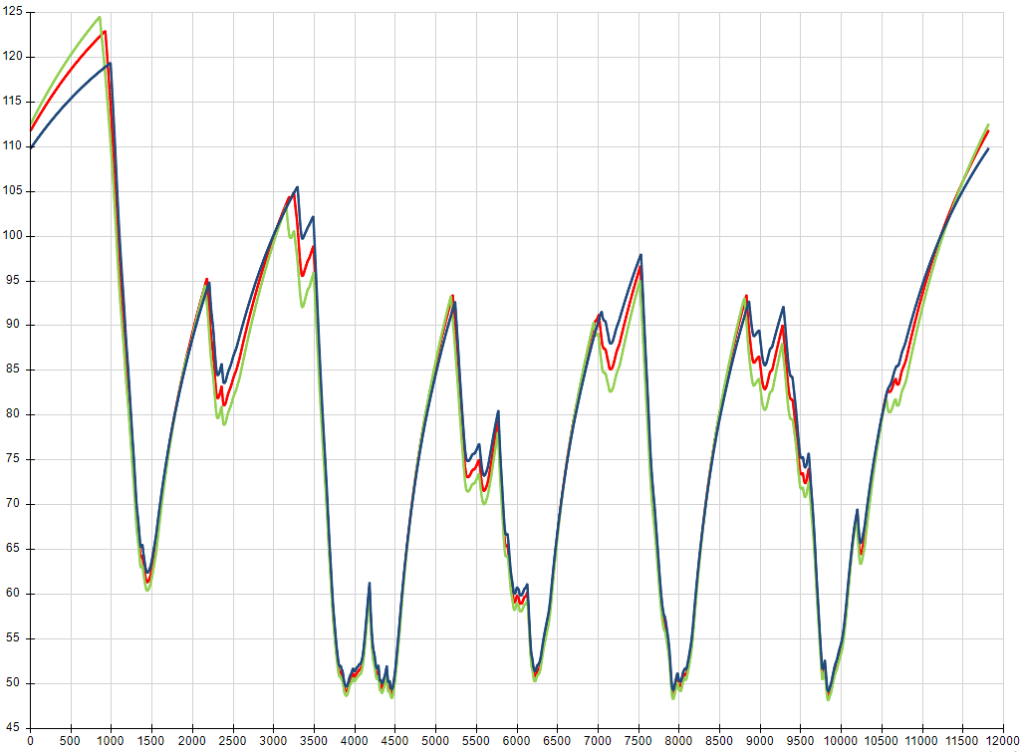
That same strategy can be used for any race track where there are shorter or fewer straights, and more corners. And so Canaan, and Club Motorsports, Pineview’s various layouts, and Waterford are also tracks where you’d go after as much downforce as possible, and completely ignore drag as a matter of any consequence.
In the middle of these extremes are most of the race tracks in the USA, which have both fast and slow sections, but not too much of either. Tracks like Gingerman, Lime Rock, Mid Ohio, NYST, Summit Point, and Thunderbolt come to mind. At these tracks, the lap time delta between Sport and Track aero is around 160%, and for the most part, you can again ignore drag and go after as much downforce as possible.
| If you’d like to know how fast your car goes around various race tracks with different aero parts, I’m available for consultations. I can build your car, any options you choose, and simulate the lap times at any race track (I can make any track from 10hz GPS data). I charge a measly $50 per hour, and it takes about that long, so contact me if you are interested in this service. |
 Occam's Racer