Most people enjoy the feeling of oversteer, it’s usually accompanied by a loud whoop and a “yeah,” “woooo,” “ha ha ha ha,” etc. It doesn’t matter if you’re on four wheels, two wheels, or no wheels, there is just something innately human that enjoys sliding sideways and yelling with glee.
Conversely, nobody likes the feeling of understeer, it often immediately evokes inward frustration rather than outward joy. Understeer is usually accompanied with words like “turn already,” “goddamnit,” “stop pushing,” “pig,” “fuck,” or more eloquently, “goddamnit, stop pushing and turn already you fucking pig!”
And yet, understeer is usually faster. Why?
- Traction sensing is easier
- You can brake later and accelerate earlier
- Mistakes require fewer corrections
- People suck at driving
Traction sensing
One reason understeer is faster for most drivers is that it’s easier to get to the limit of traction by pushing the front tires. Understeer is safe, and going over the limit doesn’t cause any drama. Conversely, exceeding the limits of rear traction can result in a spin.
You might even say that the reason most people find it easier to sense front traction is that most people are afraid of spinning. As much as I don’t want to admit it, I also fall into that camp.
My personal style of driving is to grip the steering wheel hard (probably too hard) and sense the feedback through the wheel. I don’t saw at the wheel, though, I’m very deliberate and economical with steering.
My style of driving requires a more geometric racing line, and returns a higher min speed. And while this may not be the fastest way to navigate a corner, I do so at the limit of traction. As Ross Bentley says, a person driving off the ideal line but on the limit of traction will be faster than a person driving the ideal line and driving under the limit.
Brakes and acceleration
A car that is unstable is easier to turn. Understeer is inherently more stable, which is exactly why it’s harder to turn. But this stability pays off in braking and acceleration.
An oversteering car can be difficult to control when threshold braking, and especially when trailbraking. It takes skill to keep the back from coming around. An understeering car is more stable, and allows later threshold braking and more aggressive trailbraking.
The same is true on acceleration; oversteer requires deft throttle modulation to keep from spinning, while understeer allows you to mash the gas as soon as the car is pointed correctly. In my experience, I get on the gas earlier with an oversteering car, but I get to full throttle earlier with an understeering car.
Mistake recovery
A good driver makes a lot of small mistakes and corrects them instantly. They are constantly losing and catching grip with skill and grace. A car that understeers is very easy to correct; if the car starts to lose traction, just wait until the car turns before adding more throttle. An oversteering car takes more skill to correct; sawing at the wheel and dancing on the pedals repeatedly until the car gets back into line.
An important factor here is the stability index of the car, which in layman’s terms is exactly what it sounds like, but in reality is so much math and calculations that it will make your head spin. Let’s not do math here and talk generalizations.
Mid-engine and rear-engine cars with a lot of weight on the rear tend to be very pointy, swapping ends if you are careless and lift the throttle. A car like this without modern traction control systems suffers no amateurs in the cockpit; you need skill to drive one quickly. Conversely, front engine cars tend to be much more forgiving. If you look around, how many people drift with mid- or rear-engine cars? Not many, because it’s much easier to control a car that doesn’t snap oversteer.
This isn’t just about mechanical stability and grip, but aerodynamic forces as well. Cars that have a lot of rear drag or lateral surface area (like a LeMans prototype shark fin) move the center of pressure rearwards. This in turn makes the car more stable at speed. The distance between the center of gravity and the center of pressure is called static margin, and cars with a greater static margin are more stable, and require fewer corrections to mistakes. They are also harder to turn, and so this is again an understeer vs oversteer situation, where more rear aero is easier to drive and typically faster.
People suck at driving
You can add all these factors together and conclude that understeer is faster simply because most people suck at driving. Driving a pointy car at the limit demands a lot of skill. Driving an understeering car is child’s play. That’s why virtually every car off the showroom floor comes with understeer from the factory.
Manufacturers know that people suck at driving. You’d go broke selling cars to people that requires the skill to regularly catch a spin. I’m an enthusiast and decent driver, but I’m no Max Verstappen, and I never will be (not in skill, nor in attitude; I would have sacrificed one win to let Perez take second in the Drivers Championship last year). I didn’t cut my teeth racing karts, or spend every waking moment being a douchebag racing cars.
Otherworldly drivers like Max can do things I’ll never be able to do, and driving an oversteering car faster than a understeering car is just not in my wheelhouse. I’m quite happy with my conservative, front-biased driving style. By using that style, and driving at the limit of front traction, I regularly beat the pants off people overdriving their cars under the limit.
Oversteer mythology
If understeer is faster for non-pro drivers, why do so many non-pro drivers believe that oversteer is faster?
- If oversteer was faster, the 1000 hp drift missile at your track day would set FTD. But instead it’s a Miata with too much wing on scrub SM 7.5 tires.
- If oversteer was faster, F1 cars would rotate through the majority of corners. But they don’t. You see more F1 cars push the front than the rear.
- If oversteer was faster, people would put wider tires on the front than the rear. But they don’t. High powered cars run a staggered setup, or maybe square – but you won’t see a RWD car in a gorilla stance.
- If oversteer was faster, you’d see cars with more front aero than rear. But most race cars are split about 1/3 front and 2/3 rear downforce.
- If oversteer was faster, Spec Miatas would have more oversteer than a stock Miata. But SMs have a 63% front roll couple, compared to a stock Miata’s 59%.
- If oversteer was faster… well, you get the idea. It ain’t.
If you think oversteer is faster than understeer, I want to see your data.
Driver 61
Driver 61 is a YouTube channel with great content. In one of his latest videos, he delves into understeer vs oversteer, and why Alonso loves understeer. He goes on to examine various drivers and what they prefer, and shows this list.
- Oversteer drivers: Max Verstappen, Sebastian Vettel, Charles Leclerc, Michael Schumacher, Lando Norris, Ayrton Senna.
- Understeer drivers: Lewis Hamilton, Fernando Alonso, Sergio Perez, Jenson Button, Nigel Mansel, Alain Prost.
It’s an illuminating video, and worth the watch. What’s interesting is that Driver 61 himself was originally an oversteer guy, and more recently has transition to an understeer guy. My twin brother Ian is the same, originally very rear happy, but transitioning more to understeer sadness.
Ian vs Mario
I wrote an article called Twin Studies, which is an in-depth analysis of my identical twin brother and I driving the same cars very differently. In that article we drive a NA and NB Miata, and a Veloster N, back to back.
Ian has an oversteer driving style, a la Verstappen and Schumacher. He holds the wheel lightly, thumbs on top, and pivots the car on entry. I have a more understeer style, like Alonso and Hamilton. I grip the wheel tighter, and sense traction through the front wheels.
Both styles are fast, but I know the track better, and so I was faster on this day. But not by much, and he might have eventually beat me. But he did transition more and more to my style of driving throughout the day ….
Gran Turismo Test
In this article I’ve thrown a lot of theory around, so it’s time to get the gloves on and actually do some (virtual) driving. You should do this as well, it’s very illuminating data.
In Gran Turismo (or any other game where you can easily change front and rear grip), try out this experiment: get a Miata or similar RWD car with near 50/50 weight balance and mismatch the tires.
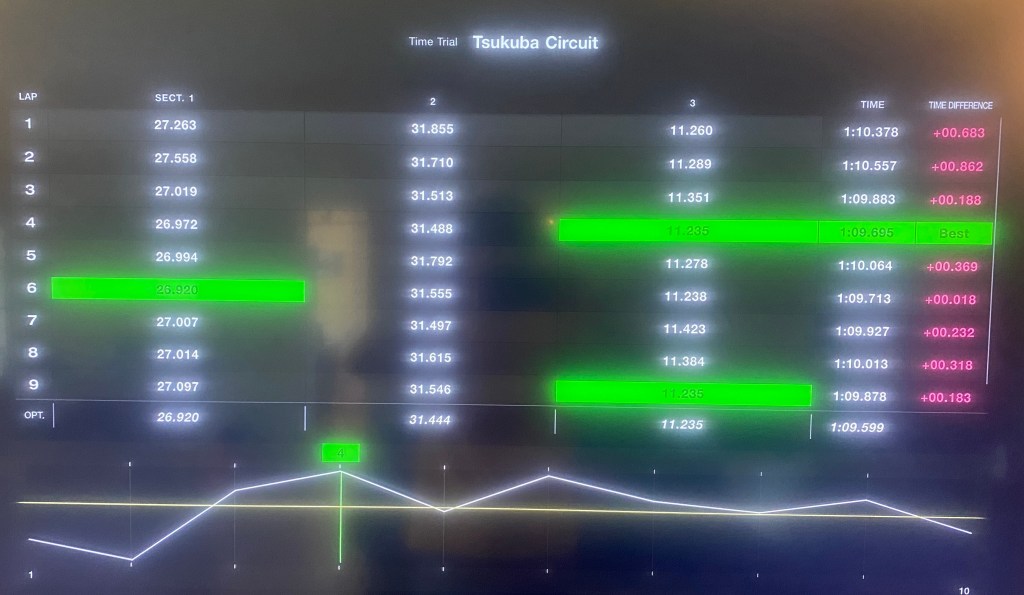
I used a bone stock ND Miata and put Sport Hard (SH) tires on the front and Sport Soft (SS) tires on the rear. Set up like this, the car understeered quite a bit. I ran ten laps at Tsukuba, then swapped the tires so that the car would now oversteer and did another 10 laps. In both cases, the car has the same amount of grip.
I started with the understeer setup and then switched to the oversteer. This gave the oversteer setup a bit of an advantage, because it’s been a while since I raced GT7 and I would have to hit my marks right away on the understeering car. I did OK, with a best lap of 1:09.695. What’s surprising is that my outlap, which isn’t shown in the lap summary, was a 1:10.3. Meaning that the understeering car was easy to get up to speed on immediately.
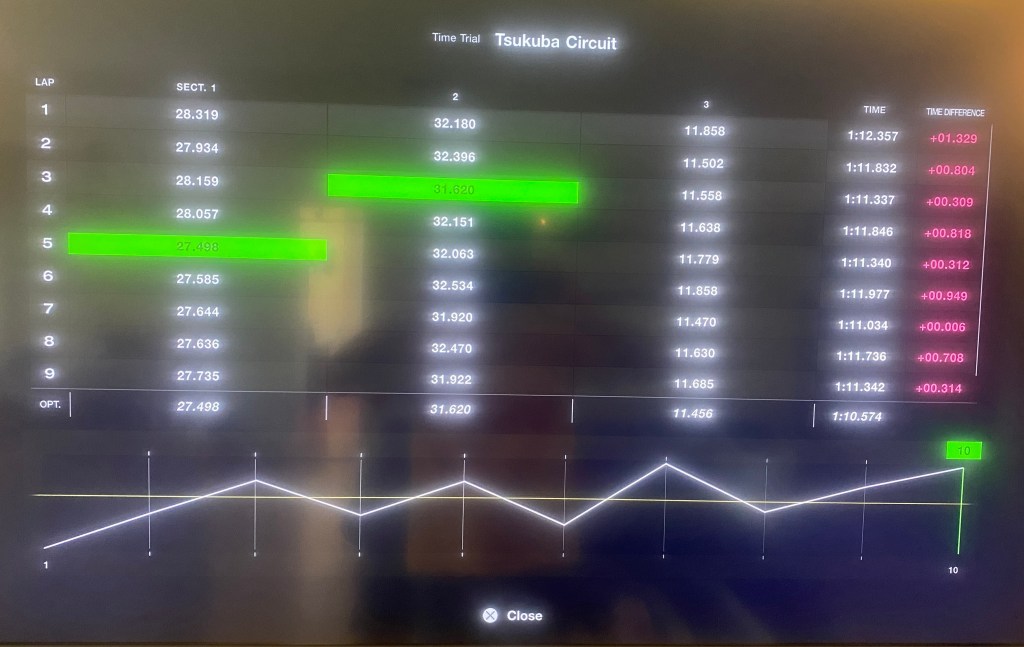
Next I swapped the tires and tried the oversteer setup. Whoah! Big difference. I almost spun twice on my outlap and barely managed a 1:13. Unlike the understeer setup, I needed to learn how to drive this. Eventually I figured it out and got down to a best lap of 1:11.028. It felt like quite an accomplishment to string together that many corners and catch the slides each time.
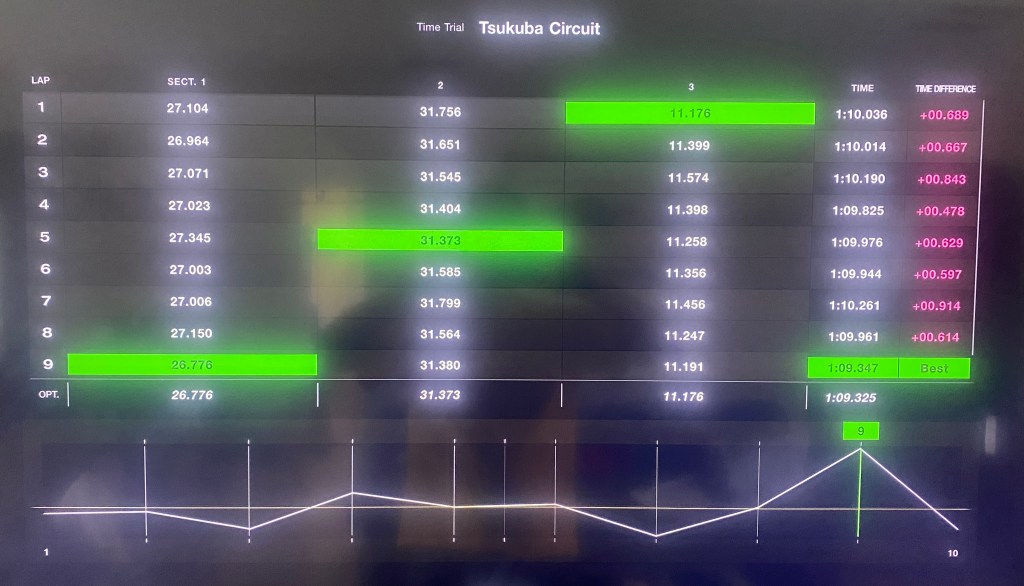
Then I put Sports Hard (SH) tires front and rear, just to see what would happen. This is using the worst tire on both ends, and isn’t really part of the oversteer-understeer experiment. But you can see that a balanced car is the fastest. Even with tires that have the least grip I did a 1:09.347.
| Setup | Best Lap | Opt Lap | Avg Lap |
| Understeer (SH/SS) | 1:09.695 | 1:09.599 | 1:10.012 |
| Oversteer (SS/SH) | 1:11.028 | 1:10.574 | 1:11.644 |
| Neutral (SH/SH) | 1:09.347 | 1:09.325 | 1:09.950 |
But to get back to the two ends of the spectrum, the understeer setup went 1.3 seconds faster than the oversteer setup, and was 1.6 seconds faster on average. In both cases, the car had the same amount of grip, and so you can see that understeer is a lot faster. At least for this driver.
I also included the optimal lap time for each, and you can see that the understeering car’s best lap was about 1/10th of a second off the optimal lap. On the other hand, the oversteering car’s optimal lap was over half a second off. This shows how sloppy my best lap was, and how difficult it is to put together a clean lap in an oversteering car.
Driving impressions
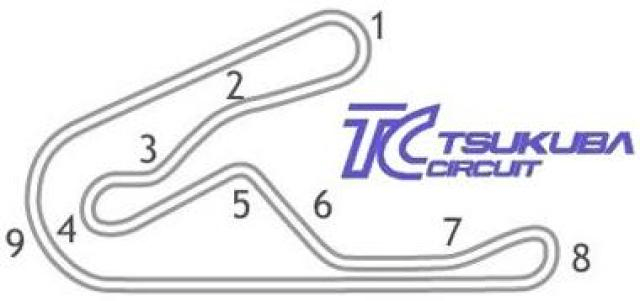
The way to drive an understeering car fast is to make it oversteer on corner entry. In the tight hairpins, turns 1, 4, and 8, I found myself diving towards the apex on the brakes, releasing slowly, and sharpening my steering through the whole corner. I didn’t always brake traction on the rear and rotate the car, but I kept the weight on the nose for as long as I could. I did something similar in the 90-degree T5, but using lift-throttle oversteer to help turn the car, then got right back on the gas again.
Conversely, through T9 I used understeer to get to full throttle early. I ran it in tight until the front set, and then stood on the throttle to the exit, purposely pushing the front tires the whole way.
I found that to drive the oversteering car quickly, I had to adopt a more “momentum” style of driving: lighter and longer braking, optimize mid-corner speed, and get on the gas early using maintenance throttle. Unlike the understeering car, which I could mash the accelerator as soon as the car was turned, on the oversteering car, feathering the gas was important.
With less grip on the rear, I needed to shift weight to balance traction, and so T5 was on throttle (lightly) the whole time. I also tried holding a taller gear, which helped keep the rear from stepping out, but I eventually figured out how to gradually get on the gas in the correct gear. I did a lot less trailbraking because the back would come around, so I rookied my way into straight-line braking and releasing the brakes quicker.
The other major difference in driving the two different tire setups was the number of steering corrections required. In the understeering car, if I went in too hot or misjudged my turn in, it was a simple matter of waiting for the car to turn before adding throttle. There was very little drama, if maybe a little cursing (“turn you pig,” kinda stuff).
On the other hand, the oversteering car was a fucking handful! I made more steering corrections in two corners than I did over an entire lap in the understeering car. It was a lot of work, but it was also more fun.
Finally, driving the balanced car was the most fun of all, and it was the fastest as well. I used some strategies from both styles of driving, and was finally able to drift all four wheels. For example, in T1 I trailbraked heavily, and in T5 I used LTO to turn the car, both understeering tactics. But I also found myself getting on the gas earlier and feathering the throttle out of most turns. The final turn was completely different: a four-wheel drift through the entire corner. You can really only do that with balanced traction.
Wet track
Next I made it rain in Japan and tried the same builds on a wet Tsukuba. This time I only did 5 laps though. No more shitty screen shots of my TV, just the data this time:
| Setup | Best Lap | Opt Lap | Avg Lap |
| Understeer (SH/SS) | 1:26.184 | 1:25.907 | 1:26.784 |
| Oversteer (SS/SH) | 1:27.452 | 1:27.072 | 1:28.317 |
| Neutral (SH/SH) | 1:28.021 | 1:27.110 | 1:28.705 |
The delta between understeer and oversteer grew a little in the rain. I put down one good lap on the oversteer setup, but the the optimal lap was two seconds faster on the understeer setup, and so it had way more potential in it.
What’s interesting is that the SH/SH combo, which was the fastest in the dry, became the slowest in the wet! So when the track is wet, you’re better off with more traction at either end than you are with balanced traction and less grip.
Conclusion
If your car has criminal understeer, you want to fix that for sure, because you’ll go faster on a dry track with a balanced setup. To do that, check out Emil’s video on the subject:
But don’t make the mistake of going too far in the opposite direction and making a car that oversteers, because that’s even worse than understeer. The ideal setup is balanced traction, and with that, you’ll go fastest on a dry track, even with tires that have less grip. But if the track is wet, or there’s mixed conditions, you’d be smart to dial in some understeer.
Real-world testing?
My brother and I have been talking about doing this Gran Turismo tire test in the real world at Pineview. It’s easy to get an empty track session, and there are so many slow corners that we’ll spend the whole time breaking the tires loose. I just need to bring two sets of different tires and make this happen.
Unfortunately both of my Miatas are out of commission right now, but if I get one up and running this summer, I’ll fill this space with the Gran Turismo exercise done IRL. I might also be able to borrow a Miata and try this, and I’m planning to meet Emil Dogaru (from the video above) at Summit Point later this year and maybe do this test with him.
Subscribe to get updates or watch this space.
 Occam's Racer
Fantastic read. This is really solidifying some of my thinking on my own driving in iRacing. I think recently I’ve been setting up with too much oversteer because of the assumed understanding that oversteer is faster. I’m going to test setting up aero balance for just a tiny hint of understeer for a while. I think this could suit me a lot better.
LikeLike
If you want, we have several cars, both front a rear wheel drive to test at Pineview
Best regards,
Bill
LikeLike
Let’s do it.
LikeLike