I saw a car last week with some of the worst front-end aero I’ve ever seen. No, this wasn’t a crapcan shitbox at a 24 Hours of Lemons race, it was a Porsche 911 GT3 at Watkins Glen.
The car didn’t come from the factory this way, these were user-modifed alterations. The mechanic who services the car does the aero, but he clearly doesn’t understand the fundamentals of how air moves around a car. The owner also doesn’t know anything about aero, and so he trusts the mechanic.

The first thing I notice about the car is it has canards… but doesn’t have underbody aero or a diffuser. Canards are useful for spinning a vortex on the side of the car, which helps the underbody aero work better by sealing the sides, so that air doesn’t intrude underneath. But this car has no underbody aero.
So I asked the mechanic why he put canards on his customer’s car, and he said because it’s been known to fix understeer on BMWs. Wait, what?
What BMWs are we talking about? Unless we’re talking about a half-million dollar 50-year old BMW M1, it’s going to have the engine in the front, and so it won’t have nearly the same weight distribution as a rear-engined 911, and so the baseline aero would be totally different. The standard formula is to balance aero with chassis aero, and on a 911 that means more rear downforce, not more front.
I’m curious if these BMWs were understeering at slow speed or high speed or both? If it’s at slow speed, this isn’t a problem you can fix with aero. If only at high speed, there’s a much easier fix.
There are so many ways to fix understeer on BMWs (or any car) I find it surprising that fitting canards is the preferred method. I wonder if it was the canard manufacturer who started this trend?
This particular 911 GT3 has only has one canard per side, which is also highly suspect, because a pair on each side is more effective at creating a vortex. If you look at a proper race car that is designed to use canards, they are mounted two to a side, one on top of the other.
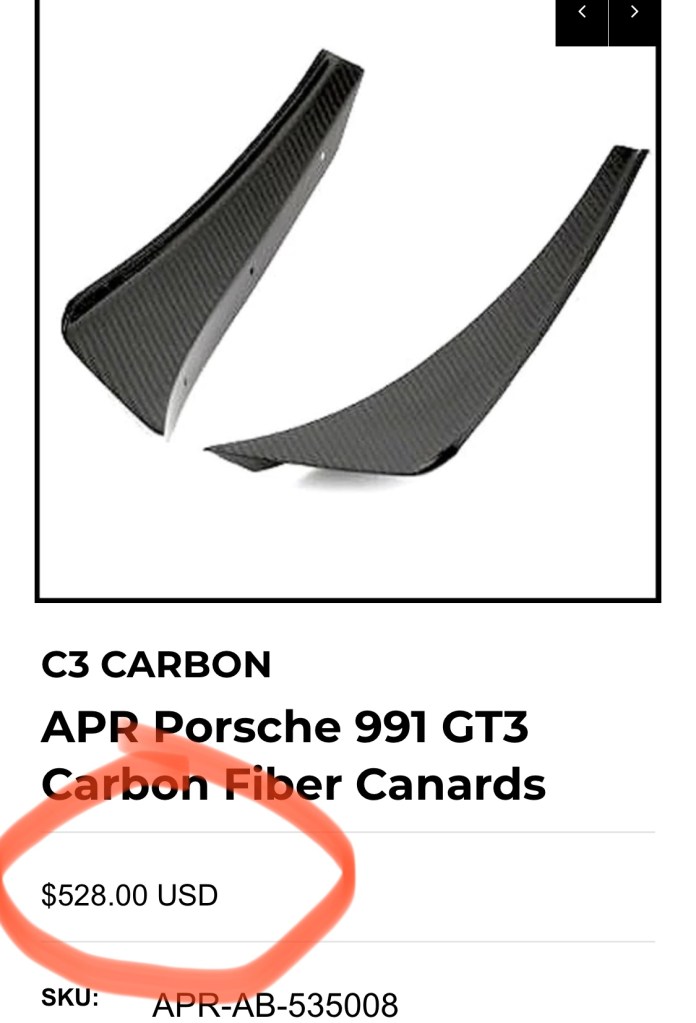
Anyway, the jump from “fixes BMWs” to “fixes GT3s,” is more of a leap of faith than sound reasoning. I must admit that the simplicity and universality of this solution is very Occam’s Razor, and in this manner I fully support it.
Except for this one thing: canards don’t make a lot of front downforce because they don’t have an airfoil shape. Wings create downforce from pressure on the top side, and suction underneath, and the suction side does the most work. Wings are also highly efficient with a lift/drag ratio of 10:1 or greater. Canards are super draggy and have a L/D of 3:1 or worse (Katz).
Because canards aren’t a proper airfoil, only the pressure side of the canard creates downforce, the air on the back side just detaches and causes drag. Also, there isn’t much planform area, and being so narrow, a disproportionate amount of that area is in the boundary layer, which is stagnant. So whatever downforce they make isn’t much. You could get the same front grip without the drag penalty by putting a 20 pound sack of potatoes in the frunk.
So if canards are truly fixing understeer on BMWs, it’s not by creating front downforce, it’s by the vortex they create. This propagates downstream as turbulence and reduces the effectiveness of the rear wing. That’s right, you didn’t fix understeer by adding a bunch of front grip, but by reducing rear grip. It seems pretty obvious to me, but I guess I’ll mention it for the canard crowd: adjusting the wing for less angle is a much better way to reduce rear downforce at speed. And as a consequence, it also reduces drag.
Anyway I wrapped up that conversation about canards and it left me wondering if the mechanic knew anything about aerodynamics. What I noticed next made me certain that he didn’t. He completely removed the front undertray.
The undertray is essential; it reduces drag, aids in cooling, and most importantly, it’s what provides the front end downforce! Well, no wonder the car understeered, you took away all the suction and gave it a bunch of front end lift!
I looked under the car and right away I noticed a sharp edge where air will separate. After detaching from the front lip, the air then has to rise an inch or so to stay attached to the underside, and it can’t change direction so quickly, so it remains detached, creating drag.
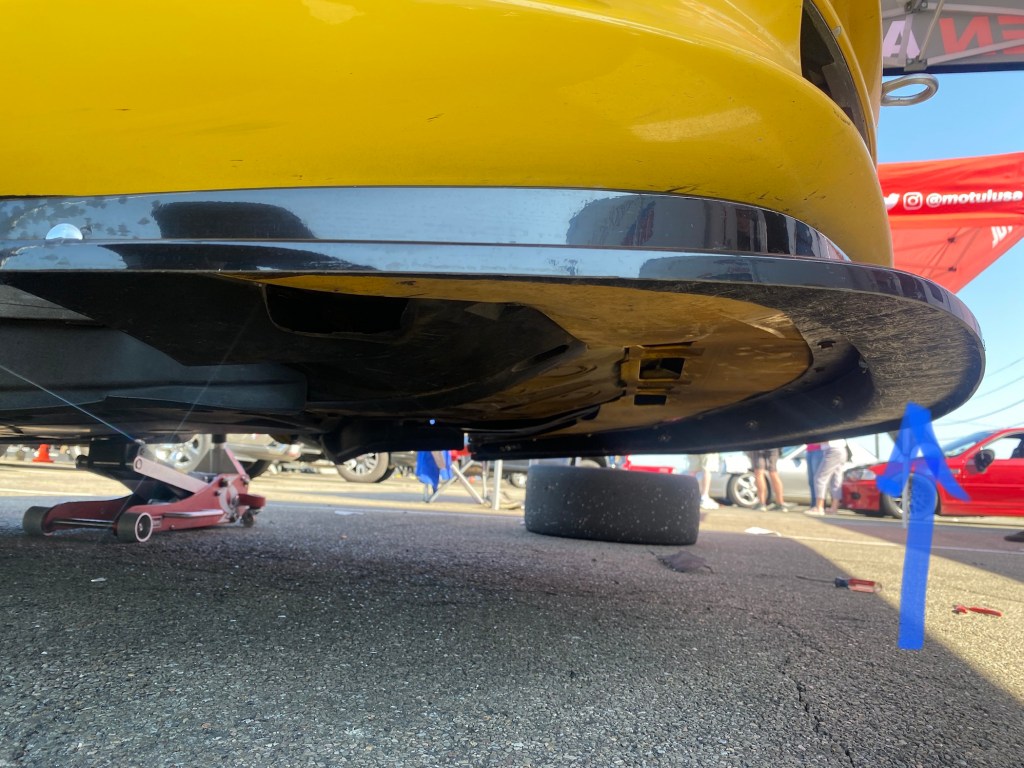
The next thing I see are a trio of holes under the car where air exits the radiator. Guess what? All that air going through the radiator now creates drag and lift underneath the car!
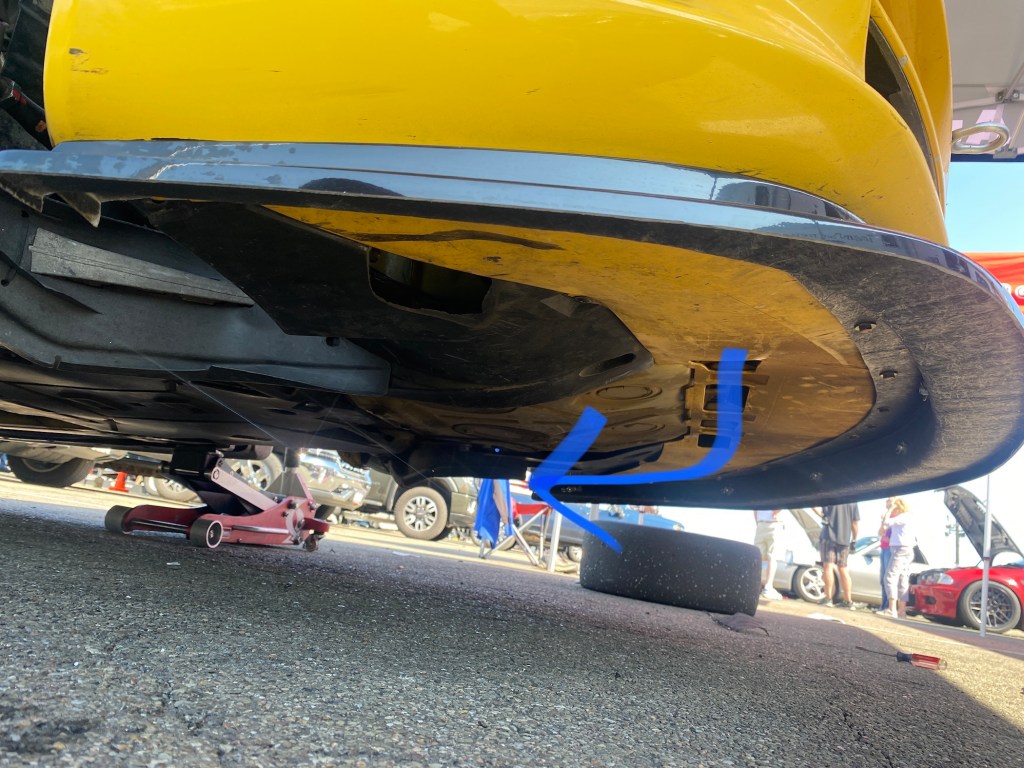
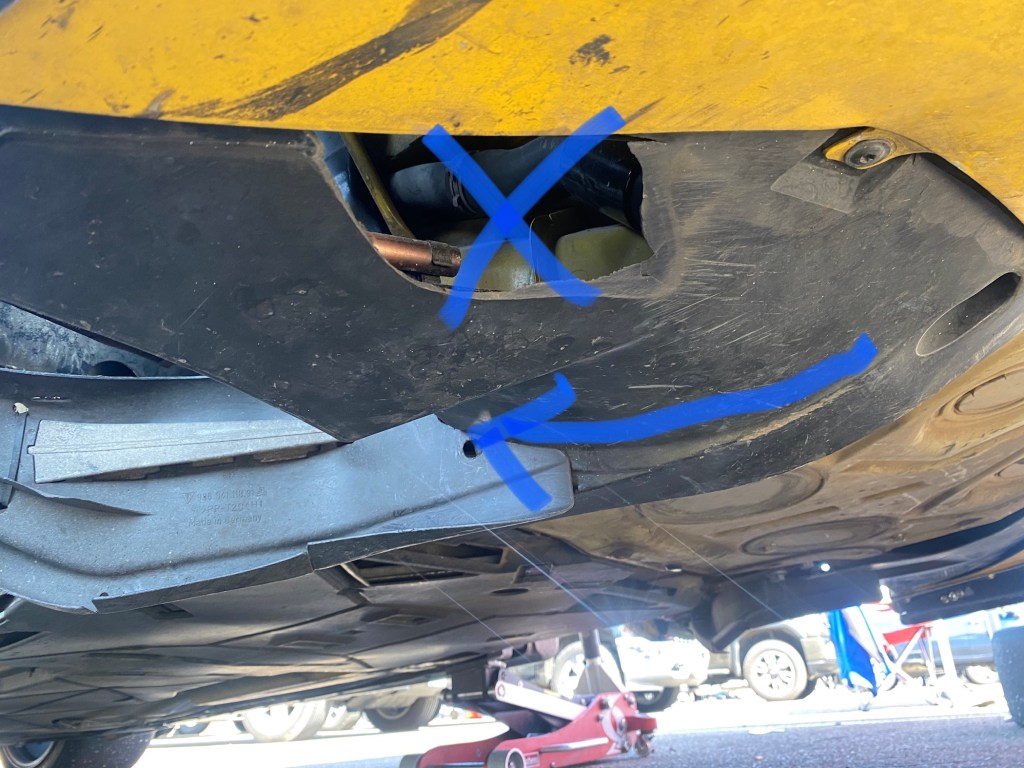
One thing that surprised me was that the car comes from the factory with splitter diffusers. Well played, Porsche, well played. These diffusers help air expand, which accelerates the air in front of them, creating more downforce. Unfortunately on this car, there’s no undertray, so the splitter diffusers accelerate the air over a dirty, detached surface. I mean, there’s even a hole in it.
Fixing this
I could fix this car’s front aero and it would go a couple seconds faster at Watkins Glen. As I mentioned at the end of The Dunning-Kruger of Car Aerodynamics, aero is largely the following principles: attached flows, changing the direction of air, maximizing suction, managing tire wakes, and manipulating vortices. What did I mean by that?
Starting at the front, I’d put a piece of Meranti BS6566 under that front lip. I’d cut it to fit snug and round the underside of the front lip, so air stays attached.
I’d then hinge the undertray at about half distance and slant it upwards to join with the splitter diffusers. By angling the entire rear half of the undertray, it would force the air to change direction and expand. This is essentially a diffuser running across the full width of the car. This will maximize suction in front of that area, and make a shit ton of downforce.
I want to keep all that suction in there, but there’s a jet of air that squirts sideways from the front tires and shoots directly into the low pressure area. As the tire rolls forward, it compresses the air underneath, and when combined with the velocity of air hitting the tire, you get a phenomenon called tire squirt.
To minimize that effect, I’d use a trio of strakes (similar to canards) to spin a vortex and smash it sideways into into the face of the tire. Vortices take energy to spin, and so this takes away energy in the air hitting the tire, which reduces tire squirt. The vortex spins outboard which aids extraction from underneath, increasing suction.
The top side of the splitter has exposed ends doing nothing. I wrote about that in Your Splitter Sucks, and rather than using something like an air fence, I’d either make vertical spats in front of the tires to create more local downforce on top of the splitter blade, or add just a simple piece of angle aluminum to kick air up and out and create more suction underneath.
Then I’d vent the fenders, first by pulling the back edge away to create a gap. You’ll recall that the car already has splitter diffusers dumping behind the wheels, and the venting is necessary to allow the air from the wheel wells to escape. This helps the splitter create more downforce.
I’d also put a vent on top of each fender, The purpose is similar to the vent behind the wheel, but with the added benefit of extracting air upwards. Air moving upwards pushes the car downwards.
There’s already a vent on the top of the bumper behind the radiator, and I’d tilt the radiator forward, and duct and extract the air upwards. Apparently later model GT3s have this style extractor vent from the factory. Sending air upwards instead of underneath the car makes downforce instead of lift.
The extractor vents on the fenders and the radiator would both get a wicker on the front edge. This holds local pressure on the upwind side, and locates a higher stagnation point on the downwind side. This change in pressure and change in direction creates more downforce.
There are probably a few smaller things, but these modifications would cover most of the front end. Oh, and the first thing I’d do is remove the fucking canards.
 Occam's Racer
“So I’d use a trio of strakes to spin a vortex and smash it sideways into into the face of the tire.”
Mario….can we have some more detail on this please.
Straight strakes starting at the splitter front edge and continuing rearward parallel to centerline car
(outboard of the Diffuser so that the air spills over them as it squeezes outboard toward the tire? Then runs across the front of the tire in the squirt zone? How high? 1″ or 1.5″…..depends on ride height i guess, but how high is necessary to spin a vortex tough enough to knock down tire squirt?
Jim Grant
LikeLike
I edited this just now to clarify it a little. They are similar to canards in shape, but backwards (pointy end forward). I don’t want to reveal too much online, but if you email me (mario.korf@gmail.com) I can send you a picture.
LikeLike