Circuit Florida, Florida Man, and The FIRM

This winter I went to Florida to visit my in-laws for a couple weeks. My original plan was to drive my Veloster down and do some track days. I’d take a break from pickleball and cribbage, and do some driving at a couple tracks I’ve been to before, The FIRM and Sebring. And then maybe pick up a new track sticker after hitting Homestead.

But The FIRM didn’t have any open track days for the two weeks I’d be down south. Same deal with Homestead. There was only one open event at Sebring, but it was a Track Night in America, and I swore I’d never do one of those again. The one TNIA I did at Palmer felt like UDWFCNIA (Unskilled Drivers in the Wrong Fucking Class Night in America).

So with no public track days on the calendar, the only chance I’d have to drive on track would be a private race track. As luck would have it, Circuit Florida is near my in-laws.

If you haven’t heard of Circuit Florida, it’s because it’s a members-only track, similar in concept to Monticello, M1 Concourse, Apex Motor Club, Atlanta Motorsports Park, etc. These are exclusive country clubs with initiation fees that range from $15k to $115k, and you pay annual dues on top of that. Many of these tracks have onsite garages and/or condos, and some require that you buy property to get into the club.
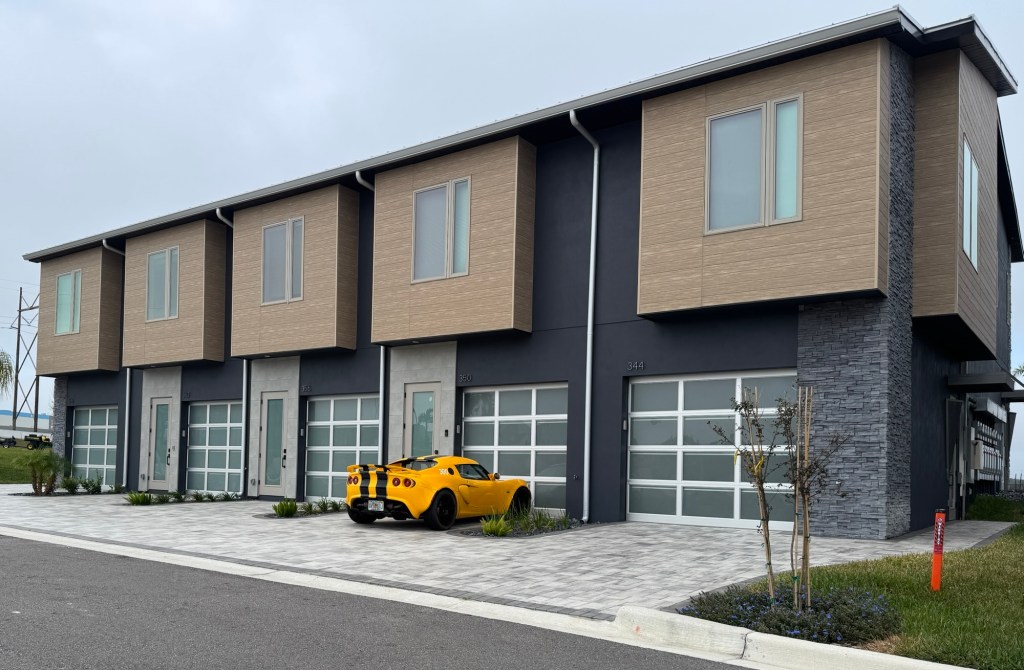
It’s so perfect it looks like a rendering. And the inside of the condos are stunning.

As expensive as they are, this business model seems to be gaining in popularity, and more private tracks are popping up. From a historical standpoint, it’s not surprising. Horses were once used for transportation, but are now mostly a pastime for the wealthy. In the future, that’s the way it may go with cars; most of us will be transported by electric self-driving shitboxes, while rich people will keep a stable of cars, and use them for recreational track driving.

Whatever happens in the distant future, the immediate future required a call to Circuit Florida to make an appointment. The track manager, Adam Ricardel said I could take some laps in my Veloster. But in the end I decided not to put 2400 miles on my car for a few parade laps. Instead we took my wife’s Mini Cooper to Florida, which is on excellent snow tires, and that would turn out to be important an important decision for the return trip.

Circuit Florida is awesome

Circuit Florida is the brainchild of Paul Scarpello, a successful businessman who had the means to buy the land and build the track by his lonesome. As such, the entire operation isn’t a fantasy-land held up in committee, but a real-world commitment driven by a single vision. That vision includes hiring Bob Barnard to design the layout, acquiring the most expensive motorsports-grade asphalt available, doing a tits job of paving it, building upscale condos and garages, and executing all of it with pace and precision.

Paul’s track manager is Adam Ricardel, who has a long list of credentials (Chief Instructor this, blah blah blah that), but I’ll tell you the one thing you need to know about the quality of his character: he races an E30 in Champcar (I’m pretty sure I’ve raced against him at Sebring and possibly WGI). He’s a savage wheelman who can can talk at eye level with both millionaires and average Joes, and is exactly the guy you’d want to be in charge of the track.

Circuit Florida has a paperclip layout, optimized for the available space, with 1.7 miles fit into fast straights and technical corners. Adam drove me around in one of the track’s fleet, a Mustang something or other, and while the car was forgettable, the track was not. It’s goddamn fantastic.
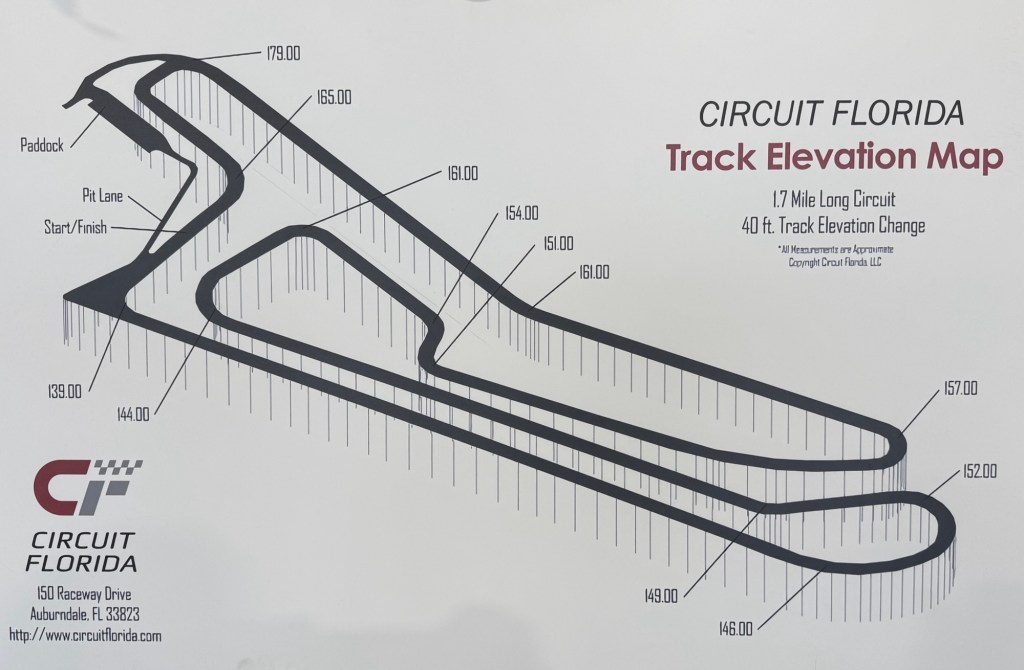
There’s 30 feet of elevation, which is well placed.

Being situated in Florida, you’d be right for thinking it’s flat. But then you’d be wrong. There is a surpising amount of elevation on this track, and it’s used strategically to create a more technical layout. With long straights and slower corners, both supercars and Miatas would be at home on this track, but the latter would be more fun. In fact the club is buying a fleet of MX-5 Cup cars just for members to race around in.

Of course there will be a swank clubhouse, and they are building a gym and restaurant, and maybe a business center, I forget. That kind of thing doesn’t blow my skirt up, but the track has my utilikilt up around my shoulders. And here’s the kicker, Circuit Florida recently received zoning and site plan approval for an extension of its racetrack to 2.4 miles, a skid pad, off-road driving course, a 6-acre industrial pad site, and 75 additional trackside condos. Hallelujah.

There’s a bit of elevation here at pit entry.

So what’s all this going to cost? About $20k for a one-year trial membership. If you’re all-in from the get-go, the initiation fee and monthly dues also works out to around $20k per year for 10 years of membership. This is a rich person’s playground, and my Veloster would look a little out of place next to the member cars I saw lapping on track. There was a brand new 911, a Lamborghini LP610, a brace of McLaren 720S (one with an extra 150 hp), and a AMG GT with all the options. I’d have passed every one of them, but there’s always an inverse relationship to money spent and skill, especially with these kinds of clubs.
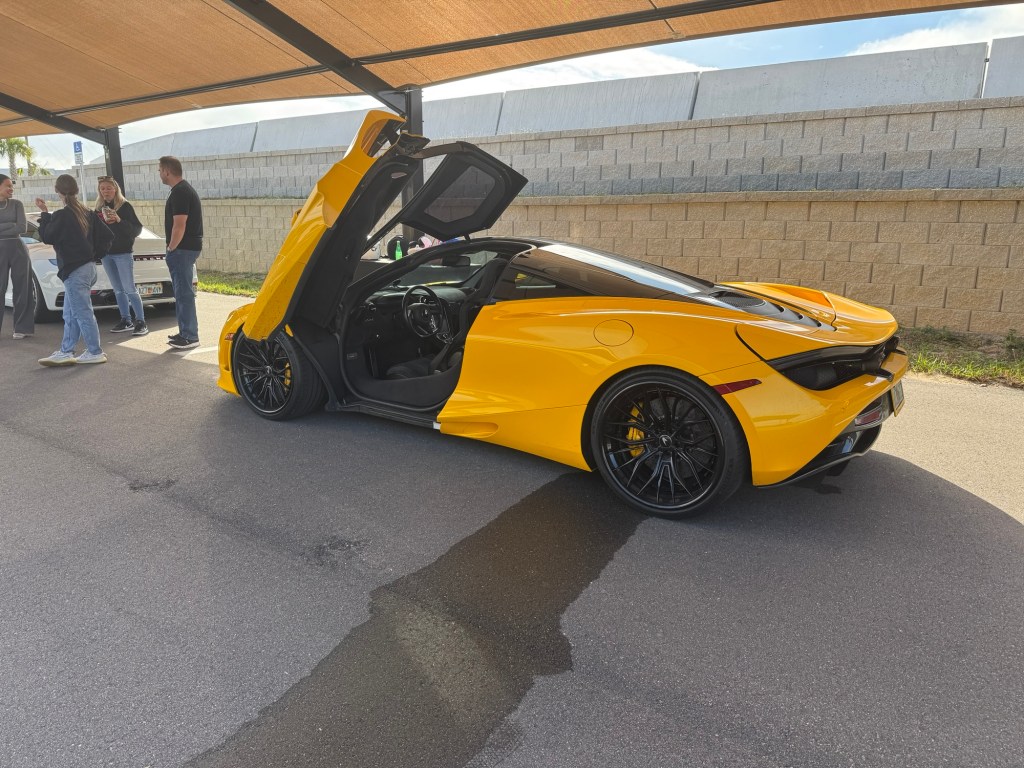
Typical member car. Just point me by, please.

Frankly, these are not my people, and it feels weird rubbing shoulders with people that don’t have dandruff on them. But if I lived in Florida, I’d join this club for the same reason I pay for YouTube Premium: I hate commercials. But in this case it’s not so much commercials, it’s the morning drivers’ meetings.

8 am drivers’ meetings are a vampire draining 30 minutes of life from 100 people at a time. It’s the same shit every time: thanking the registrar and other clerks for doing their jobs, going over the flags we’ve seen before, how to do a point-by, basic safety rules, dumb jokes, and all the other shit we’ve heard over and over again. The unfortunate part is, if there’s truly anything important to be said, it’s lost in the chaff of sameness. There ought to be a TSA-Pre version of drivers’ meetings where we get a 3×5 index card with any important safety issues. And nothing else.

Rant off. The other reason I’d join Circuit Florida is the convenience. I like to be able to show up whenever I want, run some laps, and go home after a couple-three sessions. I also do a lot of aero and tire testing, and I need a fairly open track and the ability to pit and change things every few laps. I get that now at Pineview, and I require more of the same.

I’ve been a member at Pineview Run since 2019, and the experience has spoiled me rotten. Even if Pineview Run is rather small, being able to drive at a moment’s notice outweighs the combination of cost and butting heads with management. So, yeah, I’d pay a ridiculous amount to belong to a private track club in Florida.

And it’s honestly not that ridiculous. If you consider the average track day is $400, I’d break even after 50 events. I mean, if I was living in Florida, what else am I going to do with my time? I would 100% join Circuit Florida.

Florida Man

Florida Man is an Internet meme first popularized in 2013,[1] referring to an alleged prevalence of people performing irrational or maniacal actions in the U.S. state of Florida. Internet users typically submit links to news stories and articles about unusual or strange crimes and other events occurring in Florida, with stories’ headlines often beginning with “Florida Man …” followed by the main event of the story. – Wikipedia

I’ve laughed at my share of Florida Man memes, and it makes me wonder how many are actually true. Well here’s one that’s real:

“Florida Man discovers that a small corner of a race track is within the restricted flight path of a neighboring airport and closes the track, incurring the wrath of local car racers, and nullifying years of track data.”
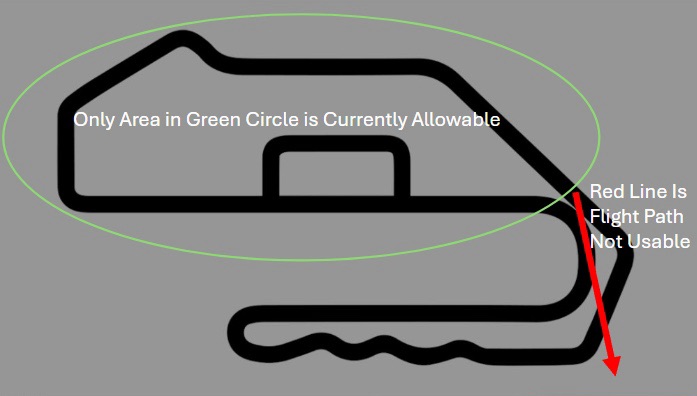
This amount of turf is apparently very important to someone in the air. Only in Florida.

As the story goes, some Florida Man made an airport surveying error back in 1999, and when The FIRM took over the lease in 2013, they had no idea said map was off by a few feet. But Florida Man 2025 decided that this is an important piece of real estate for a flight path, and shut that part of the track down.

I have to think that if it was me that noticed this tiny discrepancy, I would have let it go; it obviously hasn’t been an issue in a quarter century of takeoffs and landings. But Florida Man got a bug up his fuselage about it, involved the FAA, and now The FIRM is embroiled in a legal battle with a Government agency. I can’t imagine how much fun that’s going to be. Thank you Florida Man, I’ve got a dick punch and a hertz donut for you.

The FIRM

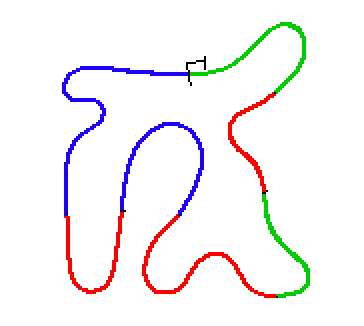
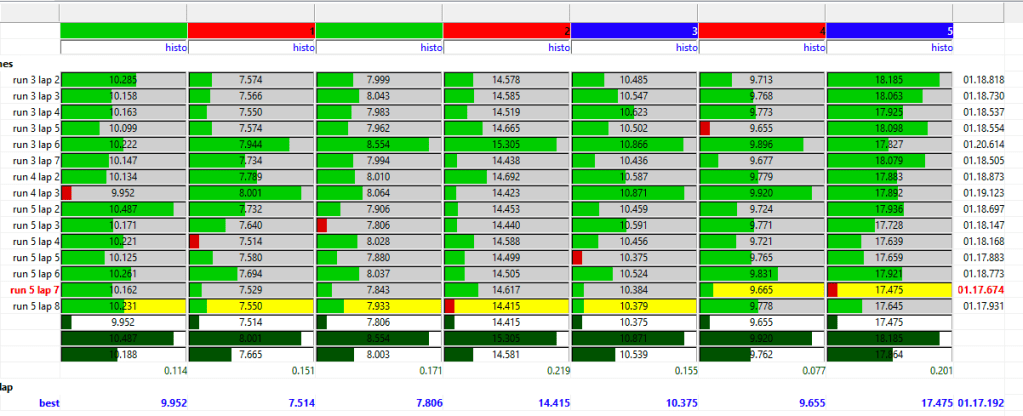
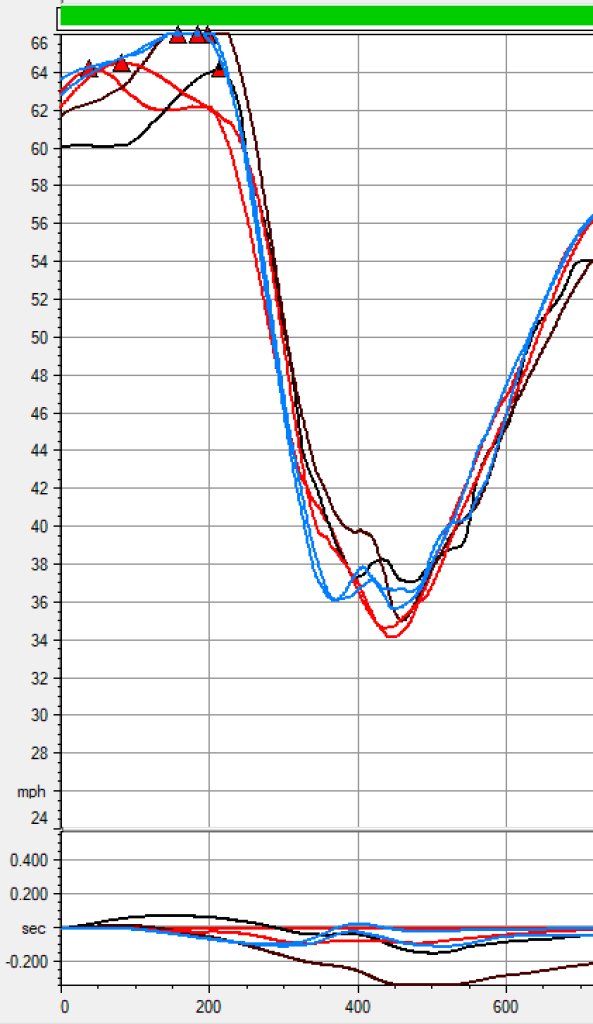
I only have one day of driving at The FIRM, in my buddy Brad Alderman’s ND2 Miata. The track is short and mostly flat, but it’s a fun combination of technical corners, one high speed pucker, and the biggest wall of Armco you’ve ever seen. Compared to places like Watkins Glen or Lime Rock, The FIRM is insignificant. Except for one thing: the Grassroots Motorsports leaderboard.

If you want to research car performance, a lot of people’s first stop would be the lap times from the Nurburgring. On this side of the pond we have don’t have the same kind of proving ground, but some journalists get together every year for Car and Driver’s Lightning Lap, which is a measure of something (if not an entirely accurate one). And then you have smaller and more accurate leaderboards, like the one GRM keeps at the FIRM.

If you check out Grassroots Motorsports ultimate guide to track car lap times, you’ll see a very good example of how to keep an accurate leaderboard. They list the tires, weather, and try to use the same driver as much as possible. If you click on the car, you’ll see an in-depth article, or even a video with data analysis. Unfortunately, whatever The FIRM does next, GRM is going to lose the ability to test new cars and compare that directly with the historical data that they’ve done such a great job acquiring.

Maybe there’s an upside to all of this, though. When The FIRM redesigns the track, perhaps they’ll be able to make some improvements. The big Armco wall is a tad intimidating, and the esses are so mild people just drive a straight line through them. So let’s be optimistic about the change, and maybe someone can figure out a correction factor to equate the old times with new.

In the meantime, did you know that the lap times from Toronto Motorsports Park are pretty close the The FIRM? Yeah, check out Speed Academy’s leaderboard and it’s nearly the same times. Let’s just cross our fingers that they don’t have a Canada Man.
Ecotec Miata Swap FTW

Miatas are underpowered from the factory, but because they have rear-wheel drive, perfect weight balance, and skinny tires, they are fun to drive. Combine those traits with sporty suspension, precise steering, and a slick 5-speed manual, and you have the ideal recipe for a backroads sports car.

But take that same car to a race track and it’s a fucking embarrassment. Worse, it’s a rolling roadblock. If you look at historical data from Car and Driver’s Lightning Lap, there are only two cars slower than a 2006 Miata: a Honda Fit and a Kia Carnival (a minivan FFS). Miatas have gotten faster through the years, but even the fastest one, a 2019 RF Club, was humiliated by two generations of Honda Civic. No, I’m not talking about the Civic Type R, but the pedestrian Si model.

Historically, the problem with older Miatas is the engine, and so the aftermarket is rife with options, from bolt-ons, to forced injection, to motor swaps. One day I’ll write an article sorting these out, but for now I just want to talk about what I feel is the right amount of power, and what I feel is the best way to get there.

The right amount of power

I’ve driven Miatas from 90 to 250 hp, and I can tell you that from my point of view, the sweet spot is below 200, and probably somewhere around 175 hp. To be clear, I’m talking about track driving, not about drag racing, highway pulls, or other straight-line bullshit that ignores the Miatas purpose.

A track-prepped Miata at 2350 lbs (with driver) and 175 hp at the wheels has about 13.5 lbs/hp. For comparison, that’s about the same as a track-prepped E36 M3, and that’s good company to be in. Of course more power is faster, but there are diminishing returns, and after a certain point, the engine begins to dominate the experience. That’s fine if you like muscle cars, but Miatas have always been about balance, and being more than the sum of its parts. As such, I don’t believe 200 hp is what this platform wants or needs; there are better cars for that.

13.5 lbs/hp is plenty fast, and with a little ballast, it would be possible to race in NASA ST5/TT5. At one point I was also considering GLTC, and after taking points for aero, the car can be no better than 13 lbs/hp. Now I’ve seen the lap times TT5 and GLTC racers put down, and I don’t need a Miata to go any faster than that.

I’ve also driven three very different Miatas back to back to back on a race track, and to my surprise, my 145 hp 1.6 Miata was faster than a 200 hp K-swapped Miata. The KMiata was on better suspension and tires, and yet both drivers went faster in the less powerful car. And so I know for certain that 200 hp isn’t the answer, and that less is sometimes more.

But the star that day was Dylan’s VVT swap, which remains one the best Miatas I’ve driven. It struck an ideal balance of power and drivability, retaining all that is good about a Miata, with a motor to match. Dylan later added a turbo, but after finding out his car was better without it, reverted to a normally aspirated build. See? More evidence.

For all of those reasons, I believe 175-ish whp is ideal for a NA/NB Miata. So, what are the options to achieve that?

  • VVT 10/10 – Getting a BP engine to 150 hp at the wheels isn’t terribly difficult, but 175 hp sure is: full bolt-ons, head work, cams, a custom exhaust, a standalone ECU, possibly ITBs, and of course, lots of dyno tuning. They say the last 10% of performance is 90% of the cost, and that’s where you’ll be. This isn’t the best use of money, but if you want this option, contact Stefan Napp.
  • Turbo – Even the smallest turbo will easily make 175 hp on an otherwise stock engine. It’s cheap and easy, but in exchange you have turbo problems. Many people accept that trade, but I’ve seen too many broken turbo Miatas to take the plunge. Also, it seems like most turbos end up above 200 hp, and thus beyond my needs.
  • Supercharger – An M45 supercharger with an intercooler and smaller diameter crank pulley can get close to 175 hp, but the problem is heat soak after multiple laps. So this is a better option for a street car than a track car, but I heartily approve of the quantity and quality of power, and of course the sound.
  • K24 – As stated earlier, I drove one on track and it was slower than my cammed 1.6. I know a lot of people are happy with their K swaps, but for me it’s too much engine, too expensive, and too Honda.
  • Hayabusa – A gen-2 Hayabusa swap from Spec13 probably won’t make 175 hp, but since the engine is lighter, the end result should be in the ideal lbs/hp range. What’s not ideal is the lack of reverse gear, and less than 100 ft-lbs of torque. I’m currently part way through my own Busa swap, and so I obviously think this is a good option for a hardcore race car, but this swap isn’t for everyone.
  • Ecotec – To get a BP Miata engine to put out 165-170 hp is a lot of money and work, which is where an Ecotec fuggin starts. The path to 175 hp is cheap and easy, and there’s buckets of torque that a BP engine can only dream about.

An Ecotec swap makes a lot of sense. Sensible person that I am, I contacted EcotecMiata a couple years ago and asked them to do a turnkey swap. I’d simply drop off my car at their headquarters, and pick it up a few weeks later ready to drive. But they were terrible with communication, and so despite several attempts, it just never happened.

Fast forward a couple years and EcotecMiata is now under new ownership. The new owner, Cameron Recknagel, is solving some of the age-old problems with the swap kit, adding new performance options, and most importantly, communicating with customers.

I’ve known Cameron for several years, his Star Wars themed Miata was the first car I featured on this blog. Back in 2019 he had a tuned BP and raced Lemons, but in the quest for better race results, and junk yard available engines, he swapped in an Ecotec. His wealth of knowledge on the platform is another strong reason to choose this swap.

Ecotec problems… solved

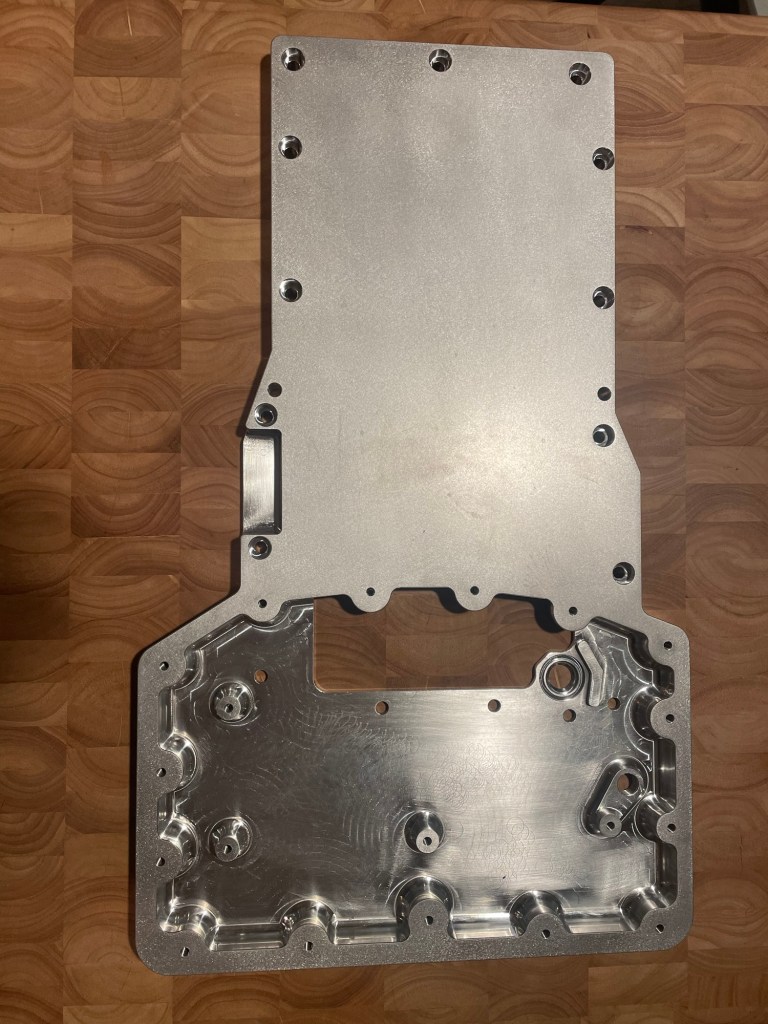
Every motor swap is in some way or another a disaster, and as an early adopter, Cameron experienced several of these teething problems. The biggest hardware problem was a leaking oil pan; it wasn’t always straight, had bad welds, and the baffles inside would break.

1” thick aluminum adapter plate.

Cameron’s solution to this is simple; use an existing oil pan from another car and make up a custom adapter plate. He let the OEMs do the hard work and adapted an off the shelf stamping to an inch of billet aluminum. Don’t worry, the oil pan sits flush or slightly above the subframe, and so it’s not going to deck out; the lowest part on the car is actually the exhaust crossover tube.

This was always a problem with the swap, because the exhaust is on the other side of the car. The exhaust needs to cross over from passenger side to driver side, but the PPF is in the way. And so is the clutch fork.

Cameron’s solution to the clutch fork problem was the same as the oil pan: use existing parts. He took an existing hydraulic throwout bearing kit and moved the clutch slave inside of the transmission. This makes routing the exhaust much easier, and his internal clutch slave kit even works with other swaps so long as they are using Miata clutch kits and transmissions.

So let’s talk numbers, most importantly cost, hours, horsepower, and torque.

Ecotec by the numbers

I’d guess most people choose an Ecotec swap because you can find junkyard motors for $200. This is dirt cheap by any measure, especially with Miata motors going for over $1200, and K24s going for a couple thousand. On a dollar for dollar performance calculation, the Ecotec wins. 

The other part of cost that you need to factor in, is how long it takes to do the swap. Most other engine swaps require modification of the stock subframe, which isn’t necessary with the Ecotec Miata swap. And unlike using forced-induction on a BP, the stock radiator is ample for the 2.4L Ecotec. It’s not a terribly difficult operation to swap in the motor, and three people can do the full swap in a weekend.

Three people? Well, extra hands help. An Ecotec is about 40 lbs heavier than a BP motor. The head is a lot bigger, and inside the block you have a heavier crank and balance shafts.

Bigger, but still plenty of room. Notice the intake is now on the cold side of the engine.

Power-wise, a bone stock port-inject Ecotec swap with a drop-in tune will make between 165-170 hp. I don’t think a Miata needs any more power than that, but if you have a heavier car and/or simply want more power, common bolt-ons include replacing the cast-iron exhaust manifold with a Polaris header, and something Miata people are familiar with, swapping OE cams.

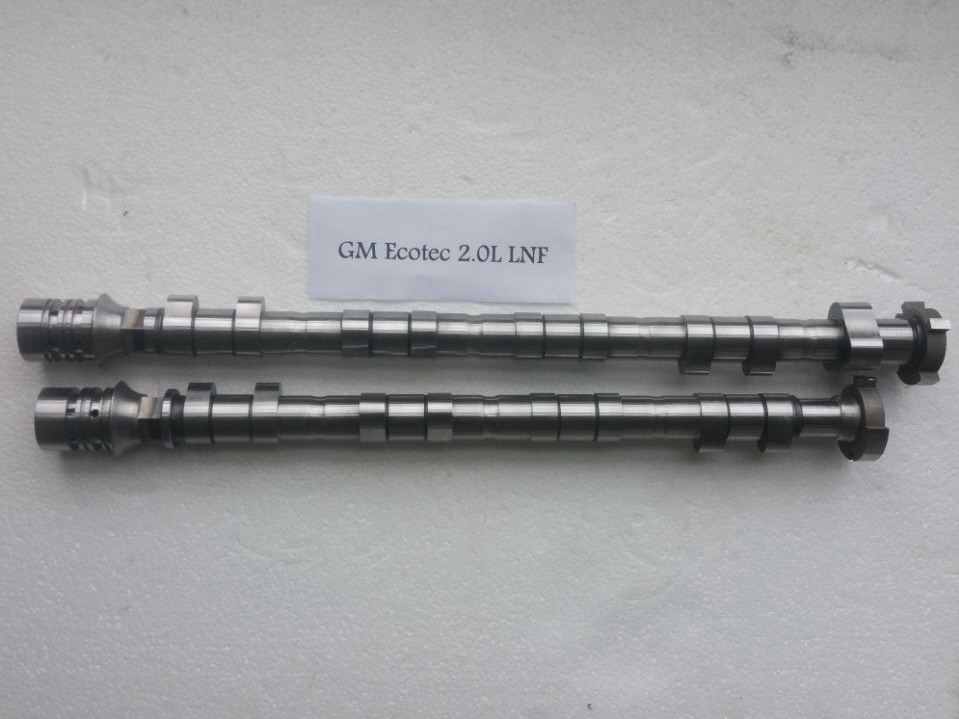
On Miatas, you can modify the exhaust cam and swap it onto the intake side, which provides a little more duration. The exhintake cam swap can make up to 8 hp when properly timed and tuned. The Ecotec cam swap is the opposite; you put the intake cam on the exhaust side. This gives more lift and duration, and results in 15-20 hp. Because you can pull a cam at the junkyard for $20, there probably isn’t a more cost effective gain to be had anywhere. 

The cheapest power you can get.

For additional power, some people may want to remove the balance shafts and/or water pump, but Cameron advises against this. The small amount of power gained simply isn’t worth the loss in reliability, or the headaches that ensue. With the balance shafts in, you end up with a Singer sewing machine up front for your daily commute that’s hiding +175 hp for the track. Keep this engine under 7500 and you can beat on it like it still owes you that $209.99+tax. Just make sure to put good oil in and a Hengst oil filter (seriously, use no other filter, they like to collapse).

If you need more power, race camshafts, a plug-n-play standalone ECM from BMEP Solutions, and turbo kits are a call away. While the internet isn’t ripe with aftermarket parts like a K-motor, parts are still readily available, and Cameron assures me Ecotec Miata is there to help.

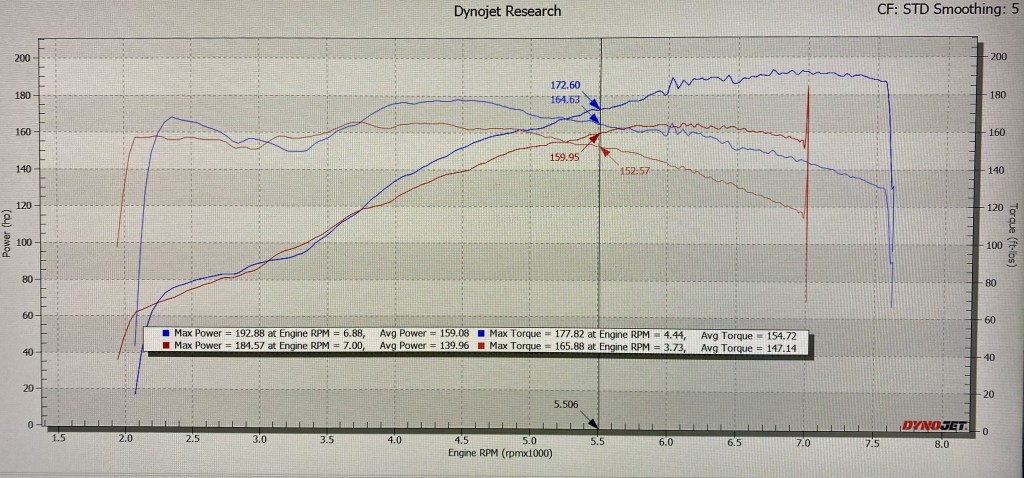
But like I started with, I don’t want anything north of 200 hp, and so a basic kit would get me there. Here’s a dyno chart showing a bone stock engine that makes 160 hp. This is a little on the low side compared to some junkyard engines, but with a Polaris Slingshot header ($200) a shorty ram intake, and a little tuning, you can easily make over 172 hp.

Red: stock. Blue: short ram intake and BMPE tuned.

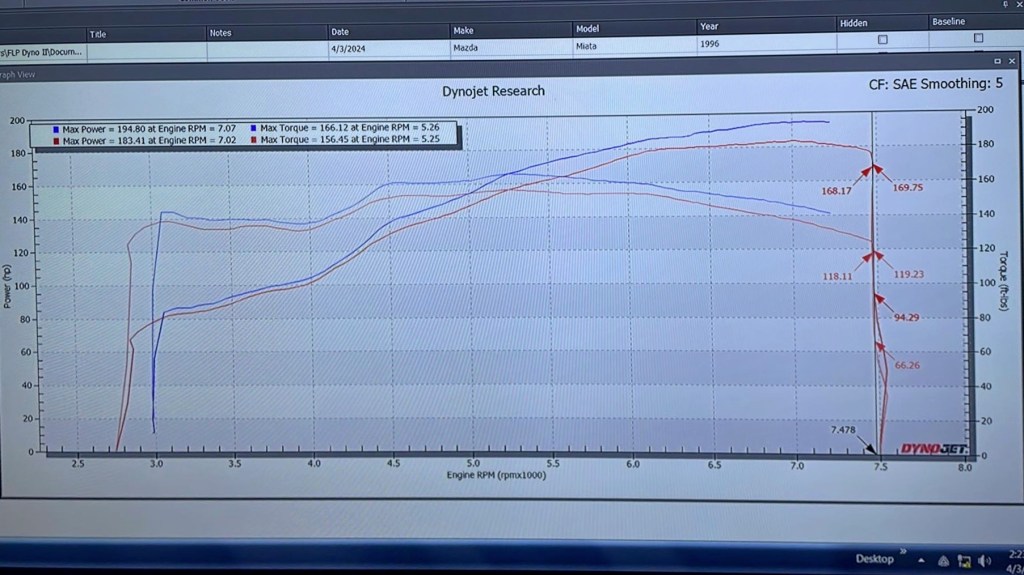
Cameron’s personal endurance racing engine sports regrind cams, and smartly retains the water pump and balance shaft for all-day running. Even with worn out piston rings this put out nearly 200 hp. See for yourself.

The swap kit is competitively priced at $4500, which is similar to a Busa swap, but cheaper than most others. The real savings is the $200 motor, and how cheaply you can get another 20 hp. With a weekend of wrenching you can upgrade that moving chicane to something that will keep putting a smile on your face, and give German sports cars something to worry about.

If I Designed a Race Series…

Northeast GT recently decided to cancel or at least rethink their new racing series after just one race. A lot of people were initially interested, and the 30+ cars that entered the first race at Thompson was a good sign. But only 8 cars signed up for the second race, and so they’ve cancelled the series.

It’s difficult to understand why this failed, but it’s possible they didn’t get the classing done correctly. Originally there were five divisions: 14:1, 11:1, 9:1, 7:1, and unlimited. I remember the early discussions on Facebook, and I was one of the minority that said they needed a slower class than 14:1. I also felt that 7:1 and Unlimited were silly, because of closing speeds with other cars. Six months later they removed the Unlimited class and added a 18:1 class, but by that time, I wonder if people even noticed the pivot.

So it got me to thinking, If I was going to design a new racing series, how would I do it? Well I wouldn’t have people build cars to a new and untested set of rules; I would make a series for cars that are already racing in the most popular classes.

I’d have the same rules for both wheel-to-wheel and time trials. This is just like NASA has done with ST and TT series, that use the same rules for both racing and time trials (TT). This is also similar to GLTC and Club TR, with the time trial division being a feeder class into racing. The classes would go something like this:

  • B-Spec and Sundae Cup – The fastest growing SCCA class, plus the popular Grid Life time trial class.
  • Clubman – Spec Miata, SE30, 944 Spec, ITA, ST6, HC2, and others of around 18:1 lbs/hp. Plus a time trial version of the same.
  • Touring – A combination of the GLTC and NASA ST4 rules, with Club TR and TT4 for the time trialers.
  • TA – Faster time attack cars.

B-Spec / Sundae Cup

In my fantasy racing series, the slowest class would be combination of B-spec and Sundae Cup. B-Spec is a class for front-wheel drive hatchbacks like Honda Fits and Minis, and it’s the fastest growing SCCA class. The number of cars on the grid is astounding, because the enthusiasm for these little cars far outweighs the performance.

You can see the same thing in Grid Life’s Sundae Cup time trial class, with lots of people excited about racing the slowest class. Sundae Cup doesn’t specify FWD cars, but most of them are, and with a 25:1 lbs/hp cap, the performance is quite similar to B-Spec. If you put a B-spec and Sundae on the same tires (or vice versa), they’d be very close in performance, and whatever difference could be adjusted with a small amount of ballast.

So there’s your first class, which would encompass one wheel-to-wheel division, and one time trial. Competitors could start in the time trial class and then as their skills improve, they can cage the car and enter wheel to wheel racing. Or not.

Clubman

If you go to a NASA or SCCA race, the most popular class is Spec Miata, and so it makes sense to have a class based around Spec Miatas, and any car with the same level of performance. If you look at lap times, SE30, and 944 Spec are nearly identical to Spec Miata, so right away you have three different cars racing in this class, and that should fill the grid.

So what else fits here? SCCA has classes like ITA and H Production that are similar in performance to Spec Miatas, and I’m sure there are other classes in NASA (H2 maybe) that do similar times.

This class would also include pretty much any car with 18:1 lbs/hp. I’d include NASA ST6 here as well, even thought it’s a 19:1 class. But because they measure average horsepower over several data points, it’s closer to 18:1 anyway.

Naturally, there would be a time trial division for this class, which serves as the feeder series for wheel-to-wheel racing, or as the end point for anyone who simply wants to race in a time attack format.

Touring

The fastest wheel-to-wheel class would be a combination of two very popular classes, Grid Life Touring Cup and NASA ST4. If you don’t know what GLTC is, you must be under a rock, because it’s got more excitement and momentum behind it than any other wheel-to-wheel racing series. Grid Life has a time trial series called Club TR, which has similar performance to GLTC, and it proves how popular cars with this level of performance are.

GLTC is based on 12.5 lbs/hp, with various modifications taken for engine performance, aero, and the like. This allows cars from Miatas to Corvettes to compete equally, and number of interesting builds is remarkable. The racing is close (at least in the mid pack), and it’s just so fucking obvious that this is the way forward.

NASA ST4 is a class with similar performance, and the time trial version, TT4, is even more popular. In fact I believe Hyperfest is based on the TT4 rule set. So if you add the GLTC and Club TR people to the ST4/TT4 people, you have a winning formula. I wouldn’t have a faster wheel-to-wheel class than this, because Grid Life doesn’t, and they are fucking killing it.

Time attack 1 and 2

I’d also have two classes for faster time trial cars. These probably would be based on NASA TT2 (10:1 lbs/hp) at the lower level, and then one unlimited class, but I’d be open to ideas. I don’t really follow this level of time attack racing, so I’d have to see what is the most popular, and then make two classes based on that. But it’s clear that time trial racing is popular, and 12.5:1 ish isn’t fast enough in the non-racing category.

Conclusion

I guess Northeast GT expected people to build cars from scratch to their unique rules, rather than allowing people who are already racing to simply show up and race. Do you race in Spec Miata? Show me your log book and you’re in Clubman. Do you race in GLTC? Show me your log book and you can race in Touring. Have you built a time attack car that fits into one of the classes? Let’s fucking go! My fantasy racing series would bring together the most popular race cars into an endurance racing format, without reinventing the wheel.

Aside from the classing, I think Northeast GT had some great rules and a neat weekend format with short endurance races. Every weekend included a free race school as well. I especially liked their aero rules, and would work some version of that into my fantasy race series.

The people behind NEGT, Nick and Armin, are good people. They hosted a free two day Instructor Fest earlier this year, and were brave enough to try something new, from scratch. I know more great things will come from this idea factory.

The most recent communication is that there may indeed be races next year, so the series isn’t yet kaput. This year there will be a Corner Faster day at Palmer on Sept 22. There will be racing, time trials, and tracking, and it looks like a fun time. I guess I have to finish Falconet if I’m going to make it there in time!

I Like Big Butts

This post is borderline inappropriate, and if it doesn’t get me cancelled, should probably classify me as a boomer. Enh.

The three-box sedans of my youth had well defined shapes, with a long hood, flat roofs, angled rear window, and flat trunk. These days cars have elongated shapes that blend together front to back.

If you compare a sedan from 20 years ago with a modern one, one design element most new cars share is a big butt. What I mean by that is, the trunks are much higher and wider. This shape brings the deck lid closer in height to the roofline, and when you blend those together, it’s creates a very efficient fastback shape.

Everyone is doing it, and you can’t tell where the roof ends and the trunk begins. The line between hatchback and sedan has blurred to insignificance. I can no longer tell a Honda Civic from a Chevy Malibu from a whatever.

Homogeneous evolution.
This isn’t surprising, because when performance is the driving factor, designs often gravitate towards function. I saw the same thing in skateboarding over the years. Shapes changed from skinny banana boards, then to pigs, then to fish, and now everything is a popsicle.

Skateboard shape evolution

To get back to the shape of cars, if you look at them from the side, most are shaped like airplane wings, meaning they have a cambered profile. As air moves over the top of the car, it creates lift. The more exaggerated the curve, the longer air stays attached, and more lift the car generates. As such, a low trunk lid keeps air attached longer, meaning less drag, but more lift.

On the other hand, a taller trunk (bigger butt) means a more gradual backlight angle, which reduces drag. In addition, air breaks away earlier on a taller trunk. Both of these factors improve performance.

Big butt genetics

Cars with big butts have evolved because they have advantages.

  • Less drag
  • Less lift
  • More trunk space
  • Fucking hot

Like many performance related genes, big butts have their roots in racing. Read any car magazine and you’ll eventually run into these cliches: “Win on Sunday, sell on Monday,” and “Racing improves the breed.”

Historically, NASCAR had great success partially because people could recognize the cars underneath. The bodywork followed the lines of factory cars (more so on the previous generations), and you could buy a semblance of one on Monday. There were of course many changes under the skin, but one of the key external differences NASCAR allowed was that you could raise the height of the trunk.

Similarly, BMW built the E30 M3 to go production racing, and one of the important elements in the design was to reduce rear-end lift. BMW accomplished this in a similar fashion by making the E30 M3 trunk 1.6″ higher than a E30 trunk.

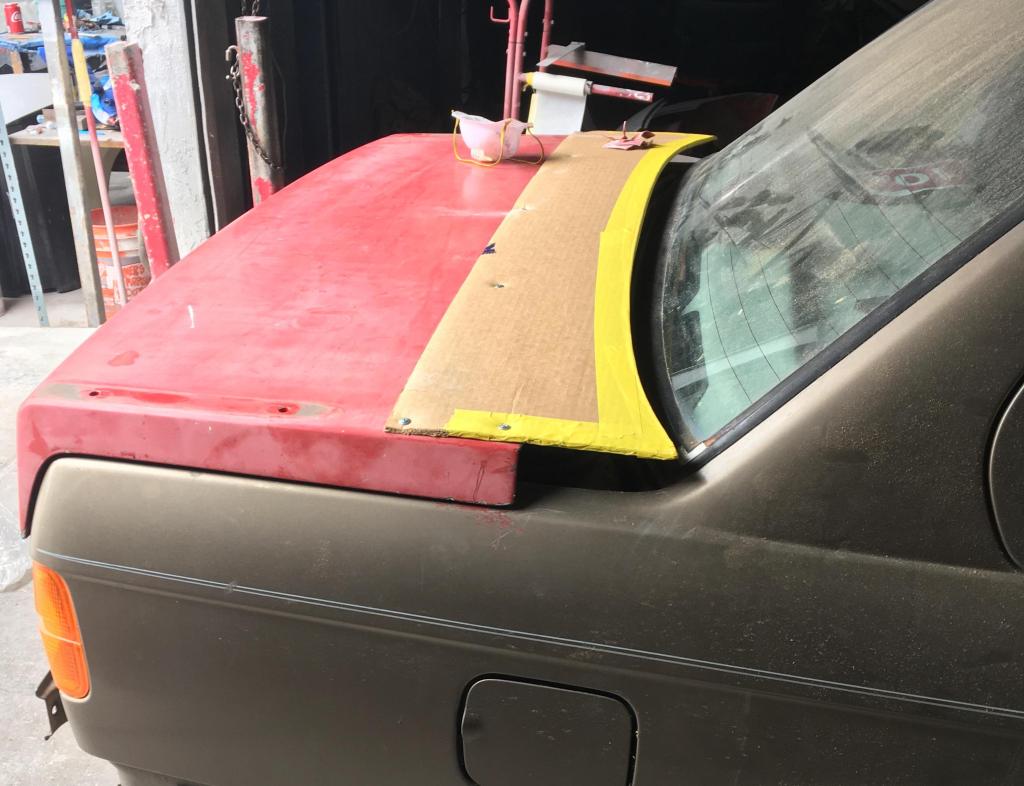
A DIY E30 M3 trunk.

Big butts improved the racing breed, and that gene is now dominant in production cars as well. As this relates to the only car that matters, each generation of Miata has had a trunk that’s higher than the previous.

The first generation Miata had a flat ass, but she was just a kid back then, and it was normal for that age.

Cute.

The NB grew up a little, and got a lady lump in the middle of the trunk.

Line drawing shows where Mazda added curvature in the trunk.

The NC was like a Miata who went to college and put on the freshman 15: bigger everywhere.

Went to school and got a degree. All my friends call it the big D.

Now in her dirty-30s, the ND is slimmed down, with a butt that is higher, boat-tailed, and pert.

Fuck me dead, the ND looks good from this angle.

Get sprung

The first rule of a production car is that it needs to sell, and that’s based more on appearance than function. But the public has embraced that form follows function, and now big butts are the norm.

Here’s some pics from PornHub.

You other brothers can’t deny, baby got back.
Backin’ that ass up.
I bet there’s some junk in that trunk.
Get that azz over here, bish.
Whassup baaaabeeee?
Choices, choices.
I’d hit that.
I think I’m going to faint.
Oh c’mon now, that’s cheating!

Beating up Miatas in a Yaris

I’m a Miata guy. I like how economical they are. I like how they handle and communicate, and that lets me extract every bit of performance. Miatas are slow, but they punch above their weight, and you can generally pass people in cars that cost 10x as much. If I’m being honest, it’s especially fun to put the hurt on German sports car owners. But this time the shoe was on the other foot. Racing one of the only cars that is slower and more economical than a Miata, we beat 10 out of 12 Miatas in a lowly Toyota Yaris.

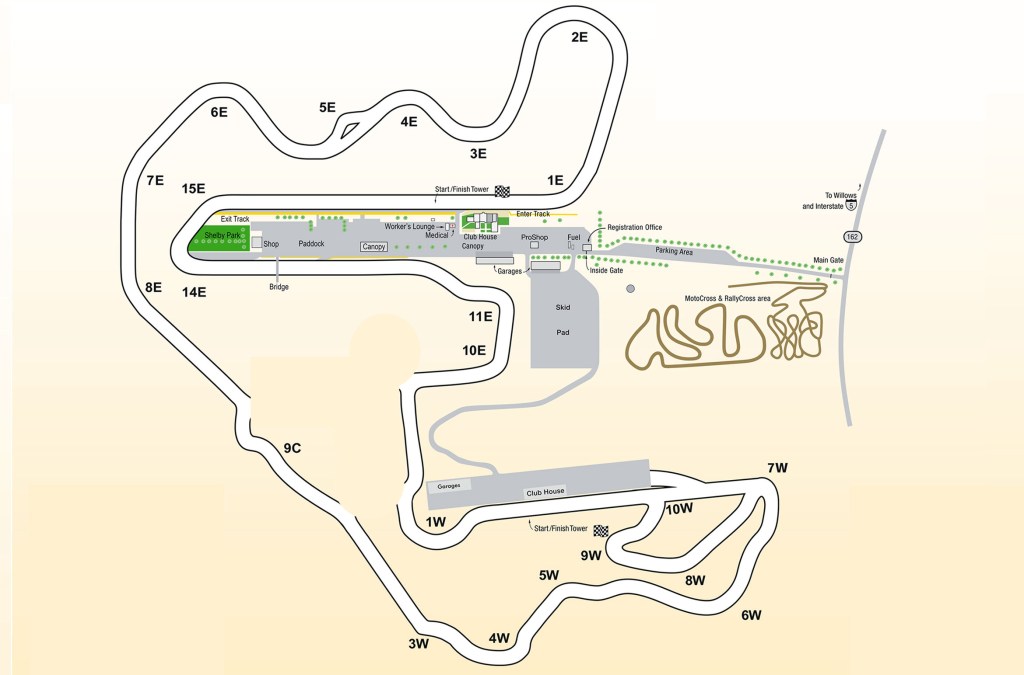
Where this shameful event occurred was at the 24 Hours of Lemons race at Thunderhill. Lemons often runs here, combining the 3-mile and 2-mile course using a bypass from Turn 7W to the front straight. That removes Turn 8W, which is a fun right hander that crests a hill and unweights the tires, and two 2nd-gear corners that are about the only place a Miata or Yaris can accelerate quickly.

Thunderhill 5 mile is fun. Backwards is more fun!

The one time they ran the full course without the bypass was back in 2014 when they set the Guinness Book of Worlds Records record for most cars in a race with 216 cars simultaneously racing on track. We were in that race, in a Miata of course, and it was as crazy as that sounds.

For this event, Lemons decided to run the entire track without the 7W bypass, and this full 5-mile configuration ranks as my all-time favorite track. Elevation, blind corners, off camber… the layout has everything you could ask for. But Lemons being Lemons, they decided to run the entire course backwards, which nobody has done before. When you run a course backwards, the curbing isn’t in the right spot, the usual reference points are gone, and you end up figuring shit out as you race. It’s exciting, but not exactly safe.

Because stupid is as stupid does, Lemons further decreed that they’d switch to the 3-mile track on Sunday. And run it in both directions. That’s right, they’d stop the race in the middle of the day, re-grid the cars, and run them in the opposite direction.

Because stupid is as stupid does, I booked a flight to Sacto. I packed my helmet, gloves, shoes, and maxed out the rest of my 50-lb weight limit with aluminum street signs, rivets, wing mounts, angle brackets, and various fabrication tools.

Yaris > Yarnis

Ian originally built his Yaris for the B-Spec class, but after one race where a backmarker idiot ran him and another car off track, and discovering the rampant cheating in the class, he gave up trying to race with the SCCA.

The Yaris has only 100 hp, and to make matters worse, the gaps between the gears are so large that the engine falls out of the powerband on every shift. There are momentum cars, and there are momentum cars; this is the latter.

For being a soft FWD car, it handles surprisingly well. What it lacks in power it makes up in being frugal, and burns only 4 gallons per hour. The car once went 2 hours and 42 minutes in a stint, but there were a lot of full course yellows. Still, it’s quite possible to get 2.5 hours out of a 10-gallon tank, and you can’t say that about many race cars.

We themed the car by putting yarn tufts all over the car, like you would for visualizing airflow. Our official team name was Toyota Kazoo Racing, but after theming we were pretty much Team Yarnis.

Tires

I’ve been using Accelera 651 Sport tires as a dual-duty tire for street and mild track use. The 651s have a 200 TW rating, but in my testing I found the performance similar to the 340 TW Continental ExtremeContact Sport. I’ve also raced these tires in Lemons before, and found they were about a second per mile slower than a proper 200 TW endurance tire.

So they are definitely at the slower end of what I’d consider an endurance racing tire, but we’d race on them anyway. Why?

Partly because the 651s go on sale occasionally for half price, and the first set has free shipping and a 30-day money back guarantee. Ian purchased a full set for $260 to his door. In addition, the importer, Tire Streets, has a racing program which awards free tires for winning in a recognized racing series. A win gets you four free tires, second gets you a pair, and third gets you a single tire. So not only were the tires cheap, depending on where we finished, they might even be free.

We’d run the Accelera 651 on the front, because the rear tires were already chosen. These are old-stock (as in 6-7 years old) 205/55r16 Maxxis VR1s. Ian got these on closeout and bought a pallet of them. The tires are 25″ diameter (compare with 23″ front tires) which required jacking up the rear shocks for clearance. The combination of tire diameter and coilover height gave the car extreme forward rake, putting way more weight on the front tires than is necessary, and way too little on the rear. But the car looks really cool this way, like a Hot Wheels car, and that is super Lemony.

To recap our amazing tire strategy: the fronts are an off-brand low-grip, $65 tire; the rears are the wrong size chosen primarily for looks, and were $59.95 each. That’s a performance-first strategy right there.

Aero

With all of that extreme forward rake from the mismatched tire sizes, I knew that we’d have to add rear grip or the car would rotate too much in fast corners. The easiest way to add rear grip at speed is to use a wing.

Ian’s teammate Mike did a really nice job making a double wing from two cheap single wings, but I felt it was mounted too close to the roof. A wing needs about a chord length under the wing so that it can create suction, and if you mount a wing too close to a trunk or roof, the low pressure region collides with the high pressure region, and you get a spoiler, not a wing.

So I made new wing mounts out of splitter plywood and bolted them to the hatchback. These wing mounts allow the wing to move forward and back, so we could theoretically adjust front/rear aero balance via leverage, independent of wing angle.

Plywood wing mounts were surprisingly sturdy.

Ian also had a 9 Lives Racing wing, but hadn’t welded on the wing mounts I gave him. So I riveted on some mounts and we’d test that wing on Sunday. With rear aero addressed, the next thing was to add more front grip and reduce drag.

For the front, my specifications were the following:

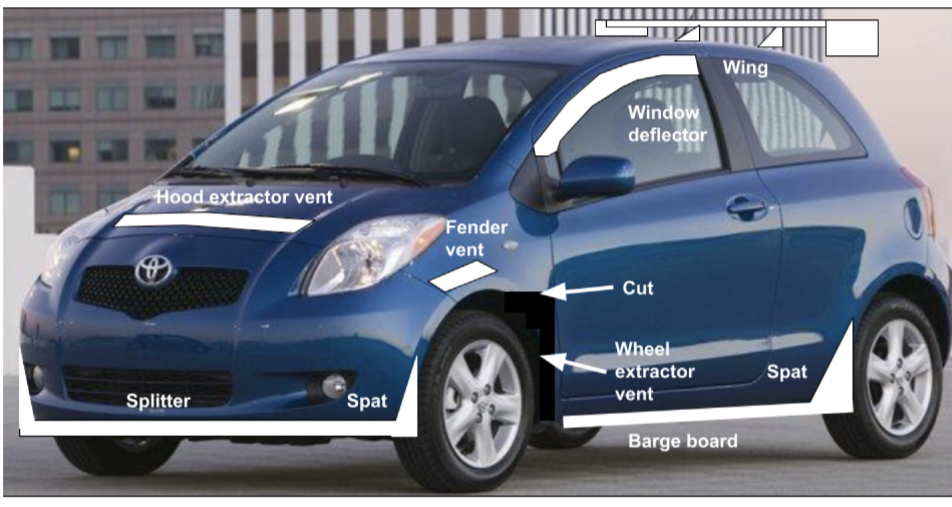
  • Flat undertray with 12-degree ramps (diffusers) dumping into the wheel wells.
  • Removable splitter, adjustable for length, with cutouts for the diffusers.
  • Radius the underside of the front splitter edge and bevel the trailing edge upwards.
  • Spats in front of the tires.
  • Duct the radiator and put an extractor vent in the hood, to make sure no air from the engine compartment could get below the splitter.
  • Vent the front quarter panel to extract any air in the wheel arch.
The original aero plan.

The next thing to address was drag reduction. The Yaris has enormous windows, and when opened, turns the rear of the car into a parachute. Mike rounded the B-pillars with sheet aluminum, which would help extract some of that air. He also added rear wheel covers to reduce drag. We also reduced the openings in the front of the car by more than half, blocking off the bottom grill, and reducing the radiator opening by 1/3.

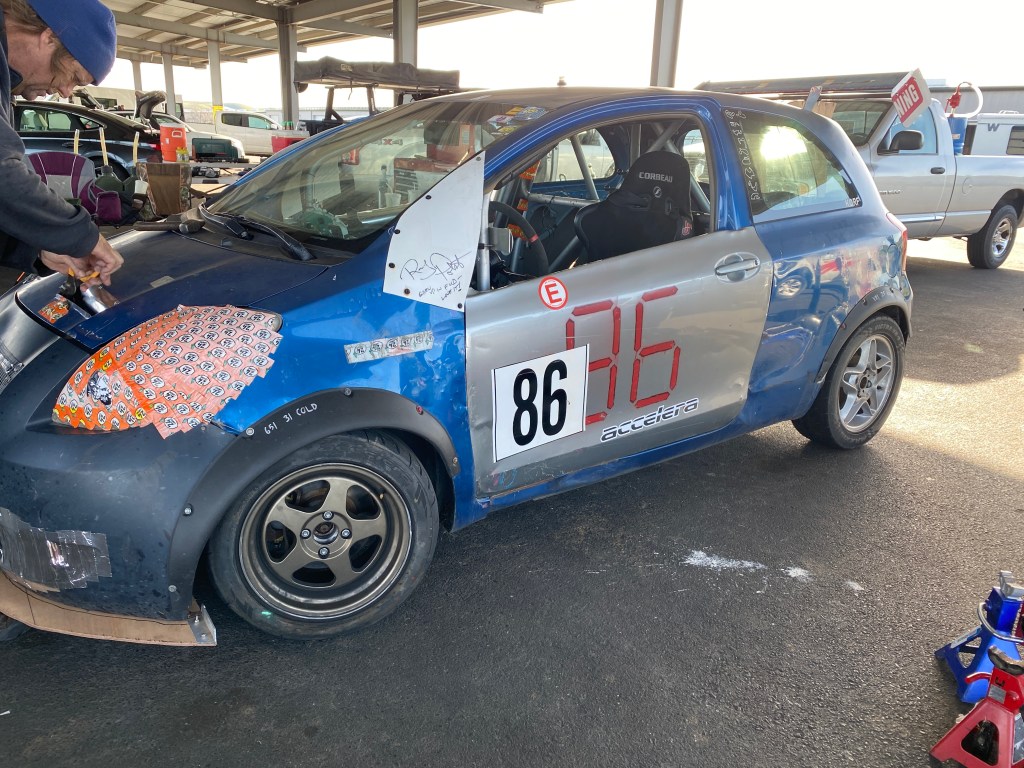
That all went mostly to plan, but it took more than the single day I had set aside, and so we were building aero in the pits all weekend. Whenever the car was not racing, it was getting cut, riveted, ducted, and otherwise transformed. I didn’t get a chance to make barge boards, they were pretty low on the list anyway.

Aero would continue to evolve through the weekend.

With all of that aero work happening in the pits on Friday, we missed our early tech spot, but we got classed in C with zero laps. We also missed our chance to test the car on track, or see what the track looks like in reverse. But we’ll figure that all out in the race tomorrow. We have four fast drivers and I feel like we have a shot of winning our class. The question is, can we stay out of the penalty box?

Attention circle

The Yaris has done well in past Lemons races, and should have won Class C by now. But the team keeps getting too many black flags from exceeding the limits of the “attention circle”.

A driver’s attention circle is a lot like a tire’s friction circle. A tire that is being used 90% for cornering has only 10% left for braking or acceleration. If you ask for more than that, you slide out. The attention circle is the same. If you have 90% of your attention on going fast, you have 10% left for watching flag stations, monitoring the car, and avoiding other idiots driving like idiots.

Unfortunately Ian’s teammates spend 95% of their attention on beating each other, and so they exceed the limits of the attention circle and get black flags regularly. From watching their progress over the past couple years, I’d guess they average about four black flags per race.

Let me just get on my high horse for a minute here…. In the past 11 years I’ve done 26 endurance races and have accrued three black flags: One was a blend line violation when I was avoiding another car; One was when I hit a car because I was driving like an idiot; And one time when I got hit from behind by someone else driving like an idiot. All of them are my fault. When you drive the car, you put yourself into situations where things happen. If you’re in the car and lighting hits it, it’s your fault; you put yourself in that situation.

Those incidents aside, I have never spun, put four off, or made a pass under yellow. Yet. I’m sure those things will happen, because that’s racing. But I also know that in endurance racing, my primary job is to take care of the car for the next driver. I won’t put the car in a compromising situation, I won’t flat spot the tires, I’ll watch the gauges and mirrors, I’ll see every flag station, and I’ll stay the fuck out of trouble.

Driving with all of those things in my attention circle means that I’m not concentrating so much on going fast. I lift when I should be flat footed, I don’t steal apexes or defend my line, I point people by, and I drive like a gentleman. I’m not the fastest driver on the team; I’m occasionally the slowest. But if you do the math, I generally come out up top.

The math is this: A black flag is at minimum a 5 minute penalty, and for the Yaris on the the 3-mile track, it works out to just over 6 seconds per lap. That’s right, whatever your best lap was, add 6 seconds to that one, that’s your fastest lap. And add 6 seconds to every other laps as well. The fact is, one black flag makes you the slowest driver on the team.

If you get a second black flag in a Lemons race, they will start to hold you longer, and as you rack up more and more BFs, they will park your car for an hour and/or make you do stupid and embarrassing shit. The organizers made sure to mention this in the driver meeting, that longer penalties would happen at your second black flag. You can probably tell I’m going somewhere with this….

I keep telling Ian there is no learning without consequence, and he should fine his drivers for black flags: $100 for the first offense, $200 for the second, and so on. Get four black flags and you’re out a thousand bucks. That’s a teachable moment right there.

Instead, Ian removed the Rumblestrip lap timer from the car, feeling that this should remove the incentive for a fast-lap competition. In addition, Ian said there would be a competition for whoever gets the best gas milage. That’s pretty clever, and he thought it might keep Danny and Mike from competing against each other for once. Unfortunately, I’m the only one who followed team orders.

Saturday

95 cars registered for the race, but I believe only 88 cars actually started. This is normal for Lemons, some cars never make the starting grid. There was a Lucky Dog race at Sonoma the same weekend, which pulled some of the attendance away, and so weren’t going to get anywhere near the 216 cars we had when we set the record. Which is fine by me, that was too many cars. With 88 cars it works out to 17.6 cars per mile, which should leave everyone plenty of room for racing.

I drove the first stint. There was no time to test all the aero changes we’d made, so my sighting laps were the only testing I’d get. Unfortunately I got stuck behind a really slow car and had a train behind me, so I couldn’t get heat into my tires. Going just half speed I lost the rear end in T7, then again had to save a spin in T1W and T7W. The extreme rake on the car meant there was very little weight on the rear tires, and even with repetitive braking couldn’t get any heat into them .

I did one full lap, and about half way through my second lap, on the west-east connector, they threw the green flag. So I started the race about 2 minutes away from the starting line, which wasn’t very good luck, but as I picked up the pace I felt the rear tires come in, and was able to push a bit.

You’ll recall that the strategy was to get the most MPG, and so I hypermiled my way around the track, short shifting and coasting into braking zones. There’s no economical way to take the 2nd-gear corners on the West side, but it was fun to out accelerate some cars. That’s really the only place that can happen.

I drove a clean stint for two hours and 27 minutes, making a lot of safe passes and bringing the team up to 24th place overall and 2nd in class. I didn’t light the track on fire, but it was a solid effort averaging 15.3 mpg. Unfortunately I set up the Aim Solo incorrectly, and Ian forgot to turn on the video cameras, so all I have are my memories from this stint.

Mike got in the car next and after a few good laps suddenly went four off in Turn 5. This is a tricky, blind, tight corner, and I saw several people go off here. But I’m not going to make excuses for Mike – there’s no reason to go off the track when you’re all alone and you’re competing for who can get the best gas milage.

Mike caught another black flag for a blend line violation exiting Turn 1. The organizers warned about this in the driver’s meeting, and said to treat all blend lines as walls, and yet at least a dozen people got black flags for this. Mike said he was going three wide there and had to cross the blend line to avoid traffic, but since he put himself in that situation, he’s 100% at fault.

That second black flag cost us a bit more time, and we discussed throwing in the towel and using the rest of the weekend for testing. I lobbied to stay the course, because other teams could also have drivers with poor judgement, or mechanicals, or simply bad luck. So with about 20 minutes in penalty time already in the bank, and knowing the next flag would park us for an hour, Mike got back on track and ran some quick, clean laps to finish out his stint.

Danny drove next and did some very fast laps that got us back to fourth place in class, and then Ian drove a short stint to close out the day. His Achilles tendon hasn’t fully healed, so he didn’t want to risk that, but wanted to get in some hot laps on this unique reverse 5-mile layout. Mission accomplished.

Saturday evening we continued on aero until the sun went down, adding more venting and spats on the spitter in front of the front tires.

Sunday

Before the race we discussed strategy and reckoned we were still in for a podium if we could avoid black flags and skip a pit stop. If all three drivers focused on economy and not lap times, we’d make the whole race on only two pit stops.

We changed to a 9 Lives Racing wing on Sunday. It was better.

I drove the first stint again and settled into hypermile mode, netting 16.3 mpg in a 2 hour and 28 minute stint. I drove a pretty boring race, but mixed it up with a GTi and a RX7 in the following clip. They have more top speed, but our aero works around Turns 8 and 7, which makes Turn 6 my passing zone (recall we are running it backwards, so the turns are descending in order). I get by the GTi and then get on the RX7, who gives me a point by on the front straight, right into a waving yellow! I back off and then make room for a second-gen MR2 to blend onto the track, which puts the RX7 out of touch for a bit. But I get by the MR2 and RX7 eventually.

A lap after I pass the RX7 I see the IS300 of the team pitted next to us. He’s closing fast but I want to show him a little of what the car can do, and I break out of hypermiling mode for a single lap and do a 1:28.14. (This is at 1:44 in the video if you care.) It doesn’t matter, the IS300 catches me and I point him by just before the front straight

I got us back into the podium positions and handed the car off to Danny, who’s job it was to drive economically and finish out the reverse direction, stay in the car for the switchover, and run the tank dry in the forward direction. It wasn’t necessary to drive flat out, since our strategy relied on skipping a fuel stop. In fact, the only way the strategy would fail is if we had to fuel an extra time. After watching Danny’s full stint, I don’t think he heard a word of the race strategy, and just went out there as usual driving with aggression and trying to make passes, not distance.

Here’s a single lap of me and Danny doing about the same lap time, compare the driving styles and notice how many steering corrections he makes. Everyone has their own driving style, but I have to think mine is easier on the tires and gets better economy. Indeed I did beat him by 1 mpg.

Just after noon was the switchover, where they stopped the race, re-gridded the cars, and put the cars back in the regular forward direction. Ian and I were in the tower watching when they threw the double yellow, and as we looked across to find Danny, we watched him pass another car going up to Turn 8. We hoped the judges didn’t see that, or we’d have earned ourselves another black flag.

Danny got lucky because the judges missed that infraction, and he got lucky again by avoiding a big pile up on the front straight:

Our last driver was Mike, and on his first lap had to return to the pits immediately for a black flag. It turns out it wasn’t for Danny’s pass under yellow, but a 4-off right before entering the pits. Jesus.

After that Mike got back on track, ran some decent (but I wouldn’t say economical) laps, and then picked up another pass under yellow at Turn 14 or 15. That one was pretty hard to see, and even the organizers felt a bit sheepish about it.

So now with four fucking black flags (shoulda been five), we’ve blown our four lap cushion, and now Anal Probe Returns to Earth are only a lap down on us. To Mike’s credit, he put in some fast laps and kept us out of danger. But turning fast laps uses more fuel, and the only way this race strategy would work is if we conserved fuel.

I was up in the tower for the end of the race, and knew there were only a couple laps left; all we had to do to get 2nd in class was cross the line without pitting for fuel or running out of gas. Then I see Mike come across the line with his index finger up, meaning he’s coming in next lap, so I run down to the hot pits and find Ian and Danny, who are planning to do a fuel stop and driver change! I yell that we can’t do that, we have to send Mike right back out again, there’s only one lap left!

Like a nightmare, we see Mike pull into the pits on the last lap, and we yell at him that he has to go back out and if the car runs out of gas, so be it. If we pit, we lose 2nd place. So he goes back on track, makes it around for a lap, and returns on fumes. We get 2nd place in class after all. Phew.

There was no time to take fuel. We ended up just 43 seconds ahead of 3rd place.

We got 13th place out of 88 cars, and like I wrote too many words ago, we somehow beat 10 out of the 12 Miatas in the race.

The team that won C class had slower lap times than we did, and yet they beat us by 8 or 9 laps and placed 9th overall. They drove a clean race and deserved to win. They also deserve to be in B class in the future, because they’ve won C class 3 times now. The Yaris is also arguably a B class car, but as long as the team keeps shooting themselves in the foot, they belong right where they are.

2nd in class, 13th overall.

All in all, it was a great race weekend. I had Mexican food every day, got in 5 hours of racing, did a ton of aero work, visited family, and made new friends. That the racing didn’t work out exactly to plan is normal, and it honestly went better than it should have.

We have some ideas for the next race (or possibly a test day), setting the car back to a normal ride height, corner balancing, using better tires, faster fueling, and better coms. And of course more aero.

2D vs 3D Wings

Fact: Interaction with the car’s roof can have a large impact on the effectiveness of a wing. Case in point: my 9 Lives Racing wing generated 130% more rear downforce when using a fastback than with the OEM hardtop. Same wing, same height, same angle of attack, more downforce. Put another way, the fastback made my 60″ wing behave as a 78″ wing. Although the converse is closer to the truth, which is that the shape of the OEM hardtop made my 60″ wing behave as a 46″ wing. Ouch. There are at least three reasons for this.

  • Less turbulence – Turbulence is bad for wings, it makes less downforce. Here’s proof: when I removed the OEM hard top (making the car into the convertible it was designed to be), I got only 40% of the downforce as the hardtop. Going in the opposite direction, the fastback had less turbulence than the hard top, and that’s where some of the 130% comes from. In other words, you could make anywhere from 40-130 lbs of downforce, at the same speed, from the same wing, just by changing the top and nothing else.
  • Air shape – The wing is flat, the roof is not. As air moves over the center of the car, it has to go up over the windshield, across the roof, down the rear window, and then across to the trunk. This creates a large curve, and air follows this curve in what I’ll call downwash angle. In the center of the car, there’s a downwash angle, outside the car where the wing is in clean air, little or none. It’s probable that the fastback flattened the shape of air, making the center of the wing work more similarly to the sides of the wing.
  • Better wing angle? – During the testing I did at Watkins Glen, I set the wing angle to 4 degrees. When I swapped roofs, I didn’t adjust wing angle. If I’d spent time optimizing wing angle for each roof, this might have made a difference. But I had other things to test and didn’t have time. 9 Lives Racing’s CFD shows that the wing stalls at 5 degrees with an OEM hard top, which is fairly close to what I measured, and so the wing should have been nearly at peak downforce behind the hardtop. However, it’s possible the fastback gave a more optimal wing angle due to a different downwash angle of air. Or it could have been worse, I don’t know. I just don’t want to leave this stone unturned.

The easiest way to mitigate all of these differences is to get the wing as high as possible, where the air is less affected everything in front of it. While the wing may make more downforce in this configuration, the car may not (based on the rear wake and and if it has a diffuser). There are other problems with wings that are too high, but that’s a different article.

I typically mount my wings at roof height, which is a good baseline. But some racing rules limit wing height to substantially less than roof height (SCCA ST) in which case the shape of the roof is going to have a big impact on the effectiveness of the wing.

3D-wings solve this problem by having a center section that has less angle than the ends. But how do you know the shape of air? How wide should the center section be, and how much offset should there be between the center angle and the ends? I mean, it’s got to be different for every car!

Making a 3D wing is expensive and requires composite materials, and a company like APR Performance isn’t going to make a 3D wing that is optimized for each and every car. It just wouldn’t be economically feasible. Instead, they make a few wings that cover typical applications for most cars. The width of the center section, and the offset between middle and ends, are going to be happy mediums.

Image result for 3d car wing gtc

Let’s take a look at some sexy carbon fibre APR wings.

  • The APR GTC-500 is 71″ or 74″, has a 10-degree offset. APR designed this wing for cars with a low-angle fastback, such as a Corvette, NSX, etc.
  • The APR GTC-300 comes in 61″ and 65″ and has a 15-degree offset. According to APR, this wing is designed for widebody sports and touring cars. This wing has a very narrow cross section.
  • The GTC-200 comes in two versions, the original 59.5″ with a 12-degree offset, and a newer 60.5″ with 14-degree offset. I have the 59.5” version, and I’ll get in the details on this one later. According to APR, these wings are designed for sports and compact cars.

Miatas are listed as one of the applications for the GTC-200. Since APR is suggesting the GTC-200 for Miatas, we can conclude that they think there’s a 12-14 degree difference in downwash angle between the center of the car and the outsides. That’s a huge difference!

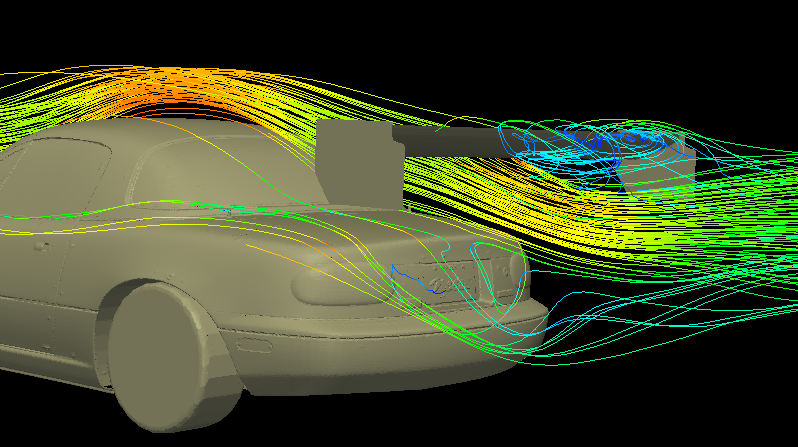
If you look at CFD for different wing shapes, you’ll see most wings operate most efficiently in a pretty narrow range, between 0-10 degrees angle of attack. What APR is telling us with a 12-14 degree offset in the middle of the wing, is that a 2D wing on a Miata will stall in the middle of the wing. Indeed, this stall condition was corroborated by CFD done by the Hancha Group.

Stall in the middle of the wing. Graphic from the Hancha Group

In the picture, notice how air coming down the Miata’s roof effectively increases the angle of attack on the wing. This downwash angle is less at the sides of the wing, and more in the center. The blue lines indicate that there’s a stall condition in the middle of the wing. Stall means more drag and less lift; it’s bad.

9 Lives Racing did their own CFD, and in it they found their wing stalled at around 5 degrees behind a Miata hard top. Based on the profile of the wing (which is similar enough to a CH-10-48-13, which stalls at around 10 degrees), we can conclude that the downwash angle on a Miata OEM hard top is around 5 degrees at roof height. Does that mean 9 Lives Racing’s CFD, or APRs wing design is wrong? No. APRs wing mounts are lower, and the downwash angle is greater closer to the trunk.

In my own testing with a DIY airflow visualizer I measured a 5-7 degree downwash angle at roof height, the greatest angle was just inside the wing stands, whereas in the middle of the roof it was flatter, at about 5 degrees. When I lowered the airflow visualizer to half height, the angle in the middle increased over the span, to about 15-degrees near the trunk. So, that means me, 9 Lives Racing, and APR are all in general agreement about the downdraft angle. Good.

APR GTC-200

I own a GTC-200, let’s take a look. They have a website with data, which APR has a lot of. They show streamlines and pressure plots, but mostly from the top-side of the wing. The suction side of the wing does more work, but they mostly ignore that. I’m also not sure what to make of pressure plots anyway. While they are colorful and look impressive, I don’t know how that translates to anything useful, like lift and drag.

They did CFD analysis and give results in spreadsheet form, which pleases me. However, the CFD appears to be done entirely in free-stream air, which completely misses the point of a 3D wing! They mention this in their explanation of how to read CFD, and this is how they put it: “Basically, this airfoil was never intended to be used in this CFD simulation’s environment of free-stream air.” Totally agree. So why do it?

If I were comparing two wings in free stream CFD, one a 3D wing, and another a 2D wing, I’d expect the 2D wing to perform better. Likewise, in the real world, I would expect a properly designed 3D wing to outperform a 2D wing.

I was going to include a CFD analysis here, but got cock blocked. The APR has a disclaimer on their website: The information contained herein is property of APR Performance, and may not be reproduced in whole or in part without prior written consent from APR Performance. I emailed them to ask permission to use this data and never got a reply.

APR have a blurb on their website that says nobody can republish their CFD without permission. I asked for permission, but they never emailed me back. I also emailed to get new end plugs and they didn’t email me back. Lame on both counts.

Since I don’t have permission to use their public data, I’ll look at my own wing. The GTC200 chord measures around 8.5″ in the middle of the wing, 7″ at the extreme ends, and averages around 8″ across its 59.5″ length. The cross-section shape of the middle of the GTC200 is shown below. I went to Airfoil Tools to find a similar shape and came away with a lot of things that are similar, but because of the chubby tail section, nothing was a really good match.

The airfoil shape that spans most of the wing.

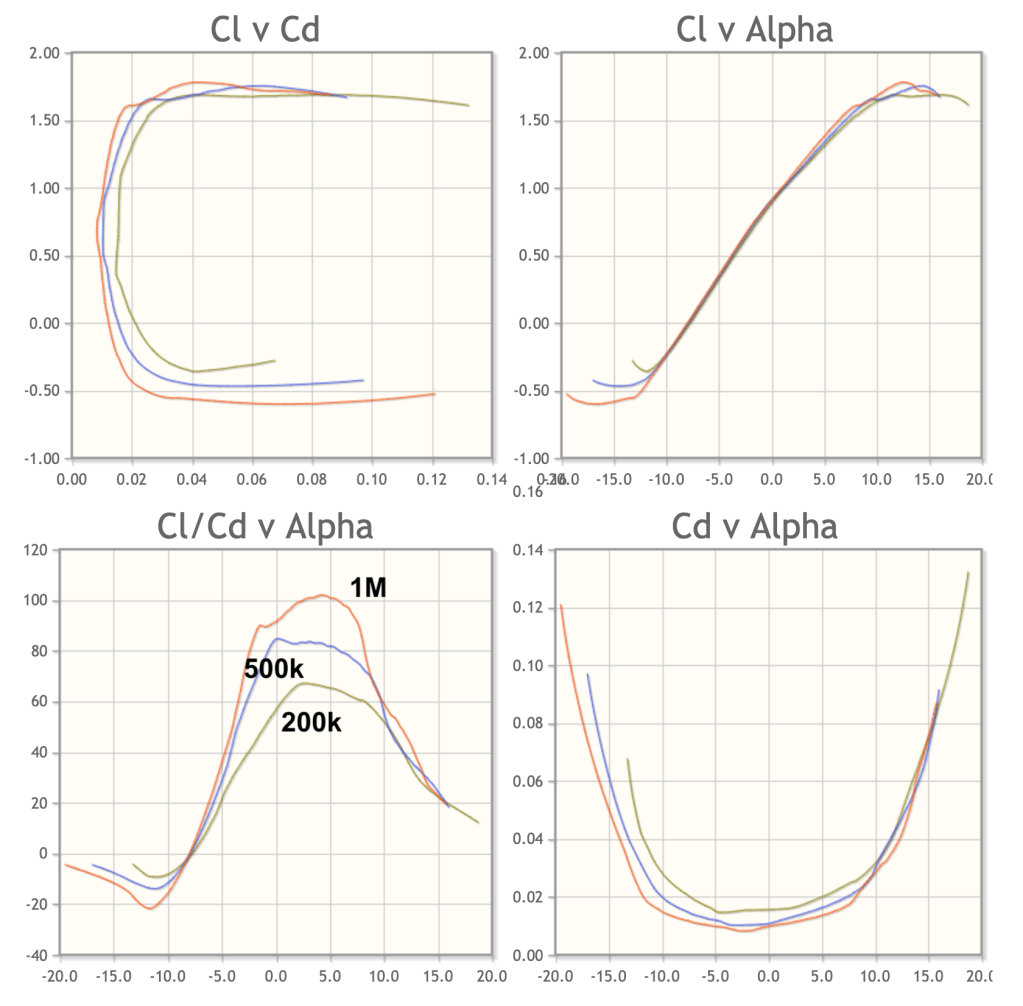
For kicks, I’ll take a look at some numbers for a Gottingen 222 airfoil, which is not dissimilar from the shape of the middle of the wing. When I examine the numbers for the usual 200k, 500k, 1M Re plots (Ncrit = 5), I see a good all-purpose wing.

Not the same profile, but in the same neighborhood.

In the 500k Re range (78 mph at mid chord), the wing is most efficient at 0 degrees, but 3-5 degrees seems like the sweet spot for a range of speeds. The wing stalls around 12 degrees, where lift goes down and drag goes way up.

The ends of the wings taper in chord, and there’s a radical change in shape for the last 10 inches. Just looking at the profile on the ends of the wing, I would imagine there’s flow separation or at least turbulence at the trailing edge with this much upsweep and angle. But I’m not a professional aerodynamicist, and I trust they did their homework. It might even be that some turbulence or separation at the ends is desirable to cancel a trailing vortex. Smarter people than me designed this.

The ends are cast aluminum, my hardware seized inside it. The trailing edge is rounded, which is a no-no in aero. This wing needs a Gurney flap.

I’m curious to see if I can find an airfoil shaped like the ends of the wing, and the closest I can find is the Gottingen 531, which, if I increase the thickness to 140 percent, is not the same, but in the same family of weird.

While this isn’t the same profile, it’s the closest I can find, and I want to see what the numbers look like. I probably should have left off the 1M plot (orange), since that represents this wing traveling at over 180 mph! But if I look at Re 200k and 500k, this shape can take a lot of angle without stalling (see the blue arrow), and 12-14 degrees actually does seem OK (recall this is the offset from the main wing). However, there’s a lot of drag at this steep of an angle.

Given all this data, I’d mount the wing 6-8” off the trunk surface. If it’s higher than that, the downdraft angle changes, and the 3D shape of the wing no longer matches what’s coming down off the roof. I’d set the angle in the center of the wing to zero degrees. If set to more than 3 degrees, the wing ends will stall, creating less downforce and a lot more drag.

Roof-height 3D wing

To be perfectly honest, I’m not crazy about APRs GTC200 wing. I don’t like the profile in the middle or the ends of the wing, and anything with a rounded trailing edge is highly suspect. I also don’t want to mount a wing close to the trunk, because you need space for the negative pressure zone under the wing.

I’d much prefer a 3D wing with a different shape, and I’d mount it at about roof height. There isn’t really anything like that in the market, but it would be simple to build one. If I created a custom 3D wing for a Miata, how much better would it be than a 2D wing?

It’s not that difficult to figure out using existing data. If we say half of the wing is working in the desired range, and the other half is working 5 degrees off (at roof height) we already know the following.

  • If you set the wing to 10 degrees, the ends of the wing will be at max downforce, but the middle of the wing will be effectively at 15 degrees. At this angle, the middle of the wing is stalling, and drag goes way up. This setting has a lot of downforce, but at the cost of too much drag. Don’t do it.
  • A better setting for maximum downforce is to set the wing to 5 degrees, then the outsides are working in a good range and the middle is essentially at 10 degrees. This gives about the same downforce as above, but a lot less drag. I wouldn’t set a wing to more than this.
  • If you set the wing to zero degrees, then the middle is making good downforce at 5 degrees, and the sides are at peak efficiency (zero). This is a good all-purpose setting.
  • You could also set the wing to a couple degrees negative, which would be the wing’s highest lift/drag ratio, but your car would go slower around every track that isn’t a high-speed oval.

Note: The wing ends, meaning the area outside of the wing mounts, accounts for 36% of the total area, but because the air is less turbulent here, they produce more downforce by comparison. That’s why I’m saying that half the wing is working in the desired range, even if it’s a 36/64 split.

Using published CFD data, let’s see how a 2D and 3D wing optimized for roof height mounting would compare at 100 mph.

Wing angleDFDragL/D
2D 0 deg15311.513.35
3D 0 deg126914
2D 5 deg1901711.18
3D 5 deg1811412.93
2D 10 degstalllotswho cares?
3D 10 deg199209.95
Calculated 2D vs 3D using 9LR CFD.

So, is a 3D wing on a Miata worth it? Barely.

At zero degrees, the 3D wing has a 5% better L/D ratio. At 5 degrees AOA, it’s about 14% better. I don’t usually look at the efficiency of a wing, because it’s the efficiency of the entire vehicle that matters, and that figure is generally the highest when the wing is making the most downforce. So how much more downforce can you get out of a 3D wing? About 5%.

That’s not very much, and because Miatas are front-downforce limited, you’re not going to get a lot of performance out of adding more in the rear. But on a low powered car, on a high speed track, then a small reduction in drag for the same amount of downforce can be marginally useful.

I’m toying with the idea of making a DIY 3D wing with Miata-specific dimensions. I’d increase the chord to 12” and maybe use a reverse swan mount. With that much rear downforce I’d need to optimize the shit out of the splitter. But that’s already in the works.

DIY Wing End Plates

Updated 1/12/2023

I originally published this article in August 2020, but after taking the JKF Aero course, and doing more independent research, I’ve updated it.

Wings without end plates allows the low-pressure air below the wing to collide with the high-pressure air on top of the wing. This interaction reduces suction under the wing and creates vortices, which further reduce downforce and create drag. The middle of the wing still works well, but you get progressively less downforce and more drag at the ends. For a quick video on why a wing needs endplates, see this video by Kyle.Engineers.

End plates separate the flow between the top and bottom of the wing, effectively reducing drag and increasing downforce. The end plate has to be large enough to keep these two pressure zones from colliding.

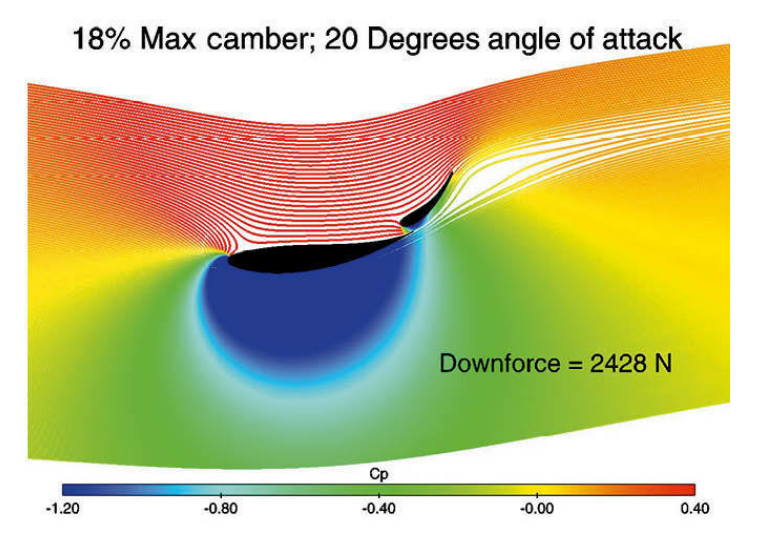
In the following image, notice how different wing shapes have similar high-pressure areas above the wing, but very different low pressure shapes below the wing. Indeed, at first blush you might think that the shape of the end plate should be similar to the pressure zone shape. Note that the low pressure side (suction) is more important than the high pressure side, and so end plates must extend further below the wing than above.

End plate shape should match pressure zone shape. Image is upside down so that it relates to car wings. Image from Race Car Aerodynamics, buy the book.

Take a look at the wing shapes above:

  • The first one (on the left) is a wing with a NACA profile around 4410. (4 degrees of camber, max camber at 40% of the chord length, thickness of 10% of chord length). Most car wings have low pressure zones that look similar to this.
  • The second “wing” looks like a skateboard deck. I’ve seen a lot of DIY wings in 24 Hours of Lemons (skateboard decks, snowboards, and just a piece of curved wood), and I love the spirit. Mostly I don’t see them with end plates. Do it!
  • The third one is a symmetrical airfoil. It doesn’t make a great wing for a car, but can excuse that because it was the first one. This shape is still good for stanchions and other places where you need to hold something up with little drag.
Inside the race cars of future past
Early days with no end plates and symmetrical air foil. We don’t use this shape now except for wing stands or other braces.

Rectangular vs shaped

Before you get started on making your own end plates, let me leave you with a couple pieces of advice from a Formula 1 aero engineer who has tried various shapes of end plates on touring cars (like Miatas):

  • First, whatever end plate you choose will make very little difference in your aero package. You will find bigger gains literally everywhere else on your car.
  • Second, if you can model your car in CFD or put it in a wind tunnel, there are some minor gains to be had by modifying the shape of the end plate. If you can’t do that, your best bet is to stick to a rectangular end plate. Changing the shape of the end plate is just as likely to be worse as it is to be better!

Let’s take a real-word example, say you have a 9 Lives Racing wing, you can use their standard rectangular end plates or pay up for their CFD end plates, or pay $130 for Kazespec endplates with gills and a cutout. But is there a true benefit? Let’s take a look at Kazespec.

First, it looks like it’s a double wing. Uh… why are you showing me this and selling me something different?

Then if you look at the data, you’ll see that the most downforce was created with the plain endplate. All the cuts and slots reduced drag, but they did so by reducing downforce.

Free stream wing data is worthless, because you have to take into account the entire vehicle. Because wings don’t have much drag to begin with, the L/D ratio of the entire vehicle is the highest when creating the most downforce, regardless of the wing’s drag. It really doesn’t matter how efficient the wing is in free stream. So when you look at that table above, you should realize that every modification to the endplate resulted in less downforce, and consequently the L/D ratio of the vehicle was the best before they modified the end plate. Just leave the damn thing alone already.

OK, so how big should this rectangular end plate be? Different racing organizations have rules on end-plate size, and for simplicity, you can make a rectangle of whatever the maximum size is.

In an article in Racecar Engineering from 2008, Simon McBeath CFD tested end plates of various depths in 25mm increments to 300mm on a 300mm chord wing. For the American audience, I’ve converted his results to inches and pounds, and summarized them in the table below. All end plates were identical in shape (rectangular), except for the depth below the wing.

DepthDownforce lbsDrag lbsL/D Ratio
0″20338.65.26
3″22439.95.61
4″22139.15.66
5″234.940.65.78
6″215.438.45.61
12″217.738.45.76
24″228.539.95.73
Lift and drag based only on end plate depth

The first thing you might notice in the table is that there’s about a 10% difference in L/D ratio between no end plate and the best end plate. That’s a big difference, and it’s why every wing needs an end plate.

However, notice that there’s less than a 3% difference in L/D ratio between the smallest end plate (3″) and anything else. To put it in practical terms of the only thing that matters, the most extreme difference in end plate performance resulted in 100 lbs versus 103 lbs of downforce. I don’t know about you, but I couldn’t feel that amount of difference.

But this is Occam’s Racer, and we don’t do things with feelings, we do them with data. On a Miata (2400 lb race weight) going around a 75 mph corner, that’s a difference of about 0.13% additional grip. It’s not nothing, but it’s close to nothing. So as long as you have something on the end of the wing, you’re good.

Notice that the highest downforce and best lift/drag ratio is with the 5″ deep end plate. The author goes into a long investigation about why this is, but it’s too complex of a relationship to go into here. It’s kind of a magic number he stumbled upon, and trying to find this on your own would be folly, because on either side of 5″, the numbers are worse.

If you throw out the 5″ outlier, then the 12″ depth end plate has the best L/D ratio, which conveniently matches the chord of the wing. So a good rule of thumb here is make your end plates the same depth as the chord of your wing.

One final note on end plate size is that end plates move the center of pressure rearward. The larger the end plate, the more the center of pressure moves rearwards. This could be useful if your car tends to oversteer in high speed corners, and it could be a hindrance if it pushes too much already.

DIY single-element end plate

I use recycled street signs for my end plate. I pay $1 per pound at my local scrapyard, so about $2 all in, and the graphics are free! But you could use any sheet metal, carbon fiber, plywood, etc. The endplate needs to be relatively stiff and light.

Pro tip: Lay a straight edge across the chord of the main wing, and use that same angle for the top of the end plate. This makes it easy to set and adjust your wing angle using the top of the end plate.

Rectangular end plates are boring, and even though I just warned you that a different shape might lose performance, it won’t be much (because there’s so little to be gained, to begin with). So, if you roll the dice, you might get lucky on your own design, or you could copy someone else’s and hope that works on your car.

  • The first thing I did was shape the bottom of the end plate to match the pressure zone of my wing, putting most of the area well forward, rounded at the front, and tapering upwards at the rear. At some point you will knock your head on the endplate, so rounding the bottom is a safety precaution as well.
  • I then cut a notch on the top trailing edge to lessen the vortex here. That’s what other people do, it must work, right?
  • I also bent a small Gurney flap on the outer edge of the wing, which theoretically increases downforce, at the expense of some additional drag. (Gurney flaps typically measure 1-5% of the chord, so on a 12″ end plate, the wicker should be 1/8″ to 1/2″ in height.)
My single-wing endplate, with a wicker

Now that’s not a very extreme end plate, and anyone could make something similar. However, if you look at F1 end plates you’ll notice slots above and below the wing, a leading-edge slat, strakes along the sides, and a gurney flap at the trailing edge. Most of the these tricks are used to tame vortices, which reduce drag, but usually results in a loss of downforce as well.

Bite-size tech: Red Bull RB12 rear wing endplates
These end plates are overkill on a Miata, but what the heck, let’s talk about it.

I personally wouldn’t bother with these modifications, because a Miata ain’t a F1 car. But end plates are a good place for personalization, and like many questionable performance modifications, great conversations pieces. And it’s always fun to build stuff.

End plates for dual wings

Last summer I raced in the 24 Hours of Lemons race at Thompson, and saw some good aero, and a lot of bad. Lemons cars have wings largely for looks, it doesn’t really matter that some of them were a slab of plywood set at an angle. Among these quasi-aero devices were a lot of cheap eBay/Amazon wings that would have worked, but were done poorly.

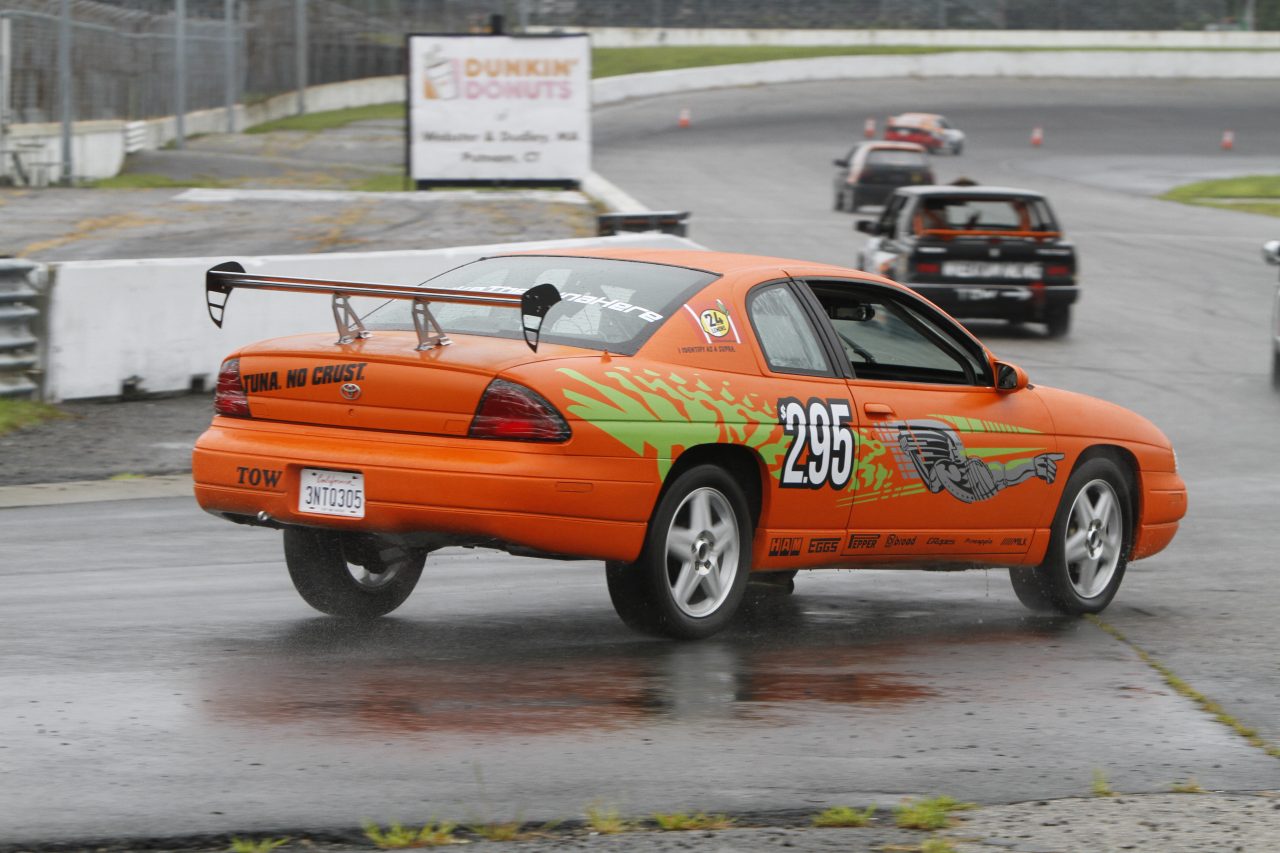
Case in point: on one orange Chevy Lumina (winner of the IOE), the wing was on backwards. I enquired about this, and apparently the wing came pre-assembled with the pointy part of the wing facing forward! That’s just dumb from the “factory” but shame on the team for not correcting it. Or maybe it was intentional? This is Lemons, it’s hard to tell.

Lemons Pittsburgh: Lemons Adds Pitt Race for 2019, Moves NJMP ...
The wing is assembled backwards, with the trailing edge pointing forwards. Love those end plates, they do nothing for the low-pressure side of the wing.

At the race I saw a lot of dual wings with absolutely ridiculous end plates that had big holes or cutouts on the underside. As you saw from the first image, the underside of the wing is what matters! Moreover, they had the upper wing mounted so far away from the main wing that it defeated the purpose of a dual wing setup.

I’ve seen a lot of terrible end plates that are more for show than go. They have most of the surface area of the endplate at the back of the wing, or cutouts below that would let the pressure zones collide. It would be easy to correct the function of these wings by building your own end plates.

GT Wing Spoiler 52Inch Universal Lightweight Aluminum Rear Spoiler Wing Adjustable Angel Double Deck Racing Spoiler BGW Drift JDM Drift Black
Designed by fucktards. No adjustability of the upper wing, too large of a gap between the wings, and the end plate is facing the wrong way.

DIY dual-element end plates

So if you have a crappy dual-element wing with crappy end plates, and you want to make it work better, build your own end plates. Again, let’s start by looking at the pressure zone below the wing.

This image is from Competition Car Aerodynamics. Buy this book.

It’s not intuitive, but the suction side is more important than the pressure side of a wing. This is apparent in the numbers: the blue is 3x the value of the red. Notice that the low-pressure zone extends below the wing by almost the length of the chord of the main wing. Meaning, if you have a 10″ chord wing, you’re going to need at least a 10″ deep end plate. Also notice that the low pressure zone extends in front of the wing, but not much at the trailing edge.

In Competition Car Aerodynamics, McBeath examines what happens with end plates of different sizes. At first he uses no end plate (ep0), and then end plates of increasing size. The larger the end plate, the more downforce and less drag.

End plates of different sizes on a dual-element wing.
End PlateDownforce% IncreaseDrag% Decrease
ep0 (none)769.2Equal194.8Equal
ep1 (minimal)786.72.3%188.33.5%
ep2 (medium)873.413.6%183.86%
ep2 (large)900.117%178.19.4%
Bigger end plate means more downforce and less drag.

OK, so if bigger is better, how big is too big? There is a height at which end plates start creating more drag, and a diminishing return on downforce. But I don’t want to give away all the secrets, so please buy the books on my Resources page and learn yourself some aero.

Make ’em

Here’s how I’d DIY myself end plates:

  • Start with a 12″ x 12″ piece of sheet metal. Use a street sign if you’re Lemons, otherwise plain aluminum will do.
  • Put most of the surface area at the front and below the wing (as pictured in the drawing, above).
  • Lay a straight edge across the chord of the main wing, and use that same angle for the top of the end plate. This will help you set and adjust your wing angle.
  • After mounting the main wing as above, mock up where you want the holes for the secondary wing. I would put a single mounting hole in front that acts as a pivot and drill two or three holes at the rear. Don’t exceed 35 degrees. I don’t trust adjustment slots because they can shift out of whack, and so I go with holes instead.
  • Make the gap between the wings about a half inch in height, and overlap the upper wing on top of the lower wing by about a quarter inch. This should create a convergent gap between the wings, meaning the front opening is larger than the rear. This will accelerate the air going through the gap.
  • Set the lower wing angle almost flat (zero degrees). Most wings will have the highest lift-drag ratio in this vicinity.
  • Start the upper wing at 25 degrees and if you need more downforce, use the 35 degree hole. Don’t exceed 35 degrees with the upper wing. If you still need more downforce, rake the entire wing a few degrees.
Three adjustment holes on the upper wing, the main wing is adjusted by the mounting bracket.

Making Lemonade from 24 Hours of Lemons

I’m standing in a puddle of my own shit and piss. I have it on my arms and legs, and I’m reflexively spitting because I got some in my mouth. I think to myself, maybe this is a sign?

Let’s rewind the clock a couple weeks. I’ve been preparing to race the 24 Hours of Lemons race at NJMP Thunderbolt. I’ve done Lemons races on the east coast and in California, but none in this Miata.

The first hurdle was passing tech. Most people think about 24 Hours of Lemons as cut-rate racing, and in some ways it is, but they cut no corners on safety. The Lemons cage rules are more stringent than any other series, and my car, which has passed tech in AER, Champcar, NASA, and SCCA, won’t pass Lemons tech. Whoever built my cage put the back stays in at a 29-degree angle, and they need to be 45 degrees, give or take.

I called my friend Tom Pyrek, whose minivan I race in 24 Hours of Lemons, and he agreed to help me out. Except that he didn’t have a lot of time, and things got pushed back a few days right when I was crunched for time. That was a headache I didn’t need, but that’s how these things go. Anyway, it gave me more time to work on the theme.

Most people these days don’t bother with a theme for Lemons, but I still think it’s an important part of the series. I wanted to do the famed Ferrari Breadvan, an iconic race car from the 1960s. Other people have done this theme (and probably better than we would), but I wanted to do it mostly to try out the aero.

The shape of things to come…

Our plan was to serve pizzas out of the back in the evenings, and so I wrote “Pizza is always the answer” on the side of the car. We were even going to deliver a pizza to the judges in the penalty box at some point during the race. If we didn’t get a penalty, we were going to do it anyway, just to recreate this moment.

Fast forward and it’s the Friday a week before the race, the new back stays are welded in, and we’ve just started the car for the first time in a while. There’s bit too much white smoke for my liking, and so we check the compression numbers: 165, 130, 130, and… 60. We put a bit of oil down the plug holes and the numbers come up, and so we knew it was rings.

Humph. Not terrible, but that one cylinder is concerning. The last time it ran was at PittRace, and we were the fastest non-swapped Miata. Alyssa was doing 2:03s on well-worn RS4s (faster than the Spec Miata record). We all felt the car was running well, so it never occurred to me to check if the engine was still healthy. There’s a mistake I won’t make again.

Ran when parked. Alyssa and Mario on grid at PittRace a few months before.

At this point I have three options. A) Run it as is and probably blow it up at some point during the race. B) Pull the engine and install new rings. C) Pull the injector and plug on one cylinder and run it as a triple.

Option C isn’t as insane as it sounds. In fact there are a whole group of motorcycle racers in the Pacific Northwest that neuter one cylinder of a 600cc four and effectively make a 450 triple out of it. They call these “Cripple Triples,” and it allows them to compete with 650cc twins on equal footing.

Now this option is so Lemony I want to do it, but when we try it, it’s super slow. I run it down the street and the engine feels like it has 50 hp. Somehow that missing cylinder, even with only 60 psi, is very important. So we decide to do option B, and rebuild it. Or at least throw in a new rings, hone the cylinders, and put in new seals. No problem.

The race was in a week, and so I ordered all the gaskets and a piston ring set from Auto Zone on Friday. I thought that should be plenty of time to pull the engine and assemble it, and in fact most of the parts came the next day. Except the piston rings. Monday came and still no rings. Fed-X said they were supposed to be there yesterday, and the new tracking info said Wednesday. Feeling queasy about that, I ordered another set from NAPA, this time next day air via UPS. I paid the price in rings for the shipping alone, but I wanted to cover my bases.

With the engine out of the car, it occurred to me that I had another block sitting on a shelf up at Berg Racing. That engine overheated and I’m sure the rings relaxed, and so it needs new rings as well. May as well do them at the same time. So I drive up and gather it, and we start the surgery of taking that one apart on the bench as well. I’ve got nothing else to do.

I just need rings

Tuesday comes and still no rings. Next day air, my ass. But I’m not sweating it, we can get the engine in quickly. I tidy up other things on the car and finish the theme.

Breadvan theme was ready

Wednesday no parts, either by truck or by air. I went to Auto Zone and Napa and made them call the manufacturer and find out what the problem was. In both cases the shipper hadn’t picked up the packages yet.

Are you fucking kidding me? The manufacturing plant in Tennessee says the parts are right there waiting for pickup, but neither UPS or Fed-X can be bothered to actually get them? I’m feeling like this is a sign or something. We are also having trouble getting rear brake pads. I ordered them a week ago, and they still haven’t arrived.

Around this time my support vehicle (Honda Element) started making belt noises. We use the Element for bringing extra tires and spares, and I really don’t need it to break down on the way there, or the way back. We mess with the belts and the noises go away, but then it throws an engine code. Bad omens or what?

And then my RV, which is race headquarters and also my tow vehicle, throws engine codes for a misfire. And then the brand new tire that I just replaced is slowly leaking. FUUUUUUCK! Everything was falling apart at the same time!

For the past few weeks this has been happening in little subtle ways. I’ve been looking at all these signs, portents, and omens and patently ignoring them. But I pressed on for good reason: My brother was flying in from California; My buddy Chris was flying in from Detroit for his first ever wheel-to-wheel race; And I don’t believe in omens. So I was going to make this happen, my dog spinning upside down on the ceiling and speaking latin backwards, or not.

I then went to dump out the RV tanks at a local state park. I was doing this on the down-low, without paying the sewage fees, so trying to be a bit sly and get it done quickly. Well, some genius (ahem) left the guillotine valves open last winter, and so when I unscrewed the cap to attach the sewer line hose, my own shit and piss sprayed out all over me. Yep, I literally shit all over myself.

It was at this time, standing in a widening brown puddle, my arms and legs covered, no longer the least bit stealthy about dumping my waste tanks without paying for it, reflexively spitting and wondering how sick this shit would make me, that I began to believe in omens. I stitched together all those signs and portents and finally figured it the fuck out. I contacted all my teammates and told them we were done. We aren’t racing. As my brother put it “when the shit hits the man, it’s time to reassess the situation.”

And Yet, Lemonade

Instead of racing, I invited all my teammates to Pineview Run. They were all coming east anyway, it was the least I could do. We spent the day hooning and gather data, and fun was had by all.

Ian drove my wife’s Honda Civic. We didn’t use it much because the VSA really overwhelms the brakes. (See my blog post Autocross N00b for the 10-step procedure to turn that off.) It wasn’t fast or fun to drive anyway, and Ian got in a lot of other cars.

Clayton drove his NB, and both Ian and I got to drive it and compare notes. I’ll follow up on this data in another post, it’s rather interesting to see how differently we drive the same car. We also got to see how Clayton drives, and while he’s off the pace, his instincts are really good. He’s a natural driver, and will keep getting better.

Jim brought his 240 hp turbo 1.6 Miata. I didn’t get a chance to try it, but I’ve driven it on the street and it’s a blast. Turbos are not my choice for track cars, but street cars, yes please. Unfortunately the charge pipe kept coming loose, both on the track and on the drive to and from, and by the end of the weekend Jim had replaced every hose and clamp.

The front end of Jim’s car is called a Wizdom. It wasn’t exactly an easy fit, but we made it work. I also made a custom undertray and left it long in front to make a splitter, and added a hood vent. It’s a bitchin car all around.

Fitting the Wizdom bumper, before splitter and other enhancements.

Chris brought his Veloster N, which is an impressive car and I regularly think about buying one. He fitted Falken RT660 tires, and while his car isn’t set up with lot of camber, he wisely got the tires heat cycled from Tire Rack before delivery. Meaning, the tires didn’t delaminate, which is what they do when run without heat cycling and with less than ideal camber.

I ran a 1:15.565 in the N, exactly two tenths of a second slower than the all-time FWD record lap time (CRX on A7s). On A052s or Hoosiers, I’d own the FWD record. In a bone-stock car. I need to make this happen.

Ian also got to drive the Veloster and I was thankfully faster than him, but only by half a second. He’s a FWD expert, and I’m a Pineview expert, but I sure as shit was not going to lose to my brother on his second ever visit to the track! Phew.

I drove my 1.6 Miata mostly on 14-year old NT01s (I shit you not), and they still grip, and wear imperceptibly. I also finally got a chance to try some take-off 245 R7s. Oddly I didn’t go any faster than I did on 205 R7s (1:14.5). The steering effort was absurd, and I overall didn’t love them. I’ll have to play with pressures and stuff and see if I can get them to work.

Honestly, it was a fantastic day, maybe even more fun than racing because we were all on track together, with five cars instead of one. Yeah, I had to eat the Lemons entry fee, the NJMP practice day, all the parts and labor to prep the car, and $800 worth of track fees at Pineview. So I lost over $3000 on this “race” weekend, but I guarantee it would have been worse if we had gone to Thunderbolt. Something bad was going to happen. Every force of nature was against me, every step of the way, I just wasn’t listening. I am now, tho.

My wife says, you win or you learn, and education costs money. It reminds me of the old joke: Do you know why divorce costs so much money? Because it’s worth it. Missing this race was oddly worth it; we made lemonade out of Lemons.

The Punchline

Saturday afternoon, the day we were supposed to be racing in New Jersey, I got a phone call saying that the rings arrived at NAPA (five days late). The next day, Auto Zone called to say the other set of rings arrived (seven days late). In the race of rings, UPS next-day air beat Fed-X freight by a day. But they are both fucking losers in my book.

Maybe I should have spent more time on mechanicals than theme?

Big Wing Tests in 2021

Last weekend I went through the MSF Level 2 course taught by Hooked on Driving. It’s an amazing program, I learned a bunch, and now I can right-seat coach for a lot of HPDE organizations. That means more track time, and more aero testing!

The first thing I want to test is different wings at different tracks. For low speed, I’ll go to Pineview Run, where I have a membership and can go whenever I want. For high speed, I’ll go to Watkins Glen, which is 20 miles from me. Finally, for medium-speed tracks, there’s NYST and PittRace, which I’ll go to a couple times each.

All the wings need to use the same mounts, and I’ll make sure they are all optimized for angle. Then I’ll record min speeds through a few important corners, max speeds on straights, and of course the overall lap time. The wing contenders are the following:

  • 9 Lives Racing – I have their 60″ wing. Most Miata people order 64″ (body width on NA/NB), but I was going to eventually mount mine from the end plates and so it’s a bit shorter. With welded mounts and end plates it weighs 13.8 lbs, and has an area of 546 square inches.
  • APR GTC-200 – This is a 59″ wing in a 3D shape, carbon fiber, very light, just 5.2 lbs with end plates and all. I modified the wing slightly to fill it with lightweight expanding foam and I made new end plates because the old ones were seized inside. The 3D shape is wider in the middle than the sides, and has an area of about 442 sq in.
  • Areyourshop – This wing is sold under numerous names on eBay, Amazon, etc. It’s a single 53″ extruded aluminum wing with adjustable brackets underneath. I reshaped the bottom and set the mounts at 41.5″. I bought mine for $60, but they’ve gone up in price since. I threw out the mounts and end plates and made my own. It weighs 5.8 lbs with end plates and a small Gurney flap, and measures 297 sq in.
  • Mophon Double – Another MIC wing, this one I’ve had for a while, also sold under a variety of names. I’ve done a couple blog posts on this one already, it makes downforce, but too much drag. I’m trying to reduce drag this time and left off the top Gurney flap. I made new end plates and re-set the upper wing angle to 35 degrees. It weighs 8 lbs and has about 424 inches of total area.

All four contenders. End plates from street signs, $1 each.

There’s one final contender, but I’ll only use it at Pineview because it’s going to have so much drag it won’t be funny. Well, maybe a little funny. This is a triple wing made up of the two made in China wings.

The main wing is the single MIC wing, and the other wings mount via the end plate. First I drew out how to mount them on a scrap piece of plastic, which was a great way to get the angles.

Mocking up the wing angles

Then I transferred these holes to aluminum (street signs) and cut out a shape that felt pleasing to the eye. I put most of the end plate area low and forward, because that’s where the low pressure zone should be. I have a digital manometer and may verify this later, but I’m not sure how much it really matters. This is mostly a conversation piece, anyway.

Three wings is three times as ridiculous!

All assembled this wing weighed exactly the same as the 9 Lives Racing wing, 13.8 lbs, with a total wing area over 720 inches. Like I said, this will be for Pineview and autocross speeds only, I have no illusions that this would work on a big track.

What am I doing for front aero? You’ll just have to stay tuned. 2021 is going to be a fun year of aero testing!

Theoretical Best Laps (and what we can learn from each other)

Last fall, Sahir brought his Miata to Pineview and allowed Josh and I to drive it. Sahir had just won the C4 class of the Pineview Challenge Cup the week before and was on pace. Josh is a two-time Challenge Cup overall winner and one of the fastest people I know. I haven’t won any championships, but I’m a self-proclaimed Miata and Pineview specialist, and I go fast when those two things are combined. So we all know the track really well, but our driving styles differ. I wanted to see by how much, and what we could learn from each other. 

I imported all the laps in Race Studio and threw out the first lap of each session. For some reason, the first laps create fast sector times that are impossible. Then I created a track map with seven sectors. Formula 1 uses three sectors, MotoGP uses four. I wanted to get more granular, and see where each driver was doing their best. This put the track divisions on the straights between T2-T3, T5-6, T7-T8, T10-T11, T11-T12, and T12-T13. See the shitty image below. 

I then used the Split Report feature to see how we did in each split. If you click the History tab on each sector, this gives you a histogram chart that makes it easier. A long green bar is a slow sector. A short red bar means the fastest sector time. Check it out. (Yellow bars are rolling laps, ignore for now.)

  • Run 3 is Sahir. He does six hot laps (laps 2-7) with a best lap of 1:18.537. He sets the fastest time in the sixth sector, the Blind Hairpin. 
  • Run 4 is Josh. You’ll notice he only puts in two laps with a best lap of 1:18.873. In an unfamiliar car, in two laps, he almost matches Sahir’s time (and only .1 seconds off Sahir’s PV Cup wining lap). Josh kills it in Sector 1. 
  • Run 5 is me. I do seven hot laps with a best lap of 1:17.674. I set the fastest time in the remaining sectors. Enh, I’m fast in Miatas, and on this track in particular. 

As good as any of us are individually, if you put all of our best sectors together, we’d do a 1:17.192! That’s half a second faster than I went, and about 1.5 seconds faster than Sahir and Josh. OK then, what can we learn from each other? 

In the following speed traces, Josh is black, Sahir is blue, and I’m red. I’m using the two fastest laps from each person. First let’s look at Josh, he’s magic in Sector 1. Notice on the bottom graph (time-distance) that one black squiggle that’s below all of the other colored lines. He has a higher minimum speed in T2, and puts some time in his pocket.

Next is sectors 2-5, and I’m fastest at three points in particular, circled in orange: In T4, my line allows me to get to the throttle earlier; In T7, I use a straighter approach that allows me to brake deeper and harder on the entry; In the Knuckle, I take a deep double-apex line that keeps my speed longer. Interestingly, we’re all very even in the Uphill Esses (notice that all the lines in the bottom graph are basically horizontal from 1700′-2400′). Nobody is winning that part. 

Sahir is fastest in Sector 6 by .01 seconds. The time-distance graph has a dip at 3500′ which corresponds to his speed advantage at that point. He’s simply braking later than us chickens, and that’s understandable because the Blind Hairpin has claimed a couple cars on the berm. 

In the final sector I gain a little time by braking later (notice the height of the red lines at 4100′), and I get another boost of speed right between Turns 14 and 15 at 4500′. (Ignore where the cursor is.)

None of us are professional drivers, and we can all improve by simply looking at what each other is doing. But this is really only possible by using data. It’s a bit late to make a New Year’s resolution, but if you aren’t using data, make a resolution to do that now instead of next year. I’ll be your accountability partner!