Miatas are underpowered from the factory, but because they have rear-wheel drive, perfect weight balance, and skinny tires, they are fun to drive. Combine those traits with sporty suspension, precise steering, and a slick 5-speed manual, and you have the ideal recipe for a backroads sports car.
But take that same car to a race track and it’s a fucking embarrassment. Worse, it’s a rolling roadblock. If you look at historical data from Car and Driver’s Lightning Lap, there are only two cars slower than a 2006 Miata: a Honda Fit and a Kia Carnival (a minivan FFS). Miatas have gotten faster through the years, but even the fastest one, a 2019 RF Club, was humiliated by two generations of Honda Civic. No, I’m not talking about the Civic Type R, but the pedestrian Si model.
Historically, the problem with older Miatas is the engine, and so the aftermarket is rife with options, from bolt-ons, to forced injection, to motor swaps. One day I’ll write an article sorting these out, but for now I just want to talk about what I feel is the right amount of power, and what I feel is the best way to get there.
The right amount of power
I’ve driven Miatas from 90 to 250 hp, and I can tell you that from my point of view, the sweet spot is below 200, and probably somewhere around 175 hp. To be clear, I’m talking about track driving, not about drag racing, highway pulls, or other straight-line bullshit that ignores the Miatas purpose.
A track-prepped Miata at 2350 lbs (with driver) and 175 hp at the wheels has about 13.5 lbs/hp. For comparison, that’s about the same as a track-prepped E36 M3, and that’s good company to be in. Of course more power is faster, but there are diminishing returns, and after a certain point, the engine begins to dominate the experience. That’s fine if you like muscle cars, but Miatas have always been about balance, and being more than the sum of its parts. As such, I don’t believe 200 hp is what this platform wants or needs; there are better cars for that.
13.5 lbs/hp is plenty fast, and with a little ballast, it would be possible to race in NASA ST5/TT5. At one point I was also considering GLTC, and after taking points for aero, the car can be no better than 13 lbs/hp. Now I’ve seen the lap times TT5 and GLTC racers put down, and I don’t need a Miata to go any faster than that.
I’ve also driven three very different Miatas back to back to back on a race track, and to my surprise, my 145 hp 1.6 Miata was faster than a 200 hp K-swapped Miata. The KMiata was on better suspension and tires, and yet both drivers went faster in the less powerful car. And so I know for certain that 200 hp isn’t the answer, and that less is sometimes more.
But the star that day was Dylan’s VVT swap, which remains one the best Miatas I’ve driven. It struck an ideal balance of power and drivability, retaining all that is good about a Miata, with a motor to match. Dylan later added a turbo, but after finding out his car was better without it, reverted to a normally aspirated build. See? More evidence.
For all of those reasons, I believe 175-ish whp is ideal for a NA/NB Miata. So, what are the options to achieve that?
- VVT 10/10 – Getting a BP engine to 150 hp at the wheels isn’t terribly difficult, but 175 hp sure is: full bolt-ons, head work, cams, a custom exhaust, a standalone ECU, possibly ITBs, and of course, lots of dyno tuning. They say the last 10% of performance is 90% of the cost, and that’s where you’ll be. This isn’t the best use of money, but if you want this option, contact Stefan Napp.
- Turbo – Even the smallest turbo will easily make 175 hp on an otherwise stock engine. It’s cheap and easy, but in exchange you have turbo problems. Many people accept that trade, but I’ve seen too many broken turbo Miatas to take the plunge. Also, it seems like most turbos end up above 200 hp, and thus beyond my needs.
- Supercharger – An M45 supercharger with an intercooler and smaller diameter crank pulley can get close to 175 hp, but the problem is heat soak after multiple laps. So this is a better option for a street car than a track car, but I heartily approve of the quantity and quality of power, and of course the sound.
- K24 – As stated earlier, I drove one on track and it was slower than my cammed 1.6. I know a lot of people are happy with their K swaps, but for me it’s too much engine, too expensive, and too Honda.
- Hayabusa – A gen-2 Hayabusa swap from Spec13 probably won’t make 175 hp, but since the engine is lighter, the end result should be in the ideal lbs/hp range. What’s not ideal is the lack of reverse gear, and less than 100 ft-lbs of torque. I’m currently part way through my own Busa swap, and so I obviously think this is a good option for a hardcore race car, but this swap isn’t for everyone.
- Ecotec – To get a BP Miata engine to put out 165-170 hp is a lot of money and work, which is where an Ecotec fuggin starts. The path to 175 hp is cheap and easy, and there’s buckets of torque that a BP engine can only dream about.
An Ecotec swap makes a lot of sense. Sensible person that I am, I contacted EcotecMiata a couple years ago and asked them to do a turnkey swap. I’d simply drop off my car at their headquarters, and pick it up a few weeks later ready to drive. But they were terrible with communication, and so despite several attempts, it just never happened.
Fast forward a couple years and EcotecMiata is now under new ownership. The new owner, Cameron Recknagel, is solving some of the age-old problems with the swap kit, adding new performance options, and most importantly, communicating with customers.
I’ve known Cameron for several years, his Star Wars themed Miata was the first car I featured on this blog. Back in 2019 he had a tuned BP and raced Lemons, but in the quest for better race results, and junk yard available engines, he swapped in an Ecotec. His wealth of knowledge on the platform is another strong reason to choose this swap.
Ecotec problems… solved
Every motor swap is in some way or another a disaster, and as an early adopter, Cameron experienced several of these teething problems. The biggest hardware problem was a leaking oil pan; it wasn’t always straight, had bad welds, and the baffles inside would break.
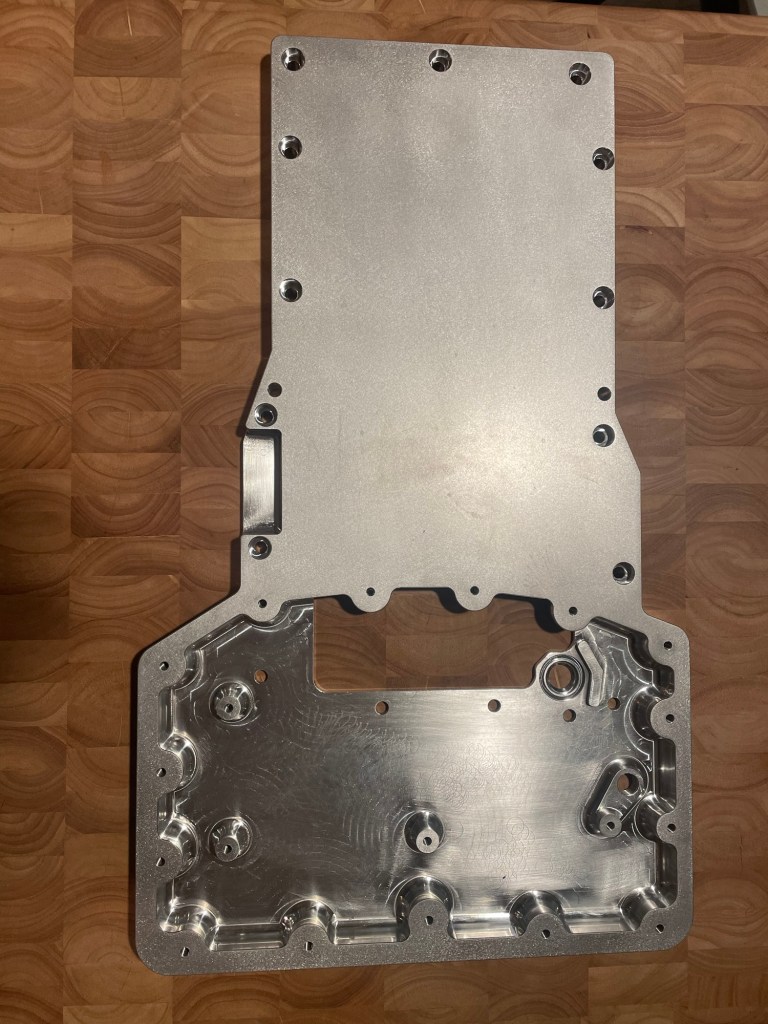
Cameron’s solution to this is simple; use an existing oil pan from another car and make up a custom adapter plate. He let the OEMs do the hard work and adapted an off the shelf stamping to an inch of billet aluminum. Don’t worry, the oil pan sits flush or slightly above the subframe, and so it’s not going to deck out; the lowest part on the car is actually the exhaust crossover tube.
This was always a problem with the swap, because the exhaust is on the other side of the car. The exhaust needs to cross over from passenger side to driver side, but the PPF is in the way. And so is the clutch fork.
Cameron’s solution to the clutch fork problem was the same as the oil pan: use existing parts. He took an existing hydraulic throwout bearing kit and moved the clutch slave inside of the transmission. This makes routing the exhaust much easier, and his internal clutch slave kit even works with other swaps so long as they are using Miata clutch kits and transmissions.
So let’s talk numbers, most importantly cost, hours, horsepower, and torque.
Ecotec by the numbers
I’d guess most people choose an Ecotec swap because you can find junkyard motors for $200. This is dirt cheap by any measure, especially with Miata motors going for over $1200, and K24s going for a couple thousand. On a dollar for dollar performance calculation, the Ecotec wins.
The other part of cost that you need to factor in, is how long it takes to do the swap. Most other engine swaps require modification of the stock subframe, which isn’t necessary with the Ecotec Miata swap. And unlike using forced-induction on a BP, the stock radiator is ample for the 2.4L Ecotec. It’s not a terribly difficult operation to swap in the motor, and three people can do the full swap in a weekend.
Three people? Well, extra hands help. An Ecotec is about 40 lbs heavier than a BP motor. The head is a lot bigger, and inside the block you have a heavier crank and balance shafts.

Power-wise, a bone stock port-inject Ecotec swap with a drop-in tune will make between 165-170 hp. I don’t think a Miata needs any more power than that, but if you have a heavier car and/or simply want more power, common bolt-ons include replacing the cast-iron exhaust manifold with a Polaris header, and something Miata people are familiar with, swapping OE cams.
On Miatas, you can modify the exhaust cam and swap it onto the intake side, which provides a little more duration. The exhintake cam swap can make up to 8 hp when properly timed and tuned. The Ecotec cam swap is the opposite; you put the intake cam on the exhaust side. This gives more lift and duration, and results in 15-20 hp. Because you can pull a cam at the junkyard for $20, there probably isn’t a more cost effective gain to be had anywhere.
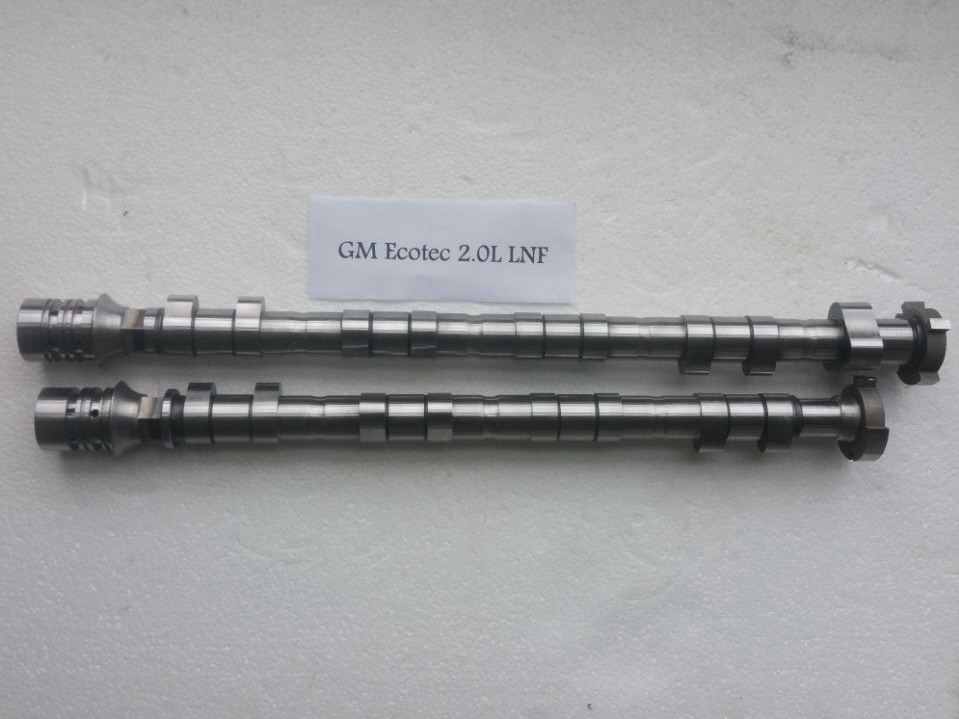
For additional power, some people may want to remove the balance shafts and/or water pump, but Cameron advises against this. The small amount of power gained simply isn’t worth the loss in reliability, or the headaches that ensue. With the balance shafts in, you end up with a Singer sewing machine up front for your daily commute that’s hiding +175 hp for the track. Keep this engine under 7500 and you can beat on it like it still owes you that $209.99+tax. Just make sure to put good oil in and a Hengst oil filter (seriously, use no other filter, they like to collapse).
If you need more power, race camshafts, a plug-n-play standalone ECM from BMEP Solutions, and turbo kits are a call away. While the internet isn’t ripe with aftermarket parts like a K-motor, parts are still readily available, and Cameron assures me Ecotec Miata is there to help.
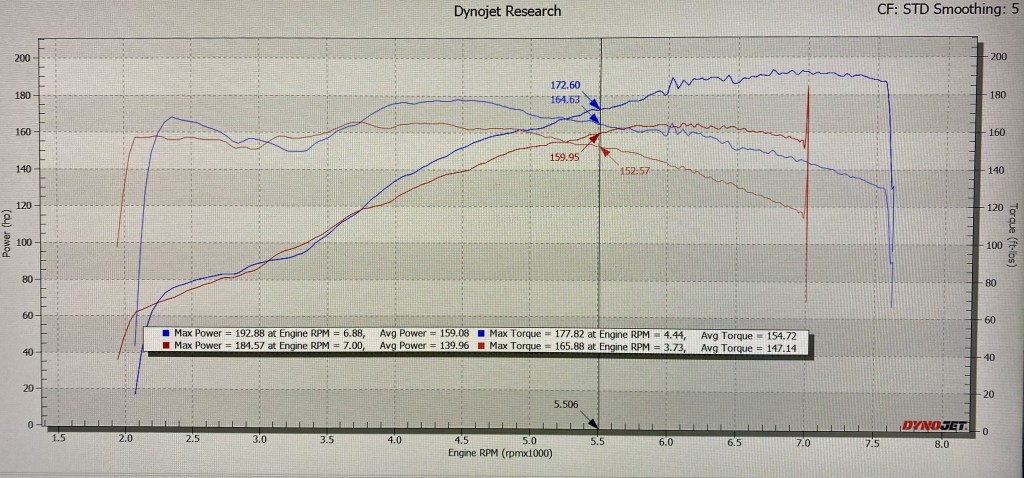
But like I started with, I don’t want anything north of 200 hp, and so a basic kit would get me there. Here’s a dyno chart showing a bone stock engine that makes 160 hp. This is a little on the low side compared to some junkyard engines, but with a Polaris Slingshot header ($200) a shorty ram intake, and a little tuning, you can easily make over 172 hp.
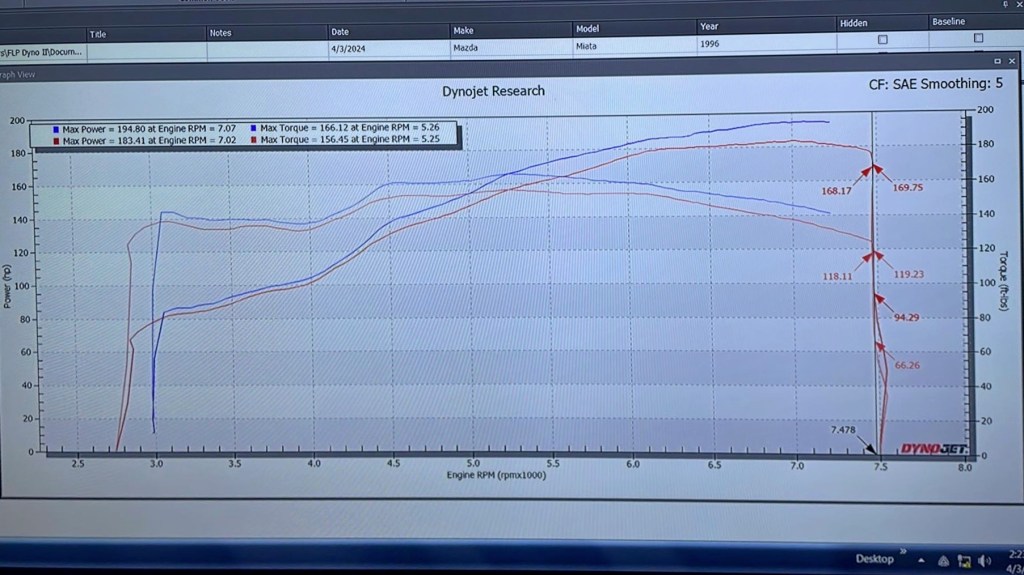
Cameron’s personal endurance racing engine sports regrind cams, and smartly retains the water pump and balance shaft for all-day running. Even with worn out piston rings this put out nearly 200 hp. See for yourself.
The swap kit is competitively priced at $4500, which is similar to a Busa swap, but cheaper than most others. The real savings is the $200 motor, and how cheaply you can get another 20 hp. With a weekend of wrenching you can upgrade that moving chicane to something that will keep putting a smile on your face, and give German sports cars something to worry about.
 Occam's Racer
Chiming in on this.
An NC miata with a 2.5 swap, cams, tune, header is just as fast as this with no need for a $4500 swap kit. You reuse the same trans, same oil pan, same wiring harness. Just got done with a track day and my street 2.5NC (coilovers and tires) is turning exactly the same time as a track prepped ecotec swapped NA miata. However I didnt have to spend $4500 to get there.
LikeLike
I was thinking NA/NB for that article, I’ve never even driven an NC on track. But if I was going to get a Miata now, I’d almost certainly go for a NC, and the 2.5 swap makes a lot of sense. What did it cost?
LikeLike
I did an Ecotec swap on my Miata last year, and it’s been great (other than the oil pan leaking at a weld!). It’s arguably the motor Mazda should have put in the NB. It revs great to 7500, sounds better than the BP and looks like it’s stock.
I met up with Jerry from Mostly Useless Garage at Mosport and talked about the swap: https://www.youtube.com/watch?v=uOjIYHzpy6Q
LikeLike
Nice looking intake on that
LikeLike
Thanks! That was a hookup from Cameron as well. It made a big difference in HP in the higher RPMs but cost a little torque.
LikeLike